Seven Theories of Religion
by Daniel L. Pals
On This Page
Description
Seven Theories of Religion introduces a sequence of "classic" attempts to explain religion scientifically, presenting each in brief outline and in non-technical language. It considers first the views of E.B. Tylor and James Frazer, two Victorian pioneers in anthropology and the comparativestudy of religion. It explores the controversial "reductionist" approaches of Freud, Marx, and Emile Durkheim, then explains the program of their most outspoken opponent, the Romanian-American scholar show more Mircea Eliade. Further on, it examines certain newer methods and ideas advanced by the Englishethnographer E.E. Evans-Pritchard and by the American Clifford Geertz, two of the present century's most celebrated names in fieldwork anthropology. Each chapter offers biographical background, exposition of the theory, comparative analysis, and critical assessment. Easily accessible to students inintroductory religion courses, Seven Theories of Religion is an enlightening treatment of this controversial and fascinating subject. show lessTags
Recommendations



















Member Recommendations

Member Reviews
Interesting read that gives you a sound grasp of the main theories “explaining" religion. These range from superstitious primitive explanation of the natural world, projection and avoidance of human responsibilities, a means of creating allegiances of individuals to the group, illusion masking social oppression, expressions of the sacred over time, fundamental beliefs underpinning what is normal, expected, unexceptional social practices that to question is to ask for a destruction of all that is ordinary.
These theories as theories can be debated and weaknesses exposed as the book does. But what is interesting is to take them head on and consider the theological implications. Do we want a Christianity that has a bishop thanking God show more for deliverance from a car bomb, which had seen his wife and child killed days earlier? Do we want a Christianity that is about fellowship and community alone? Does Christianity side with the poor or the land-owners in 3rd world countries?
The last approach is a cause for more concern. Karen Armstrong explores the raise of fundamentalism since the early 20th century. Enlightenment, industrialisation and Liberals questioning all the key questions of their faith as part of the intellectual revolutions are experienced as attacking what is normal, right and ordinary, For them they are expected to question such fundamental “facts” that to do so would cause a major existential crisis that most of us are not capable of dealing with.
It’s to acknowledge that changing bible-belt Christians, Jewish settlers and Islamic jihadists need more then critical arguments. Friends at my Meeting some years ago went to an international Quaker conference about 5 years ago in South America but Evangelical African Friends saw them as pagans! show less
These theories as theories can be debated and weaknesses exposed as the book does. But what is interesting is to take them head on and consider the theological implications. Do we want a Christianity that has a bishop thanking God show more for deliverance from a car bomb, which had seen his wife and child killed days earlier? Do we want a Christianity that is about fellowship and community alone? Does Christianity side with the poor or the land-owners in 3rd world countries?
The last approach is a cause for more concern. Karen Armstrong explores the raise of fundamentalism since the early 20th century. Enlightenment, industrialisation and Liberals questioning all the key questions of their faith as part of the intellectual revolutions are experienced as attacking what is normal, right and ordinary, For them they are expected to question such fundamental “facts” that to do so would cause a major existential crisis that most of us are not capable of dealing with.
It’s to acknowledge that changing bible-belt Christians, Jewish settlers and Islamic jihadists need more then critical arguments. Friends at my Meeting some years ago went to an international Quaker conference about 5 years ago in South America but Evangelical African Friends saw them as pagans! show less
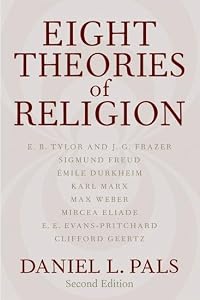
Pals surveys the major names: Tylor, Frazer, Freud, Durkheim, Marx, Eliade, Evans-Pritichard, and Geertz to describe seven main theories of religion in the history of religions. This is one of seminal theoretical works on religion.
compares theories about the origin and meaning of religion
"A sequence of attempts to explain religion scientifically"
Articles by Tylor, Frazer, Freud, Durkheim, Karl Marx, Eliade, Evans-Pritchard, Geertz. Theories about what "religion" is, how it arises. This is part of an effort to frame a scientific theory of religion.
The Author is a professor/chairman at the University of Miami.
The Author is a professor/chairman at the University of Miami.
Ratings
Members
- Recently Added By
Author Information

12 Works 600 Members
Daniel L. Pals is Professor of Religious studies and History at the University of Miami. He is the author of Introducing Religion: Readings from the Classic Theorists (OUP, 2008).
Classifications
- Genres
- Nonfiction, Religion & Spirituality, Anthropology, Philosophy, General Nonfiction
- DDC/MDS
- 200.7 — Religion The Bible & Christianity Religion Education, research, related topics
- LCC
- BL41 .P36 — Philosophy, Psychology and Religion Religions. Mythology. Rationalism Religions. Mythology. Rationalism Religion (General)
- BISAC
Statistics
- Members
- 279
- Popularity
- 115,561
- Reviews
- 5
- Rating
- (3.88)
- Languages
- English
- Media
- Paper
- ISBNs
- 2