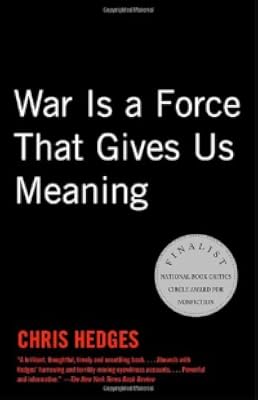
War Is a Force that Gives Us Meaning
by Chris Hedges
On This Page
Description
As a veteran war correspondent, Chris Hedges has survived ambushes in Central America, imprisonment in Sudan, and a beating by Saudi military police. He has seen children murdered for sport in Gaza and petty thugs elevated into war heroes in the Balkans. Hedges, who is also a former divinity student, has seen war at its worst and knows too well that to those who pass through it, war can be exhilarating and even addictive. "It gives us purpose, meaning, a reason for living."Drawing on his own show more experience and on the literature of combat from Homer to Michael Herr, Hedges shows how war seduces not just those on the front lines but entire societies, corrupting politics, destroying culture, and perverting basic human desires. Mixing hard-nosed realism with profound moral and philosophical insight, War Is a Force That Gives Us Meaning is a work of terrible power and redemptive clarity whose truths have never been more necessary. show lessTags
Recommendations




Member Recommendations

SCPeterson Hedges theory of war is profoundly affected by Shakespeare, especially this book.
Member Reviews
Chris Hedges wrote War Is a Force That Gives Us Meaning after the events of September 2001, but before the Afghanistan and Iraq wars of the 21st century that make it all the more painful to read today. About two thirds of the text is memoir, but in the form of anecdotes pressed into service for a war correspondent's reflections about the perennial nature of war and what it does to societies and individuals. Many of these stories are grueling to read, and Hedges very consciously straddles a line on which he hopes to make patent the attractions of war without himself glamorizing it.
There are many literary references in this book, especially to the classics of antiquity which Hedges studied at Harvard during a hiatus in his work as a show more journalist. He gives these their due as evidence of the enduring attributes of war, but he avoids elevating them into sanction for it. He also returns at various points to his own need for literary sustenance in the midst of war (e.g. 90, 169).
In his introduction, Hedges disclaims a pacifist agenda. He writes that his aim is "a call for repentance" in the face of growing US military hubris. The book is concerned with the ways in which war is fostered by the dehumanizing falsehoods of nationalism, destroying culture and erecting an abstract "cause" to which life must be subordinated. Hedges proposes memory and love as the antidotes to the martial impulse, where these are rooted in lived contact with others, particularly across ethnic and religious divides. Unfortunately, this book is as timely now as when it was first published, and there is no real likelihood that it will become irrelevant in the foreseeable human future. show less
There are many literary references in this book, especially to the classics of antiquity which Hedges studied at Harvard during a hiatus in his work as a show more journalist. He gives these their due as evidence of the enduring attributes of war, but he avoids elevating them into sanction for it. He also returns at various points to his own need for literary sustenance in the midst of war (e.g. 90, 169).
In his introduction, Hedges disclaims a pacifist agenda. He writes that his aim is "a call for repentance" in the face of growing US military hubris. The book is concerned with the ways in which war is fostered by the dehumanizing falsehoods of nationalism, destroying culture and erecting an abstract "cause" to which life must be subordinated. Hedges proposes memory and love as the antidotes to the martial impulse, where these are rooted in lived contact with others, particularly across ethnic and religious divides. Unfortunately, this book is as timely now as when it was first published, and there is no real likelihood that it will become irrelevant in the foreseeable human future. show less
This is a terrible book because it is true. Chris Hedges spent 15 years reporting wars around the world. This book is the result of those experiences. It exposes war as it actually is, devoid of myth and glory. It should be required reading in every school but no government would allow it.
Hedges has a reporter's view of war which somehow never reaches the newspapers or other media they work for. He speaks of how scum rises to the top through ruthlessness and amorality, the atrocities on all sides and the governments that crush truth in favor of myth to promote the wars they want.
The writing here is a professional product, well written and easy to read. He has an excellent knowledge of the classics and uses that knowledge well. I urge show more everyone to read this book. show less
Hedges has a reporter's view of war which somehow never reaches the newspapers or other media they work for. He speaks of how scum rises to the top through ruthlessness and amorality, the atrocities on all sides and the governments that crush truth in favor of myth to promote the wars they want.
The writing here is a professional product, well written and easy to read. He has an excellent knowledge of the classics and uses that knowledge well. I urge show more everyone to read this book. show less
It is indeed, but not a meaning that can endure in peacetime. War — like any life threatening disaster (tsunami, earthquake, volcanic eruption, plague) — makes priorities suddenly clear: first, to survive, and second to save whatever is most important to us. And when the bombs strike Sarajevo, what is most important becomes suddenly, magically clear, regardless of any existential doubts we may have had the nights before. The importance of this book is not that it tells us anything new — as Hedges reminds us, Homer and Shakespeare (especially in Troilus and Cressida) and many others have told us both the horrible and wonderful things that happen in the terrible excitement of war. No, Hedges does not claim to be saying anything new, show more but because he speaks not just from literature or watching CNN but from his own personal and often terrifying experience as a war correspondent for The New York Times and other media in many wars, of the addiction of violence, the intense but entirely circumstantial camaraderie of combattants, and the deliberate distortions and mythologizing by those at the homefront that make such destruction possible and recurrent, he makes us believe. We have to be grateful to him for living these experiences on our behalf, and for recounting them so vividly. show less
With the recent passing of Henry Kissinger and the current ongoing genocides in the Middle East I was drawn to read this Chris Hedges work from 2002. Sadly it is distressingly still relevant in every way today. His graphic telling of brutalities and overpowering repulsions of carnage suggest a pornographic attraction, which is one of the themes in this book about the personal impacts of being in war. Deep psychological effects are coupled with observations on propaganda campaigns selling wars to constituencies. He is well seasoned and carefully calculated in weighing his facts. His narrative is up close and personal. Yet the book is largely philosophical. Invoking literary references as well as other military sources, Hedges constructs show more a point of view that endures. In part this supports the man in the street perspective of how civilizations crumble into dust. While not offered as such it contributes at least little towards understanding how Israel and Hamas are hell bent on obliterating their homeland. This seems to be no middle ground and probably never has been, especially once at war. show less
Hedges delivers a brutal analysis of war and its impact on individuals and society. I've admired his journalism for a long time and I appreciated his incorporation of his personal experiences, even his dark and fearful moments. Evoking classic Greek literature and Shakespeare also gave his argument a broad and weighty scope deeply rooted in a history of human experiences of war and he carnage it brings.
As the title suggests, this is a book about the attractions of war, its mythic appeal, and the ways in which that appeal is willfully distorted by media, government, and ideological forces. But also, more disturbingly, Hedges shows how war can hold a very real, authentic attraction for some--for those individuals who become obsessed with death, with being a hero, and for those movements and peoples who latch on to it as a source of collective identity and even feel nostalgia for the forces of social unification and individual intimacy it bears.
I think this is one of the best attempts I've read to try and de-glorify war, but still examine why humans have such a love affair with it.
It's a thoughtful, measured approach and draws on many historical and fictional examples from literature and our past. There's also a healthy dose of personal experience used as a leavening agent.
It's a thoughtful, measured approach and draws on many historical and fictional examples from literature and our past. There's also a healthy dose of personal experience used as a leavening agent.
Members
- Recently Added By
Lists

Really Good Narrative Non-Fiction
65 works; 24 members

Stories of War and Revolution
143 works; 54 members

Shaykh Hamza's Book Recommendations
439 works; 3 members

2000s (the decade, not the century)
184 works; 11 members

Books Read in 2011
684 works; 19 members

Literary Works Read in College
316 works; 15 members

Best 21st Century Books (So Far)
670 works; 85 members

Books about the Balkans
19 works; 2 members

Five star books
1,755 works; 108 members
Author Information

31+ Works 7,670 Members
Chris Hedges is a graduate of Harvard Divinity School and a former Pulitzer Prize-winning journalist for The New York Times. He is the author of eleven books, including the New York Times bestsellers War Is a Force That Gives Us Meaning, American Fascists, and Days of Destruction, Days of Revolt, which he coauthored with Joe Sacco.
Awards and Honors
Common Knowledge
- Original publication date
- 2002
- Important places
- Bosnia; Balkans
- Dedication
- For my father, the Rev. Thomas Hedges,
who taught me that compassion was the highest virtue,
and for the Rev. Coleman Brown,
who has never let me forget it. - First words
- Sarajevo in the summer of 1995 came close to Dante's inner circle of hell.
- Quotations
- The enduring attraction of war is this: Even with its destruction and carnage it can give us what we long for in life. It can give us purpose, meaning, a reason for living. Only when we are in the midst of conflict does the... (show all) shallowness and vapidness of much of our lives become apparent.
When I finally did leave, my last act was, in a frenzy of rage and anguish, to leap over the KLM counter in the airport in Costa Rica because of a perceived slight by a hapless airline clerk. I beat him to the floor as his b... (show all)ewildered colleagues locked themselves in the room behind the counter. Blood streamed down his face and mine. I refused to wipe the dried stains off my cheeks on the flight to Madrid, and I carry a scar on my face from where he thrust his pen into my cheek. War's sickness had become mine.
In wartime the state seeks to destroy its own culture. It is only when this destruction has been completed that the state can begin to exterminate the culture of its opponents. In times of conflict authentic culture is subv... (show all)ersive.
The Gulf War made war fashionable again. It was a cause the nation willingly embraced. It gave us media-manufactured heroes and a heady pride in our military superiority and technology. It made war fun. And the blame, as ... (show all)in many conflicts, lay not with the military but the press. - Last words
- (Click to show. Warning: May contain spoilers.)And love, as the poets remind us, is eternal.
- Canonical DDC/MDS
- 355.02
- Canonical LCC
- U21.2 .H43
Classifications
- Genres
- Nonfiction, Sociology, General Nonfiction, History, Philosophy, Biography & Memoir
- DDC/MDS
- 355.02 — Society, government, & culture Public administration & military science The Military - Land, Air & Sea / Warfare War
- LCC
- U21.2 .H43 — Military Science Military science (General) War. Philosophy. Military sociology
- BISAC
Statistics
- Members
- 1,840
- Popularity
- 11,774
- Reviews
- 33
- Rating
- (4.07)
- Languages
- 6 — English, French, Italian, Japanese, Spanish, Turkish
- Media
- Paper, Audiobook, Ebook
- ISBNs
- 21
- ASINs
- 11