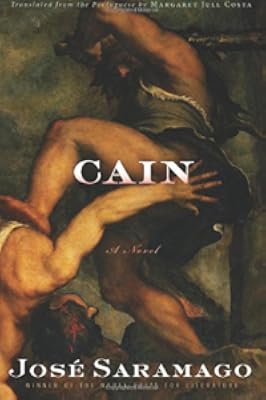
Cain
by José Saramago
On This Page
Description
"In this, his last novel, Saramago daringly reimagines the characters and narratives of the Bible through the story of Cain. Condemned to wander forever after he kills Abel, he is whisked around in time and space. He experiences the almost-sacrifice of Isaac by Abraham, the Tower of Babel, the destruction of Sodom and Gomorrah, Joshua at the battle of Jericho, Job's ordeal, and finally Noah's ark and the Flood. And over and over again Cain encounters an unjust, even cruel God. A startling, show more beautifully written, and powerful book, in all ways a fitting end to Saramago's extraordinary career"-- show lessTags
Recommendations














Member Recommendations
Member Reviews
*chuckle* I was going to place a cultural warning that readers who are very religious might not like this book or my review of it, but I see from consumer reviews at Library Thing that a punctuation warning might be more important to some readers!
Cain, the final novel from José Saramago, (1922-2010), is at 159 pages more of a novella than a novel, so it fits the brief for #NovNov (Novellas in November). But — quite apart from the author's provocative stance on the Old Testament God and his deeds — although there are chapters to break up the text, there's barely a paragraph to be seen and the other punctuation crimes include run-on sentences, the absence of quotation marks to signal speech and the lack of capital letters to signal show more proper names. I didn't mind it, I was too busy laughing...
Saramago sets the tone from the start with God's realisation that he has forgotten to give Adam and Eve the power of speech. Like many who can't find anyone to blame but himself, he gets into a temper:
Cain, as we know from the Bible stories we were told when young, was jealous of Adam because God preferred Adam's sacrifice, and so Cain bumped him off, earning himself a place in Biblical history as the first murderer. In Saramago's novel, this is the first of many occasions when Cain challenges the logic of the lord's punishments.
TO read the rest of my review, please visit https://anzlitlovers.com/2021/11/13/cain-a-novel-by-jose-saramago-translated-by-... show less
Cain, the final novel from José Saramago, (1922-2010), is at 159 pages more of a novella than a novel, so it fits the brief for #NovNov (Novellas in November). But — quite apart from the author's provocative stance on the Old Testament God and his deeds — although there are chapters to break up the text, there's barely a paragraph to be seen and the other punctuation crimes include run-on sentences, the absence of quotation marks to signal speech and the lack of capital letters to signal show more proper names. I didn't mind it, I was too busy laughing...
Saramago sets the tone from the start with God's realisation that he has forgotten to give Adam and Eve the power of speech. Like many who can't find anyone to blame but himself, he gets into a temper:
"In an excess of rage, surprising in someone who could have solved any problem simply by issuing another quick fiat, he rushed over to adam and eve and unceremoniously, no half-measures, stuck his tongue down the throats of first one and then the other. From the texts which, over the centuries, have provided a somewhat random record of these remote times, be it of events that might, at some future date, be awarded canonical status and others deemed to be the fruit of apocryphal and irredeemably heretical imaginations, it is not at all clear what kind of tongue was being referred to here, whether the moist, flexible muscle that moves around in the buccal cavity and occasionally outside it too, or the gift of speech, also known as language, that the lord had so regrettably forgotten to give them about which we know nothing, since not a trace of it remains, not even a heart engraved on the bark of the tree, accompanied by some sentimental message, something along the lines of I love eve." (p.1-2)
Cain, as we know from the Bible stories we were told when young, was jealous of Adam because God preferred Adam's sacrifice, and so Cain bumped him off, earning himself a place in Biblical history as the first murderer. In Saramago's novel, this is the first of many occasions when Cain challenges the logic of the lord's punishments.
TO read the rest of my review, please visit https://anzlitlovers.com/2021/11/13/cain-a-novel-by-jose-saramago-translated-by-... show less
“Deep down, the problem is not a God that does not exist, but the religion that proclaims Him. I denounce religions, all religions, as harmful to Humankind. These are harsh words, but one must say them.” - Jose Saramago
When I was a young child, I was given a three volume set of The Bible Story Library, the Holy Scriptures retold in story form for the young…
José Saramago’s Cain is the book I wish I was given instead. It would have been a welcome companion to my youthful incredulity. It would have let me know that despite the professed beliefs of those around me, I was not alone in believing these stories were merely myths about a god that was anything but praiseworthy.
Jennifer Michael Hecht says in her book Doubt, “There are show more saints of doubt, martyrs of atheism, and sages of happy disbelief…” Then there’s Saramago.
Cain is Saramago’s evisceration of the Old Testament’s Jehovah. Pythonesque but more mocking and derisive in tone, Saramago delivers not a midrash, but a mauling - and ultimately shows that what is reaped is what is sowed. This apple will not fall far from the tree.
In Saramago’s reimagining of Cain, this doomed son of Adam is a fratricide and insatiable libertine, and yet seemingly also the moral center of the story.
When God confronts him after the murder of Abel, Cain accuses God of being just as culpable as himself due to the fact that He could have intervened (which He shows Himself all too willing to do when it suits His purpose) but consciously chose not to. ”You gods, you and all the others, have a duty to those you claim to have created,” Cain tells him.
God then tells Cain it was a moral test and he failed, and marks Cain, telling him he is now under divine protection - doomed to wander the earth heavy with sin.
What follows is a twisted tale where Cain mysteriously finds himself traveling through time and space, allowing Saramago to imagine him participating in and giving moral commentary on some of the most highly problematic stories in the Old Testament (the Destruction of Sodom and Gomorrah, Abraham’s attempted sacrifice of his son, and the great flood are just a few examples).
Each successive encounter leaves Cain more perplexed and disgusted by the actions of this petulant, vindictive Jehovah.
A nonconformist (as dismissive of syntactic convention as he is of religious dogma), Saramago seems to be asking the reader: Does this make any sense to you? Do you find this praiseworthy?
Albert Camus said ”A world that can be explained even with bad reasons is a familiar world. But, on the other hand, in a universe suddenly divested of illusions and lights, man feels an alien, a stranger.”
Mythologies may not be true or worthy, but they do provide a lifeboat for those struggling to stay afloat through the tempest.
Saramago needs no lifeboat. He shows himself an audacious swimmer - even against the strongest current. show less
“Deep down, the problem is not a God that does not exist, but the religion that proclaims Him. I denounce religions, all religions, as harmful to Humankind. These are harsh words, but one must say them.” - Jose Saramago
When I was a young child, I was given a three volume set of The Bible Story Library, the Holy Scriptures retold in story form for the young…
José Saramago’s Cain is the book I wish I was given instead. It would have been a welcome companion to my youthful incredulity. It would have let me know that despite the professed beliefs of those around me, I was not alone in believing these stories were merely myths about a god that was anything but praiseworthy.
Jennifer Michael Hecht says in her book Doubt, “There are show more saints of doubt, martyrs of atheism, and sages of happy disbelief…” Then there’s Saramago.
Cain is Saramago’s evisceration of the Old Testament’s Jehovah. Pythonesque but more mocking and derisive in tone, Saramago delivers not a midrash, but a mauling - and ultimately shows that what is reaped is what is sowed. This apple will not fall far from the tree.
In Saramago’s reimagining of Cain, this doomed son of Adam is a fratricide and insatiable libertine, and yet seemingly also the moral center of the story.
When God confronts him after the murder of Abel, Cain accuses God of being just as culpable as himself due to the fact that He could have intervened (which He shows Himself all too willing to do when it suits His purpose) but consciously chose not to. ”You gods, you and all the others, have a duty to those you claim to have created,” Cain tells him.
God then tells Cain it was a moral test and he failed, and marks Cain, telling him he is now under divine protection - doomed to wander the earth heavy with sin.
What follows is a twisted tale where Cain mysteriously finds himself traveling through time and space, allowing Saramago to imagine him participating in and giving moral commentary on some of the most highly problematic stories in the Old Testament (the Destruction of Sodom and Gomorrah, Abraham’s attempted sacrifice of his son, and the great flood are just a few examples).
Each successive encounter leaves Cain more perplexed and disgusted by the actions of this petulant, vindictive Jehovah.
A nonconformist (as dismissive of syntactic convention as he is of religious dogma), Saramago seems to be asking the reader: Does this make any sense to you? Do you find this praiseworthy?
Albert Camus said ”A world that can be explained even with bad reasons is a familiar world. But, on the other hand, in a universe suddenly divested of illusions and lights, man feels an alien, a stranger.”
Mythologies may not be true or worthy, but they do provide a lifeboat for those struggling to stay afloat through the tempest.
Saramago needs no lifeboat. He shows himself an audacious swimmer - even against the strongest current. show less
I gave this book 5 stars to partly counter the reviews that deduct stars on account of Saramago's grammatical style. All his books, that I have read, use a similar style. I can't say I love the run-on sentences without capitalization, punctuation, format or informative terminations such as question marks, etc, but I will say that Saramago is bursting with things to get on to paper and I think the style makes me aware of his energy. With Saramago, it is not about the grammar, it is about the forcefulness and confidence of the prose. Think of a person opposite you ranting nonstop - and yet you are engaged.
Spoiler: Be warned that Saramago might make you question your faith or belief in god. He seems to deal with every question I had show more reading the old testament as a child, starting with How did Adam and Eve start the human race if they only had two sons and one killed the other? Nothing, nothing is sacred to Saramago.
Another spoiler: I did not appreciate the abrupt ending. For me, it did not tie up the book in any way and I even wonder if he actually finished writing it before he died. Did someone just say "ok, everyone dies and lets pretend he wrote it like that" ? show less
Spoiler: Be warned that Saramago might make you question your faith or belief in god. He seems to deal with every question I had show more reading the old testament as a child, starting with How did Adam and Eve start the human race if they only had two sons and one killed the other? Nothing, nothing is sacred to Saramago.
Another spoiler: I did not appreciate the abrupt ending. For me, it did not tie up the book in any way and I even wonder if he actually finished writing it before he died. Did someone just say "ok, everyone dies and lets pretend he wrote it like that" ? show less
Con una gran irreverencia y con una magistralidad narrativa, José Saramago nos relata de manera satírica algunos pasajes del antiguo testamento, empezando por Adán y Eva, su creación, su expulsión del paraíso y su integración a la vida cotidiana dando a luz dos hijos, Caín y Abel.
Ya sabemos que Caín mató a Abel, así pues Dios recrimina al primero y éste a su vez le dice que lo ha hecho por su culpa, de esta manera Dios y Caín llegan a un acuerdo donde Dios permite a Caín seguir con vida pero errante.
Así pues a través de la visión de Caín vemos a Abraham, Job, Noé, Moisés y algunos otros reconocidos personajes de este libro ya muy antiguo, sin embargo, no es la historia lo que interesa sino la manera en la que se nos show more relata.
Con un sentido del humor negro y muy fino, Saramago en palabras de Caín crítica a Dios a su obra y sus decisiones más alocadas y también se burla, no solo de las historias relatadas en la Biblia sino de los que creemos en ellas.
Este libro no está escrito para quienes tienen creencias religiosas muy arraigadas, la irreverencia, la crítica y la burla son predominantes y además es imposible no pensar “¡Hombre claro, es que eso es tan loco!” y es que Dios es el creador, pero no es precisamente muy bueno que digamos y Caín se lo dice, lo critica, lo enfrenta y lo reniega una y otra vez.
Es una delicia leer a Saramago la manera que tenía para contar historias que tenía este señor es digno de alabarse y por supuesto de disfrutarse, todo mundo debería de leerlo al menos una vez en su vida, si no éste, cualquiera de sus libros, en definitiva es difícil encasillar a Saramago, imposible compararlo, fue un fuera de serie, su estilo, su calidad, su manera de hacer sus libros, he leído libros muy duros de él, también libros donde resalta su retorcido sentido del humor pero siempre estableciendo la crítica social, levantando la voz por las injusticias y como en este caso ante la religión, que como bien lo hace notar Saramago, no siempre resulta en algo ni lógico ni beneficioso. show less
Ya sabemos que Caín mató a Abel, así pues Dios recrimina al primero y éste a su vez le dice que lo ha hecho por su culpa, de esta manera Dios y Caín llegan a un acuerdo donde Dios permite a Caín seguir con vida pero errante.
Así pues a través de la visión de Caín vemos a Abraham, Job, Noé, Moisés y algunos otros reconocidos personajes de este libro ya muy antiguo, sin embargo, no es la historia lo que interesa sino la manera en la que se nos show more relata.
Con un sentido del humor negro y muy fino, Saramago en palabras de Caín crítica a Dios a su obra y sus decisiones más alocadas y también se burla, no solo de las historias relatadas en la Biblia sino de los que creemos en ellas.
Este libro no está escrito para quienes tienen creencias religiosas muy arraigadas, la irreverencia, la crítica y la burla son predominantes y además es imposible no pensar “¡Hombre claro, es que eso es tan loco!” y es que Dios es el creador, pero no es precisamente muy bueno que digamos y Caín se lo dice, lo critica, lo enfrenta y lo reniega una y otra vez.
Es una delicia leer a Saramago la manera que tenía para contar historias que tenía este señor es digno de alabarse y por supuesto de disfrutarse, todo mundo debería de leerlo al menos una vez en su vida, si no éste, cualquiera de sus libros, en definitiva es difícil encasillar a Saramago, imposible compararlo, fue un fuera de serie, su estilo, su calidad, su manera de hacer sus libros, he leído libros muy duros de él, también libros donde resalta su retorcido sentido del humor pero siempre estableciendo la crítica social, levantando la voz por las injusticias y como en este caso ante la religión, que como bien lo hace notar Saramago, no siempre resulta en algo ni lógico ni beneficioso. show less
This is the first I've read of Saramago, and I wonder now how I could have missed him up to now. Saramago uses the story of Cain ("cain" for Saramago) to rewrite the relationship between God ("god") and humanity, not so much as between creator and servant but between true father and grown child, struggling to come to terms with one another. "The history of mankind," he says, as part of the narrative of Cain's life, "is the history of our misunderstandings with god, for he doesn't understand us, and we don't understand him."
The story is more than irreverent, it's a full-on confrontation between freedom and authority. Cain dares to judge his god and find him wanting. Sure, Cain has killed his brother, but Cain is witness to innumerable show more atrocities at the hand of his god, so astounding that Cain is led to announce, "I have learned one thing . . . that our god, the creator of heaven and earth, is completely mad."
This is a Cain unhitched from normal continuities of space and time, traveling chunkily from episode to episode, witnessing the events that confound him and lead him and God to a kind of final one on one on into eternity.
I recommend the book not so much because I think Saramago is "right" about something as for the questions he provokes. His writing, and his thinking about the place of God in our understandings of ourselves and our lives, are unrestrained -- it's the extreme perspective we need to see. Even if we retreat from it after experiencing it, we won't ever be the same again.
I can't articulate as well as I'd like why I can only rate the book 4 stars rather than 5. It's a translation from the original Portuguese, and the reading didn't flow easily for me. The vocabulary seemed to strain towards its irreverent tone at times rather than just coming naturally. But the story and the themes behind it are 5 star. show less
The story is more than irreverent, it's a full-on confrontation between freedom and authority. Cain dares to judge his god and find him wanting. Sure, Cain has killed his brother, but Cain is witness to innumerable show more atrocities at the hand of his god, so astounding that Cain is led to announce, "I have learned one thing . . . that our god, the creator of heaven and earth, is completely mad."
This is a Cain unhitched from normal continuities of space and time, traveling chunkily from episode to episode, witnessing the events that confound him and lead him and God to a kind of final one on one on into eternity.
I recommend the book not so much because I think Saramago is "right" about something as for the questions he provokes. His writing, and his thinking about the place of God in our understandings of ourselves and our lives, are unrestrained -- it's the extreme perspective we need to see. Even if we retreat from it after experiencing it, we won't ever be the same again.
I can't articulate as well as I'd like why I can only rate the book 4 stars rather than 5. It's a translation from the original Portuguese, and the reading didn't flow easily for me. The vocabulary seemed to strain towards its irreverent tone at times rather than just coming naturally. But the story and the themes behind it are 5 star. show less
Che la relazione tra dio (il dio degli eserciti, giusto per sapere di che cosa stiamo parlando) sia nata sotto una cattiva stella e si sia dall'inizio imbrogliata di equivoci, era una cosa di cui avevamo il forte sospetto, e Saramago ce ne da le prove, in linguaggio corrente e col suo solito, incredibile stile.
Saramago offre anche una possibile soluzione del problema, per mano di quell'uomo contro il quale, per primo, si scatenò tutta la doppiezza divina, e vien da pensare che è un peccato che si tratti di sola letteratura.
Saramago offre anche una possibile soluzione del problema, per mano di quell'uomo contro il quale, per primo, si scatenò tutta la doppiezza divina, e vien da pensare che è un peccato che si tratti di sola letteratura.
Members
- Recently Added By
Published Reviews
Que la obra de Caín de José de Saramago, es muy buena y nos da entender la bipolaridad de DIOS que a muchos le causa frustración ya que muchas personas lo pintaban de ser un Dios bueno pero al final de leer lo que les hizo en sodoma y gomorra y que la mayoria de la gente de ese lugar pagara los platos rotos por solo unas cuantas personas es muy injunto y de ahí por que Dios es bipolar, show more podria hasta decirse que a Dios es quien decide quien puede vivir y quien no pero en eso esta gente buena y que ahi es cunado los meten en un solo saco y el señor es quien mata indiscriminadamente y por lo cual Caín al final de la obra se venga matando a todos los de la arca de Noe y el es al final quien empieza a recrear a la humanidad. show less
added by Erick-Omar-IC
Lists

Recommend the 20 best books you've read in the last five years
2,168 works; 601 members

Five star books
1,767 works; 110 members

Authors from Portugal
3 works; 1 member

Books Read in 2020
4,379 works; 124 members

A Novel Cure
742 works; 23 members

Genesis in literature
47 works; 7 members
Author Information

241+ Works 53,280 Members
José Saramago was born on November 16, 1922. He spent most of his childhood on his parent's farm, except while attending school in Lisbon. Before devoting himself exclusively to writing novels in 1976, he worked as a draftsman, a publisher's reader, an editor, translator, and political commentator for Diario de Lisboa. He is indisputably show more Portugal's best-known literary figure and his books have been translated into more than 25 languages. Although he wrote his first novel in 1947, he waited some 35 years before winning critical acclaim for work such as the Memorial do Convento. His works include The Year of the Death of Ricardo Reis, The Stone Raft, Baltasar and Blimunda, The History of the Siege of Lisbon, The Gospel According to Jesus Christ, and Blindness. At age 75, he was awarded the Nobel Prize for Literature in 1998 for his work in which "parables sustained by imagination, compassion and irony, continually enables us to apprehend an elusory reality." He died from a prolonged illness that caused multiple organ failure on June 18, 2010 at the age of 87. (Bowker Author Biography) show less
Some Editions
Awards and Honors
Common Knowledge
- Canonical title*
- Caino
- Original title
- Caim: romance
- Original publication date
- 2009
- People/Characters
- Caim; Noé; Abraão; Isaque; Eva; Adão (show all 8); Deus; Lilith
- Important places
- Garden of Eden (Genesis 2+3); Sodom; Gomorrah
- Epigraph*
- Per la fede, Abele offrì a Dio un sacrificio migliore di quello di Caino. A causa della sua fede, Dio lo considerò suo amico e accettò con soddisfazione le sue offerte. Ed è per la fede che Abele, anche se è morto, ancor... (show all)a parla.
(Ebreo, 11, 4)
Libro degli spropositi - Dedication*
- A Pilar, come se dicessi acqua
- First words*
- Quando il signore, noto anche come dio, si accorse che ad adamo ed eva, perfetti in tutto ciò che presentavano alla vista, non usciva di bocca una parola né emettevano un sia pur semplice suono primario, dovette prendersela... (show all) con se stesso, dato che non c'era nessun altro nel giardino dell'eden cui poter dare la responsabilità di quella mancanza gravissima.
- Quotations
- The history of mankind is the history of our misunderstandings with god, for he doesn't understand us, and we don't understand him.
- Last words*
- (Click to show. Warning: May contain spoilers.)L'histoire est terminée, il n'y aura rien d'autre à raconter.
- Original language
- Portuguese
*Some information comes from Common Knowledge in other languages. Click "Edit" for more information.
Classifications
- Genres
- General Fiction, Fiction and Literature, Romance
- DDC/MDS
- 869.3 — Literature & rhetoric Spanish Literature Literatures of Portuguese and Galician languages Portuguese fiction
- LCC
- PQ9281 .A66 .C3513 — Language and Literature French, Italian, Spanish and Portuguese literatures Portuguese literature Individual authors, 1961-2000
- BISAC
Statistics
- Members
- 1,806
- Popularity
- 12,099
- Reviews
- 83
- Rating
- (3.77)
- Languages
- 21 — Albanian, Catalan, Czech, Danish, Dutch, English, French, German, Greek, Hebrew, Hungarian, Italian, Norwegian (Bokmål), Polish, Portuguese, Romanian, Russian, Croatian, Spanish, Swedish, Turkish
- Media
- Paper, Audiobook, Ebook
- ISBNs
- 76
- ASINs
- 14