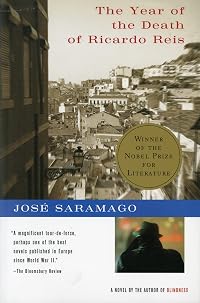
The Year of the Death of Ricardo Reis
by José Saramago
On This Page
Description
The year is 1936, and the dictator António de Oliveira Salazar is establishing himself in Portugal, edging his country toward civil war. At the same time, Dr. Ricardo Reis has returned home to Lisbon after a long sojourn in Brazil. What's brought him back is word that the great poet, Fernando Pessoa, has died. With no intention of resuming his practice, Reis now dabbles in his own poetry, wastes his days strolling the boulevards and back streets, engages in affairs with two different show more women-and is followed through each excursion by Pessoa's ghost. As a fascist revolution roils, and as Reis's path intersects with three relative strangers-two living, one dead-Reis may finally discover the reality of his own chimerical existence. show lessTags
Recommendations










Member Recommendations

Member Reviews
All we can ask of a character is that they inhabit the earth for a time, whether that is the time we read about them, or the times in which they exist on the page. A character is a fiction, the work is a fiction. Yet they can travel through real time and place, and use real words on a page, make us walk side by side with them as real (or at least plausible), force real thoughts and emotions out of us. Living in strange times (all times are strange, though some are worse for more protagonists than others) turns fiction into a universe that makes more sense than the world did before we read it. Saramago was aware of this when he set this in the 1930s.
What a strange time to be placed in as a character, alive during a dictatorship, when show more nothing makes sense, everything uttered by the state is a fiction, an exaggeration, a corporate cliche. Well, fortunately for Dr Ricardo Reis he doesn't exist, he is a creation of the poet Fernando Pessoa who died just a few months before Reis returns from Brazil after 16 years absence. Reis doesn't exist, but we do. So we are left to process this half-life during dictatorship. It shouldn't make sense that a fictional character talks to a real author during the time immediately after his death. And yet what better way do we have to understand the universe created by dictatorships?
Nothing is stable. Reis lives in a half-way place, a hotel, for three months. There, everything is taken care of: bed, meals, warmth, polite conversation with manager and staff, and the chambermaid Lydia becomes his mistress. Lydia is real, in the sense that Pessoa did not invent her. The weather - it rains all day, that is real, as is the cold and facts Reis reads in the newspapers, the republic in Spain and the military coup, these are all real. Fernando Pessoa, Reis' creator, shows up one night and the two men talk, creator to heteronym. A heteronym for Pessoa's purposes was something like an alter ego but also a pseudonym of sorts. Pessoa had several and they all wrote poetry or prose- Dr Reis wrote classical lyrical works for instance. I looked it up and 'heteronym' means a word spelled the same but has two different meanings. Ideal, since Pessoa was only dealing with words on the page.
Reis has little or no purpose and no real plans. When it gets too difficult in the hotel, after an influx of new Spanish guests, right wing refugees from the republic - all obnoxious self important and fatuous, Reis takes an apartment. He lives off English currency and has savings still in Brazil. Lydia keeps coming and going, cleaning the apartment, pretending she is in a relationship. But Reis also fantasises about the elegant and young Marcenda, who has a crippled hand. Reis becomes a locum doctor, filling in for a cardiologist. Another indication that he doesn't actually exist - he works without proper experience and qualification as a cardiologist. But he muddles through. Fiction is like that.
The crisis in Spain spills over to Portugal. The rhetoric of dictators like Salazar is real, even if it is nonsense, enough people believe it all, like they believe in the miracles of Fatima and go there on pilgrimage in droves.
Pessoa turns up at any and all hours. He is bound by some death ritual to travel the world for nine months after his death. But he cannot read in the real world so Reis informs him of goings on. They have philosophical discussions after which Pessoa disappears. We never know when he might return.
"A word lies. With the same word, one can speak the truth. We are not what we say, we are true only if others believe us." Says Reis.
In other words, fiction can be as powerful as reality. Dr Reis exists because Pessoa invented him and Saramago writes a convincing novel about him. A plausible story, the same as the plausible ideas in the speeches of Salazar the dictator on the modern greatness of Portugal, or as Saramago reminds us in the words of Unamuno: the fascists are protecting western civilisation. Of course they are.
Pessoa wrote in the Book of Disquiet:
"Everything we do in art or in life is the imperfect copy of what we thought of doing"
And so Reis is the imperfect creature on the page, indecisive, shallow - he pines for one woman, yet happily sleeps with another - flops around without much of a plan, vain and neurotic - he worries about what time to go down to dinner and what the hotel manager thinks of him. Perhaps that makes him the perfect creature of a writer's imagination. At least in art we can appreciate failures and imprecise representations. Reis is the perfect creature to arise out of Pessoa's brain, the antidote to the perfectible human - the good Portuguese, like the great Aryan - that other ideal national hero doing the rounds during the 1930s. Failure is of greater value to Pessoa than the sham of perfection.
Saramago is meticulous in trawling through the daily history of 1936. A big year for Portugal, Spain, the world. Fascism was on the rise. It seemed like the only reality and many were falling over themselves to be part of it. Not just the dictators like Salazar, but we are reminded too that so was Chamberlain. And that great philanthropist, Rockefeller was funding Franco, and the abdicated king of England was dancing cheek to cheek with Adolf. Fascism seemed like such a good idea. The world was on a knife-edge between the real and the fictional. Fascist fiction is also very real unfortunately.
And that's the problem when we listen to the bullshit of corporations and narcissist presidents. It all seems so real for a time. Thankfully we have literature, and make believe, to tell us the difference between bullshit and real.
Addit. I dipped into Pessoa's extraordinary guide to a life - The Book of Disquiet - after reading this. Saramago drew on Pessoa's persona closely for both Reis, Pessoa and the themes of his novel:
"I existed only so much as I filled time with consciousness and thought"
"It's so hard to describe what I feel when I feel I really exist and my soul is a real entity that I don't know what human words could define it." show less
This book blends magical realism, historical fiction, and literary fiction. The title character, Ricardo Reis, a doctor and poet, returns to Lisbon, Portugal, after living in Brazil for sixteen years. He stays at a hotel, encounters two women, is questioned by local authorities, and is visited by the spirit of recently deceased poet Fernando Pessoa, an historic figure. The year is 1935 to 1936, and the backdrop is the rise of the fascist movement in Europe.
This is a philosophical novel, filled with musings on life, love, art, literature, politics, religion, history, and death. It is character driven and the plot is sparse. The protagonist seems to be sleep-walking through life, withdrawing into his personal world, avoiding reality. He show more strikes up a relationship with a woman he considers beneath his station and longs for a much-younger woman for whom he writes poetry. He appears oblivious to the political situation taking place around him, though he reads the papers and recounts the headlines of the day.
Saramago is a keen observer of human nature. He inserts his wit and clever observations about life. He speaks directly to the reader, at points even referencing the reading process and preferences:
“A chambermaid appeared, but it wasn’t Lydia. Ah, Carlota, light a heater and put it in the lounge. Whether such details are indispensable or not for a clear understanding of this narrative is something each of us must judge for himself, and the judgment will vary according to our attention, mood, and temperament. There are those who value broad ideas above all, who prefer panoramas and historical frescoes, whereas others appreciate the affinities and contrasts between small brush strokes.”
Saramago’s style is not for everyone. He employs long paragraphs, stretching over many pages. Dialogue is embedded within these paragraphs. For me, this type structure is hard on the eyes, as it provides no natural stopping places for reflection (and this book requires lots of reflection). I have to say though, I found it kept my interest and I learned quite a bit about Portuguese history and literature.
Memorable quotes:
“Clearly man is trapped in his own labyrinth.”
“One reaches a point where there is nothing but hope, and that is when we discover that hope is everything.”
“Man, in the final analysis, is an irrational creature.”
“There is nothing more pointless in this world than regret.”
“One cannot resist time, we are within it and accompany it, nothing more.”
“Poets often begin at the horizon, for that is the shortest path to the heart.” show less
This is a philosophical novel, filled with musings on life, love, art, literature, politics, religion, history, and death. It is character driven and the plot is sparse. The protagonist seems to be sleep-walking through life, withdrawing into his personal world, avoiding reality. He show more strikes up a relationship with a woman he considers beneath his station and longs for a much-younger woman for whom he writes poetry. He appears oblivious to the political situation taking place around him, though he reads the papers and recounts the headlines of the day.
Saramago is a keen observer of human nature. He inserts his wit and clever observations about life. He speaks directly to the reader, at points even referencing the reading process and preferences:
“A chambermaid appeared, but it wasn’t Lydia. Ah, Carlota, light a heater and put it in the lounge. Whether such details are indispensable or not for a clear understanding of this narrative is something each of us must judge for himself, and the judgment will vary according to our attention, mood, and temperament. There are those who value broad ideas above all, who prefer panoramas and historical frescoes, whereas others appreciate the affinities and contrasts between small brush strokes.”
Saramago’s style is not for everyone. He employs long paragraphs, stretching over many pages. Dialogue is embedded within these paragraphs. For me, this type structure is hard on the eyes, as it provides no natural stopping places for reflection (and this book requires lots of reflection). I have to say though, I found it kept my interest and I learned quite a bit about Portuguese history and literature.
Memorable quotes:
“Clearly man is trapped in his own labyrinth.”
“One reaches a point where there is nothing but hope, and that is when we discover that hope is everything.”
“Man, in the final analysis, is an irrational creature.”
“There is nothing more pointless in this world than regret.”
“One cannot resist time, we are within it and accompany it, nothing more.”
“Poets often begin at the horizon, for that is the shortest path to the heart.” show less
An intriguing book. There is more going on in The Year of the Death of Ricardo Reis than the simple tale of a man returning to his native Portugal after sixteen years in Brazil. More than a tenuously-romantic relationship between this man and the chambermaid Lydia at the hotel he stays in. More than the crush he develops on a young woman, Mercenda, whose left arm is paralyzed. His brief, threatening interview with the Lisbon police. His ongoing conversations with the dead poet Fernando Pessoa. But what?
Jose Saramago's novel is full of small mysteries left unexplained: why Reis was exiled in Brazil – if in fact he was exiled, or merely chose to live there; why he returns to Lisbon; why the police are interested in a nondescript, show more middle-aged doctor who spends his days wandering the city and reading the newspaper. Even when Reis has indeed died (as foretold by the title), the book leaves the reader not surprised by the suddenness of the death but rather by the lack of a cause. If in fact it was a death, for the name Ricardo Reis is a pseudonym the actual, living Pessoa used, giving rise to the question of whether Reis himself is a real person in the novel or merely another ghost of Pessoa.
Saramago writes in long sentences and lengthy paragraphs that race along like wind-blown detritus. Yet there is a deliberate dichotomy between the pace of his sentences and the action they contain. They refuse to follow literary conventions – speech is not denoted by quotation marks, nor even broken into separate paragraphs when the speaker changes. The narrative tense shifts, sometimes mid-sentence, and the unnamed narrator often interrupts with his own commentary. At times you are not sure whether the action described is a figment of Reis' imagination or real events. But none of this is distracting; rather, it adds to the surreal atmosphere of the novel. It leaves the reader wondering what the novel means, whether it is supposed to mean anything.
The Year of the Death of Ricardo Reis is a stylistic departure from Blindness, his other novel I highly recommend. My translation was copyrighted seven years after the original publication, has no foreword, barely credits the translator, and has only the briefest of biographies of the Nobel Prize recipient on the back cover. This minimalist approach downplays the greatness of this book. show less
Jose Saramago's novel is full of small mysteries left unexplained: why Reis was exiled in Brazil – if in fact he was exiled, or merely chose to live there; why he returns to Lisbon; why the police are interested in a nondescript, show more middle-aged doctor who spends his days wandering the city and reading the newspaper. Even when Reis has indeed died (as foretold by the title), the book leaves the reader not surprised by the suddenness of the death but rather by the lack of a cause. If in fact it was a death, for the name Ricardo Reis is a pseudonym the actual, living Pessoa used, giving rise to the question of whether Reis himself is a real person in the novel or merely another ghost of Pessoa.
Saramago writes in long sentences and lengthy paragraphs that race along like wind-blown detritus. Yet there is a deliberate dichotomy between the pace of his sentences and the action they contain. They refuse to follow literary conventions – speech is not denoted by quotation marks, nor even broken into separate paragraphs when the speaker changes. The narrative tense shifts, sometimes mid-sentence, and the unnamed narrator often interrupts with his own commentary. At times you are not sure whether the action described is a figment of Reis' imagination or real events. But none of this is distracting; rather, it adds to the surreal atmosphere of the novel. It leaves the reader wondering what the novel means, whether it is supposed to mean anything.
The Year of the Death of Ricardo Reis is a stylistic departure from Blindness, his other novel I highly recommend. My translation was copyrighted seven years after the original publication, has no foreword, barely credits the translator, and has only the briefest of biographies of the Nobel Prize recipient on the back cover. This minimalist approach downplays the greatness of this book. show less
L'anima di un morto, soprattutto se il morto è un poeta, ha nove mesi, il tempo di formare una vita, per lasciare la terra, e in questi nove mesi si svolge un fitto dialogo tra il poeta Pessoa e il suo personaggio incarnato Ricardo Reis.
E in questi nove mesi in Portogallo si afferma il salazarismo, inizia la guerra civile in Spagna, si vince la guerra di Etiopia e la Germania di Hitler avanza tra il plauso delle altre nazioni d'Europa, incapaci di capire le conseguenze di tutta questa religione, di tutto questo ordine sbandierato.
E Saramago, attraverso Ricardo Reis, Pessoa, la cameriera Lidia e gli infiniti altri personaggi, che siano esseri umani o statue, popolo o paesaggio, e persino tempo meteorologico, racconta questi nove mesi show more così densi di durature conseguenze per l'Europa. show less
E in questi nove mesi in Portogallo si afferma il salazarismo, inizia la guerra civile in Spagna, si vince la guerra di Etiopia e la Germania di Hitler avanza tra il plauso delle altre nazioni d'Europa, incapaci di capire le conseguenze di tutta questa religione, di tutto questo ordine sbandierato.
E Saramago, attraverso Ricardo Reis, Pessoa, la cameriera Lidia e gli infiniti altri personaggi, che siano esseri umani o statue, popolo o paesaggio, e persino tempo meteorologico, racconta questi nove mesi show more così densi di durature conseguenze per l'Europa. show less
Wonderfully leisurely, complex, often rather puzzling debate about the natures of poetry and death and their relationships with political action. A book you have to read with a street map of Lisbon by your side (or even better, sitting on a bench on top of a hill with Lisbon spread out in front of you): the rhythms of the city's peculiar geography are every bit as important to the story as the newspaper headlines of 1936 and Pessoa's poetry.
This book blends magical realism, historical fiction, and literary fiction. The title character, Ricardo Reis, a doctor and poet, returns to Lisbon, Portugal, after living in Brazil for sixteen years. He stays at a hotel, encounters two women, is questioned by local authorities, and is visited by the spirit of recently deceased poet Fernando Pessoa, an historic figure. The year is 1935 to 1936, and the backdrop is the rise of the fascist movement in Europe.
This is a philosophical novel, filled with musings on life, love, art, literature, politics, religion, history, and death. It is character driven and the plot is sparse. The protagonist seems to be sleep-walking through life, withdrawing into his personal world, avoiding reality. He show more strikes up a relationship with a woman he considers beneath his station and longs for a much-younger woman for whom he writes poetry. He appears oblivious to the political situation taking place around him, though he reads the papers and recounts the headlines of the day.
Saramago is a keen observer of human nature. He inserts his wit and clever observations about life. He speaks directly to the reader, at points even referencing the reading process and preferences:
“A chambermaid appeared, but it wasn’t Lydia. Ah, Carlota, light a heater and put it in the lounge. Whether such details are indispensable or not for a clear understanding of this narrative is something each of us must judge for himself, and the judgment will vary according to our attention, mood, and temperament. There are those who value broad ideas above all, who prefer panoramas and historical frescoes, whereas others appreciate the affinities and contrasts between small brush strokes.”
Saramago’s style is not for everyone. He employs long paragraphs, stretching over many pages. Dialogue is embedded within these paragraphs. For me, this type structure is hard on the eyes, as it provides no natural stopping places for reflection (and this book requires lots of reflection). I have to say though, I found it kept my interest and I learned quite a bit about Portuguese history and literature.
Memorable quotes:
“Clearly man is trapped in his own labyrinth.”
“One reaches a point where there is nothing but hope, and that is when we discover that hope is everything.”
“Man, in the final analysis, is an irrational creature.”
“There is nothing more pointless in this world than regret.”
“One cannot resist time, we are within it and accompany it, nothing more.”
“Poets often begin at the horizon, for that is the shortest path to the heart.” show less
This is a philosophical novel, filled with musings on life, love, art, literature, politics, religion, history, and death. It is character driven and the plot is sparse. The protagonist seems to be sleep-walking through life, withdrawing into his personal world, avoiding reality. He show more strikes up a relationship with a woman he considers beneath his station and longs for a much-younger woman for whom he writes poetry. He appears oblivious to the political situation taking place around him, though he reads the papers and recounts the headlines of the day.
Saramago is a keen observer of human nature. He inserts his wit and clever observations about life. He speaks directly to the reader, at points even referencing the reading process and preferences:
“A chambermaid appeared, but it wasn’t Lydia. Ah, Carlota, light a heater and put it in the lounge. Whether such details are indispensable or not for a clear understanding of this narrative is something each of us must judge for himself, and the judgment will vary according to our attention, mood, and temperament. There are those who value broad ideas above all, who prefer panoramas and historical frescoes, whereas others appreciate the affinities and contrasts between small brush strokes.”
Saramago’s style is not for everyone. He employs long paragraphs, stretching over many pages. Dialogue is embedded within these paragraphs. For me, this type structure is hard on the eyes, as it provides no natural stopping places for reflection (and this book requires lots of reflection). I have to say though, I found it kept my interest and I learned quite a bit about Portuguese history and literature.
Memorable quotes:
“Clearly man is trapped in his own labyrinth.”
“One reaches a point where there is nothing but hope, and that is when we discover that hope is everything.”
“Man, in the final analysis, is an irrational creature.”
“There is nothing more pointless in this world than regret.”
“One cannot resist time, we are within it and accompany it, nothing more.”
“Poets often begin at the horizon, for that is the shortest path to the heart.” show less
Bókin The Year of the Death of Richardo Reis eftir portúgalska nóbelsverðlaunaskáldið Jose Saramago fjallar nákvæmlega um það sem titillinn segir. Sagan hefst á því þegar Reis kemur aftur heim til Portúgal eftir sjálfskipaða útlegð í Brasilíu til nokkurra ár. Hann snýr aftur eftir að hafa lesið um andlát vinar síns, Pessoa, og hann á síðan eftir að hitta þennan vin sinn reglulega og spjalla við hann enda er sagan skrifuð í með töfra-raunsæi sem Saramago nýtir sér til að skoða einstaka hluti út frá öðru sjónarhorni. Pessoa og Reis tengjast sterkum böndum enda er annar þeirra höfundarnafn hins.
Saramago sýnir sterklega stéttskipt samfélag og hvernig íbúarnir búa saman og tengjast í show more hugsun og orði. Fasisminn í Evrópu er vaxandi og síðari heimsstyrjöldin dregur nær.
Hann gerir þetta vel og innsýnin sem hann veitir í samfélagið sem hann skapar er eftirminnileg og heillandi. show less
Saramago sýnir sterklega stéttskipt samfélag og hvernig íbúarnir búa saman og tengjast í show more hugsun og orði. Fasisminn í Evrópu er vaxandi og síðari heimsstyrjöldin dregur nær.
Hann gerir þetta vel og innsýnin sem hann veitir í samfélagið sem hann skapar er eftirminnileg og heillandi. show less
Members
- Recently Added By
Lists

1001 Books You Must Read Before You Die
1,448 works; 1,134 members

1,001 BYMRBYD Concensus
723 works; 27 members

Books Read in 2015
3,299 works; 129 members

Books I Own But Haven't Read
144 works; 2 members

Books about the Spanish Civil War
57 works; 3 members

Fiction with Men's Given Names in the Title
302 works; 11 members

In Our Time books
4,934 works; 2 members
Talk Discussions
Past Discussions
Group Read, May 2015: The Year of the Death of Ricardo Reis in 1001 Books to read before you die (May 2015)
Author Information

241+ Works 53,241 Members
José Saramago was born on November 16, 1922. He spent most of his childhood on his parent's farm, except while attending school in Lisbon. Before devoting himself exclusively to writing novels in 1976, he worked as a draftsman, a publisher's reader, an editor, translator, and political commentator for Diario de Lisboa. He is indisputably show more Portugal's best-known literary figure and his books have been translated into more than 25 languages. Although he wrote his first novel in 1947, he waited some 35 years before winning critical acclaim for work such as the Memorial do Convento. His works include The Year of the Death of Ricardo Reis, The Stone Raft, Baltasar and Blimunda, The History of the Siege of Lisbon, The Gospel According to Jesus Christ, and Blindness. At age 75, he was awarded the Nobel Prize for Literature in 1998 for his work in which "parables sustained by imagination, compassion and irony, continually enables us to apprehend an elusory reality." He died from a prolonged illness that caused multiple organ failure on June 18, 2010 at the age of 87. (Bowker Author Biography) show less
Some Editions
Awards and Honors
Awards
Notable Lists
Series
Belongs to Publisher Series
ポルトガル文学叢書 (12)
Work Relationships
Common Knowledge
- Canonical title
- The Year of the Death of Ricardo Reis
- Original title
- O Ano da Morte de Ricardo Reis; Ano da Morte de Ricardo Reis
- Original publication date
- 1984
- People/Characters*
- Ricardo Reis; Fernando Pessoa
- Important places
- Lisbon, Portugal
- Epigraph*
- Wijs is hij die genoegen neemt met het schouwspel van de wereld
Ricardo Reis
Ik heb in mijn leven altijd angstvallig gezocht naar manieren om niet te hoeven handelen
Bernardo Soares
Als men tegen mij zou zeggen dat het dwaas is om zo te praten over iemand die nooit heeft bestaan, antwoord ik dat ik ook geen bewijzen heb dat Lissabon ooit heeft bestaan, of ik die dit schrijf, of wat dan ook.
Fer... (show all)nando Pessoa
Ricardo Reis werd geboren in 1887 (de precieze dag en maand kan ik me niet herinneren, maar heb ik wel ergens liggen) in Porto, is arts en zit momenteel in Brazilië.
Fernando Pessoa
(Brief van 13 januari 1935)
Ricardo Reis keerde na de dood van Fernando Pessoa terug naar Portugal.
José Saramago - First words
- Here the sea ends and the earth begins.
Aqui o mar acaba e a terra principia. - Last words
- (Click to show. Warning: May contain spoilers.)Here, where the sea ends and the earth awaits.
- Original language
- Portuguese
*Some information comes from Common Knowledge in other languages. Click "Edit" for more information.
Classifications
- Genres
- Fiction and Literature, General Fiction, Romance
- DDC/MDS
- 869.342 — Literature & rhetoric Spanish Literature Literatures of Portuguese and Galician languages Portuguese fiction 20th Century 1945-1999
- LCC
- PQ9281 .A66 .A8413 — Language and Literature French, Italian, Spanish and Portuguese literatures Portuguese literature Individual authors, 1961-2000
- BISAC
Statistics
- Members
- 2,060
- Popularity
- 10,099
- Reviews
- 45
- Rating
- (4.01)
- Languages
- 22 — Catalan, Danish, Dutch, English, Finnish, French, German, Greek, Hebrew, Hungarian, Italian, Japanese, Lithuanian, Norwegian (Bokmål), Norwegian, Polish, Romanian, Russian, Spanish, Swedish, Turkish, Portuguese (Portugal)
- Media
- Paper, Audiobook, Ebook
- ISBNs
- 77
- ASINs
- 12