
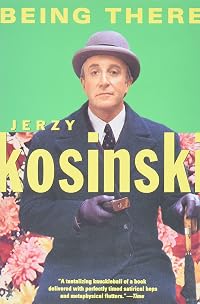
Being There
by Jerzy Kosiński
On This Page
Description
A quirky, brilliant novel starring Chauncey Gardiner, an enigmatic man who rises from nowhere to become a media phenomenon--"a fabulous creature of our age" (Newsweek). One of the most beloved novels by the New York Times-bestselling and National Book Award-winning author of The Painted Bird and Pinball, Being There is the story of a mysterious man who finds himself at the center of Wall Street and Washington power--including his role as a policy adviser to the president--despite the fact show more that no one is quite sure where he comes from, or what he is actually talking about. Nevertheless, Chauncey "Chance" Gardiner is celebrated by the media, and hailed as a visionary, in this satirical masterpiece that became an award-winning film starring Peter Sellers. As wise and timely as ever, Being There is "a tantalizing knuckleball of a book delivered with perfectly timed satirical hops and metaphysical flutters" (Time). show lessTags
Recommendations













Member Recommendations
Member Reviews
A blank slate enters the world, and the world responds.
An afternoon's quick read, this is the story of a simple-minded man, named Chance, who had spent his life up until the story's opening in two places only: in a secluded garden as the gardener, and in front of a TV set. All he knows about the world are those two things plus a few interactions with a cook he calls "black Louise." He wasn't mistreated but he had an extremely isolated life. The TV, while giving him a sense of familiarity, is familiarity but without his cognitive ability to understand it.
Once out in the real world, no longer secluded (hidden by his "benefactor"), he describes his physical interactions with others in this strange way, a way no doubt formed by years of show more television watching,
"When one was addressed and viewed by others, one was safe. Whatever one did would then be interpreted by the others in the same that one interpreted what they did. They would never know more about one than one knew about them."
I'm not telling you much about the story because if you don't know it, or haven't seen the movie, then even telling you a little is a spoiler. The story is too simple, like the protagonist Chance himself.. It is a satire on how by giving simple answers to all manner of questions in the only way he knows how--in information about gardening or general comments about TV--people he meets project onto him their own interpretations, usually in agreement with their own existing opinions and expectations.
In fact, I think readers will do the same. The movie itself did that with its ending, an ending that is not in the book. At the end, I too have my own thoughts about the meaning of this book. I think about the author's life as Jew, camouflaged as a Christian in Poland during WW II, and how that experience might have been an influence on this work. But what is Kosiński saying?
That's the absolute beauty of it. There are many answers to that simple question, and your answer would depend on your existing opinions and world view. It's one of those books that I will continue to gently ponder for a while.
For sure, I'll be continuing to ponder the title. show less
An afternoon's quick read, this is the story of a simple-minded man, named Chance, who had spent his life up until the story's opening in two places only: in a secluded garden as the gardener, and in front of a TV set. All he knows about the world are those two things plus a few interactions with a cook he calls "black Louise." He wasn't mistreated but he had an extremely isolated life. The TV, while giving him a sense of familiarity, is familiarity but without his cognitive ability to understand it.
Once out in the real world, no longer secluded (hidden by his "benefactor"), he describes his physical interactions with others in this strange way, a way no doubt formed by years of show more television watching,
"When one was addressed and viewed by others, one was safe. Whatever one did would then be interpreted by the others in the same that one interpreted what they did. They would never know more about one than one knew about them."
I'm not telling you much about the story because if you don't know it, or haven't seen the movie, then even telling you a little is a spoiler. The story is too simple, like the protagonist Chance himself.. It is a satire on how by giving simple answers to all manner of questions in the only way he knows how--in information about gardening or general comments about TV--people he meets project onto him their own interpretations, usually in agreement with their own existing opinions and expectations.
In fact, I think readers will do the same. The movie itself did that with its ending, an ending that is not in the book. At the end, I too have my own thoughts about the meaning of this book. I think about the author's life as Jew, camouflaged as a Christian in Poland during WW II, and how that experience might have been an influence on this work. But what is Kosiński saying?
That's the absolute beauty of it. There are many answers to that simple question, and your answer would depend on your existing opinions and world view. It's one of those books that I will continue to gently ponder for a while.
For sure, I'll be continuing to ponder the title. show less
The more of Kosinski I read the more of an anomaly he seems. The Painted Bird was a furious work of cathartic brilliance, brimming with a searing hatred juxtaposed with an innocence that, while certainly changed and even tainted by the overabundance of evil and sin in the world, still retained, if not its power, than at least its presence.
But then I read this book which feels worlds apart from the previous novel. Now, I know that Kosinksi was accused of plagiarism concerning the painted bird. Whether he did or he didn't, or if he did how much of it wasn't 'his', well, odd thing to say I know, but 1.) I don't believe he did, call it groundless intuition or 'faith' and 2.) Even if he did, I don't care, the work was written and set into show more the world, and for that I'm forever grateful, it's an almost atrociously powerful text that is beyond being simply necessary reading.
Back to the book at hand. Being There. This is a really enjoyable story. At once breezy and at times even whimsical the story navigates between the tabula rasa of the character protagonist Chance and his comedy of errors style ascension to possibly the seat of president of the united states. The genius of this book lies in Kosinski's threading darkness in innocence, which seems to be one of his trademarks. Chance is not only an ideal candidate but more and more as the story progresses he's presented as the ideal man for the time to come. In a world of increasing complication and material abundance, where the heavy curtains block the sun glare off a window from casting shadows in nigh palatial new york town houses packed to the rafters with ornate clocks, dense bookcases and oak desks too heavy to be moved over the plush and luxurious carpets, Chance's ignorance/pre-Fall innocence seem to act as substitute and even function for sanity.
Chance's obsession with television and televised/popularly collectivized imagery (essentially the media) is probably the most memorable, at least for me, aspect of the story. Chance is for all intents and purposes a ghost. And his view of television as not only his palliative but as really his one true connection to the world, whilst acknowledging in a particularly cutting section, that while it presents everything of the world it tells absolutely nothing of the inner world and reasoning behind the depicted actions, is acid inked satire at its best.
The character of Chance is an intriguing one and honestly, the main reason this book doesn't score higher from me is because it was just too damn short, I wanted to see Chance rise higher or lower, or better yet both, possibly reaching the very pinnacle or very deepest abyss of the living experience of modern man in this world, perhaps even confronting the passage or even the beast of time itself, Chance vs. Time. Kosinksi could have done so much more. But what we are given as readers is definitely not to be ignored. It's a short tale with more than a few spots of dazzling authorial skill, definitely worth a read. show less
But then I read this book which feels worlds apart from the previous novel. Now, I know that Kosinksi was accused of plagiarism concerning the painted bird. Whether he did or he didn't, or if he did how much of it wasn't 'his', well, odd thing to say I know, but 1.) I don't believe he did, call it groundless intuition or 'faith' and 2.) Even if he did, I don't care, the work was written and set into show more the world, and for that I'm forever grateful, it's an almost atrociously powerful text that is beyond being simply necessary reading.
Back to the book at hand. Being There. This is a really enjoyable story. At once breezy and at times even whimsical the story navigates between the tabula rasa of the character protagonist Chance and his comedy of errors style ascension to possibly the seat of president of the united states. The genius of this book lies in Kosinski's threading darkness in innocence, which seems to be one of his trademarks. Chance is not only an ideal candidate but more and more as the story progresses he's presented as the ideal man for the time to come. In a world of increasing complication and material abundance, where the heavy curtains block the sun glare off a window from casting shadows in nigh palatial new york town houses packed to the rafters with ornate clocks, dense bookcases and oak desks too heavy to be moved over the plush and luxurious carpets, Chance's ignorance/pre-Fall innocence seem to act as substitute and even function for sanity.
Chance's obsession with television and televised/popularly collectivized imagery (essentially the media) is probably the most memorable, at least for me, aspect of the story. Chance is for all intents and purposes a ghost. And his view of television as not only his palliative but as really his one true connection to the world, whilst acknowledging in a particularly cutting section, that while it presents everything of the world it tells absolutely nothing of the inner world and reasoning behind the depicted actions, is acid inked satire at its best.
The character of Chance is an intriguing one and honestly, the main reason this book doesn't score higher from me is because it was just too damn short, I wanted to see Chance rise higher or lower, or better yet both, possibly reaching the very pinnacle or very deepest abyss of the living experience of modern man in this world, perhaps even confronting the passage or even the beast of time itself, Chance vs. Time. Kosinksi could have done so much more. But what we are given as readers is definitely not to be ignored. It's a short tale with more than a few spots of dazzling authorial skill, definitely worth a read. show less
The writing is as meticulous and taut as Chance himself. There is a bizarre relevance to this book, some 45 years after the publication, perhaps even a new meaning for thematic revisionists of literature. In today's world, Chancey, the idiot gardener, is what middle class America has become; largely sheltered, ignorant and a parrot for what is churned out to them in media. Politicians latch on to the simpleton for their own gain, using the spew back in your face tactic in order to keep careers and political gain. And what ends is a strange cycle of stagnation and philistinism as the cultural snake constantly eats the tail. A re-write of this would include social media for certain. We see what we want to see, we hear what we want to show more hear, even in an idiot that is merely reciting television. At the same time, Chance's reflections on gardening are lovely and simple, it just gets wildly bastardized. Jerzy Kosinski has created a parable that has held the test of time and leaves room for generations of interpretations. show less
Postmodern brilliance. Stunning in what is says in what it doesn't say. I actually prefer Kosinki's The Painted Bird, which is a little more brutal, but I honestly think Being There is the author's best truly "postmodern" work, translated well to the screen, and perfectly holds a mirror up to society. Will they even glance at it? I did. Kicked my ass. Couldn't be more recommended, but for those you don't like minimalist postmodern, you may find yourself bored, possibly not picking up on some subtleties, or simply unimpressed. Or you may actually walk away feeling more and more impressed the more you think about it. (In fact, I was so impressed with it that I wrote a short paper on it from a Reader Response position and it was published show more in a peer-reviewed, MLA-indexed journal: The Arkansas Review. It's titled "The Dialectics of Getting There: Kosinski's Being There and the Existential Anti-Hero." It's actually online somewhere, but I don't know what the policy here for giving our URLs is, so if you're interested at all, you cane either do a search or go to my blog listed on my profile (hankrules2011), with hyperlink, and find it listed among a few publications. Feel free to leave comments re your own observations, if you've read it. It's definitely not a universally admired or appreciated text. Which makes it all the more delicious for me. ;) show less
You can Google this book and come up with numerous learned and not-so-learned papers discussing it, and this might lead you to think it significant. You might be swayed by people who call it a postmodern masterpiece or an existential gem, or by the fact that it was made into a film. But look at Kosinski's prose: this particular emperor is stark naked. In short, this novel has a good premise and is full of good ideas, amateur in their execution.
A back-of-the-book puff piece in my copy cites "a critic" who said that Kosinski "writes his novels so sparsely as though they cost him a thousand dollars a word, and a misplaced or misused locution would cost him his life." Perhaps our unidentified critic noted that this book is slim; in any show more case, he failed to note the superfluous adjectives that pepper its pages. Were they removed, it would be slimmer still. Don't get me started on its amateurish expository dialogue. However intelligent the ideas behind it, this novel reads as if it was written by a high school student.
This novel is Chauncey Gardiner, a half-wit of a novel, surrounded by uncritical and empty-headed admiration. And no doubt someone, somewhere will declare that this is what makes it brilliant. show less
A back-of-the-book puff piece in my copy cites "a critic" who said that Kosinski "writes his novels so sparsely as though they cost him a thousand dollars a word, and a misplaced or misused locution would cost him his life." Perhaps our unidentified critic noted that this book is slim; in any show more case, he failed to note the superfluous adjectives that pepper its pages. Were they removed, it would be slimmer still. Don't get me started on its amateurish expository dialogue. However intelligent the ideas behind it, this novel reads as if it was written by a high school student.
This novel is Chauncey Gardiner, a half-wit of a novel, surrounded by uncritical and empty-headed admiration. And no doubt someone, somewhere will declare that this is what makes it brilliant. show less
A delightful modern parable. Chance, who has worked as the gardner at The Old Man's estate for as long as he can remember, finds himself - through no fault of his own and without hardly saying a word - is transformed into Chauncy Gardiner, and projected into the highest levels of international politics. When he does speak, he frames every observation around his experiences in the garden. Everyone around him takes his very literal answers as deep allegorical philosophy. As Rock Man said, "People see what they want to see and hear what they want to hear." A very quick read, which will leave you with plenty to think about.
In Chance, or Chauncey Gardiner as he becomes known to the world, Jerzy Kosinski, has provided the other characters of this story as well as the reader a way to project what they want to see and hear in a person.
Chance, who appears to suffer from some form of mental impairment (some version of autism?), cannot read nor write, he can converse without a problem, although his conversations are mostly limited to television and his gardening, as he knows nothing outside these two elements. Fate throws Chance into the political consiciousness of the world, and everyone who encounters him takes his simple answers as deep thought analogies or admissions. Chance is not lying, simply speaking of what he knows, which is pretty limited. People show more project their hopes, desires and plans on him and his words, not realizing that he is unable to understand even their most basic needs.
A great (but short) read. Will provide plenty to discuss and ponder. show less
Chance, who appears to suffer from some form of mental impairment (some version of autism?), cannot read nor write, he can converse without a problem, although his conversations are mostly limited to television and his gardening, as he knows nothing outside these two elements. Fate throws Chance into the political consiciousness of the world, and everyone who encounters him takes his simple answers as deep thought analogies or admissions. Chance is not lying, simply speaking of what he knows, which is pretty limited. People show more project their hopes, desires and plans on him and his words, not realizing that he is unable to understand even their most basic needs.
A great (but short) read. Will provide plenty to discuss and ponder. show less
Members
- Recently Added By
Lists

Read the book and saw the movie
1,170 works; 195 members

Top Five Books of 2013
1,562 works; 715 members

Best Satire
188 works; 29 members

1970s
657 works; 23 members

A Good Read (Radio 4)
79 works; 1 member

satirical
8 works; 1 member
Author Information

32+ Works 8,832 Members
Jerzy Kosinski was born in Lodz, Poland on June 8, 1933. In 1939, he was separated from his family when the Nazi's invaded Poland and he wandered through villages for six years, surviving by his wits. In shock, he remained mute from the age of nine to fourteen. He was finally reunited with his family. He moved to the United States in 1957. His show more first novel, The Painted Bird, was published in 1965 and received France's Prix du Meilleur Livre Etranger. His second novel, Steps, won the National Book Award in 1969. His other novels included Being There, The Devil Tree, Cockpit, and Blind Date. Blind Date tells the story of the Manson killings, which is where he would have been if he had not been stuck in JFK Airport dealing with improperly tagged luggage. He committed suicide on May 3, 1991 at the age of 57. (Bowker Author Biography) show less
Some Editions
Awards and Honors
Awards
Distinctions
Series
Belongs to Publisher Series
Work Relationships
Is contained in
Has the adaptation
Common Knowledge
- Canonical title
- Being There
- Original title
- Being There
- Alternate titles*
- Oltre il giardino
- Original publication date
- 1971
- People/Characters
- Chance (Chauncey Gardiner); Elizabeth Eve 'EE' Rand; Benjamin Rand; Vladimir Skrapinov
- Related movies
- Being There (1979 | IMDb)
- Dedication
- For KATHERINA v. F. who taught me
that love is more ... (show all)
than the longing
to be together - First words
- It was Sunday.
- Quotations
- 'In a garden,' he said, 'growth has its seasons. There are spring and summer, but there are also fall and winter. And then spring and summer again. As long as the roots are not severed, all is well and all will be well.'
- Last words
- (Click to show. Warning: May contain spoilers.)Peace filled his chest.
- Original language
- English
- Canonical DDC/MDS
- 813.54
- Canonical LCC
- PS3561.O8
*Some information comes from Common Knowledge in other languages. Click "Edit" for more information.
Classifications
Statistics
- Members
- 2,191
- Popularity
- 9,220
- Reviews
- 53
- Rating
- (3.80)
- Languages
- 15 — Czech, Danish, Dutch, English, Estonian, Finnish, French, German, Italian, Polish, Croatian, Spanish, Swedish, Turkish, Portuguese (Portugal)
- Media
- Paper, Audiobook, Ebook
- ISBNs
- 67
- ASINs
- 32