On This Page
Description
Two Texas Rangers fight Indians and bandits while trying to sort affairs with their women. One is Gus McCrae, a hard-drinking womanizer jilted by his love, the other is sober Woodrow Call, father of a boy by a prostitute.Tags
Recommendations













Member Reviews
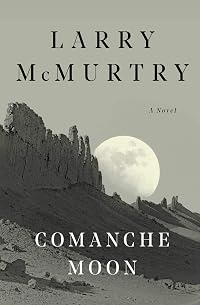
The cover of Comanche Moon announces that it is the “final volume of the Lonesome Dove saga,” a series of four novels of the Old West by Larry McMurtry. It may have been the last one composed, but it is a prequel to its more famous ostensible sequel, Lonesome Dove.
Comanche Moon is a pretty good tale in its own right. In it, we meet most of the characters who achieved fame in the television miniseries of the earlier written Lonesome Dove. It is a long (752 pages) narrative that rarely drags. The principal characters, many of whom are Native Americans, are always interesting. McMurtry’s inhabitants (both red and white) of southwest Texas in the mid 19th century were extremely tough and often brutal. Nevertheless, some of them show more achieve a high level of dignity in McMurtry’s telling, even if they (the Comanches) are inclined to torture their captives or (the Texas rangers) hang their suspected criminal prisoners without trial.
When we enter the minds of the Indians (that’s what they were called in those days), we encounter spirits, witches, and omens. I don’t know whether the Indians back then actually thought that way, but the trope is useful as a way of emphasizing a very real difference in perception between them and their Texan enemies.
The meta-message behind the literal narrative is the end of the Comanche’s way of life as white settlers move in and drive away the great buffalo herds that were their primary source of food and clothing. Their great war chief, Buffalo Hump, leads one last great raid from the plains all the way to the Gulf of Mexico, but in the end even he realizes that not only he, but his entire culture, is dying.
A fine tale, well-told.
(JAB) show less
Comanche Moon is a pretty good tale in its own right. In it, we meet most of the characters who achieved fame in the television miniseries of the earlier written Lonesome Dove. It is a long (752 pages) narrative that rarely drags. The principal characters, many of whom are Native Americans, are always interesting. McMurtry’s inhabitants (both red and white) of southwest Texas in the mid 19th century were extremely tough and often brutal. Nevertheless, some of them show more achieve a high level of dignity in McMurtry’s telling, even if they (the Comanches) are inclined to torture their captives or (the Texas rangers) hang their suspected criminal prisoners without trial.
When we enter the minds of the Indians (that’s what they were called in those days), we encounter spirits, witches, and omens. I don’t know whether the Indians back then actually thought that way, but the trope is useful as a way of emphasizing a very real difference in perception between them and their Texan enemies.
The meta-message behind the literal narrative is the end of the Comanche’s way of life as white settlers move in and drive away the great buffalo herds that were their primary source of food and clothing. Their great war chief, Buffalo Hump, leads one last great raid from the plains all the way to the Gulf of Mexico, but in the end even he realizes that not only he, but his entire culture, is dying.
A fine tale, well-told.
(JAB) show less
"Just go due south to the Rio Grande and turn left," a helpful rancher says to Texas Rangers Woodrow Call and Augustus McCrae in Larry McMurtry's Comanche Moon. "You'll eventually come to Lonesome Dove." (pg. 457). And you know what, he's right; finally, after two false starts, we have a worthy successor to McMurtry's peerless Western epic Lonesome Dove. Streets of Laredo and Dead Man's Walk were both decent stories, but somewhat, well, south of what we had expected. Comanche Moon is the left turn.
Because, for the first time since that first book, we have characters who feel like themselves, in a story that feels organic. Gus and Call finally speak in their own voices; no longer are they the callow youths of Dead Man's Walk or (in show more Call's case) the weary man of Streets of Laredo. They jaw at one another in a way they've not been allowed to since that great cattle drive of the first book, and they also have two great foils in Clara and Maggie. Both these ladies have relationships with the two Ranger captains that influence Lonesome Dove, and it's fascinating to delve into – particularly with Maggie, who we have not heard from before. Add to this the welcome return of Newt, Deets and Pea Eye, and, short of giving Gus an opportunity to kick a pig, there's little more McMurtry could have done to bring us back, however belatedly, to the joys of Lonesome Dove.
There are still some mis-steps – the Inish and Inez Scull plotline leads to nothing, and the Ahumado eye-torture left me feeling unnecessarily queasy – and Comanche Moon lacks that fortuitous lightning-in-a-bottle quality that Lonesome Dove had, but this is, by any reasonable metric, an excellent book. The Indian characters are particularly well done, as the novel's territory moves into the late 1860s and 1870s and the end of the buffalo herds on the plains – which in turns means the end of the fighting tribes. McMurtry wrings out the pathos of this without resorting to sentimentality about the noble savage: this is still a brutal land. I liked the bit-part braves like Three Birds and Idahi, and previously deployed characters like Buffalo Hump, Kicking Wolf and Famous Shoes were more fully realised here. Thinking how this book managed to catch fire where the previous two did not, it just proves that it's not just about having good characters, but how you place them. I for one am pleased McMurtry was able to get one more great story out of this, before his West was tamed forever. show less
Because, for the first time since that first book, we have characters who feel like themselves, in a story that feels organic. Gus and Call finally speak in their own voices; no longer are they the callow youths of Dead Man's Walk or (in show more Call's case) the weary man of Streets of Laredo. They jaw at one another in a way they've not been allowed to since that great cattle drive of the first book, and they also have two great foils in Clara and Maggie. Both these ladies have relationships with the two Ranger captains that influence Lonesome Dove, and it's fascinating to delve into – particularly with Maggie, who we have not heard from before. Add to this the welcome return of Newt, Deets and Pea Eye, and, short of giving Gus an opportunity to kick a pig, there's little more McMurtry could have done to bring us back, however belatedly, to the joys of Lonesome Dove.
There are still some mis-steps – the Inish and Inez Scull plotline leads to nothing, and the Ahumado eye-torture left me feeling unnecessarily queasy – and Comanche Moon lacks that fortuitous lightning-in-a-bottle quality that Lonesome Dove had, but this is, by any reasonable metric, an excellent book. The Indian characters are particularly well done, as the novel's territory moves into the late 1860s and 1870s and the end of the buffalo herds on the plains – which in turns means the end of the fighting tribes. McMurtry wrings out the pathos of this without resorting to sentimentality about the noble savage: this is still a brutal land. I liked the bit-part braves like Three Birds and Idahi, and previously deployed characters like Buffalo Hump, Kicking Wolf and Famous Shoes were more fully realised here. Thinking how this book managed to catch fire where the previous two did not, it just proves that it's not just about having good characters, but how you place them. I for one am pleased McMurtry was able to get one more great story out of this, before his West was tamed forever. show less
This is the fourth and final book set in the world of Lonesome Dove, but is actually the second prequel, predating the events in the original novel. The series in publication order is: Lonesome Dove (1985, USA), Streets of Laredo (1993, USA), Dead Man’s Walk (1994, USA), Comanche Moon (1997, USA). But the stories chronologically are: Dead Man’s Walk, Comanche Moon, Lonesome Dove and Streets of Laredo. It’s worth noting that Lonesome Dove was adapted as a successful television miniseries in 1989, and a sequel TV series was broadcast in 1993… which may or may not have prompted McMurtry to write an actual sequel himself, and its subsequent success may have then led to the prequels…
Certainly, Lonesome Dove was a fun novel, show more surprisingly funny, and while brutal in parts, mostly optimistic. Streets of Laredo closed off some of the characters’ stories, and added a little more brutality. The first prequel, Dead Man’s Walk, was unremittingly grim, with little of the humour or optimism of Lonesome Dove. And so it is with Comanche Moon, a direct sequel to Dead Man’s Walk.
So we have three books, of which Comanche Moon is the last written, likely only produced to capitalise on the success of the first, and while they feature the same cast they have lost the humour and enjoyment of the original.
Woodrow Call and Gus McCrae are still members of the Texas Rangers. Buffalo Hump (whose actual Comanche name apparently translated as “erection that won’t go down”) is still a thorn in their side. As is superlative Comanche horse thief, Kicking Wolf. McCrae and Call are members of Colonel Scull’s troop. When Scull’s Shire horse is stolen by Kicking Wolf, Scull sets off on his own in pursuit. Which leads to him being captured by psychopath Mayan bandit Ahumado.
McCrae and Call become captains in the Texas Rangers. They rescue Scull. Buffalo Hump is killed by his son, Blue Duck, another psychopath, who appeared in Lonesome Dove and Streets of Laredo. A lot of the narrative dwells on the tortures and violence inflicted by Blue Duck and Ahumado. The Comanche slowly disappear as the whites drive them from their lands. The American Civil War takes place but it doesn’t impact Call or McCrae much.
I really didn’t care for Comanche Moon - this is a series with diminishing returns - even though it finishes before Lonesome Dove begins. The first book I’d happily recommend, but I’d also recommend stopping there. The treatment of the Comanche and Apache and Mexicans in all four books is pretty racist. Everyone except the whites, and the one black character, are also complete psychopaths. Yet the myth of white colonisation of North America is built on the backs of sociopaths and psychopaths. It’s why US culture valorises such people. It’s why the US is like it is now. show less
Certainly, Lonesome Dove was a fun novel, show more surprisingly funny, and while brutal in parts, mostly optimistic. Streets of Laredo closed off some of the characters’ stories, and added a little more brutality. The first prequel, Dead Man’s Walk, was unremittingly grim, with little of the humour or optimism of Lonesome Dove. And so it is with Comanche Moon, a direct sequel to Dead Man’s Walk.
So we have three books, of which Comanche Moon is the last written, likely only produced to capitalise on the success of the first, and while they feature the same cast they have lost the humour and enjoyment of the original.
Woodrow Call and Gus McCrae are still members of the Texas Rangers. Buffalo Hump (whose actual Comanche name apparently translated as “erection that won’t go down”) is still a thorn in their side. As is superlative Comanche horse thief, Kicking Wolf. McCrae and Call are members of Colonel Scull’s troop. When Scull’s Shire horse is stolen by Kicking Wolf, Scull sets off on his own in pursuit. Which leads to him being captured by psychopath Mayan bandit Ahumado.
McCrae and Call become captains in the Texas Rangers. They rescue Scull. Buffalo Hump is killed by his son, Blue Duck, another psychopath, who appeared in Lonesome Dove and Streets of Laredo. A lot of the narrative dwells on the tortures and violence inflicted by Blue Duck and Ahumado. The Comanche slowly disappear as the whites drive them from their lands. The American Civil War takes place but it doesn’t impact Call or McCrae much.
I really didn’t care for Comanche Moon - this is a series with diminishing returns - even though it finishes before Lonesome Dove begins. The first book I’d happily recommend, but I’d also recommend stopping there. The treatment of the Comanche and Apache and Mexicans in all four books is pretty racist. Everyone except the whites, and the one black character, are also complete psychopaths. Yet the myth of white colonisation of North America is built on the backs of sociopaths and psychopaths. It’s why US culture valorises such people. It’s why the US is like it is now. show less
When we join the Texas Rangers in Austin, this time they do not have a particular mission. Their main objective appears to be keeping the Comanche tribe from interrupting the travel of whites headed west across their land. They spend more time burying the dead than they do protecting them when alive. Augustus McCrae and Woodrow Call are growing up and developing deeper relationships with women. Like Dead Man's Walk, Comanche Moon is full of torture and death, but it is the characters that make it the epic tale that it is.
This might be a spoiler alert, but I found myself liking McMurtry for not having the happy endings we all think we need. Maggie and Clara find different men to love. Blue Duck exacts his revenge on his father. Good men show more die. Despicable men somehow thrive. show less
This might be a spoiler alert, but I found myself liking McMurtry for not having the happy endings we all think we need. Maggie and Clara find different men to love. Blue Duck exacts his revenge on his father. Good men show more die. Despicable men somehow thrive. show less
I remember reading Lonesome Dove back in the day and liking it, so when I saw this paperback at a library sale, I picked it up. I'm about a third of the way through, and...I just don't know. The omniscient narrative style keeps us from getting too close to any one character. It jumps around a lot. It's not bad, per se, but it feels very rambling, with a slow pace. And I can tell, with the amount of times he is referred to, we're going to encounter the Black Vaquero, an outlaw who is known for torture. And I don't know if I'm down for that, especially because some reviews on this site have cited the awfulness of the torture scenes.
I'm finding the scenes with Inez Scull and her sexual voraciousness to be a cross between distasteful and show more ridiculous. It's feels weird that sexual assault is portrayed as somehow comic, even if it is a female perpetrator; it makes this novel seem dated. It was written in 1997, so almost 30 years ago, but still. I just don't think a woman of this era would act this way, not so publicly at least. The mores of the time would have prohibited it, especially for a society woman. I also have a hard time believing that an experienced frontiersman (Captain Scull) would just set off across the prairie on foot, without provisions, in the middle of winter, when he doesn't have to.
I haven't decided if I'm going to read any more.
Ok, I've decided. DNF show less
I'm finding the scenes with Inez Scull and her sexual voraciousness to be a cross between distasteful and show more ridiculous. It's feels weird that sexual assault is portrayed as somehow comic, even if it is a female perpetrator; it makes this novel seem dated. It was written in 1997, so almost 30 years ago, but still. I just don't think a woman of this era would act this way, not so publicly at least. The mores of the time would have prohibited it, especially for a society woman. I also have a hard time believing that an experienced frontiersman (Captain Scull) would just set off across the prairie on foot, without provisions, in the middle of winter, when he doesn't have to.
I haven't decided if I'm going to read any more.
Ok, I've decided. DNF show less
It’s been a long journey, and I’ve finally completed the Lonesome Dove series by Larry McMurtry. I chose to read the books in the order they were published, so the series finale is Comanche Moon. It’s been an absolute pleasure to ride alongside Call and McCrae as they embarked on a decades-long journey across the rugged western United States.
I first read Lonesome Dove in 2018 at the enthusiastic recommendation of a friend who’s a huge fan of the entire series. I was informed that there are two ways to read the series: in the order of publication or chronologically by the storyline. I decided to start with Lonesome Dove, considering its popularity, and if I didn’t enjoy it enough to continue, I would have been content with just show more reading this book. To my delight, I found it incredibly enjoyable.
It took me a while to return to the series, as I didn’t read Streets of Laredo until 2025. I decided to read the series in the order of publication, as it seemed logical to me. I assumed there was a reason behind the books being written in this order. I thoroughly enjoyed Streets of Laredo, and I was intrigued by the adventures that awaited Call. I devoured every moment of Lorena and Pea Eye’s relationship and dedication to each other and their children. I especially adored meeting Famous Shoes.
A few people recommended that I watch the television miniseries of Lonesome Dove. I started reading Dead Man’s Walk in early 2026 and decided it was the perfect time to watch the miniseries. I was captivated by Robert Duvall’s portrayal of Gus McCrae. Seeing the story of Lonesome Dove come to life was immensely enjoyable. I was then surprised to learn that there’s a television miniseries for every book in the series! I decided to watch them in the order I read the books, so I recently enjoyed Streets of Laredo. Up next is Dead Man’s Walk.
Watching the Lonesome Dove miniseries reignited my interest in completing the book series with Comanche Moon, while the events of the series were still fresh in my mind. Comanche Moon is the second chronological book (and fourth published) in the series. Set in the 1850s and 1860s on the Texas frontier, it follows Texas Rangers Augustus McCrae and Woodrow Call—now in their middle years—as they navigate personal hardships, Ranger duties, and the brutal conflicts between encroaching settlers and the defiant Comanche people.
The story begins with an eccentric captain’s pursuit of the legendary Comanche horse thief Kicking Wolf, leading to wild chases across the Llano Estacado and into Mexico. This journey involves formidable figures such as war chief Buffalo Hump and the torturous bandit Ahumado. With the help of the skilled Kickapoo tracker Famous Shoes, Gus and Call confront the waning era of the free-roaming Comanche while grappling with love, loss, and the harsh realities of the changing West.
I thoroughly enjoyed this final book. I genuinely cherished my time with Gus and Call and will undoubtedly miss their adventures, humorous banter, and the unique camaraderie among the men who acted like family. I am incredibly grateful for the opportunity to immerse myself in these captivating stories.
However, I found the conclusion of Comanche Moon somewhat disappointing. I had hoped that the story would have taken Gus and Call further, creating a stronger connection to Lonesome Dove. This would have provided a sense of closure and a feeling that the story had reached its full circle. It’s not the first time I’ve felt this way while reading the last three books, as I’ve often noticed that McMurtry leaves several loose ends, particularly when the outcomes of certain characters are not clearly defined. Hours after finishing a book and processing its content, I’m frequently reminded of specific characters and wonder about their fates. These moments can be unsettling.
I understand that this series was never meant to be a series. Lonesome Dove began as a standalone novel, and due to its immense popularity, McMurtry decided to write Streets of Laredo as a sequel to explore the lives of survivors like Captain Call in a harsher, more disillusioned later era. Later, McMurtry wrote Dead Man’s Walk and Comanche Moon as prequels to expand their backstories after fan interest and commercial success made the characters iconic. Knowing this makes sense as to why I don’t believe the individual books connect to each other as a series as well as they could.
Well, I suppose it’s time for me to bid farewell to the Lonesome Dove series—at least in the book format. I’m eager to savor my time with Gus and Call a little longer through the remaining television miniseries episodes I have left to watch.
I purchased Comanche Moon from Audible. Frank Muller provided a good voice to the story.
I have photos and additional information that I'm unable to include here. It can all be found on my blog, in the link below.
A Book And A Dog show less
I first read Lonesome Dove in 2018 at the enthusiastic recommendation of a friend who’s a huge fan of the entire series. I was informed that there are two ways to read the series: in the order of publication or chronologically by the storyline. I decided to start with Lonesome Dove, considering its popularity, and if I didn’t enjoy it enough to continue, I would have been content with just show more reading this book. To my delight, I found it incredibly enjoyable.
It took me a while to return to the series, as I didn’t read Streets of Laredo until 2025. I decided to read the series in the order of publication, as it seemed logical to me. I assumed there was a reason behind the books being written in this order. I thoroughly enjoyed Streets of Laredo, and I was intrigued by the adventures that awaited Call. I devoured every moment of Lorena and Pea Eye’s relationship and dedication to each other and their children. I especially adored meeting Famous Shoes.
A few people recommended that I watch the television miniseries of Lonesome Dove. I started reading Dead Man’s Walk in early 2026 and decided it was the perfect time to watch the miniseries. I was captivated by Robert Duvall’s portrayal of Gus McCrae. Seeing the story of Lonesome Dove come to life was immensely enjoyable. I was then surprised to learn that there’s a television miniseries for every book in the series! I decided to watch them in the order I read the books, so I recently enjoyed Streets of Laredo. Up next is Dead Man’s Walk.
Watching the Lonesome Dove miniseries reignited my interest in completing the book series with Comanche Moon, while the events of the series were still fresh in my mind. Comanche Moon is the second chronological book (and fourth published) in the series. Set in the 1850s and 1860s on the Texas frontier, it follows Texas Rangers Augustus McCrae and Woodrow Call—now in their middle years—as they navigate personal hardships, Ranger duties, and the brutal conflicts between encroaching settlers and the defiant Comanche people.
The story begins with an eccentric captain’s pursuit of the legendary Comanche horse thief Kicking Wolf, leading to wild chases across the Llano Estacado and into Mexico. This journey involves formidable figures such as war chief Buffalo Hump and the torturous bandit Ahumado. With the help of the skilled Kickapoo tracker Famous Shoes, Gus and Call confront the waning era of the free-roaming Comanche while grappling with love, loss, and the harsh realities of the changing West.
I thoroughly enjoyed this final book. I genuinely cherished my time with Gus and Call and will undoubtedly miss their adventures, humorous banter, and the unique camaraderie among the men who acted like family. I am incredibly grateful for the opportunity to immerse myself in these captivating stories.
However, I found the conclusion of Comanche Moon somewhat disappointing. I had hoped that the story would have taken Gus and Call further, creating a stronger connection to Lonesome Dove. This would have provided a sense of closure and a feeling that the story had reached its full circle. It’s not the first time I’ve felt this way while reading the last three books, as I’ve often noticed that McMurtry leaves several loose ends, particularly when the outcomes of certain characters are not clearly defined. Hours after finishing a book and processing its content, I’m frequently reminded of specific characters and wonder about their fates. These moments can be unsettling.
I understand that this series was never meant to be a series. Lonesome Dove began as a standalone novel, and due to its immense popularity, McMurtry decided to write Streets of Laredo as a sequel to explore the lives of survivors like Captain Call in a harsher, more disillusioned later era. Later, McMurtry wrote Dead Man’s Walk and Comanche Moon as prequels to expand their backstories after fan interest and commercial success made the characters iconic. Knowing this makes sense as to why I don’t believe the individual books connect to each other as a series as well as they could.
Well, I suppose it’s time for me to bid farewell to the Lonesome Dove series—at least in the book format. I’m eager to savor my time with Gus and Call a little longer through the remaining television miniseries episodes I have left to watch.
I purchased Comanche Moon from Audible. Frank Muller provided a good voice to the story.
I have photos and additional information that I'm unable to include here. It can all be found on my blog, in the link below.
A Book And A Dog show less
I loved the Lonesome Dove TV series and finally listened to the audiobook recently. Then I discovered that Lonesome Dove was part of a four-book series, and I delved right into Dead Man’s Walk, Book 1 in terms of story timeline, and watched the movie on YouTube. Now, I just finished Book 2, Comanche Moon. The movie can be purchased but is not available on YouTube, except for trailers and short clips.
Comanche Moon was quite a page-turner with lots of action and excellent characters. I liked getting to know Maggie and ached for her love of Call who could give nothing back. Clara’s character was fleshed out, though by the time she married Bob Allen, she must have been in her mid-to-late 20s, an old maid by the standards of the day.
Blue show more Duck had an interesting background, with his mother being a Mexican captive who died when he was born, and his father, Buffalo Hump, the chief, who was never really a father to him. Blue Duck became a mouthy, rebellious youth, which explains why he became not a brave Comanche warrior but an all-around bad guy.
My main complaints were:
1 – Perhaps there were more torture scenes than were needed. There were methods of torture that I never imagined and wish I could unknow. I never skipped a scene. But at least one ongoing torture act was unskippable because there was so much dialog included that the whole scene would have to be skipped.
2 – The outlandish sexual escapades of Scull’s rich wife seemed over the top. The purpose was probably for comic relief. Nowadays, it would be called sexual assault. It was only funny (at times) because it was a woman doing the assaults, not a man. That’s a method of comedy—turning the tables—but it’s still assault. Though the men were obviously scared and embarrassed, they could not say no because they were manly cowboys (even those who were quite young) and, therefore, supposedly, always wanted sex, even bizarre sex. But she was a one-dimensional character who became cartoonish.
Otherwise, it is an excellent story from a master storyteller and is highly recommended! 4.5 stars rounded to 5.
Now on to Book 4, Streets of Laredo. show less
Comanche Moon was quite a page-turner with lots of action and excellent characters. I liked getting to know Maggie and ached for her love of Call who could give nothing back. Clara’s character was fleshed out, though by the time she married Bob Allen, she must have been in her mid-to-late 20s, an old maid by the standards of the day.
Blue show more Duck had an interesting background, with his mother being a Mexican captive who died when he was born, and his father, Buffalo Hump, the chief, who was never really a father to him. Blue Duck became a mouthy, rebellious youth, which explains why he became not a brave Comanche warrior but an all-around bad guy.
My main complaints were:
1 – Perhaps there were more torture scenes than were needed. There were methods of torture that I never imagined and wish I could unknow. I never skipped a scene. But at least one ongoing torture act was unskippable because there was so much dialog included that the whole scene would have to be skipped.
2 – The outlandish sexual escapades of Scull’s rich wife seemed over the top. The purpose was probably for comic relief. Nowadays, it would be called sexual assault. It was only funny (at times) because it was a woman doing the assaults, not a man. That’s a method of comedy—turning the tables—but it’s still assault. Though the men were obviously scared and embarrassed, they could not say no because they were manly cowboys (even those who were quite young) and, therefore, supposedly, always wanted sex, even bizarre sex. But she was a one-dimensional character who became cartoonish.
Otherwise, it is an excellent story from a master storyteller and is highly recommended! 4.5 stars rounded to 5.
Now on to Book 4, Streets of Laredo. show less
Members
- Recently Added By
Lists

Best Westerns
20 works; 6 members

Books Read in 2016
4,666 works; 197 members
Author Information

96+ Works 43,351 Members
Larry McMurtry, winner of the Pulitzer Prize for Fiction, among other awards, is the author of twenty-four novels, two collections of essays, two memoirs, more than thirty screenplays, & an anthology of modern Western fiction. He lives in Archer City, Texas. (Publisher Provided) Novelist Larry McMurtry was born June 3, 1936 in Wichita Falls, show more Texas. He received a B.A. from North Texas State University in 1958, an M.A. from Rice University in 1960, and attended Stanford University. He married Josephine Ballard in 1959, divorced in 1966, and had one son, folksinger James McMurtry. Until the age of 22, McMurtry worked on his father's cattle ranch. When he was 25, he published his first novel, "Horseman, Pass By" (1961), which was turned into the Academy Award-winning movie Hud in 1962. "The Last Picture Show" (1966) was made into a screenplay with Peter Bogdanovich, and the 1971 movie was nominated for eight Oscars, including one for best screenplay adaptation. "Terms of Endearment" (1975) received little attention until the movie version won five Oscars, including Best Picture, in 1983. McMurtry's novel "Lonesome Dove" (1985) won the Pulitzer Prize in 1986 and the Spur Award and was followed by two popular TV miniseries. The other titles in the Lonesome Dove Series are "Streets of Laredo" (1993), "Dead Man's Walk" (1995), and "Comanche Moon" (1997). The other books in his Last Picture Show Trilogy are "Texasville" (1987) and "Duane's Depressed" (1999). McMurtry suffered a heart attack in 1991 and had quadruple-bypass surgery. Following that, he suffered from severe depression and it was during this time he wrote "Streets of Laredo," a dark sequel to "Lonesome Dove." His companion Diana Ossana, helping to pull him out of his depression, collaborated with him on "Pretty Boy Floyd" (1994) and "Zeke and Ned" (1997). He co-won the Best Screenplay Golden Globe and the Academy Award for Best Adapted Screenplay for Brokeback Mountain in 2006. He made The New York Times Best Seller List with his title's Custer and The Last Kind Words Saloon. McMurtry is considered one of the country's leading antiquarian book dealers. (Bowker Author Biography) show less
Awards and Honors
Awards
Distinctions
Series

Belongs to Publisher Series
Work Relationships
Is contained in
Contains
Has the adaptation
Common Knowledge
- Canonical title
- Comanche Moon
- Original title
- Comanche Moon
- Alternate titles*
- Lonesome dove. 4, L'affrontement : Lune comanche
- Original publication date
- 1997 (1e édition originale américaine) (1e édition originale américaine); 2017-06-01 (1e traduction et édition française, Nature writing, Gallmeister) (1e traduction et édition française, Nature writing, Gallmeister); 2019-09-05 (Réédition française, Totem, Gallmeister) (Réédition française, Totem, Gallmeister)
- People/Characters
- Augustus McCrae; Woodrow F. Call; Joshua Deets; Jake Spoon; Pea Eye Parker; Ahumado, the Black Vaquero (show all 14); Blue Duck; Kicking Wolf; Buffalo Hump; Captain Inish Scull; Inez Scull; Clara Forsythe; Maggie Tilton; Famous Shoes
- Important places
- Texas, USA
- Related movies
- Comanche Moon (2008 | IMDb)
- Epigraph*
- /
- Dedication
- For Susan Sontag: She's rangered long...She's rangered far...
- First words
- Captain Inish Scull liked to boast that he had never been thwarted in pursuit—as he liked to put it—of a felonious foe, whether Spanish, savage, or white.
- Last words
- (Click to show. Warning: May contain spoilers.)"It may be over but it wasn't fun," Call said, looking at the long dry distance that still waited to be crossed.
- Original language*
- Anglais (Etats-Unis) (Etats-Unis)
*Some information comes from Common Knowledge in other languages. Click "Edit" for more information.
Classifications
Statistics
- Members
- 2,186
- Popularity
- 9,275
- Reviews
- 32
- Rating
- (3.89)
- Languages
- 5 — English, French, Hungarian, Italian, Spanish
- Media
- Paper, Audiobook, Ebook
- ISBNs
- 44
- UPCs
- 1
- ASINs
- 17