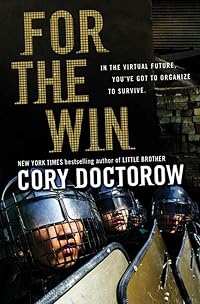
For the Win
by Cory Doctorow
On This Page
Description
A group of teens from around the world find themselves drawn into an online revolution arranged by a mysterious young woman known as Big Sister Nor, who hopes to challenge the status quo and change the world using her virtual connections.Tags
Recommendations


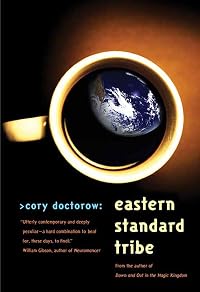

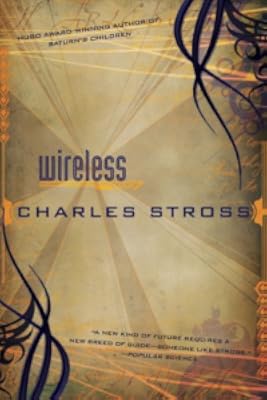
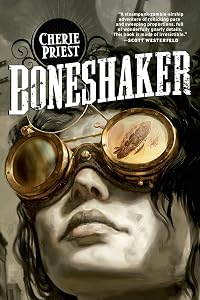
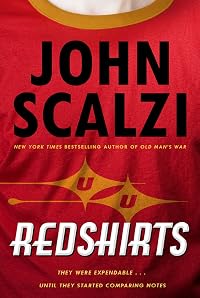





Member Recommendations

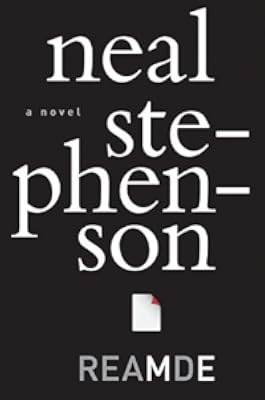
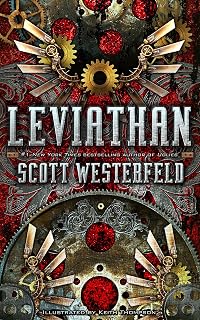
weener For the Win is kind of like a modern-day version of the Jungle: a heavy-handed, painful, yet readable book about labor rights.
Member Reviews
Kudos to Cory Doctorow for making a cast of gold farmers sympathetic. It should not be possible, and I loved them dearly, and it was incredible. Also lots of nostalgia for this ex-hardcore gamer.
This book is an excellent update of Upton Sinclair's The Jungle, imo, and if you're not faint of stomach, I recommend reading The Jungle first. Four stars instead of five because the ending makes about as little sense as The Jungle's. But it was well worth the ride, and I still recommend it.
This book is an excellent update of Upton Sinclair's The Jungle, imo, and if you're not faint of stomach, I recommend reading The Jungle first. Four stars instead of five because the ending makes about as little sense as The Jungle's. But it was well worth the ride, and I still recommend it.
I was so excited by this book, that before I'd even finished it, I was recommending it. It's fast-paced, terrifically imagined, and beautifully realized. Gamers in developing countries (and a few in North America) struggle physically and virtually for their rights to safe and sane work environments. Having said that makes this book sound really boring. But Doctorow creates believable, strong characters who fight with their wits and their bodies; he sets you directly in the streets and poor apartments of cities in China and India, and creates a world that is only a few years in the probable future of ours. Read this book!
Ambitious and entertaining, this sprawling story is set in a near future where massive, networked, multi-player games have become nation-sized economies. Doctorow speculates on what that future may look like, and hones in on the people who try to make a living there - as opposed to simply playing for entertainment - and what might happen if they tried to organise into unions. The story - like the games - is globe-spanning (and the locales felt very convincing), with a vast array of characters.
This book could have been amazing if it had been firing on all cylindars, but unfortunately most of them seemed to misfire. The ecnomics stuff was interesting, but wasn't explained quite well enough; the story was a bit too convoluted and started show more to feel repetitive; the characters weren't quite well-defined enough; the book a bit too long; and the ending didn't deliver like I'd hoped it would.
So enjoyable, original and ambitious - and that's not bad. show less
This book could have been amazing if it had been firing on all cylindars, but unfortunately most of them seemed to misfire. The ecnomics stuff was interesting, but wasn't explained quite well enough; the story was a bit too convoluted and started show more to feel repetitive; the characters weren't quite well-defined enough; the book a bit too long; and the ending didn't deliver like I'd hoped it would.
So enjoyable, original and ambitious - and that's not bad. show less
Not every day you pick up a young-adult novel that's essentially a thriller intended to dramatize the continued value of labor unions.
I kind of love the idea that parents may get this for their kids thinking it's an action-oriented book about video gamers, when in fact the gamers are gold-farmers being paid a pittance to bulk up the characters of westerners, and the gold farmers unite to get proper workplace rights.
I remain unclear on what makes a book a young adult novel -- clearly lengthy sections on economics, the threat of rape against under-age characters, and the rat-race malaise of a corporate economist don't get the book kicked upstairs to the adult section.
Doctorow's numerous detailed asides about how money works are show more informative, but they never make that edge into abstraction, like David Foster Wallace did at his best, or loop back into the narrative in a surprising way, which Neal Stephenson does reflexively -- which means they're a little didactic.
The book isn't as taut as Little Brother (Doctorow's previous young-adult book) or as emotional as Makers (his previous novel), but the extensive details of the business culture of gaming are informative, and the story moves smoothly from China to India to Los Angeles and round and round again, until the various plots come together. It's a little unfortunate that a solidly left-wing book needs a wealthy protagonist to get the political action to succeed -- though a lot of fun when the protagonist needs to call his mom for help.
Longtime readers of Doctorow will note familiar threads, including the magical world of Disney. show less
I kind of love the idea that parents may get this for their kids thinking it's an action-oriented book about video gamers, when in fact the gamers are gold-farmers being paid a pittance to bulk up the characters of westerners, and the gold farmers unite to get proper workplace rights.
I remain unclear on what makes a book a young adult novel -- clearly lengthy sections on economics, the threat of rape against under-age characters, and the rat-race malaise of a corporate economist don't get the book kicked upstairs to the adult section.
Doctorow's numerous detailed asides about how money works are show more informative, but they never make that edge into abstraction, like David Foster Wallace did at his best, or loop back into the narrative in a surprising way, which Neal Stephenson does reflexively -- which means they're a little didactic.
The book isn't as taut as Little Brother (Doctorow's previous young-adult book) or as emotional as Makers (his previous novel), but the extensive details of the business culture of gaming are informative, and the story moves smoothly from China to India to Los Angeles and round and round again, until the various plots come together. It's a little unfortunate that a solidly left-wing book needs a wealthy protagonist to get the political action to succeed -- though a lot of fun when the protagonist needs to call his mom for help.
Longtime readers of Doctorow will note familiar threads, including the magical world of Disney. show less
Cory Doctorow sets a high bar for 'best of 2014' with the brilliant' For the Win'. The iconic 'Wobbles' are reincarnated for a new century and a new industry as the downtrodden gold miners and labourers of the on-line gaming digital workplace form the 'International Workers of the World Wide Web' (the Webblies) to fight a decent living wage, battling the robber barons of cyberspace and their digital Pinkertons. A much needed parable for 21st Century as the 0.1% continue to rape and pillage more than their fare share of the world's resources. And it is available as a free download on the internet! http://craphound.com/ftw/download/
I got my grubby paws on an advance reading copy of this by virtue of, as Granny Gertrude put it, being a web whore. ;-) Thank you, Harper Voyager (@_TheVoyager_' on Twitter)!
For the Win is a young adult novel in true Doctorow style. Readers of Little Brother will be familiar with it: action-packed, gritty, polemical, sickening and empowering all at the same time.
For the Win is set in the not-too-distant future, all around the 'real' world and in virtual reality. It features a set of diverse teenage protagonists from all sorts of different backgrounds: from the Jewish-American Wei-Dong Goldberg (smitten with the idea of China), to the Mumbai slum children Mala and Yasmin, the Chinese gold farmers Matthew and Lu, to the Indonesian union show more leader Big Sister Nor and her gang.
In a world where some of the largest economies are MMORPGs (Massively Multiplayer Online Role-PLaying Games - think World of Warcraft or Second Life next generation) run by multinational corporations like Coca Cola and Nintendo, playing for money - extracting 'gold' and valuable items from the game to sell to lazy rich Western players - is big business. It's the kind of big business conducted in sweatshops in China, India, Singapore, HK, KL, Russia, Africa and South America, run by corrupt and criminal 'bosses' exploiting gaming kids. It's also the kind of business that the corporations running the games really don't like as it cuts into their bottom line - leaving the 'gold farmers' very much between the frying pan and the fire.
(And if you think this stuff is made up, have a look at this hilarious way of advertising your farmed gold in WoW and Second Life's US$64 million GDP in 2006. This is only the start of it.)
Into this toxic mix step two leaders: Big Sister Nor, the union organiser who has moved from real-world factories and unions into the online gaming space, and Jie/Jiandi, the Chinese underground reporter who re-establishes the links between the gold farmers and Chinese factory workers through her online radio show. As strikes break out in online space, they are joined by striking union workers in Chinese and Indian industry. We witness epic battles online and off, and as some are lost and some are won, at least a small part of the world is changed forever, with hope that others will follow soon.
The polemical passages in this book are more focused than those in Little Brother, which ranged from computer security to city planning. In For the Win, the focus is strictly economics. In some ways, this is very much a book of the credit crunch. Cory Doctorow does have one of the best explanations of credit default swaps (using game gold to add to the irony) that I have ever read. And again, where Little Brother was unashamedly left-wing in its politics, this book is refreshingly and unashamedly left-wing in its economics, unfashionable though left-wing economics has become since the end of the Cold War and especially since New Labour. It bites the bullet that I've been struggling with recently - namely that while sweatshops are horrible, for the people working in them they're the best option available - and offers a way out. We don't come out with a socialist utopia, but we come out, to quote an obscure 1980s rock band, a little better than before, and that's a start.
Something else I like about this book is its spectacularly socialist take on diversity: the only difference that matters is class. We have characters from different nations, different races, different religious backgrounds, different genders and abilities - and they all work together. And (admittedly from my white middle-class European perspective), Cory Doctorow does a damn good job of writing the Other. One of the most passionate passages in the book is Ashok addressing a group of traditional national trade unionists, explaining to them how the national borders they operate in work against them, how the only way to truly achieve something is to work across borders - a statement as true now as it was 160 years ago when Marx published the Communist Manifesto, and a goal a lot more achievable now than then.
And finally on the diversity note, does this book pass the Bechdel test? (Recap for non-feminists: Bechdel Test: 1. Does a movie/book/other work of fiction have more than one female character in it? 2. Do these female characters at any point in the plot meet and have a conversation? 3. Is that conversation about something other than a man?) For the Win blows the Bechdel test out of the water. We have pretty much a 50/50 gender split in main characters. The women in the book are at least as much part of the action as the men, and often more so. They are competent and passionate, they drive the plot forward, lead real world trade unions and gamespace armies, they talk to each other about politics and economics, justice, work, life. They are characters in their own right. It's sad that 10 years into the 21st century this should be a notable thing, but barely half the books I read last year came even close to passing Bechdel, and this book is completely in a league of its own. Thank you Cory Doctorow! show less
For the Win is a young adult novel in true Doctorow style. Readers of Little Brother will be familiar with it: action-packed, gritty, polemical, sickening and empowering all at the same time.
For the Win is set in the not-too-distant future, all around the 'real' world and in virtual reality. It features a set of diverse teenage protagonists from all sorts of different backgrounds: from the Jewish-American Wei-Dong Goldberg (smitten with the idea of China), to the Mumbai slum children Mala and Yasmin, the Chinese gold farmers Matthew and Lu, to the Indonesian union show more leader Big Sister Nor and her gang.
In a world where some of the largest economies are MMORPGs (Massively Multiplayer Online Role-PLaying Games - think World of Warcraft or Second Life next generation) run by multinational corporations like Coca Cola and Nintendo, playing for money - extracting 'gold' and valuable items from the game to sell to lazy rich Western players - is big business. It's the kind of big business conducted in sweatshops in China, India, Singapore, HK, KL, Russia, Africa and South America, run by corrupt and criminal 'bosses' exploiting gaming kids. It's also the kind of business that the corporations running the games really don't like as it cuts into their bottom line - leaving the 'gold farmers' very much between the frying pan and the fire.
(And if you think this stuff is made up, have a look at this hilarious way of advertising your farmed gold in WoW and Second Life's US$64 million GDP in 2006. This is only the start of it.)
Into this toxic mix step two leaders: Big Sister Nor, the union organiser who has moved from real-world factories and unions into the online gaming space, and Jie/Jiandi, the Chinese underground reporter who re-establishes the links between the gold farmers and Chinese factory workers through her online radio show. As strikes break out in online space, they are joined by striking union workers in Chinese and Indian industry. We witness epic battles online and off, and as some are lost and some are won, at least a small part of the world is changed forever, with hope that others will follow soon.
The polemical passages in this book are more focused than those in Little Brother, which ranged from computer security to city planning. In For the Win, the focus is strictly economics. In some ways, this is very much a book of the credit crunch. Cory Doctorow does have one of the best explanations of credit default swaps (using game gold to add to the irony) that I have ever read. And again, where Little Brother was unashamedly left-wing in its politics, this book is refreshingly and unashamedly left-wing in its economics, unfashionable though left-wing economics has become since the end of the Cold War and especially since New Labour. It bites the bullet that I've been struggling with recently - namely that while sweatshops are horrible, for the people working in them they're the best option available - and offers a way out. We don't come out with a socialist utopia, but we come out, to quote an obscure 1980s rock band, a little better than before, and that's a start.
Something else I like about this book is its spectacularly socialist take on diversity: the only difference that matters is class. We have characters from different nations, different races, different religious backgrounds, different genders and abilities - and they all work together. And (admittedly from my white middle-class European perspective), Cory Doctorow does a damn good job of writing the Other. One of the most passionate passages in the book is Ashok addressing a group of traditional national trade unionists, explaining to them how the national borders they operate in work against them, how the only way to truly achieve something is to work across borders - a statement as true now as it was 160 years ago when Marx published the Communist Manifesto, and a goal a lot more achievable now than then.
And finally on the diversity note, does this book pass the Bechdel test? (Recap for non-feminists: Bechdel Test: 1. Does a movie/book/other work of fiction have more than one female character in it? 2. Do these female characters at any point in the plot meet and have a conversation? 3. Is that conversation about something other than a man?) For the Win blows the Bechdel test out of the water. We have pretty much a 50/50 gender split in main characters. The women in the book are at least as much part of the action as the men, and often more so. They are competent and passionate, they drive the plot forward, lead real world trade unions and gamespace armies, they talk to each other about politics and economics, justice, work, life. They are characters in their own right. It's sad that 10 years into the 21st century this should be a notable thing, but barely half the books I read last year came even close to passing Bechdel, and this book is completely in a league of its own. Thank you Cory Doctorow! show less
If somebody alked up to me and said, "I have a book I know you're going to love. It's all about economics, labour unions, and the unfair working conditions in developping countries," I might suspect this person doesn't know my reading tastes very well. Such a book might appeal to those with specific interests, but me, well, that's not my thing.
And then this person would hand me For the Win, and I'd be intrigued because it involves gaming, something I'm familiar with. And then I'd read it, and be blown away.
That's Doctorow's genius in this book. He can take all of the above concepts and make them not only interesting, but make them into something that anyone can relate to, especially today's game-happy youth culture. He can take show more economics and break them down into the simply complex and absurd things that they are, and make it comprehensible. He makes the legnths that some companies go to to control virtual wealth seem like what it is: ridiculous and yet incredibly valuable. This book makes you look at the world, see it in a different light, and get outraged that it isn't better. It's hard-hitting, heartbreaking, and like the games it talks about, endlessly entertaining.
The characters are, above all else, wonderfully human. There are sides of right and wrong, and the lines are clearly drawn, but the people on the side of good are still flawed, violent and angry and they make mistakes, and sometimes those mistakes end up fatal. These are people you could pass on the street, could see at school; they don't have to be half a world away in some poorly-ventilated sweatshop, and that just seeks to underscore the message of labour equality that's the main focus of the novel. "There are no Chinese workers. There are just workers."
If you think this books comes across as being a bit preachy, you'd be right. But when your characters are fighting for the right to refuse 22-hour shifts without being beaten, fighting for the right to not be raped in order to hang onto their jobs, I think a little preachiness is allowed.
This book came to me highly recommended, and it leaves my hands in the same state. Go, pick up this book, read it and learn things that you may not have even thought about before. And I dare you to tell me that at the end of it, you didn't feel your moral centre being tugged at, even just a little. show less
And then this person would hand me For the Win, and I'd be intrigued because it involves gaming, something I'm familiar with. And then I'd read it, and be blown away.
That's Doctorow's genius in this book. He can take all of the above concepts and make them not only interesting, but make them into something that anyone can relate to, especially today's game-happy youth culture. He can take show more economics and break them down into the simply complex and absurd things that they are, and make it comprehensible. He makes the legnths that some companies go to to control virtual wealth seem like what it is: ridiculous and yet incredibly valuable. This book makes you look at the world, see it in a different light, and get outraged that it isn't better. It's hard-hitting, heartbreaking, and like the games it talks about, endlessly entertaining.
The characters are, above all else, wonderfully human. There are sides of right and wrong, and the lines are clearly drawn, but the people on the side of good are still flawed, violent and angry and they make mistakes, and sometimes those mistakes end up fatal. These are people you could pass on the street, could see at school; they don't have to be half a world away in some poorly-ventilated sweatshop, and that just seeks to underscore the message of labour equality that's the main focus of the novel. "There are no Chinese workers. There are just workers."
If you think this books comes across as being a bit preachy, you'd be right. But when your characters are fighting for the right to refuse 22-hour shifts without being beaten, fighting for the right to not be raped in order to hang onto their jobs, I think a little preachiness is allowed.
This book came to me highly recommended, and it leaves my hands in the same state. Go, pick up this book, read it and learn things that you may not have even thought about before. And I dare you to tell me that at the end of it, you didn't feel your moral centre being tugged at, even just a little. show less
Members
- Recently Added By
Published Reviews
ThingScore 100
Once again Doctorow has taken denigrated youth behavior (this time, gaming) and recast it into something heroic.
added by khuggard
Lists

Speculative Fiction to Read
706 works; 32 members

KayStJ's to-read list
1,616 works; 11 members

Simulated Reality in Fiction
124 works; 7 members
Author Information

121+ Works 25,952 Members
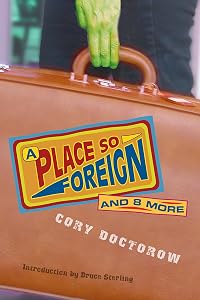
Writer and activist Cory Doctorow was born in Toronto, Canada on July 17, 1971. In 1999 he co-founded a free software company called Opencola and served as Canadian Regional Director of the Science Fiction and Fantasy Writers of America. For four years he worked as European Affairs Coordinator for the Electronic Frontier Foundation and in 2007 won show more its Pioneer Award. His first novel, Down and Out in the Magic Kingdom, won a Locus Award for Best First Novel. His short story collection A Place So Foreign and Eight More won a Sunburst Award, and his bestselling novel Little Brother received the 2009 Prometheus Award, a Sunburst Award, and the John W. Campbell Memorial Award. Doctorow also writes nonfiction books and articles, and he co-edits the blog Boing Boing. (Bowker Author Biography) show less
Awards and Honors
Awards
Work Relationships
Is contained in
Common Knowledge
- Canonical title
- For the Win
- Original publication date
- 2010-05-11
- People/Characters
- Mala (General Robotwallah); Big Sister Nor (Nor-Ayu); Matthew Fong; Wei-Dong Rosenbaum (Leonard); Yasmin Gardez; Zha Yue Lu (show all 33); Connor Prikkel; Ashok Balgangadhar Tilak; Jie (Jiandi); Justbob; Mighty Krang; Mr. Wing; Ping; Mrs. Dibyendu; Mr. Banerjee; Mr. Adams; Ms. Ramirez; Benny Rosenbaum; Gopal; Rachel Rosenbaum; Sushant; Mr. Phadkar; Mr. Honnenahalli; Mrs. Rukmini; Mrs. Muthappa; Fairfax; Kaden; Palmer; Ira; Ruiling; Huang; Jake Snider; William Vaughan
- Important places
- Mumbai, India; Shenzhen, China; Los Angeles, California, USA; Atlanta, Georgia, USA; Geylang, Singapore
- Dedication
- For Poesy:
Live as though it were the early days of a better nation. - First words
- In the game, Matthew's characters killed monsters, as they did every single night. But tonight, as Matthew thoughtfully chopsticked a dumpling out of a styrofoam clamshell, dipped it in the red hot sauce and popped it into hi... (show all)s mouth, his little squadron did something extraordinary: they began to win.
- Last words
- (Click to show. Warning: May contain spoilers.)They set off for the train station. Jie snorted. "I can't wait to broadcast this." Leonard grinned. He couldn't wait either.
- Blurbers
- Gaiman, Neil; Westerfeld, Scott; Gould, Steven; Vaughan, Brian K.
Classifications
- Genres
- Fiction and Literature, Science Fiction, Teen, Young Adult
- DDC/MDS
- 813.6 — Literature & rhetoric American literature in English American fiction in English 2000-
- LCC
- PZ7 .D66237 .F — Language and Literature Fiction and juvenile belles lettres Fiction and juvenile belles lettres Juvenile belles lettres
- BISAC
Statistics
- Members
- 1,328
- Popularity
- 18,105
- Reviews
- 81
- Rating
- (3.67)
- Languages
- English, German
- Media
- Paper, Audiobook, Ebook
- ISBNs
- 20
- ASINs
- 14