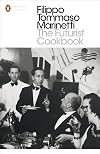
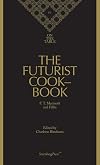
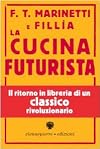
The Futurist Cookbook
by Filippo Tommaso Marinetti (Author), Fillia (Author)
On This Page
Description
Apart from the legendary and widely extolled exceptions, humans up to this point have fed themselves like ants, mice, cats and oxen. With us, the Futurists, the first human cuisine is born--that is to say, the art of feeding. Like all the arts, it excludes plagiarism and demands creative originality. It is no accident that this work is being published in the midst of a world financial crisis, the development and outcome of which apparently cannot be determined; what can be determined, show more however, is the dangerous and dispiriting panic it engenders. This panic we counter with a Futurist cuisine: in other words, optimism at the table.In 1932, F. T. Marinetti and his collaborator Fill a published The Futurist Cookbook, a manifesto-as-culinary-innovation. Replete with experimental recipes (the founder of Futurism, Marinetti, is known to have ranted about the social dangers of pasta eating), the book is a multilayered exploration of cultural metabolisms, with the dining table as its centerpiece, of course show lessTags
Recommendations
























Member Reviews
wtf I hate pasta now
Marinetti's futurist cookbook is fearless and radical. The challenges that Futurists faced with art/music/dance were mere hurdles compared to the struggle of changing a country's palate. While he would mock the the phrase "don't fix what isn't broken" his vacuous destruction of taste and focus on aesthetics of food was a ripple in Italy and the world's menus. Even if you never try and of the recipes in this you must appreciate his passion.. or jetfuel for dynamic, unsurmountable, boundary breaking ideas that could only be fenced in by the universal love for what actually tastes good.
Marinetti's futurist cookbook is fearless and radical. The challenges that Futurists faced with art/music/dance were mere hurdles compared to the struggle of changing a country's palate. While he would mock the the phrase "don't fix what isn't broken" his vacuous destruction of taste and focus on aesthetics of food was a ripple in Italy and the world's menus. Even if you never try and of the recipes in this you must appreciate his passion.. or jetfuel for dynamic, unsurmountable, boundary breaking ideas that could only be fenced in by the universal love for what actually tastes good.
225. First published in 1932, a collection of essays, exhortations, scenarios, and recipes for food of the future relates the artistic movement of Futurism to food and challenges typical nineteenth-century Italian fare. Filippo Tommaso Marinetti was an Italian poet and editor and the founder of the Futurist movement. He hated pasta. It represented "the Italian addiction to nostalgia and tradition."
A "serious joke", overturning "with ribald laughter everything 'food' and 'cookbooks' held sacred."
futurist forumulas for restaurants and quisibeve
(The vague quantities given in many of these formulas, far from constituting a matter of concern, should on the contrary stimulate the imagination of Futurist cooks, for fortuitous mistakes often lead to new dishes.)
This is no ordinary cookbook!
futurist forumulas for restaurants and quisibeve
(The vague quantities given in many of these formulas, far from constituting a matter of concern, should on the contrary stimulate the imagination of Futurist cooks, for fortuitous mistakes often lead to new dishes.)
This is no ordinary cookbook!
eu 2.000; Pont. 3.800
The woman who wrote the introduction--Leslie Chamberlain--has an interesting appreciation on her website: www.lesleychamberlain.co.uk/books.htm
Ratings
Members
- Recently Added By
Published Reviews
ThingScore 75
added by booksaplenty1949
Author Information

Born in Egypt and educated in Paris, Marinetti gained a reputation as a writer in French long before he launched the "futurist movement" with his manifesto of February 20, 1909, in Le Figaro. Proclaiming an ideal of "words in liberty," that manifesto elicited high praise from Wyndham Lewis, Guillaume Apollinaire, Ezra Pound, and D. H. Lawrence, as show more well as the Italians Aldo Palazzeschi, Giovanni Papini, and Ardengo Soffici. After his French works were translated into Italian, he was arrested and spent two months in an Italian jail for immorality. Despite the notoriety of his first manifesto, the subsequent Technical Manifesto of 1912 epitomizes the essence of futurism: the glorification of war, masculinity, violence, and the machine. As William De Sua correctly wrote: "Of all his works, the Technical Manifesto alone should secure his place among such figures as Pablo Picasso, Ezra Pound, Igor Stravinsky, and Guillaume Apollinaire as one of the greatest movers and shapers of modern art." (Bowker Author Biography) show less
Some Editions
Series
Belongs to Publisher Series
Common Knowledge
- Canonical title
- The Futurist Cookbook
- Original title
- La cucina futurista
- Original publication date
- 1932
- Original language
- French
Classifications
Statistics
- Members
- 214
- Popularity
- 153,268
- Reviews
- 6
- Rating
- (3.57)
- Languages
- 7 — English, French, German, Italian, Norwegian (Bokmål), Portuguese, Spanish
- Media
- Paper, Ebook
- ISBNs
- 18
- ASINs
- 3