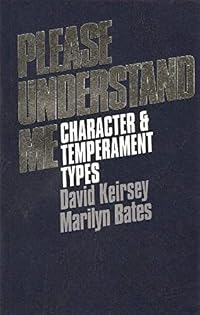
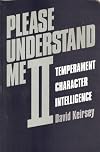
Please Understand Me: Character & Temperament Types
by David Keirsey, Marilyn Bates (Author)
On This Page
Description
After presenting a brief rundown of 20th-century psychology movements, Keirsey and Bates encourage you to take the 70-question "Keirsey Temperament Sorter," a sort of mini-Myers-Briggs test that places you in 1 of 16 personality types. Like the Myers-Briggs system, this test sorts your personality into groups of extraversion/introversion (E/I), sensation/intuition (S/N), thinking/feeling (T/F), and perceiving/judging (P/J). Unlike the Myers-Briggs system, Please Understand Me also presents show more four easy-to-remember temperament types--Dionysian (freedom first), Epimethean (wants to be useful), Promethean (desires power), and Apollonian (searches for self)--that underlie the 16 possible personalities identified by the test. The book then delves into a detailed analysis of each type, with sections on mates, children, and leaders. An appendix paints portraits of the 16 possible personality types. show lessTags
Recommendations
















Member Recommendations
Member Reviews
Let's be clear - I am not rating this a 5 because it's a great book. It's not. As others have pointed out, there is a lot of bias (and some sexism) here. I am rating it a 5 because it's a great tool I have been able to return to again and again for insight into my own behavior and relationships. By far the best temperament sorter I've ever found (in terms of the results actually being accurate - I will never forget the shock of reading my description and having my internal thought process described on the page). The new version may be better; I don't know as I haven't read it. But definitely a great tool.
This is what started all the MBTI interest for me, although I know that Keirsey's temperaments are not exactly the same as MBTI. It was such a relief to realize that no, there wasn't anything wrong with me because my life's goal wasn't "self-actualization" but to know everything in the world.
I was a bit dubious when introduced to this by my sister-in-law eleven years ago but I did the test anyway. Imagine my surprise when I read the description of my temperament type (INFJ) and realized just how accurate it was; as if the authors had interviewed me personally. Imagine my sister-in-law's surprise at finding another INFJ for the first time ever! I keep coming back to MBTI because I find it helpful in understanding others and myself, particularly in terms of relationships. Its also a relief to know why I've always felt 'different' from most people around me; its because I AM different. I feel much more comfortable being me whenever I read this book because it reminds me that its okay to be different.:-)
An eye opener!
I took the MBTI some time ago and wanted to know more. I ended up with Keirsey and this is what started my interest in personality types.
This is highly recommended for starters. There are more elaborate books and theories on the subject, but most of them overlap and I am still sceptical about cognitive functions theory as a whole. So it´s always back to Keirsey for me. The book contains the test and compact descriptions of all 16 types and 4 temperaments as well as extensive chapters on how these relate to learning, work and love. The division into the 4 temperaments seems arbitrary at times (why these dichotomies instead of others?) but it is still an excellent introduction for all those interested in why their neighbor show more is so annoyingly different from them! show less
I took the MBTI some time ago and wanted to know more. I ended up with Keirsey and this is what started my interest in personality types.
This is highly recommended for starters. There are more elaborate books and theories on the subject, but most of them overlap and I am still sceptical about cognitive functions theory as a whole. So it´s always back to Keirsey for me. The book contains the test and compact descriptions of all 16 types and 4 temperaments as well as extensive chapters on how these relate to learning, work and love. The division into the 4 temperaments seems arbitrary at times (why these dichotomies instead of others?) but it is still an excellent introduction for all those interested in why their neighbor show more is so annoyingly different from them! show less
I friend had this book in class back in 1989; i mocked it calling it pop psychology. He defended the book; I took the test (INTJ); he read the blurb in back, and all my friends laughed out loud because it was so spot on. I have since read it multiple times, from multiple points of view: to know myself, as a spouse, as a father of two, and to understand the people around me. People are individuals and their type will get focused differently by that lens, but it is still very insightful.
I discovered this book in 1981 at local book store. At the time I realized that I didn't have very good insight into myself or the people around me. This book introduced me to the Myers-Briggs personality classification system. After reading this book, I had a better understanding of myself, both my strengths and my weaknesses. My appreciation of people who were different from me grew significantly and I was able to start thinking of them as different rather than "plodding" or "insensitive". I came to realize that there was great value in people who were more systematic than me, or who cared more about truth than people. This book has also been an assistance as I concerned career changes.
A group of our friends took this personality inventory. We are not gullible people; all of us with PhDs, half of those in the hard sciences. And in every case, the assessment was spot on. Often embarrassingly so.
Members
- Recently Added By
Published Reviews
Does your spouse's need to alphabetically organize books on the shelves puzzle you? Do your boss's tsunami-like moods leave you exasperated? Do your child's constant questions make you batty? If you've ever wanted to change your mate, your coworkers, or a family member, then "Put down your chisel," advise David Keirsey and Marilyn Bates in this book of personality types. We are different for a show more reason, and that reason is probably more good than bad. Keirsey and Bates believe that not only is it impossible to truly change others (which they call embarking on a "Pygmalion project"), it's much more important to understand and affirm differences. Sounds easier than it is, you might say. Well, this book is a guide for putting an end to the Pygmalion projects in your life and starting on the path to acceptance.
For anyone acquainted with the ubiquitous Myers-Briggs personality test, Please Understand Me will be familiar territory--but gone over with a fine-toothed comb. And for the uninitiated, this book will be a quick introduction to personality typing the Myers-Briggs way--with a Jungian accent. After presenting a brief rundown of 20th-century psychology movements, Keirsey and Bates encourage you to take the 70-question "Keirsey Temperament Sorter," a sort of mini-Myers-Briggs test that places you in 1 of 16 personality types. Like the Myers-Briggs system, this test sorts your personality into groups of extraversion/introversion (E/I), sensation/intuition (S/N), thinking/feeling (T/F), and perceiving/judging (P/J). Unlike the Myers-Briggs system, Please Understand Me also presents four easy-to-remember temperament types--Dionysian (freedom first), Epimethean (wants to be useful), Promethean (desires power), and Apollonian (searches for self)--that underlie the 16 possible personalities identified by the test. The book then delves into a detailed analysis of each type, with sections on mates, children, and leaders. An appendix paints portraits of the 16 possible personality types.
Unless you're already a true personality-typing devotee, this book may seem a little esoteric, especially the somewhat "in" references to psychological theory that few laypeople will be likely to understand. But give it a chance and you may find that you'll begin to understand why you always know where to find Anna Karenina on the shelf (you have an ESTJ husband), why your boss is sarcastic one day and praises your achievements the next (she's an NF), and why knowing the reason that the sun comes up in the same place every day is important to your little one (he's Promethean). You may even find that once you accept quirks and ticks in others, they will understand you a little better, too. show less
For anyone acquainted with the ubiquitous Myers-Briggs personality test, Please Understand Me will be familiar territory--but gone over with a fine-toothed comb. And for the uninitiated, this book will be a quick introduction to personality typing the Myers-Briggs way--with a Jungian accent. After presenting a brief rundown of 20th-century psychology movements, Keirsey and Bates encourage you to take the 70-question "Keirsey Temperament Sorter," a sort of mini-Myers-Briggs test that places you in 1 of 16 personality types. Like the Myers-Briggs system, this test sorts your personality into groups of extraversion/introversion (E/I), sensation/intuition (S/N), thinking/feeling (T/F), and perceiving/judging (P/J). Unlike the Myers-Briggs system, Please Understand Me also presents four easy-to-remember temperament types--Dionysian (freedom first), Epimethean (wants to be useful), Promethean (desires power), and Apollonian (searches for self)--that underlie the 16 possible personalities identified by the test. The book then delves into a detailed analysis of each type, with sections on mates, children, and leaders. An appendix paints portraits of the 16 possible personality types.
Unless you're already a true personality-typing devotee, this book may seem a little esoteric, especially the somewhat "in" references to psychological theory that few laypeople will be likely to understand. But give it a chance and you may find that you'll begin to understand why you always know where to find Anna Karenina on the shelf (you have an ESTJ husband), why your boss is sarcastic one day and praises your achievements the next (she's an NF), and why knowing the reason that the sun comes up in the same place every day is important to your little one (he's Promethean). You may even find that once you accept quirks and ticks in others, they will understand you a little better, too. show less
added by Bekalyn
Lists

Non-Fiction Worth Reading
1,015 works; 259 members

Psicología - Clásicos
165 works; 2 members

My List
302 works; 1 member
Author Information

11 Works 3,644 Members
Work Relationships
Has as a supplement
Common Knowledge
- Canonical title
- Please Understand Me: Character & Temperament Types
- Original title
- Please Understand Me: Character & Temperament Types
- Alternate titles
- Please Understand Me
- Original publication date
- 1978
- People/Characters
- Isabel Briggs Myers
- First words
- If I do not want what you want, please try not to tell me that my want is wrong.
- Last words
- (Click to show. Warning: May contain spoilers.)How about you?
- Blurbers
- Montgomery, Stephen
- Original language
- English
Classifications
Statistics
- Members
- 2,134
- Popularity
- 9,501
- Reviews
- 17
- Rating
- (3.91)
- Languages
- Czech, English, German, Spanish
- Media
- Paper, Audiobook
- ISBNs
- 7
- ASINs
- 14
