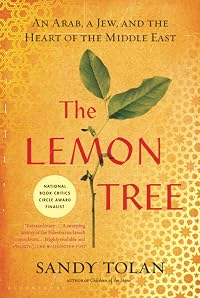
The Lemon Tree: An Arab, a Jew, and the Heart of the Middle East
by Sandy Tolan
On This Page
Description
History. Juvenile Nonfiction. Religion & Spirituality. HTML:The tale of friendship between two people, one Israeli and one Palestinian, that symbolizes the hope for peace in the Middle East."Makes an incredibly complicated topic comprehensible."—School Library Journal
In 1967, a twenty-five-year-old refugee named Bashir Khairi traveled from the Palestinian hill town of Ramallah to Ramla, Israel, with a goal: to see the beloved stone house with the lemon tree in its backyard that he and show more his family had been forced to leave nineteen years earlier. When he arrived, he was greeted by one of its new residents: Dalia Eshkenazi Landau, a nineteen-year-old Israeli college student whose family had fled Europe following the Holocaust. She had lived in that house since she was eleven months old.
On the stoop of this shared house, Dalia and Bashir began a surprising friendship, forged in the aftermath of war and later tested as political tensions ran high and Israelis and Palestinians each asserted their own right to live on this land. Adapted from the award-winning adult book and based on Sandy Tolan's extensive research and reporting, The Lemon Tree is a deeply personal story of two people seeking hope, transformation, and home. show less
Tags
Recommendations









Member Reviews
I feel embarrassed writing this, but I don't know a whole lot about the conflict between Palestinians and Israelis in the Middle East. I mean, I've heard of the major milestones that have shaped it during my own lifetime, but the background, I don't know a lot about it. And before reading "The Lemon Tree", I knew even less.
Which is why I think this is a fairly good introduction to the conflict's major dilemmas. Yes, it forgoes some of the historical sweep of the events that it describes to focus on the lives of two people, Dalia and Bashir, who have a house and a lemon tree in common. But their relationship also serves as a potent allegory for some of the conflict's most complex and intractable questions. They are, after all, two show more individuals who have an interest in a very specific peace of land, and, to varying extents, their lives were shaped by the conflict about who really owns it. In the book's introduction, Tolan relates how his book was, astonishingly enough, received warmly by people on both sides of the Israeli/Palestinian conflict, but this was clearly his intention. Whether he's describing what local politics was like in Ramla before the British left or talking about how Dalia's parents' memories of Bulgaria influenced her, the past weighs heavily on everyone here. Unfortunately, one of the other things they seem to have in common is a conviction that they belong in Palestine. Tolan should be credited for explaining how individuals from two communities might have reason to believe this, but it's a a mutual assertion that seemed to be running out of common ground for potential negotiation even when the book was published. The potential for deal-making has not, to say the least, has not improved since.
There are a couple of other interesting themes running through "The Lemon Tree." Tolan writes well about the Bulgarian experience in World War II and how a nominal fascist ally was able to save -- if sometimes at a terrible price -- a very significant percentage of its Jewish community from the Nazis. He also writes well about how the region's politics have become less flexible on both sides as time has gone by. A growing feeling on the Palestinian side that return was not inevitable has made violence insurrection seem more appealing, while Israel's politics have, in some ways, grown less democratic and amenable to any sort of compromise. In this context, it's heartbreaking to read about the slow decline of the Oslo Accords and how much attitudes and facts on the ground have shifted since various two-state solutions were proposed. While Bashir and Dalia's connection still seems like a courageous and valuable thing, "The Lemon Tree" is not necessarily an optimistic book, as both communities' claims are still deeply felt and victory by one side might require the obliteration of the others' entire self-concept. The house describes in this book still stands, and is being used both as a school for local Arab children and as a point of encounter for both communities. It's a small enough hope in a confoundingly difficult situation. show less
Which is why I think this is a fairly good introduction to the conflict's major dilemmas. Yes, it forgoes some of the historical sweep of the events that it describes to focus on the lives of two people, Dalia and Bashir, who have a house and a lemon tree in common. But their relationship also serves as a potent allegory for some of the conflict's most complex and intractable questions. They are, after all, two show more individuals who have an interest in a very specific peace of land, and, to varying extents, their lives were shaped by the conflict about who really owns it. In the book's introduction, Tolan relates how his book was, astonishingly enough, received warmly by people on both sides of the Israeli/Palestinian conflict, but this was clearly his intention. Whether he's describing what local politics was like in Ramla before the British left or talking about how Dalia's parents' memories of Bulgaria influenced her, the past weighs heavily on everyone here. Unfortunately, one of the other things they seem to have in common is a conviction that they belong in Palestine. Tolan should be credited for explaining how individuals from two communities might have reason to believe this, but it's a a mutual assertion that seemed to be running out of common ground for potential negotiation even when the book was published. The potential for deal-making has not, to say the least, has not improved since.
There are a couple of other interesting themes running through "The Lemon Tree." Tolan writes well about the Bulgarian experience in World War II and how a nominal fascist ally was able to save -- if sometimes at a terrible price -- a very significant percentage of its Jewish community from the Nazis. He also writes well about how the region's politics have become less flexible on both sides as time has gone by. A growing feeling on the Palestinian side that return was not inevitable has made violence insurrection seem more appealing, while Israel's politics have, in some ways, grown less democratic and amenable to any sort of compromise. In this context, it's heartbreaking to read about the slow decline of the Oslo Accords and how much attitudes and facts on the ground have shifted since various two-state solutions were proposed. While Bashir and Dalia's connection still seems like a courageous and valuable thing, "The Lemon Tree" is not necessarily an optimistic book, as both communities' claims are still deeply felt and victory by one side might require the obliteration of the others' entire self-concept. The house describes in this book still stands, and is being used both as a school for local Arab children and as a point of encounter for both communities. It's a small enough hope in a confoundingly difficult situation. show less
As much a biography of nations as two families, while still as focused on character and individuals as on history, this is a careful and fascinating work. Built from massive amounts of research and interviews, the work still manages to read like a story and quickly becomes impossible to put down even as it progresses with ever more nuance.
I'm glad to have finally gotten around to reading it, and feel like I've got a far better handle on the intricacies surrounding this part of the Middle East.
Recommended.
I'm glad to have finally gotten around to reading it, and feel like I've got a far better handle on the intricacies surrounding this part of the Middle East.
Recommended.
Well-written non-fiction that sheds light on the Palestinian-Israeli conflict in the Middle East. It highlights two families connected by one home in the current Israeli town of Ramla. The Khairis, a Palestinian family, built the house in 1936, and planted a lemon tree in the yard. They were exiled in the wake of the violence during the 1948 war. The eldest son, Bashir, vowed to return one day, to reclaim their home. The Eshkenazis, a family of Bulgarian Jews, arrived in newly established Israel, and moved into the home with the lemon tree. Their only child, Dalia, was only a year old at the time.
The book opens with the meeting of Dalia and Bashir after the Six-Day War. Bashir returns briefly to al-Ramla, seeking to see his old home. show more He meets Dalia, and she invites him in. Tolan has written a history of the Middle East based around the unlikely friendship between Bashir and Dalia. He interweaves their personal stories with documentation found in his research. He includes direct quotes from interviews, primary sources, and declassified materials. This alternation between micro and macro is effective in conveying the multiple Arab and Israeli perspectives, such that the reader can put himself or herself in their shoes.
The book spans the historical panorama, including such topics as the political conferences, the leaders of various movements, important locations, the involvements of Syria, Jordan, Lebanon, and Egypt, and differing governmental policies that changed over time. I read the version that includes an epilogue, which provides an update as of 2020. Tolan’s book helps facilitate understanding of the complex issues in the Middle East and will appeal to those who want to learn more about the history of the region and the outlook for an eventual peaceful resolution. show less
The book opens with the meeting of Dalia and Bashir after the Six-Day War. Bashir returns briefly to al-Ramla, seeking to see his old home. show more He meets Dalia, and she invites him in. Tolan has written a history of the Middle East based around the unlikely friendship between Bashir and Dalia. He interweaves their personal stories with documentation found in his research. He includes direct quotes from interviews, primary sources, and declassified materials. This alternation between micro and macro is effective in conveying the multiple Arab and Israeli perspectives, such that the reader can put himself or herself in their shoes.
The book spans the historical panorama, including such topics as the political conferences, the leaders of various movements, important locations, the involvements of Syria, Jordan, Lebanon, and Egypt, and differing governmental policies that changed over time. I read the version that includes an epilogue, which provides an update as of 2020. Tolan’s book helps facilitate understanding of the complex issues in the Middle East and will appeal to those who want to learn more about the history of the region and the outlook for an eventual peaceful resolution. show less
Well-written non-fiction that sheds light on the Palestinian-Israeli conflict in the Middle East. It highlights two families connected by one home in the current Israeli town of Ramla. The Khairis, a Palestinian family, built the house in 1936, and planted a lemon tree in the yard. They were exiled in the wake of the violence during the 1948 war. The eldest son, Bashir, vowed to return one day, to reclaim their home. The Eshkenazis, a family of Bulgarian Jews, arrived in newly established Israel, and moved into the home with the lemon tree. Their only child, Dalia, was only a year old at the time.
The book opens with the meeting of Dalia and Bashir after the Six-Day War. Bashir returns briefly to al-Ramla, seeking to see his old home. show more He meets Dalia, and she invites him in. Tolan has written a history of the Middle East based around the unlikely friendship between Bashir and Dalia. He interweaves their personal stories with documentation found in his research. He includes direct quotes from interviews, primary sources, and declassified materials. This alternation between micro and macro is effective in conveying the multiple Arab and Israeli perspectives, such that the reader can put himself or herself in their shoes.
The book spans the historical panorama, including such topics as the political conferences, the leaders of various movements, important locations, the involvements of Syria, Jordan, Lebanon, and Egypt, and differing governmental policies that changed over time. I read the version that includes an epilogue, which provides an update as of 2020. Tolan’s book helps facilitate understanding of the complex issues in the Middle East and will appeal to those who want to learn more about the history of the region and the outlook for an eventual peaceful resolution. show less
The book opens with the meeting of Dalia and Bashir after the Six-Day War. Bashir returns briefly to al-Ramla, seeking to see his old home. show more He meets Dalia, and she invites him in. Tolan has written a history of the Middle East based around the unlikely friendship between Bashir and Dalia. He interweaves their personal stories with documentation found in his research. He includes direct quotes from interviews, primary sources, and declassified materials. This alternation between micro and macro is effective in conveying the multiple Arab and Israeli perspectives, such that the reader can put himself or herself in their shoes.
The book spans the historical panorama, including such topics as the political conferences, the leaders of various movements, important locations, the involvements of Syria, Jordan, Lebanon, and Egypt, and differing governmental policies that changed over time. I read the version that includes an epilogue, which provides an update as of 2020. Tolan’s book helps facilitate understanding of the complex issues in the Middle East and will appeal to those who want to learn more about the history of the region and the outlook for an eventual peaceful resolution. show less
Ostensibly, this is the (true) biography of the friendship between the Israeli woman Dalia Eshkenazi and the Palestinian man Bashir Khairi. However, the book also focuses strongly on background information--providing a wonderful history of the Israel-Palestine conflict since the 1940's. I was hugely pleased by this book for two reasons. First, the friendship between Dalia and Bashir was touching because they both had such strong nationalistic feelings. Somehow, despite their very different views, they were able to remain on good terms for many years. That's touching to me because many books with this let's-make-peace message tend to be about people who are all about love and peace and aren't as strongly influenced by their negative show more emotions as Dalia and (especially) Bashir. This is a friendship that was difficult to maintain, and yet it prevailed. The second reason I loved this book is because of the wonderful history of the region it provided. It's supposedly a "balanced" view--and it is, in the sense that it recommends justice (and sacrifice) be made by both sides. However, I'd say the book tended to be sympathetic towards to Palestinians. This SLIGHT bias is necessary in this case because many people in the Western world are over-exposed to the Israeli side and don't realize the Palestinians have a side at all. This book is highly recommended to anyone interested in the conflict. show less
Beautiful work of art - deeply researched journalism but it reads like a novel. Tell the story of two people - one Israeli, one Palestinian - but also the story of both of their families, across generations, countries, decades. It's complex and nuanced, as are the views of each person featured, each of whom appears to be a predictable stereotype from a distance but the more we learn of each person, the harder it is to fit them into a box. I deeply enjoyed this book, and its "characters" - real people! - and their stories and questions they raise - will stay with me for a long time. I have deep gratitude for the writer, the people who shared their stories to make this book possible, and the good friends who recommended it to me.
It took all the willpower I had to begin reading this book. Being brought up Jewish, believing (as I still do) in the right of Israel to exist in peace, I had to face harsh realities of what happened in 1948 and 1967 as well as in the later conflicts that I knew more about because they transpired when I was an adult. Tolan's book looked at what happened on the ground during the wars, the displacements, deaths, terrorist attacks and insecurities that occurred during this time. I don't know anything about Sandy Tolan so I am hesitant to say whether this is an accurate picture of 1948 or 1967. It does not exactly mesh with what I was taught, although you could put that down to differences in nuance. On the other hand "history is written by show more the victors" as the old saying goes.
The story is about a Palestinian Arab who travels back to his childhood home, from which he was forced to flee in 1948. There he meets a young Israeli woman who graciously takes him through the house. They begin a decades-long relationship — difficult to call it a friendship but maybe that is what it is — in which they have many discussions to try and find a way they can live with each other and each have a place they call home in the land of Palestine. I got into this beautifully written story looking for something to give me a direction, a road towards peace in the Middle East.
I am sorry to say this book did not give me much hope that a solution to the conflict between Arab and Israeli Palestinians can be found. Bashar and Dalia talk for decades without resolution. Her view is compromise in which the Palestinians establish a state at the pre-1967 border. His is the departure of Jews that arrived before the Balfour Declaration in 1917 and the establishment of a secular state. I have my own opinions, which have changed over the years, on how to do that but I don't see anything constructive happening any time soon. The book is beautifully written and brings out the anguish and loss felt by both Arabs and Jews during times of persecution and displacement. I recommend it highly, with the reservation that I don't know how accurate the details are. I have found one website saying it is not, but others say differently. I am too emotional about the subject to know the truth. For that reason, I think I will leave it unstarred for now. show less
The story is about a Palestinian Arab who travels back to his childhood home, from which he was forced to flee in 1948. There he meets a young Israeli woman who graciously takes him through the house. They begin a decades-long relationship — difficult to call it a friendship but maybe that is what it is — in which they have many discussions to try and find a way they can live with each other and each have a place they call home in the land of Palestine. I got into this beautifully written story looking for something to give me a direction, a road towards peace in the Middle East.
I am sorry to say this book did not give me much hope that a solution to the conflict between Arab and Israeli Palestinians can be found. Bashar and Dalia talk for decades without resolution. Her view is compromise in which the Palestinians establish a state at the pre-1967 border. His is the departure of Jews that arrived before the Balfour Declaration in 1917 and the establishment of a secular state. I have my own opinions, which have changed over the years, on how to do that but I don't see anything constructive happening any time soon. The book is beautifully written and brings out the anguish and loss felt by both Arabs and Jews during times of persecution and displacement. I recommend it highly, with the reservation that I don't know how accurate the details are. I have found one website saying it is not, but others say differently. I am too emotional about the subject to know the truth. For that reason, I think I will leave it unstarred for now. show less
Members
- Recently Added By
Lists

Top Five Books of 2013
1,562 works; 721 members

The Emergence of the Modern Middle East
289 works; 13 members

Books Read in 2024
4,727 works; 128 members
Author Information

5 Works 1,579 Members
Sandy Tolan is the cofounder of Homelands Productions. He has won more than twenty national and international journalism awards, was a Nieman Fellow at Harvard University, and has taught journalism at the University of California, Berkeley
Awards and Honors
Awards
Common Knowledge
- Original publication date
- 2006
- People/Characters
- Bashir Khairi; Dalia Eshkenazi
- Important places
- Ramla, Palestine
- Important events
- Six-Day War (1967-06-05 | 1967-06-10); Israeli War of Independence (1948)
- Dedication
- For the children, Arab and Jew, between the river and the sea. And for Lamis, who brought me into the story.
- First words
- The young arab man approached a mirror in the washroom of Israel's West Jerusalem bus station.
- Last words
- (Click to show. Warning: May contain spoilers.)Perhaps some day, he said, he would be back home in al-Ramla, and on that day, he would see the tree for himself.
- Blurbers
- Karon, Tony; Segev, Tom; Shafak, Elif
- Original language
- English
Classifications
- Genres
- Nonfiction, General Nonfiction, History, Biography & Memoir
- DDC/MDS
- 956.94050922 — History & geography History of Asia Middle East Asia: Turkey, Iraq, Syria, Lebanon, Israel, Jordan The Levant Israel and Palestine
- LCC
- DS126.6 .A2 .T65 — History of Europe, Asia, Africa and Oceania Asia History of Asia Israel (Palestine). The Jews
- BISAC
Statistics
- Members
- 1,408
- Popularity
- 16,854
- Reviews
- 46
- Rating
- (4.00)
- Languages
- Dutch, English, French, Turkish
- Media
- Paper, Audiobook, Ebook
- ISBNs
- 21
- UPCs
- 1
- ASINs
- 15