On This Page
Description
William II, better known as William Rufus, was the third son of William the Conqueror and England's king for only 13 years (1087-1100) before he was mysteriously assassinated. In this vivid biography, here updated and reissued with a new preface, Frank Barlow reveals an unconventional, flamboyant William Rufus-a far more attractive and interesting monarch than previously believed. Weaving an intimate account of the life of the king into the wider history of Anglo-Norman government, Barlow show more shows how William confirmed royal power in England, restored the ducal rights in France, and consolidated the Norman conquest.A boisterous man, William had many friends and none of the cold cruelty of most medieval monarchs. He was famous for his generosity and courage and generally known to be homosexual. Licentious, eccentric, and outrageous, his court was attacked at the time by Anselm, archbishop of Canterbury, and later by censorious historians. This highly readable account of William Rufus and his brief but important reign is an essential volume for readers with an interest in Anglo-Saxon and medieval history or in the lives of extraordinary monarchs. show lessTags
Recommendations
























Member Reviews
Biographers of William Rufus have to get used to being challenged, "Prove it!"
The reign of Rufus, the son of William the Conqueror, raises a lot of difficult questions. Was he homosexual? (Probably, but we don't have the direct evidence.) Was he murdered? (Probably, but we don't have the direct evidence.) Did his father really designate him as his successor in England while making his older brother Robert heir of Normandy? (Probably, but we don't.... you get the idea.)
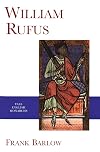
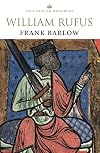
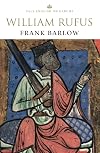
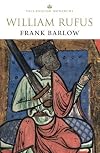
The lack of sources makes things difficult. This is visible even on the cover of the paperback edition, which shows a picture of William II from British Library MS. Cotton Claudius B VI. It's not contemporary, but it's about all we have. And the face is grey-brown, not show more pink or another flesh color. The white lead used to paint it has gone dark.
And so have most of the sources. We know even less about Rufus than about his father; the Anglo-Saxon Chronicle doesn't have as many details as we would like, the Domesday Book is completed, the household records haven't started yet -- and the church just plain didn't like Rufus, and either ignored or blackwashed him. It makes life very difficult for a biographer.
Frank Barlow's book does all it can to clear that up. He sorts through all kinds of sources -- not just chronicles and charters but saints' lives and faint hints in literature and non-English writings. It's hard to imagine someone wringing much more out of the data.
Sadly, Barlow's writing skill did not match his research skills. His books tend to be ponderous, and even though this one involves a truly interesting subject, he hasn't managed to produce a particularly good read. As a scholarly work, this ranked very high. As a piece of writing, it stands somewhat below the average of the English Monarchs series. Still, if you want to know about this period of English history, this is a must-have book.
And that statement hardly requires proof. show less
The reign of Rufus, the son of William the Conqueror, raises a lot of difficult questions. Was he homosexual? (Probably, but we don't have the direct evidence.) Was he murdered? (Probably, but we don't have the direct evidence.) Did his father really designate him as his successor in England while making his older brother Robert heir of Normandy? (Probably, but we don't.... you get the idea.)
The lack of sources makes things difficult. This is visible even on the cover of the paperback edition, which shows a picture of William II from British Library MS. Cotton Claudius B VI. It's not contemporary, but it's about all we have. And the face is grey-brown, not show more pink or another flesh color. The white lead used to paint it has gone dark.
And so have most of the sources. We know even less about Rufus than about his father; the Anglo-Saxon Chronicle doesn't have as many details as we would like, the Domesday Book is completed, the household records haven't started yet -- and the church just plain didn't like Rufus, and either ignored or blackwashed him. It makes life very difficult for a biographer.
Frank Barlow's book does all it can to clear that up. He sorts through all kinds of sources -- not just chronicles and charters but saints' lives and faint hints in literature and non-English writings. It's hard to imagine someone wringing much more out of the data.
Sadly, Barlow's writing skill did not match his research skills. His books tend to be ponderous, and even though this one involves a truly interesting subject, he hasn't managed to produce a particularly good read. As a scholarly work, this ranked very high. As a piece of writing, it stands somewhat below the average of the English Monarchs series. Still, if you want to know about this period of English history, this is a must-have book.
And that statement hardly requires proof. show less
Ratings
Members
- Recently Added By
Lists

al.vick-wishlist-history
70 works; 2 members
Author Information

24 Works 1,319 Members
Series

Common Knowledge
- Canonical title
- William Rufus
- Original publication date
- 1983; 2000-05 (2nd Ed.) (2nd Ed.)
- People/Characters
- William II, King of England; Henry I, King of England; Anselm of Canterbury (1033-1109); Eudo dapifer; Haimo dapifer; Hugh of Avranches, Earl of Chester (show all 23); Hugh of Montgomery, Earl of Shrewsbury; Lanfranc of Canterbury (or L. of Bec, c. 1005-1089); Odo, Bishop of Bayeux; Osmund, Bishop of Salisbury; Philip I, King of France; Ranulf Flambard, Bishop of Durham; Robert, Count of Meulan; Robert Curthose, Duke of Normandy; Robert Bloet, Bishop of Lincoln; Robert of Bellème, Earl of Shrewsbury; Robert FitzHaimo; Roger Bigot; Roger of Montgomery, Earl of Shrewsbury; Urse of Abetot; Walkelin, Bishop of Winchester; Walter Giffard, Earl of Buckinghamshire; William of St. Calais, Bishop of Durham
- Important places
- Normandy, France; Caen, Calvados, Normandy, France; Canterbury, Kent, England, UK; Fécamp, Seine-Maritime, Normandy, France; Gloucester, Gloucestershire, England, UK; London, England, UK (show all 11); County of Maine; Le Mans, Sarthe, Pays de la Loire, France; Rouen, Seine-Maritieme, Normandy, France; Westminster, London, England, UK; Pays de la Loire, France
- First words
- Chapter I
BACKGROUND AND YOUTH
William Rufus had a remarkable career, even for the late eleventh century, when opportunities for the adventurous and talented were plentiful.
PREFACE TO THE FIRST EDITION -- When I was teaching at the University of Exeter, I offered the Reign of William Rufus a few times as a 'Special Subject' and followed my usual method of devoting the seminars to the reading and... (show all) exposition of the main literary texts.
PREFACE TO THE YALE EDITION -- It is always a pleasure to revisit William Rufus. I first explored Normandy about 1927 with my younger brother and a friend, schoolboys on bikes with a tent; and I was very impressed by the Baye... (show all)ux Tapestry.
Classifications
- Genres
- History, Nonfiction, Biography & Memoir, General Nonfiction
- DDC/MDS
- 942.02 — History & geography History of Europe England and Wales England Norman 1066-1154
- LCC
- DA197.5 .B37 — History of Europe, Asia, Africa and Oceania Great Britain History of Great Britain England History By period Early and medieval to 1485 Celts. Romans. Saxons. Danes. Normans
- BISAC
Statistics
- Members
- 207
- Popularity
- 158,070
- Reviews
- 1
- Rating
- (3.84)
- Languages
- English
- Media
- Paper, Ebook
- ISBNs
- 5
- ASINs
- 4