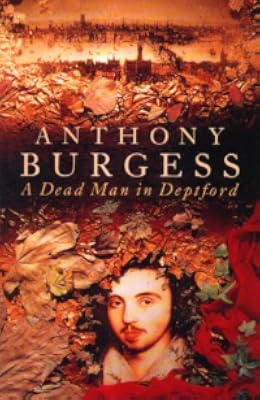
A Dead Man in Deptford
by Anthony Burgess 
On This Page
Description
With A Dead Man in Deptford, Burgess concluded his literary career to overwhelming acclaim for his re-creation of the Elizabethan poet Christopher Marlowe. In lavish, pitch-perfect, and supple, readable prose, Burgess matches his splendid Shakespeare novel, Nothing Like the Sun. The whole world of Elizabethan England-from the intrigues of the courtroom, through the violent streets of London, to the glory of the theater-comes alive in this joyous celebration of the life of Christopher show more Marlowe, murdered in suspicious circumstances in a tavern brawl in Deptford more than four hundred years ago. show lessTags
Recommendations

















Member Reviews
Hard to imagine a large market for a contemporary book written in authentic 16th century English prose! Your reward for taking up the challenge is a tale that is at once scholarly, erudite, philosophical, metaphysical, historical, literary and deeply engaging.
Burgess's 100% commitment to authenticity has the feel of a doctoral student who has spent so long immersed in their topic, they've lost all perspective of what passes for "normal" interest in their area of obsession. For this isn't just a fictionalized account of Marlowe's adult life, focused particularly on his intellectual meditations, his sexuality, and his flirtation with espionage, but also a deep (deep, deep, deep) dive into the world that he inhabited, a chaotic show more tintinnabulation of religious bickering, political chicanery, literary experimentation, scientific revelation, philosophical musing, global exploration, xenophobia, corruption, violence, plague, and genius.
Some tips for those who may be considering taking the plunge:
* DO maintain a glossary of players, because Burgess's cast of characters tend to reappear in multiple acts, playing multiple roles; maintaining a "cheat sheet" will keep you from having to continually double back to recall the relevancy of each;
* DO sketch out the family trees, because this will help clarify motives and affiliations;
* DO look up the arcane vocab/investigate the historical references/translate the bits in Latin, because if you don't you'll miss out on important connotation;
* DO take your time! Give yourself permission to linger over the language, which is extravagant, evocative, and exceedingly clever; to absorb the Elizabethan ambiance that Burgess conjures with alchemical artistry; and to consider the dense philosophical, religious and political issues that Burgess introduces, an astonishing number of which feel as relevant today as they were back in 1580. (Politicians stoking xenophobia to suit their own purposes ... sound familiar?)
Will admit that I wouldn't recommend this to the vast majority of my acquaintances. Had I not gone into this armed with a degree in English specializing in 16th-17th century literature + a decent familiarity with Kit Marlowe's bio + credentials as a researcher/analyst, I'm not sure I would have gotten as much out of it as the effort I put in. Even with the benefit of this foundation, still ended up devoting 3 full weeks to working my way through this, involving as many as 5-6 annotations per page clarifying arcane language, obscure historical references, and/or literary allusions. But I thoroughly enjoyed every moment of the journey, and am grateful to Burgess for this stunningly unique homage to Marlowe's complicated life and genius. show less
Burgess's 100% commitment to authenticity has the feel of a doctoral student who has spent so long immersed in their topic, they've lost all perspective of what passes for "normal" interest in their area of obsession. For this isn't just a fictionalized account of Marlowe's adult life, focused particularly on his intellectual meditations, his sexuality, and his flirtation with espionage, but also a deep (deep, deep, deep) dive into the world that he inhabited, a chaotic show more tintinnabulation of religious bickering, political chicanery, literary experimentation, scientific revelation, philosophical musing, global exploration, xenophobia, corruption, violence, plague, and genius.
Some tips for those who may be considering taking the plunge:
* DO maintain a glossary of players, because Burgess's cast of characters tend to reappear in multiple acts, playing multiple roles; maintaining a "cheat sheet" will keep you from having to continually double back to recall the relevancy of each;
* DO sketch out the family trees, because this will help clarify motives and affiliations;
* DO look up the arcane vocab/investigate the historical references/translate the bits in Latin, because if you don't you'll miss out on important connotation;
* DO take your time! Give yourself permission to linger over the language, which is extravagant, evocative, and exceedingly clever; to absorb the Elizabethan ambiance that Burgess conjures with alchemical artistry; and to consider the dense philosophical, religious and political issues that Burgess introduces, an astonishing number of which feel as relevant today as they were back in 1580. (Politicians stoking xenophobia to suit their own purposes ... sound familiar?)
Will admit that I wouldn't recommend this to the vast majority of my acquaintances. Had I not gone into this armed with a degree in English specializing in 16th-17th century literature + a decent familiarity with Kit Marlowe's bio + credentials as a researcher/analyst, I'm not sure I would have gotten as much out of it as the effort I put in. Even with the benefit of this foundation, still ended up devoting 3 full weeks to working my way through this, involving as many as 5-6 annotations per page clarifying arcane language, obscure historical references, and/or literary allusions. But I thoroughly enjoyed every moment of the journey, and am grateful to Burgess for this stunningly unique homage to Marlowe's complicated life and genius. show less
Marlowe has always somehow been more interesting than Shakespeare. The Bard is established canon, taught in schools, safe and accepted and familiar. Marlowe is more secret and dangerous and obscure by comparison. Atheist, homosexual, spy, who wrote the ultimate play of damnation for knowledge, he lurks in the shadows of Elizabethan England, his death a mystery never to be solved. Burgess sheds a little light on the shadows, but it's a fictional light, for what that's worth, itself a kind of shadow, and the whole novel is a kind of play, constructed with Elizabethan language to create the set and the sights and the sounds, full of word-play and poetry and clashing ideas, rationality wrestling with religion, and danger everywhere, every show more thought and deed a step to the Tower or the noose, conspiracy, real and fraudulent, and plays of power and brutal clashes of doctrine. Once grown accustomed to the language, the book comes to life and follows Kit Marlowe's life to that fateful reckoning in Deptford. show less
In his author’s note at the end of this novel about the final few years of Christopher Marlowe life Burgess says: “The virtue of a historical novel is its vice - the flat footed affirmation of possibility as fact.” There are few facts known about the late sixteenth century playwright and poet Christopher Marlowe and so Burgess has great fun making up a story that fits with the facts that we do know. It is a rumbustious, roisterous, sacrilegious look at the life of a writer making his living around the playhouses of Elizabethan England and one asks oneself “was it ever thus” - well it just may have been.
Anthony Burgess was no stranger to Elizabethan England having written a thesis on Marlowe’s Dr Faustus at university and show more published in 1964 his “historical” novel: Nothing like the sun: A story of Shakespeares love life. A Dead Man in Deptford tells the story of the last six years of Malowe’s life. He died on 30 May 1593 at the age of 29 years; killed in an upstairs room of a tavern after an altercation with some known violent characters. There is much conjecture that Marlowe was employed by Francis Walsingham the Elizabethan spymaster, there is no doubt that his outspoken views on religion (he was named as an atheist) caused him to be marked as a suspicious character and he was arrested in 1593 after being named by fellow playwright Thomas Kyd as a writer of heretical letters. It was at a time when the Elizabethan government were nervous about a foreign invasion, nervous about threats from both the Puritans and the Catholics and concerned about unruly and riotous behaviour around the London theatres and so Marlowe with his reputation may well have been in the wrong place at the wrong time. However Burgess spins a much more exciting tale of espionage, plots against the government and murder. He surmises that Marlowe was an agent for Walsingham, spying on the catholics in Rheims, and those around the court of James VI in Scotland. He also describes a meeting with John Penry who was hung drawn and quartered for setting up a printing press for the scurrilous Martin mar-prelate puritan pamphlets. Like many agents at the time Marlowe would have been blackmailed into serving the state. He also imagines Marlowe as being part of the coterie that met at Sir Walter Raleigh’s house addicted to the “nymph” (tobacco smoking). Much of this is conjecture, but as Burgess says it is all grist to the mill in the “flat footed affirmation of possibility as fact”.
The story is told by a young actor and sometime lover of Kit Marlowe who says he knows a little of the story, but proceeds to tell a whole lot more. The story then starts in the first person, but there are passages of imagined conversations involving Marlowe that change the point of view. Burgess has fun from the first sentence when the boy actor addresses the “fair or foul reader, but whats the difference” and then plays around with the syntax of his sentences and phrases to give an impression of how the Elizabethans may have spoken to each other. It would seem to me that Hilary Mantel may have gained much from reading this novel in developing her own style for her Wolf Hall novel.
Burgess describes Marlowe as a violent man, quick to take offence and an easy maker of enemies. His education and reasonably humble beginnings equip him to slip in and out of all levels of society and as a successful and notorious writer and poet more doors are open to him than would have normally been the case. His careless talk, religious views and homosexuality made him both a dangerous character to know as well as an exciting companion for the more adventurous. He was certain of his own talents and disparaging of others, when it would have been advisable to hold his tongue, he could not bring himself to do it. He was a man who easily got himself into trouble. Burgess imagines him having an affair with Thomas Walsingham cousin of Sir Francis, of working with Thomas Watson the poet and translator and having to collaborate with Thomas Kyd the playwright and then there is young Tom the actor - all these Toms Burgess says “a world of Toms like a night roof top” It is a typical aside because Burgess’ writing appears as undisciplined as the character he is describing, not being able to resist a quip, perhaps letting his pen run away with him, but always showing his love and knowledge of the period. The use of alliteration was a favourite ploy of many Elizabethan poets and playwrights and Burgess has fun imitating this style as well as dredging up some arcane words. Here is Marlowe holed up in Newgate jail with his friend Tom Watson and reflecting about the rats in their cell:
“ We could catch one, Tom said and eat it raw. Though rats are as they say inesculent. The learned word bounced hollowly.
A man should not play with these things. jails and privation and death. I sit comfortably with my pen penning men into pens of this kind. I did not think I could be so short of breath.”
It is always advisable to have access to a dictionary when reading Anthony Burgess and I realised that I have led a sheltered life, having to look up irrumatio and torchcul.
There are quotes from Marlowe’s plays and poems, sometimes quoted inaccurately back to him by other characters and there is a mock pastoral singing contest that takes place in an ale house in Rheims. Burgess portrays Elizabethan England as a dangerous and dirty place, especially for those people like Marlowe living on the edge of the criminal world, however this is not the main thrust of the novel because Burgess is more interested in the conversations, the word play and the invention of a good story. In my opinion it is a book that would be appreciated more fully by a reader already familiar with Marlowe for example there is a running joke about Marlowe’s name: is he Marley, or Merlin, perhaps Morely or Marlin: this all stems from there being only one document in existence signed by Marlowe and this looks like he has signed himself Morely. This is an historical novel and so there are no helpful notes and readers not familiar with this fact might wonder why Burgess continues with this idea. It is all part of the fun, in-jokes a-plenty as Burgess flexes his muscles as writer and entertainer. I was entertained even if:
“Elation made his member swell visibly in his codpiece, and he was thus led to the composing of a poem of love”
A four star read. show less
Anthony Burgess was no stranger to Elizabethan England having written a thesis on Marlowe’s Dr Faustus at university and show more published in 1964 his “historical” novel: Nothing like the sun: A story of Shakespeares love life. A Dead Man in Deptford tells the story of the last six years of Malowe’s life. He died on 30 May 1593 at the age of 29 years; killed in an upstairs room of a tavern after an altercation with some known violent characters. There is much conjecture that Marlowe was employed by Francis Walsingham the Elizabethan spymaster, there is no doubt that his outspoken views on religion (he was named as an atheist) caused him to be marked as a suspicious character and he was arrested in 1593 after being named by fellow playwright Thomas Kyd as a writer of heretical letters. It was at a time when the Elizabethan government were nervous about a foreign invasion, nervous about threats from both the Puritans and the Catholics and concerned about unruly and riotous behaviour around the London theatres and so Marlowe with his reputation may well have been in the wrong place at the wrong time. However Burgess spins a much more exciting tale of espionage, plots against the government and murder. He surmises that Marlowe was an agent for Walsingham, spying on the catholics in Rheims, and those around the court of James VI in Scotland. He also describes a meeting with John Penry who was hung drawn and quartered for setting up a printing press for the scurrilous Martin mar-prelate puritan pamphlets. Like many agents at the time Marlowe would have been blackmailed into serving the state. He also imagines Marlowe as being part of the coterie that met at Sir Walter Raleigh’s house addicted to the “nymph” (tobacco smoking). Much of this is conjecture, but as Burgess says it is all grist to the mill in the “flat footed affirmation of possibility as fact”.
The story is told by a young actor and sometime lover of Kit Marlowe who says he knows a little of the story, but proceeds to tell a whole lot more. The story then starts in the first person, but there are passages of imagined conversations involving Marlowe that change the point of view. Burgess has fun from the first sentence when the boy actor addresses the “fair or foul reader, but whats the difference” and then plays around with the syntax of his sentences and phrases to give an impression of how the Elizabethans may have spoken to each other. It would seem to me that Hilary Mantel may have gained much from reading this novel in developing her own style for her Wolf Hall novel.
Burgess describes Marlowe as a violent man, quick to take offence and an easy maker of enemies. His education and reasonably humble beginnings equip him to slip in and out of all levels of society and as a successful and notorious writer and poet more doors are open to him than would have normally been the case. His careless talk, religious views and homosexuality made him both a dangerous character to know as well as an exciting companion for the more adventurous. He was certain of his own talents and disparaging of others, when it would have been advisable to hold his tongue, he could not bring himself to do it. He was a man who easily got himself into trouble. Burgess imagines him having an affair with Thomas Walsingham cousin of Sir Francis, of working with Thomas Watson the poet and translator and having to collaborate with Thomas Kyd the playwright and then there is young Tom the actor - all these Toms Burgess says “a world of Toms like a night roof top” It is a typical aside because Burgess’ writing appears as undisciplined as the character he is describing, not being able to resist a quip, perhaps letting his pen run away with him, but always showing his love and knowledge of the period. The use of alliteration was a favourite ploy of many Elizabethan poets and playwrights and Burgess has fun imitating this style as well as dredging up some arcane words. Here is Marlowe holed up in Newgate jail with his friend Tom Watson and reflecting about the rats in their cell:
“ We could catch one, Tom said and eat it raw. Though rats are as they say inesculent. The learned word bounced hollowly.
A man should not play with these things. jails and privation and death. I sit comfortably with my pen penning men into pens of this kind. I did not think I could be so short of breath.”
It is always advisable to have access to a dictionary when reading Anthony Burgess and I realised that I have led a sheltered life, having to look up irrumatio and torchcul.
There are quotes from Marlowe’s plays and poems, sometimes quoted inaccurately back to him by other characters and there is a mock pastoral singing contest that takes place in an ale house in Rheims. Burgess portrays Elizabethan England as a dangerous and dirty place, especially for those people like Marlowe living on the edge of the criminal world, however this is not the main thrust of the novel because Burgess is more interested in the conversations, the word play and the invention of a good story. In my opinion it is a book that would be appreciated more fully by a reader already familiar with Marlowe for example there is a running joke about Marlowe’s name: is he Marley, or Merlin, perhaps Morely or Marlin: this all stems from there being only one document in existence signed by Marlowe and this looks like he has signed himself Morely. This is an historical novel and so there are no helpful notes and readers not familiar with this fact might wonder why Burgess continues with this idea. It is all part of the fun, in-jokes a-plenty as Burgess flexes his muscles as writer and entertainer. I was entertained even if:
“Elation made his member swell visibly in his codpiece, and he was thus led to the composing of a poem of love”
A four star read. show less
If you find Christopher Marlowe fascinating, you’ll find this book fascinating. If you don’t, well… I am really sorry about your cultural impoverishment. My sincere condolences.
Christopher Marlowe was so many things: a Man-about-town (London) with various acquaintances in high society and in low (very low); a playwright who brought the pentameter line to heights only equalled by his great successor, never surpassed; poet too with at least one poem that will never lose its place in the anthologies (‘Come Live with Me and Be My Love…’). And spy. Not so much known about the ‘spy’ bit, I gather, but aspects of his comings and goings and the people he met strongly point to it. What talent! But what a terrible entry in the show more annals of Eng. Lit. that he died aged just 39 in a tavern brawl in Deptford.
I’m not a great fan of ‘historical fiction’ and have tried out many a book of its kind only to give up soon enough because of the way the historical characters were made to speak / act just did not ring true for me. Also there’s usually cartloads of ‘atmospheric background’ which smells of hours spent in the reference / research library section and which holds up the plot no end.
Anthony Burgess does NOT hold things up. He goes at cracking pace, and his ‘atmospherics’ are largely carried by the way he recreates an ‘Elizabethan’ English language, and in the way he just doesn’t tell you about the sights and sounds of the London of the time. He takes you out and about in the streets and taverns in the company of the characters and shows you the sights. Some of them are unforgettable, unfortunately. I can’t get out of my mind the executions at at St. Giles Fields where the poor miserable wretches were first half-hanged, then their privates sliced off, then their bellies slit open and their guts pulled out for them to see before they died. And then the executioner and his apprentices set to chopping up the remains and throwing them into a vat to boil. And then… OK. Sorry. Just wanted to get across the authenticity of the writing…
It has to said that I was ready to like this book before I read it. I still remember reading Tamburlaine at UCD ( a very long time ago) and what a great thing it was. I was not alone in being absolutely mesmerised by the Elizabethan Age and its literature, and Christopher Marlowe made a really big impression on me. It was great to be drawn into his world and (in however imaginary a way) brought closer to him. What a read! show less
Christopher Marlowe was so many things: a Man-about-town (London) with various acquaintances in high society and in low (very low); a playwright who brought the pentameter line to heights only equalled by his great successor, never surpassed; poet too with at least one poem that will never lose its place in the anthologies (‘Come Live with Me and Be My Love…’). And spy. Not so much known about the ‘spy’ bit, I gather, but aspects of his comings and goings and the people he met strongly point to it. What talent! But what a terrible entry in the show more annals of Eng. Lit. that he died aged just 39 in a tavern brawl in Deptford.
I’m not a great fan of ‘historical fiction’ and have tried out many a book of its kind only to give up soon enough because of the way the historical characters were made to speak / act just did not ring true for me. Also there’s usually cartloads of ‘atmospheric background’ which smells of hours spent in the reference / research library section and which holds up the plot no end.
Anthony Burgess does NOT hold things up. He goes at cracking pace, and his ‘atmospherics’ are largely carried by the way he recreates an ‘Elizabethan’ English language, and in the way he just doesn’t tell you about the sights and sounds of the London of the time. He takes you out and about in the streets and taverns in the company of the characters and shows you the sights. Some of them are unforgettable, unfortunately. I can’t get out of my mind the executions at at St. Giles Fields where the poor miserable wretches were first half-hanged, then their privates sliced off, then their bellies slit open and their guts pulled out for them to see before they died. And then the executioner and his apprentices set to chopping up the remains and throwing them into a vat to boil. And then… OK. Sorry. Just wanted to get across the authenticity of the writing…
It has to said that I was ready to like this book before I read it. I still remember reading Tamburlaine at UCD ( a very long time ago) and what a great thing it was. I was not alone in being absolutely mesmerised by the Elizabethan Age and its literature, and Christopher Marlowe made a really big impression on me. It was great to be drawn into his world and (in however imaginary a way) brought closer to him. What a read! show less
In his "Author's Note," Burgess reveals that in 1940, as the Luftwaffe was attempting to destroy England, he was typing his university thesis on Marlowe. But, it was not until 1993, the quatercenterary of Marlowe's death, that he published his long-promised-to-himself novel about Christopher Marlowe: "Now, with the commemoration of Marlowe's murder in 1593, I am able to pay such homage as is possible to an ageing writer."
A Dead Man in Deptford is a breathtaking tour-de-force through the theatres, spy-rings, noble houses and stews of late Elizabethan England. Narrated by an unnamed actor, famed for his portrayal of Belphoebe as a boy, who observes and speculates about Marlowe's forays in poet-tasting, play-making and spying, the novel show more brings the reader a richness, both strange and familiar. Most of the university wits and early playwrights make an appearance -- Lyly, Kyd, Lodge, Nashe, Greene -- even a young Will from Warwickshire.
Burgess's Marlowe, the son of a Canterbury shoemaker, is the brilliant, but impoverished scholarship student who is lured into the sometimes profitable, but inescapable, spy ring of Sir Francis Walsingham's "Service." His servitude is sweetened by a passionate relationship with Sir Francis's young cousin, Thomas Walsingham.
Burgess is in love with the English language, most particularly here the language of early modern English with its inventiveness and muscularity. We overhear Marlowe struggling with his "mighty line" -- the blank verse that would serve not only his plays, but Shakespeare's, so well:
The five to the line was not natural. There were no fives in nature save in cinquefoil flowers. No wait, five fingers, but the thumb was of a different make and purpose. He meant that the rhythm of two or four was in nature, for it was the heart beating and the walking legs. So then the line pentametric was unnatural unless its fifth beat was take to be a starting a new suppositious four. To ride in triumph through Persepolis. There was a pause, sure, after that, and a long one, either in the air or in the head. There was a justification for end-stopping and the line as a bludgeon. Moreover.
For anyone interested in the Elizabethan theatre, A Dead Man in Deptford is required reading. show less
A Dead Man in Deptford is a breathtaking tour-de-force through the theatres, spy-rings, noble houses and stews of late Elizabethan England. Narrated by an unnamed actor, famed for his portrayal of Belphoebe as a boy, who observes and speculates about Marlowe's forays in poet-tasting, play-making and spying, the novel show more brings the reader a richness, both strange and familiar. Most of the university wits and early playwrights make an appearance -- Lyly, Kyd, Lodge, Nashe, Greene -- even a young Will from Warwickshire.
Burgess's Marlowe, the son of a Canterbury shoemaker, is the brilliant, but impoverished scholarship student who is lured into the sometimes profitable, but inescapable, spy ring of Sir Francis Walsingham's "Service." His servitude is sweetened by a passionate relationship with Sir Francis's young cousin, Thomas Walsingham.
Burgess is in love with the English language, most particularly here the language of early modern English with its inventiveness and muscularity. We overhear Marlowe struggling with his "mighty line" -- the blank verse that would serve not only his plays, but Shakespeare's, so well:
The five to the line was not natural. There were no fives in nature save in cinquefoil flowers. No wait, five fingers, but the thumb was of a different make and purpose. He meant that the rhythm of two or four was in nature, for it was the heart beating and the walking legs. So then the line pentametric was unnatural unless its fifth beat was take to be a starting a new suppositious four. To ride in triumph through Persepolis. There was a pause, sure, after that, and a long one, either in the air or in the head. There was a justification for end-stopping and the line as a bludgeon. Moreover.
For anyone interested in the Elizabethan theatre, A Dead Man in Deptford is required reading. show less
With wide definitions of lust, faith and loyalty splayed out by the art of poets, theologians and executioners, Anthony Burgess structures a deft spy novel. "A Dead Man in Deptford" is a delightful collection of Easter eggs painting Christopher Marlowe as a player in the art of reason.
This book is tremendous--difficult to read sometimes, given the way the dialog is written, but at the same time it's incredibly bracing and makes the espionage, the religion, the politics, the love of (Kit or Kat Marlin or Merlin or Marlowe) come to life. I think there's a nonfiction biography to go along with this book that discusses Marlowe's mysterious death--stabbed in the eye, allegedly over "le reckynygge" (the bill) at a local tavern. Many historians and biographers believe, however, and Burgess posits, a death stemming from Marlowe’s unorthodox life. The afterward is a touching elegy to a man who might have rivaled Shakespeare, had time let him. Highly recommended to any lovers of brilliant prose and historically accurate fiction.
Members
- Recently Added By
Lists

20th Century Literature
1,161 works; 55 members

real people in fiction circumstances
74 works; 10 members

Books discovered on LibraryThing
256 works; 36 members

Blue Pyramid 1,276 Best Books of All Time
1,248 works; 32 members
Author Information

120+ Works 48,185 Members
Anthony Burgess was born in 1917 in Manchester, England. He studied language at Xaverian College and Manchester University. He had originally applied for a degree in music, but was unable to pass the entrance exams. Burgess considered himself a composer first, one who later turned to literature. Burgess' first novel, A Vision of Battlements show more (1964), was based on his experiences serving in the British Army. He is perhaps best known for his novel A Clockwork Orange, which was later made into a movie by Stanley Kubrick. In addition to publishing several works of fiction, Burgess also published literary criticism and a linguistics primer. Some of his other titles include The Pianoplayers, This Man and Music, Enderby, The Kingdom of the Wicked, and Little Wilson and Big God. Burgess was living in Monaco when he died in 1993. (Bowker Author Biography) show less
Anthony Burgess has a Legacy Library. Legacy libraries are the personal libraries of famous readers, entered by LibraryThing members from the Legacy Libraries group.
Some Editions
Common Knowledge
- Canonical title
- A Dead Man in Deptford
- Original title
- A Dead Man In Deptford
- Original publication date
- 1993
- People/Characters
- Christopher Marlowe
- Important places
- London, England, UK; Deptford, London, England, UK; Reims, Marne, Grand-Est, France
- Important events
- Babington Plot
- Related movies
- A Dead Man in Deptford (2011 | IMDb)
- Dedication
- To Sam Wanamaker (and family) as a
tribute to his courage in bringing back
from the dead a playhouse that
Marlowe never knew. - First words
- You must and will suppose (fair or foul reader, but where's the difference?) that I suppose a heap of happenings that I had no eye to eye knowledge of or concerning.
- Last words
- (Click to show. Warning: May contain spoilers.)That dagger continues to pierce, and it will never be blunted.
Classifications
Statistics
- Members
- 944
- Popularity
- 28,238
- Reviews
- 19
- Rating
- (3.79)
- Languages
- 8 — English, French, German, Italian, Polish, Spanish, Swedish, Turkish
- Media
- Paper, Audiobook, Ebook
- ISBNs
- 18
- ASINs
- 13