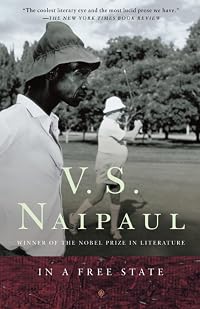
In a Free State
by V. S. Naipaul
On This Page
Description
No writer has rendered our boundaryless, post-colonial world more acutely or prophetically than V. S. Naipaul, or given its upheavals such a hauntingly human face. A perfect case in point is this riveting novel, a masterful and stylishly rendered narrative of emigration, dislocation, and dread, accompanied by four supporting narratives.On a road trip through Africa, two English people-Bobby, a civil servant with a guilty appetite for African boys; and Linda, a supercilious "compound show more wife"-are driving back to their enclave after a stay in the capital. But in between lies the landscape of an unnamed country whose squalor and ethnic bloodletting suggest Idi Amin's Uganda. And the farther Naipaul's protagonists travel into it, the more they find themselves crossing the line that separates privileged outsiders from horrified victims. Alongside this Conradian tour de force are four incisive portraits of men seeking liberation far from home.By turns funny and terrifying, sorrowful and unsparing, In a Free State is Naipaul at his best. show lessTags
Recommendations











Member Reviews
Naipaul is an exquisite writer. This collection of stories addresses states of freedom -- from the intimacy within one's own mind all the way to the vastness of a country's political upheaval, along with various states in between. A malaise surrounds the narratives, all relating to displaced protagonists, wandering, not at home anywhere, I think; I say that because there's a certain disconnectedness roving through the hearts & souls of these words, something that works to keep all of the characters as outsiders from themselves & others &, yet, still human. Is anyone ever really in a free state? Recommended.
Nominally a novel, but actually more like a collection of short stories, In a Free State by V. S. Naipaul is in this way different than other works of Naipaul that I have read. But in other ways it is similar and even better than the others. This is primarily because all the five stories are linked thematically and they share Naipaul's beautiful prose style.
The novel includes stories that are all about people who find themselves in places where they feel, or are made to feel, that they don’t belong; the stories are about boundaries, purity, pollution, incommensurability and just plain strangeness. In the opening prologue, the presence of an English tramp on a Greek ferry causes uproar. The second story tells of an Indian servant who show more tries to adjust to a new life in Washington D.C. Next, in a story that demonstrated a striking voice with a melancholy that I found disturbing, a South Asian West Indian immigrant in London reflects on the ruins of his life. His relationship with boy he is helping deteriorates as he slowly realizes the failure of the boy to live up to his naive ideal.
The final story, “In a Free State,” is equally pessimistic. In it, Bobby and Linda share a car ride from the capital, in the northern part of the African country, to the so-called Southern Collectorate, where Bobby works and where Linda will rejoin her husband. Ethnic rivalries within the country make this journey perilous because the president, whose politically and militarily dominant people control the north, has set up roadblocks to apprehend the king, whose weaker people populate the south.
The basic conflict between the two characters concerns their attitude toward Africa: Bobby, a homosexual who suffered a nervous breakdown at Oxford, has emigrated to Africa and plans to make it his home. “My life is here,” he says. Linda has lived in the country for six years and considers it an exciting place for her and her husband to work, but she intends to go to South Africa, if it ever stops being “like a John Ford Western.” Her attitude suggests that Europeans can never be accepted in black African society. In the epilogue an Asian businessman travelling through Milan and Cairo reflects on cruelty and empire.
While I found interesting aspects to all the shorter stories, In a Free State clearly stands out among the lot. While neither of the two main characters are appealing, the contrast between the self-deluding Bobby, who claims to have some sort of authentic connection with “Africa,” and the cynical, weary Linda is very effective. They wear their prejudices on their sleeves, so to speak, and only differ in tone and personality. More effective for me was the setting and the use of description to maintain a tension that suggested (not unlike a Hitchcock thriller) the presence of horror just around the bend. Whether you agree with the view represented in these stories about the difficulty of adjusting your being to a new place and a different culture you can, through the graceful prose style of V. S. Naipaul, enjoy the book. show less
The novel includes stories that are all about people who find themselves in places where they feel, or are made to feel, that they don’t belong; the stories are about boundaries, purity, pollution, incommensurability and just plain strangeness. In the opening prologue, the presence of an English tramp on a Greek ferry causes uproar. The second story tells of an Indian servant who show more tries to adjust to a new life in Washington D.C. Next, in a story that demonstrated a striking voice with a melancholy that I found disturbing, a South Asian West Indian immigrant in London reflects on the ruins of his life. His relationship with boy he is helping deteriorates as he slowly realizes the failure of the boy to live up to his naive ideal.
The final story, “In a Free State,” is equally pessimistic. In it, Bobby and Linda share a car ride from the capital, in the northern part of the African country, to the so-called Southern Collectorate, where Bobby works and where Linda will rejoin her husband. Ethnic rivalries within the country make this journey perilous because the president, whose politically and militarily dominant people control the north, has set up roadblocks to apprehend the king, whose weaker people populate the south.
The basic conflict between the two characters concerns their attitude toward Africa: Bobby, a homosexual who suffered a nervous breakdown at Oxford, has emigrated to Africa and plans to make it his home. “My life is here,” he says. Linda has lived in the country for six years and considers it an exciting place for her and her husband to work, but she intends to go to South Africa, if it ever stops being “like a John Ford Western.” Her attitude suggests that Europeans can never be accepted in black African society. In the epilogue an Asian businessman travelling through Milan and Cairo reflects on cruelty and empire.
While I found interesting aspects to all the shorter stories, In a Free State clearly stands out among the lot. While neither of the two main characters are appealing, the contrast between the self-deluding Bobby, who claims to have some sort of authentic connection with “Africa,” and the cynical, weary Linda is very effective. They wear their prejudices on their sleeves, so to speak, and only differ in tone and personality. More effective for me was the setting and the use of description to maintain a tension that suggested (not unlike a Hitchcock thriller) the presence of horror just around the bend. Whether you agree with the view represented in these stories about the difficulty of adjusting your being to a new place and a different culture you can, through the graceful prose style of V. S. Naipaul, enjoy the book. show less
Published in 1971, and winner of the Booker Prize, In a Free State is a combination of two short stories, one novella, and two segments of travelogue set in countries around the world. The travelogue provides the introduction and involves a trip by ship from Greece to Egypt. It also provides the conclusion, 25 years later, in Egypt. One Out of Many is about Santosh, a servant living in Bombay, who accompanies his employer to Washington D.C. In Tell Me Who to Kill, a Trinidadian in London desires to fund his brother’s education but finds his brother has been deceitful. In the titular novella, two British bureaucrats take a road trip in an unnamed African country (similar to Uganda) in the midst of political upheaval, where they show more encounter racial divisions and violence.
This is a book that requires a “big picture” mindset. The stories are not connected except in themes, which include displacement, alienation, and different interpretations of “freedom.” The protagonists are unrelated, but all are outside their home countries. I most enjoyed One Out of Many – the adventures of Santosh as he experiences western version of freedom but is unable to replicate the happiness he found in Bombay. In this story, Santosh is a fully developed character, and the reader can follow his gradual disillusionment.
In the novella, two unpleasant British expats, Bobby and Linda, on the road to a remote compound, exhibit their perceived “superiority” to the African inhabitants. I am sure it is intended for the reader to feel tension and discomfort and it succeeds. I appreciate the themes and Naipaul’s brilliant writing style. It is worth reading for its literary merit and effective in its social commentary, but do not expect anything remotely cheery. show less
This is a book that requires a “big picture” mindset. The stories are not connected except in themes, which include displacement, alienation, and different interpretations of “freedom.” The protagonists are unrelated, but all are outside their home countries. I most enjoyed One Out of Many – the adventures of Santosh as he experiences western version of freedom but is unable to replicate the happiness he found in Bombay. In this story, Santosh is a fully developed character, and the reader can follow his gradual disillusionment.
In the novella, two unpleasant British expats, Bobby and Linda, on the road to a remote compound, exhibit their perceived “superiority” to the African inhabitants. I am sure it is intended for the reader to feel tension and discomfort and it succeeds. I appreciate the themes and Naipaul’s brilliant writing style. It is worth reading for its literary merit and effective in its social commentary, but do not expect anything remotely cheery. show less
I can see why Robert McCrum chose this for the 1970s nominee for the Golden Booker. It may not be better than some of the other excellent winners, but it's very very good. Is it Naipaul's best? I don't know, I haven't read all the novels, but his best is very good indeed.
This is a series of thematically connected stories with two very short journal-entry vignettes bookending the beginning and end. There are two short-ish stories and one novella (the latter being the titular story). All consider the issues raised by immigration, colonialism, exile, and color/race supremacy. The three major pieces are quite different from each other in terms of plot and character, but the threads connecting them are clear.
Naipaul is hard to read. He's show more at best pitiless and at worst cruel. But his writing is so phenomenal, his eye so acute, and his evocation of the natural and built worlds so penetrating (from beautiful to horrible as the subject requires), that he demands to be read, carefully and thoroughly.
ETA: The way Naipaul depicts African people is frequently painful, even more than his usual unsparingly cruel eye. In the main story these depictions are primarily through the perspective of the main characters, who are mostly unlikable, but he is definitely making points about the extent to which humans resemble the less pleasant aspects of animals (or just animals in general). But it *is* painful for the reader. show less
This is a series of thematically connected stories with two very short journal-entry vignettes bookending the beginning and end. There are two short-ish stories and one novella (the latter being the titular story). All consider the issues raised by immigration, colonialism, exile, and color/race supremacy. The three major pieces are quite different from each other in terms of plot and character, but the threads connecting them are clear.
Naipaul is hard to read. He's show more at best pitiless and at worst cruel. But his writing is so phenomenal, his eye so acute, and his evocation of the natural and built worlds so penetrating (from beautiful to horrible as the subject requires), that he demands to be read, carefully and thoroughly.
ETA: The way Naipaul depicts African people is frequently painful, even more than his usual unsparingly cruel eye. In the main story these depictions are primarily through the perspective of the main characters, who are mostly unlikable, but he is definitely making points about the extent to which humans resemble the less pleasant aspects of animals (or just animals in general). But it *is* painful for the reader. show less
I don’t think I’ve ever read any Naipaul before. Can’t think why. This was an excellent series of short stories wandering through themes of empire, colonialism and identity and is as relevant today as it was 40 years ago, if not more so.
The book has four narratives:
The opening and closing are from the point of view of a traveller embarking on a ship to Egypt and then being a tourist in Egypt.
There is a narrative about a guy who is a cook for an Indian diplomat who takes him to the US where he ends up being an illegal immigrant.
The most opaque story involves the bitter thoughts of a man whose brother had made a success of emigration while he still struggles due to some bad choices.
The longest story involves a car journey that show more two ex-pats take through an East African country which is fictional but which has recently gained independence with all the consequent instability that brings.
All the stories have are deeply psychological with Naipaul using tension throughout to convey the impression of dislocation and crisis for almost all the characters. Much of what the characters struggle with is very moving. The Indian narrative in particular brought to mind the struggles of the characters in Mistry’s A Fine Balance. Naipaul must surely have influenced many Indian writers.
If you’re like me and you’ve spent your life wandering the earth and have given up all hope of finding a place where you feel settled, then a lot of what these characters go through will resonate with you. Through some prophetic serendipity, this was also the Booker Prize winner from the year of my birth.
This is not an uplifting read, but it is a very powerful book that deals with the realities of the colonial legacy. With the rise of globalism in the decades following its publication, it has only become more relevant to our times. It quite rightly brought Naipaul the accolades and recognition he would come to deserve in his lifetime. show less
The book has four narratives:
The opening and closing are from the point of view of a traveller embarking on a ship to Egypt and then being a tourist in Egypt.
There is a narrative about a guy who is a cook for an Indian diplomat who takes him to the US where he ends up being an illegal immigrant.
The most opaque story involves the bitter thoughts of a man whose brother had made a success of emigration while he still struggles due to some bad choices.
The longest story involves a car journey that show more two ex-pats take through an East African country which is fictional but which has recently gained independence with all the consequent instability that brings.
All the stories have are deeply psychological with Naipaul using tension throughout to convey the impression of dislocation and crisis for almost all the characters. Much of what the characters struggle with is very moving. The Indian narrative in particular brought to mind the struggles of the characters in Mistry’s A Fine Balance. Naipaul must surely have influenced many Indian writers.
If you’re like me and you’ve spent your life wandering the earth and have given up all hope of finding a place where you feel settled, then a lot of what these characters go through will resonate with you. Through some prophetic serendipity, this was also the Booker Prize winner from the year of my birth.
This is not an uplifting read, but it is a very powerful book that deals with the realities of the colonial legacy. With the rise of globalism in the decades following its publication, it has only become more relevant to our times. It quite rightly brought Naipaul the accolades and recognition he would come to deserve in his lifetime. show less
Sometimes when I rate a book three stars, it is because the book is good but doesn’t make it to very good or great. But on a positive note, it is consistently good. In other cases, a book gets three stars because it is great in places and in other places, I really struggle with it. This book falls into the second category. The book is made up of two “short” short stories or vignettes, the Prologue and Epilogue, two short stories of decent length, One Out of Many and Tell Me Who to Kill, and finally a short novel, In a Free State. Each of these pieces describes one or more individuals residing, sometimes temporarily sometimes permanently, in a foreign culture, their adaptation or failure to adapt to that culture and their conflicts show more and the conflicts they encounter within the culture. What was truly impressive to me about the writing, and this was my first by V.S. Naipaul, was that each described a different part of the world, a different culture and different conflicts.
The Prologue and Epilogue, although they didn’t feel like true short stories, were very good. The Prologue focuses on a boat trip to Egypt; the Epilogue describes a short tourist visit in Egypt. One Out of Many, the first of the true short stories, was the gem. It was a precursor, at least based on when it was written, to some of the stories I have read of immigrants adapting to a new culture, particularly the United States. The Namesake by Jhumpi Lahari and A Free Life by Ha Jin come to mind. In One Out of Many, I often found myself laughing but then realizing it was no laughing matter for Santosh, an Indian domestic who travels to Washington D.C. with his boss. This story also brings to the forefront racial prejudice in ways with which I was not familiar. Tell Me Who to Kill is the story of an older brother who sacrifices his future to help his younger brother. While it has strong points, it felt like it lost its way to me. Finally, the novel In a Free State provides an excellent description of an African nation struggling with its recent freedom and the attendant clashes of various races and nationalities, but the two main characters generated no strong feelings in me and I found most of the story tedious.
Overall, I was disappointed in the inconsistency of what I read, but this was my first V.S. Naipaul and given some of the high points, I intend to try something else of his. show less
The Prologue and Epilogue, although they didn’t feel like true short stories, were very good. The Prologue focuses on a boat trip to Egypt; the Epilogue describes a short tourist visit in Egypt. One Out of Many, the first of the true short stories, was the gem. It was a precursor, at least based on when it was written, to some of the stories I have read of immigrants adapting to a new culture, particularly the United States. The Namesake by Jhumpi Lahari and A Free Life by Ha Jin come to mind. In One Out of Many, I often found myself laughing but then realizing it was no laughing matter for Santosh, an Indian domestic who travels to Washington D.C. with his boss. This story also brings to the forefront racial prejudice in ways with which I was not familiar. Tell Me Who to Kill is the story of an older brother who sacrifices his future to help his younger brother. While it has strong points, it felt like it lost its way to me. Finally, the novel In a Free State provides an excellent description of an African nation struggling with its recent freedom and the attendant clashes of various races and nationalities, but the two main characters generated no strong feelings in me and I found most of the story tedious.
Overall, I was disappointed in the inconsistency of what I read, but this was my first V.S. Naipaul and given some of the high points, I intend to try something else of his. show less
Published in 1971, and winner of the Booker Prize, In a Free State is a combination of two short stories, one novella, and two segments of travelogue set in countries around the world. The travelogue provides the introduction and involves a trip by ship from Greece to Egypt. It also provides the conclusion, 25 years later, in Egypt. One Out of Many is about Santosh, a servant living in Bombay, who accompanies his employer to Washington D.C. In Tell Me Who to Kill, a Trinidadian in London desires to fund his brother’s education but finds his brother has been deceitful. In the titular novella, two British bureaucrats take a road trip in an unnamed African country (similar to Uganda) in the midst of political upheaval, where they show more encounter racial divisions and violence.
This is a book that requires a “big picture” mindset. The stories are not connected except in themes, which include displacement, alienation, and different interpretations of “freedom.” The protagonists are unrelated, but all are outside their home countries. I most enjoyed One Out of Many – the adventures of Santosh as he experiences western version of freedom but is unable to replicate the happiness he found in Bombay. In this story, Santosh is a fully developed character, and the reader can follow his gradual disillusionment.
In the novella, two unpleasant British expats, Bobby and Linda, on the road to a remote compound, exhibit their perceived “superiority” to the African inhabitants. I am sure it is intended for the reader to feel tension and discomfort and it succeeds. I appreciate the themes and Naipaul’s brilliant writing style. It is worth reading for its literary merit and effective in its social commentary, but do not expect anything remotely cheery. show less
This is a book that requires a “big picture” mindset. The stories are not connected except in themes, which include displacement, alienation, and different interpretations of “freedom.” The protagonists are unrelated, but all are outside their home countries. I most enjoyed One Out of Many – the adventures of Santosh as he experiences western version of freedom but is unable to replicate the happiness he found in Bombay. In this story, Santosh is a fully developed character, and the reader can follow his gradual disillusionment.
In the novella, two unpleasant British expats, Bobby and Linda, on the road to a remote compound, exhibit their perceived “superiority” to the African inhabitants. I am sure it is intended for the reader to feel tension and discomfort and it succeeds. I appreciate the themes and Naipaul’s brilliant writing style. It is worth reading for its literary merit and effective in its social commentary, but do not expect anything remotely cheery. show less
Members
- Recently Added By
Published Reviews
ThingScore 75
"In a Free State" is a novel by V.S. Naipaul, originally published in 1971. The book consists of three interconnected narratives set in different parts of the world, exploring themes of displacement, identity, and the human condition. Through vivid storytelling and keen observation, Naipaul depicts characters grappling with the complexities of post-colonial societies and the search for show more belonging in a rapidly changing world. The novel offers a poignant reflection on the universal struggles of individuals caught between the aspirations of freedom and the realities of constraint, showcasing Naipaul's mastery in capturing the human experience with depth and insight. show less
added by Michael_Vannin
Lists

1001 Books You Must Read Before You Die
1,448 works; 1,136 members

Booker Prize
491 works; 62 members

1970s
657 works; 23 members

1,001 BYMRBYD Concensus
723 works; 27 members

Man Booker Prize Longlist 1971
6 works; 1 member

Booker Prize Shortlist: Titles Not Yet Read
161 works; 4 members
Author Information

99+ Works 25,831 Members
Vidiadhar Surajprasad Naipaul was born of Indian ancestry in Chaguanas, Trinidad on August 17, 1932. He was educated at University College, Oxford and lived in Great Britain since 1950. From 1954 to 1956, he edited a radio program on literature for the British Broadcasting Corporation's Caribbean Service. His first novel, The Mystic Masseur, was show more published in 1957. His other novels included A House for Mr. Biswas, A Bend in the River, Guerrillas, and Half a Life. In a Free State won the Booker Prize in 1971. He started writing nonfiction in the 1960s. His first nonfiction book, The Middle Passage, was published in 1962. His other nonfiction works included An Area of Darkness, Among the Believers, Beyond Belief, and A Turn in the South. He was knighted in 1990 and received the Nobel Prize in Literature in 2001. He died on August 11, 2018 at the age of 85. (Bowker Author Biography) show less
Some Editions
Awards and Honors
Common Knowledge
- Canonical title
- In a Free State
- Original title
- In a Free State
- Original publication date
- 1971
- Important places
- Trinidad and Tobago; Africa
- First words*
- De oversteek van Piraeus naar Alexandrië duurde slechts twee dagen, maar zodra ik de groezelige kleine Griekse schuit zag, kreeg ik het gevoel dat ik anders had moeten reizen.
- Quotations
- And it was strange, I thought, that sorrow lasts and can make a man look forward to death, but the mood of victory fills a moment and then is over.
- Last words*
- (Click to show. Warning: May contain spoilers.)Zeventien maanden later zouden deze mannen, of mannen zoals zij, een totale nederlaag lijden in de woestijn; en nieuwsfoto's genomen vanuit laagvliegende helikopters zouden laten zien hoe ze verdwaalde pogingen deden om naar huis terug te lopen, met lange schaduwen voor zich uit op het zand.
- Original language*
- Engels
*Some information comes from Common Knowledge in other languages. Click "Edit" for more information.
Classifications
Statistics
- Members
- 1,255
- Popularity
- 19,636
- Reviews
- 31
- Rating
- (3.42)
- Languages
- 13 — Catalan, Chinese, Dutch, English, Finnish, French, German, Italian, Norwegian (Bokmål), Portuguese, Serbian, Spanish, Swedish
- Media
- Paper, Audiobook, Ebook
- ISBNs
- 54
- ASINs
- 15