The Method Treating of Mechanical Problems
by Archimedes
On This Page
Description
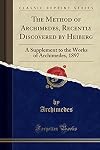
Excerpt from The Method of Archimedes, Recently Discovered by Heiberg: A Supplement to the Works of Archimedes, 1897 Greeks had some method or methods of analysis hardly less powerful than those of modern analysis yet, in general, they seem to have taken pains to clear away all traces of the machinery used and all the litter, so to speak, resulting from tentative efforts, before they permitted themselves to publish, in sequence carefully thought out, and with definitive and rigorously show more scientific proofs, the results obtained. A partial exception is now furnished by the Method for here we have a sort of lifting of the veil, a glimpse of the interior of Archimedes' workshop as it were. He tells us how he discovered certain theorems in quadrature and cubature, and he is at the same time careful to insist on the difference between (1) the means which may be sufficient to suggest the truth of theorems, although not furnishing scientific proofs of them, and (2) the rigorous demonstra tions of them by irrefragable geometrical methods which must follow before they can be finally accepted as established; to use Archi medes' own terms, the former enable theorems to be investigated (oewpe'iv) but not to be proved The mechanical method, then, used in our treatise and shown to be so useful for the discovery of theorems is distinctly said to be incapable of furnishing proofs of them; and Archimedes promises to add, as regards the two main theorems enunciated at the beginning, the necessary supplement in the shape of the formal geometrical proof. One of the two geometrical proofs is lost, but fragments of the other are contained in the ms. Which are sufficient to show that the method was the orthodox method of exhaustion in the form in which Archimedes applies it elsewhere, and to enable the proof to be reconstructed. About the Publisher Forgotten Books publishes hundreds of thousands of rare and classic books. Find more at www.forgottenbooks.com This book is a reproduction of an important historical work. Forgotten Books uses state-of-the-art technology to digitally reconstruct the work, preserving the original format whilst repairing imperfections present in the aged copy. In rare cases, an imperfection in the original, such as a blemish or missing page, may be replicated in our edition. We do, however, repair the vast majority of imperfections successfully; any imperfections that remain are intentionally left to preserve the state of such historical works. show lessTags
Recommendations






























Member Reviews
Members
- Recently Added By
Author Information

74+ Works 949 Members
Archimedes was a mathematician and inventor, born in Syracuse, Sicily, about 287 B.C. He became famous for his law of the lever and for inventing the catapult, parabolic mirror, and the mechanical crane that was capable of capsizing a ship by overturning it. These inventions were designed to defend Syracuse during the Second Punic War, which were show more waged between Rome and Carthage. While Archimedes made fundamental contributions to physics, his greatest contributions were to theoretical mathematics. Some of his works have come down to us. When Syracuse was taken in 212 B.C., Archimedes was killed by the Roman soldiers, being at the time intent upon a mathematical problem. show less
Work Relationships
Common Knowledge
- Canonical title
- The Method Treating of Mechanical Problems
Classifications
Statistics
- Members
- 42
- Popularity
- 699,575
- Reviews
- 1
- Rating
- (5.00)
- Languages
- 6 — Catalan, English, Greek (Ancient), Greek, Italian, Spanish
- Media
- Paper
- ISBNs
- 7