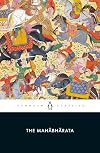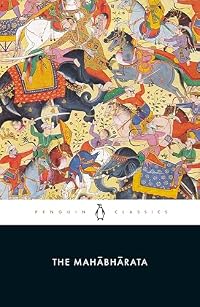
Mahābhārata (John D. Smith ed.)
by Vyasa, John D. Smith (Editor)
On This Page
Description
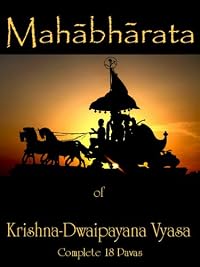
The Maha?bha?rata is one of the great works of world culture and the pinnacle of Sanskrit literature. It is also by some distance an epic of extraordinary length and breadth. Whilst there are many versions the longest is in the order of 1.9 million words across 200,000 lines of verse. In context if you combined both the Iliad and the Odyssey they would run to a mere quarter of its length. Within this sweep lies the Kuruks?etra War and the fates of the Kaurava and the Pa?n?d?ava princes. show more Woven within this are many devotional and philosophical offerings, including much on the four "goals of life" or purus?a?rtha; Dharma (righteousness, moral values), Artha (prosperity, economic values), Kama (pleasure, love, psychological values) and Moksha (liberation, spiritual values). Also enclosed within it are other well-known stories such as the Bhagavad Gita, the story of Damayanti, an abbreviated version of the Ra?ma?yan?a, and the story of R?s?yasringa. These are also considered as complete works in their own right. Turning to the issue of authorship it has traditionally been attributed to Vya?sa (also known as Veda Vya?sa, or Krishna Dvaipa?yana) who is also a character within it. Despite much scholarly detective work to unravel and reveal its history absolute certainty is difficult. The oldest preserved parts of the text are thought to be from around 400 BCE, although it is believed that its origin lies several centuries earlier perhaps as far back as the 9th century BCE and much of this was of oral tradition. The final version of the text probably reached its finished form by the early Gupta period (around the 4th century CE). The title 'Maha?bha?rata' may be best translated as "the great tale of the Bha?rata dynasty". Kisari Mohan Ganguli, known also as K. M. Ganguli has translated this version of all eighteen books from Sanskrit into English between the years 1883 and 1896. show lessTags
Recommendations








Member Reviews
If you ever start to feel like there's something special or unique about the Western literary tradition, here's a nice reminder that "our" background is kind of like the poor, illiterate, brutish cousin of a sophisticated, knowledgeable, emotionally wealthy woman. I'd read retellings of the M, but they conveyed nothing of the sheer joy of the whole; this, John D. Smith's translation/abridgement/retelling, manages to make clear just how amazing the whole thing must be, without actually giving you the experience of reading the whole thing. Instead, he translates sizable chunks, then summarises the rest--everything. The summaries are quite exhaustive and, particularly in the great battle scenes, exhaustingly dull. But hey, it's ancient show more literature. They cared about who killed whom and how.
Other thoughts that I had while reading this:
* why are there eighteen hundred translations of 1001 Nights, but only two complete English renderings of this poem, which is far more interesting from a narrative/structural level (storytellers telling stories that they heard from this guy who was told it in this fashion at this event--digression into that event, and the genealogies of participants in it usw), as well as having far more interesting individual tales embedded in it?
* why are there a similarly large number of translations of the Bhagavad Gita, but so few of Bhishma's far more interesting deathbed sermon? (summarized, rather than translated, here: it might get pretty boring if it were 1000 pages long, I guess).
* why do so many men in this poem spontaneously ejaculate when they witness a beautiful woman? Why is there always a goddess, or woman, or animal, or river on hand to collect up the spilled seed and turn it into children?
* This is the coolest thing I've ever read.
The problem I was left with was: I want to read lots of M, not necessarily the battle bits, but all the philosophy and tales and genealogies and so on. And there's no complete translation that seems readable and reliable. That said, I'm very keen to read all of book 3, and books 11-13. The former is available in the U of Chicago Press edition; the latter in the Clay Sanskrit Library.
Another problem, and a warning--I can't imagine this would be useful as a first approach to the M. But it was perfect for me. For the record, before starting it I'd read one of the short retellings (which cut out all the digressions, genealogies, philosophy and tales, i.e., the good stuff), the Bhagavad Gita, and the Oxford World's Classics translation of book 10. They're all short, and all approachable. show less
Other thoughts that I had while reading this:
* why are there eighteen hundred translations of 1001 Nights, but only two complete English renderings of this poem, which is far more interesting from a narrative/structural level (storytellers telling stories that they heard from this guy who was told it in this fashion at this event--digression into that event, and the genealogies of participants in it usw), as well as having far more interesting individual tales embedded in it?
* why are there a similarly large number of translations of the Bhagavad Gita, but so few of Bhishma's far more interesting deathbed sermon? (summarized, rather than translated, here: it might get pretty boring if it were 1000 pages long, I guess).
* why do so many men in this poem spontaneously ejaculate when they witness a beautiful woman? Why is there always a goddess, or woman, or animal, or river on hand to collect up the spilled seed and turn it into children?
* This is the coolest thing I've ever read.
The problem I was left with was: I want to read lots of M, not necessarily the battle bits, but all the philosophy and tales and genealogies and so on. And there's no complete translation that seems readable and reliable. That said, I'm very keen to read all of book 3, and books 11-13. The former is available in the U of Chicago Press edition; the latter in the Clay Sanskrit Library.
Another problem, and a warning--I can't imagine this would be useful as a first approach to the M. But it was perfect for me. For the record, before starting it I'd read one of the short retellings (which cut out all the digressions, genealogies, philosophy and tales, i.e., the good stuff), the Bhagavad Gita, and the Oxford World's Classics translation of book 10. They're all short, and all approachable. show less
http://nwhyte.livejournal.com/1645186.html
The Mahābhārata is much more accessible than, say, The Koran or Ta Hsüeh and Chung Yung, though also much much longer - the Penguin edition is 800 pages, and that is with two thirds of the text brutally summarized. Of course, it helps that there is a plot as well as profound philosophical, theological and moral discourse; perhaps the fairer comparison is with Homer (where I think the Mahābhārata still wins).
I did sometimes find it difficult to keep the names straight on my head; John D. Smith's translation and adaptation makes few concessions. I'm not used to Indian nomenclature and wasn't quite prepared for Kṛṣṇa rather than Krishna. It was rather late in the book before I show more distinguished Bhīṣma and Bhīma; and I was puzzled by the brother and sister demons Hiḍimbā and Hiḍimba until I looked a bit closer. But this is how one learns.
The epic itself is a grand mythological tale of a battle between two families, the hundred demonic sons of Dhṛtarāṣtra and the five Pāṇḍava brothers (who between them have four fathers and two mothers). The first five books (of 18) are the setup: the genealogy of the two sides, including various miraculous feats of reproduction - pregnancies varying in length from a day to a year, children born from the landscape after passing heroic men ejaculate upon it; I note also that women in the Mahābhārata actually menstruate which is rare in any fiction I have read. There is even a transsexual charioteer, Śikhaṇḍī.
The actual battle, which occupies the next five books, is about as tedious as most fictional epic battles. I was interested though that the world of the Mahābhārata is actually rather high-tech; Indra's chariot which takes people to another world is distinctly spaceshippy, and the mystical Weapons of This and That which are wielded on the battlefield are definitely technologies of mass destruction, a thought which famously occurred to Robert Oppenheimer. Also of course one has built up a certain sympathy for the characters in the earlier chapters, particularly the Pāṇḍava brothers and their long-suffering joint wife, Draupadī.
The philosophy comes in two large chunks. The more famous passage is actually the shorter of the two: the Bhagavad Gītā is preached by Kṛṣṇa to Arjuna, the most attractive character among the Pāṇḍava brothers, on the eve of the battle, and is an exposition on the theme of dharma, which encompasses duty, legal obligation, and destiny. But I actually found more interesting the longer passage, two entire books (books 12 and 13) of the dying reflections of Bhīṣma (fatally wounded at the start of the battle, seven books earlier). It is a fascinating blend of very profound meditations on the meaning of life and how one should behave to one's fellow human beings and the natural world, combined with a fairly strong element of supernatural justification for the continued social supremacy of the Brahman class.
Anyway, this is a colossally intense read, and probably it's worth trying to absorb through some other medium rather than a paperback adaptation (eg the Indian TV series, which in this day and age cannot be too difficult to obtain). But I found it rather rewarding. show less
The Mahābhārata is much more accessible than, say, The Koran or Ta Hsüeh and Chung Yung, though also much much longer - the Penguin edition is 800 pages, and that is with two thirds of the text brutally summarized. Of course, it helps that there is a plot as well as profound philosophical, theological and moral discourse; perhaps the fairer comparison is with Homer (where I think the Mahābhārata still wins).
I did sometimes find it difficult to keep the names straight on my head; John D. Smith's translation and adaptation makes few concessions. I'm not used to Indian nomenclature and wasn't quite prepared for Kṛṣṇa rather than Krishna. It was rather late in the book before I show more distinguished Bhīṣma and Bhīma; and I was puzzled by the brother and sister demons Hiḍimbā and Hiḍimba until I looked a bit closer. But this is how one learns.
The epic itself is a grand mythological tale of a battle between two families, the hundred demonic sons of Dhṛtarāṣtra and the five Pāṇḍava brothers (who between them have four fathers and two mothers). The first five books (of 18) are the setup: the genealogy of the two sides, including various miraculous feats of reproduction - pregnancies varying in length from a day to a year, children born from the landscape after passing heroic men ejaculate upon it; I note also that women in the Mahābhārata actually menstruate which is rare in any fiction I have read. There is even a transsexual charioteer, Śikhaṇḍī.
The actual battle, which occupies the next five books, is about as tedious as most fictional epic battles. I was interested though that the world of the Mahābhārata is actually rather high-tech; Indra's chariot which takes people to another world is distinctly spaceshippy, and the mystical Weapons of This and That which are wielded on the battlefield are definitely technologies of mass destruction, a thought which famously occurred to Robert Oppenheimer. Also of course one has built up a certain sympathy for the characters in the earlier chapters, particularly the Pāṇḍava brothers and their long-suffering joint wife, Draupadī.
The philosophy comes in two large chunks. The more famous passage is actually the shorter of the two: the Bhagavad Gītā is preached by Kṛṣṇa to Arjuna, the most attractive character among the Pāṇḍava brothers, on the eve of the battle, and is an exposition on the theme of dharma, which encompasses duty, legal obligation, and destiny. But I actually found more interesting the longer passage, two entire books (books 12 and 13) of the dying reflections of Bhīṣma (fatally wounded at the start of the battle, seven books earlier). It is a fascinating blend of very profound meditations on the meaning of life and how one should behave to one's fellow human beings and the natural world, combined with a fairly strong element of supernatural justification for the continued social supremacy of the Brahman class.
Anyway, this is a colossally intense read, and probably it's worth trying to absorb through some other medium rather than a paperback adaptation (eg the Indian TV series, which in this day and age cannot be too difficult to obtain). But I found it rather rewarding. show less
Mixed set. 12 volumes. English from the Sanskrit
Ratings
Members
- Recently Added By
Lists

Most Popular Penguins
70 works; 5 members

The Top Ten: Writers Pick Their Favorite Books
240 works; 31 members

Reading LIst
648 works; 1 member
Author Information

72+ Works 13,514 Members
Awards and Honors
Series
Belongs to Publisher Series
Work Relationships
Contains
Has the adaptation
Has as a student's study guide
Common Knowledge
Classifications
- Genres
- Religion & Spirituality, Fiction and Literature
- DDC/MDS
- 808 — Literature & rhetoric Literature, rhetoric & criticism Rhetoric and collections of literary texts from more than two literatures
- LCC
- BL1138.24 .E5 — Philosophy, Psychology and Religion Religions. Mythology. Rationalism Religions. Mythology. Rationalism History and principles of religions Asian. Oriental By religion Hinduism
- BISAC
Statistics
- Members
- 471
- Popularity
- 64,223
- Reviews
- 4
- Rating
- (4.28)
- Languages
- English
- Media
- Paper, Audiobook, Ebook
- ISBNs
- 17
- ASINs
- 3