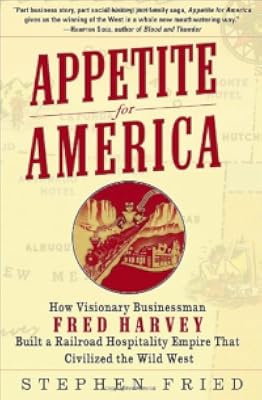
Appetite for America: Fred Harvey and the Business of Civilizing the Wild West--One Meal at a Time
by Stephen Fried 
On This Page
Description
Business. History. Nonfiction. Economics. Appetite for America is the incredible real-life story of Fred Harvey-told in depth for the first time ever. As a young immigrant, Fred Harvey worked his way up from dishwasher to household name: He was Ray Kroc before McDonald's, J. Willard Marriott before Marriott Hotels, Howard Schultz before Starbucks. His eating houses and hotels along the Atchison, Topeka, and Santa Fe railroad (including historic lodges still in use at the Grand Canyon) were show more patronized by princes, presidents, and countless ordinary travelers looking for the best cup of coffee in the country. Harvey's staff of carefully screened single young women-the celebrated Harvey Girls-were the country's first female workforce and became genuine Americana, even inspiring an MGM musical starring Judy Garland. With the verve and passion of Fred Harvey himself, Stephen Fried tells the story of how this visionary built his business from a single lunch counter into a family empire whose marketing and innovations we still encounter in myriad ways. Inspiring, instructive, and hugely entertaining, Appetite for America is historical biography that is as richly rewarding as a slice of fresh apple pie-and every bit as satisfying. show lessTags
Recommendations



















Member Reviews
I am old enough to remember the last gasp of Fred Harvey's hospitality empire in Chicago. Whenever we would pick up relatives at either the Dearborn or Union station, we would always go to the big Fred Harvey restaurants there before we went home. Later as the Interstate highway system began to criss-cross the state, the company ran the restaurants that were located in the oases that crossed the tollways. And in the 1950's I rode the Santa Fe Super Chief with my grandparents out to Los Angeles and got to spend three days eating sumptuous Fred Harvey meals in the dining car. But I really knew very little of the company or of Fred Harvey himself.
An immigrant from England in the 1850's, he worked in both the food service industry and then show more for the railroads, and also was a freelance salesman on the side. In his early forties, he decided to reinvent himself and started a business feeding train passengers in the American West, which in those days was still very wild, and in doing so became the father of what we know today as the American service industry. "Fred Harvey" was the first widely known and trusted brand in the country. He ran all the hotels and restaurants along the country's largest railroad, the Santa Fe, from Chicago to Los Angeles and later went on to serve the cross-country driving public along the fabled Route 66. His grandson took an interest in the early days of flying and was an original partner in TWA along with Charles Lindbergh and Henry Ford. He also provided countless women with employment opportunities as his famous Harvey Girls, championed the formation of the Grand Canyon National Park, and also created a national chain of newsstands and bookstores across the country.
He did all this while demanding the highest standards of service and quality of his product. At its peak Fred Harvey had sixty-five restaurants and lunch counters, a dozen large hotels (including El Tovar and Angel Brite on the South rim of the Grand Canyon and La Fonda in Santa Fe), all the restaurants and retail shops in the country's largest train stations, and controlled so many newsstands and bookstores that his orders affected the best seller lists.
Lastly, he played a huge role in developing the American tourism industry as we know it. He was largely responsible for creating the Grand Canyon as the country's premier National Park, and was a driving force in developing appreciation for Native American arts and culture. His embrace of Native American/Spanish American imagery in his hotels and restaurants in the American Southwest gave birth to what we know today as the "Santa Fe style."
But then what happened? As is often the case, the third generation of the family, raised in luxury, dropped the ball. Fred HArvey's grandson, Freddy, was more interested in flying than in attending to the day-to-day concerns of the business, and when he and his wife were killed in a tragic plane crash in the 1930's, the company was taken over by Fred Harvey;'s younger son Byron and his children., who decided to hitch their fortunes to the railroad instead of the driving or flying public, and we all know how that turned out. In 1966 what was left of the company went public and then was sold to a Hawaiian based conglomerate and that was that.
This is a fascinating story of an American entrepreneur who built a hospitality empire with the highest standards only for it to fall to pieces due to disruptive technologies in the twentieth century. show less
An immigrant from England in the 1850's, he worked in both the food service industry and then show more for the railroads, and also was a freelance salesman on the side. In his early forties, he decided to reinvent himself and started a business feeding train passengers in the American West, which in those days was still very wild, and in doing so became the father of what we know today as the American service industry. "Fred Harvey" was the first widely known and trusted brand in the country. He ran all the hotels and restaurants along the country's largest railroad, the Santa Fe, from Chicago to Los Angeles and later went on to serve the cross-country driving public along the fabled Route 66. His grandson took an interest in the early days of flying and was an original partner in TWA along with Charles Lindbergh and Henry Ford. He also provided countless women with employment opportunities as his famous Harvey Girls, championed the formation of the Grand Canyon National Park, and also created a national chain of newsstands and bookstores across the country.
He did all this while demanding the highest standards of service and quality of his product. At its peak Fred Harvey had sixty-five restaurants and lunch counters, a dozen large hotels (including El Tovar and Angel Brite on the South rim of the Grand Canyon and La Fonda in Santa Fe), all the restaurants and retail shops in the country's largest train stations, and controlled so many newsstands and bookstores that his orders affected the best seller lists.
Lastly, he played a huge role in developing the American tourism industry as we know it. He was largely responsible for creating the Grand Canyon as the country's premier National Park, and was a driving force in developing appreciation for Native American arts and culture. His embrace of Native American/Spanish American imagery in his hotels and restaurants in the American Southwest gave birth to what we know today as the "Santa Fe style."
But then what happened? As is often the case, the third generation of the family, raised in luxury, dropped the ball. Fred HArvey's grandson, Freddy, was more interested in flying than in attending to the day-to-day concerns of the business, and when he and his wife were killed in a tragic plane crash in the 1930's, the company was taken over by Fred Harvey;'s younger son Byron and his children., who decided to hitch their fortunes to the railroad instead of the driving or flying public, and we all know how that turned out. In 1966 what was left of the company went public and then was sold to a Hawaiian based conglomerate and that was that.
This is a fascinating story of an American entrepreneur who built a hospitality empire with the highest standards only for it to fall to pieces due to disruptive technologies in the twentieth century. show less
I really enjoyed this book and had the desire to try out the Harvey Houses still around after reading this book. Perhaps one day I really will. I love reading about the company and how it was able to thrive for so many years. Even today visiting train museum throughout the country many of them still mention the Harvey Houses, so learning the in depth story about them was fun and it was told with such excitement and knowledge.
As the book tells the story of the man, Fred Harvey, it also tells the story of the business that bore his name. It also chronicles a fascinating time in American history, as the expansion of the railroads led to new frontiers. As people moved west Fred Harvey did more that feed them--he also brought culture to the towns his eateries and hotels operated in as he imported fine dining, an expectation for manners and generosity, and females as the famous Harvey Girls took advantage of his offer for employment and a new start. It was quite interesting to read this detailed account of the the man and the company, which was eventually passed to his son but which did not manage to continue it's success after the railroads lost their status as show more the main mode of transportation. show less
Wonderful history. I was surprised how little I knew about the Harvey business (limited to the Judy Garland movie) given how trailblazing it was -- the first restaurant chain, its role in opening and civilizing the Southwest, the Grand Canyon. Probably those who live in the Southwest might know more, but this is a must read for anyone interested in the history of the Southwest or U.S. business history. Very well-researched and easily understood. Kudos.
A nice read. Well written, well researched, and plenty of extra material in the form of appendices and notes. I knew very little about Fred Harvey, but after this book I feel that he and his offspring are my bosom buddies.
Fred Harvey came to America, immigrating from London, in 1853 when he was seventeen. He quickly found work and began his journey towards owning a nationally known and influential business that as the subtitle for the book says was a "Railroad Hospitality Empire That Civilized the Wild West". I really enjoyed this story about Harvey, his business, and all the railroad and western history that Fried gave the reader. Even the appendices were interesting, especially the one of recipes from the Fred Harvey Houses.
This is a terrific book written by a highly talented author. The late 19th century was a very dynamic period in American history and the author captures the huge changes in America through a lens focused on the development of a great company led by the incomparable Fred Harvey and his son Ford. An amazing story and a highly enjoyable read.
Members
- Recently Added By
Published Reviews
ThingScore 75
Before it was a brand, Fred Harvey was a man, and while Fried’s book includes his biography — the tale of a poor immigrant who became the founding father of the American hospitality industry — Harvey’s death, in 1901, comes before the story is halfway through. Fried follows Fred Harvey, the company, as it grew and thrived well into the mid-20th century. When the business passed from show more Fred Harvey to his son and then his grandson, the brand never changed. Long after his death, customers still felt “as if they were being taken care of by Fred Harvey himself.” show less
added by Shortride
In "Appetite for America," Stephen Fried aims to give Fred Harvey his due, making an impressive case for this Horatio Alger tale written in mashed potatoes and gravy.
added by atbradley
Author Information

17+ Works 1,185 Members
Stephen Fried is a journalist and author. His books include Thing of Beauty: The Tragedy of Supermodel Gia, Appetite for America: Fred Harvey and the Business of Civilizing the Wild West-One Meal at a Time, Bitter Pills: Inside the Hazardous World of Legal Drugs, The New Rabbi, and Husbandry. He and Patrick J. Kennedy wrote A Common Struggle: A show more Personal Journey through the Past and Future of Mental Illness and Addiction. He won the National Magazine Award twice and is an adjunct professor at Columbia University Graduate School of Journalism. (Bowker Author Biography) show less
Stephen Fried is a LibraryThing Author, an author who lists their personal library on LibraryThing.
Awards and Honors
Awards
Distinctions
Notable Lists
Common Knowledge
- Original publication date
- 2010
- People/Characters
- Fred Harvey; Ford Harvey; Harvey Girls; Freddy Harvey
- Epigraph
- Fred Harvey? Do you know the name? If not, then your education has been much neglected...
Fred Harvey set a standard of excellence!...He has been a civilizer and a benefactor. He has added to the physical, mental an... (show all)d spiritual welfare of millions. No sermon can equal a Fred Harvey example--no poet can better a Fred Harvey precept. Fred Harvey simply kept faith with the public. He gave pretty nearly a perfect service...
The kind of business a man builds up is a reflection of himself--spun out of his heart. Man, like Deity, creates in his own image. I take my hat off to Fred Harvey, who served...so faithfully and well, that dying, he yet lives, his name a symbol of all that is honest, excellent, hygienic, beautiful and useful.
--Elbert Hubbard, renowned American orator, philosopher, and author of the early twentieth century
Wild buffalo fed the early traveler in the West and for doing so they put his picture on a nickel.
Well, Fred Harvey took up where the buffalo left off.
For what he has done for the traveler, one of his waitress... (show all)'s pictures (with an arm load of delicious ham and eggs) should be placed on both sides of every dime. He has kept the West in food--and wives.
--Will Rogers
RADIO INTERVIEWER: "How do you feel today, Mr. President?"
HARRY TRUMAN: "Fine. I just had breakfast, and I aways feel fine after having a meal at Fred Harvey's. That's a 'plug' and I won't get paid for it, but I like ... (show all)the food anyway." - Dedication
- To Mom and Nana, who taught me the comforts of food, home, and family; and to my traveling companion in life, Black Bart
- First words
- On that spring night in 1882, the drunken cowboys riding through northern New Mexico could have been forgiven for squinting in disbelief at the sight of the Montezuma Hotel.
- Last words
- (Click to show. Warning: May contain spoilers.)"On the Atchison, Topeka, and the Santa Fe" was America's audio comfort food--the nostalgic sound of the most powerful nation in the world finally at peace.
Classifications
- Genres
- History, Nonfiction, General Nonfiction, Business, Biography & Memoir, Food & Cooking
- DDC/MDS
- 647.95092 — Applied science & technology Home economics & family management Management of public households (Institutional housekeeping) Specific kinds of public households and institutions Eating and drinking places modified standard subdivisions History, geographic treatment, biography Biography
- LCC
- TX910.5 .H34 .F75 — Technology Home economics Home economics Hospitality industry. Hotels, clubs,
- BISAC
Statistics
- Members
- 376
- Popularity
- 83,271
- Reviews
- 10
- Rating
- (4.15)
- Languages
- English
- Media
- Paper, Audiobook, Ebook
- ISBNs
- 5
- ASINs
- 7