
About the Author
Stephen Fried is a journalist and author. His books include Thing of Beauty: The Tragedy of Supermodel Gia, Appetite for America: Fred Harvey and the Business of Civilizing the Wild West-One Meal at a Time, Bitter Pills: Inside the Hazardous World of Legal Drugs, The New Rabbi, and Husbandry. He show more and Patrick J. Kennedy wrote A Common Struggle: A Personal Journey through the Past and Future of Mental Illness and Addiction. He won the National Magazine Award twice and is an adjunct professor at Columbia University Graduate School of Journalism. (Bowker Author Biography) show less
Image credit: jim graham/graham studios inc
Works by Stephen Fried
Appetite for America: Fred Harvey and the Business of Civilizing the Wild West--One Meal at a Time (2010) 377 copies, 10 reviews
Rush: Revolution, Madness, and Benjamin Rush, the Visionary Doctor Who Became a Founding Father (2018) 263 copies, 11 reviews
Mobile Device Security: A Comprehensive Guide to Securing Your Information in a Moving World (2010) 2 copies
Rush 1 copy
A Common Struggle: A Personal Journey Through the Past and Future of Mental Illness and Addiction 1 copy
The Fred Harvey Cookbook 1 copy
Associated Works
Smithsonian Magazine, Vol. 48, No. 1. April 2017: Ring Freedom - How The Liberty Bell Won The Great War (2017) — Author, some editions — 2 copies
Tagged
Common Knowledge
- Birthdate
- c.1959
- Gender
- male
- Education
- University of Pennsylvania (1979)
- Short biography
- I'm the author of THING OF BEAUTY: The Tragedy of Supermodel Gia (which inspired the Emmy-winning film Gia and introduced the word "fashionista" into the English language), BITTER PILLS: Inside the Hazardous World of Legal Drugs, THE NEW RABBI, an essay collection, HUSBANDRY, and a new historical biography, APPETITE FOR AMERICA: How Visionary Businessman Fred Harvey Built a Railroad Hospitality Empire that Civilized the Wild West. I teach magazine writing at Columbia University Graduate School of Journalism, and write for national magazines. I live in Philadelphia with my wife, author Diane Ayres. www.stephenfried.com
- Nationality
- USA
- Places of residence
- Philadelphia, Pennsylvania, USA
Harrisburg, Pennsylvania, USA - Associated Place (for map)
- Pennsylvania, USA
Members
Reviews

There are many angles to motivate reading this book, and mine is from a deep interest in HIV. The supermodel known simply as "Gia" was one of the first prominent women to die of AIDS-related complications, and she remains one of the best-explored IV drug users who died from AIDS. Of course, most of the world knows her as a model who quickly rose to the front pages of the world's leading fashion magazines in the 1970s. Then, just as quickly, she disappeared from the public light and died an show more obscure, untimely death.
The biography explores her unstable relationship with her mother, her lesbian relationships, her vast drug use including heroin, and the ephemeral vacuity of a modeling career. Everyone was willing to photograph her for a photo spread, but no one was willing to get her help. That speaks as a moral indictment of the entire industry. The narrative also indicts President Reagan's "Just Say No" campaign that undercut any compassionate care for recovering drug addicts.
Gia was at once a superstar and a marginalized figure. She was both rich and tortured. The ever-present pain behind her eyes both tantalized the camera and drove an unstable life. The book reads like a journalist's account of her life and does not enter into much philosophical exploration of her life's meaning or of the inhumane treatment she gathered. But at least, it did memorialize her life so that obscurity and ignominy were not the last words. show less
The biography explores her unstable relationship with her mother, her lesbian relationships, her vast drug use including heroin, and the ephemeral vacuity of a modeling career. Everyone was willing to photograph her for a photo spread, but no one was willing to get her help. That speaks as a moral indictment of the entire industry. The narrative also indicts President Reagan's "Just Say No" campaign that undercut any compassionate care for recovering drug addicts.
Gia was at once a superstar and a marginalized figure. She was both rich and tortured. The ever-present pain behind her eyes both tantalized the camera and drove an unstable life. The book reads like a journalist's account of her life and does not enter into much philosophical exploration of her life's meaning or of the inhumane treatment she gathered. But at least, it did memorialize her life so that obscurity and ignominy were not the last words. show less
Rush: Revolution, Madness, and Benjamin Rush, the Visionary Doctor Who Became a Founding Father by Stephen Fried
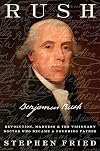
One of the best biographies of a Founding Father. The author has a true passion for the topic which engulfs the reader. The selection of material from such a long productive life must have been agonizing. Benjamin Rush was obviously a key player in America's existence but also one of the least recognized. Mr. Fried made this point abundantly clear in a fresh, compelling and revealing way. This author has a unique ability to disclose the details of the subject's humanity. This is refreshingly show more done for a founding father. Benjamin Rush was an amazing model for many of us, a product of his time but also a visionary with a true Christian soul. show less
Rush: Revolution, Madness, and Benjamin Rush, the Visionary Doctor Who Became a Founding Father by Stephen Fried
Summary: A full-length biography of this doctor-founder of the American republic covering his personal life and beliefs, advocacy, war service, and friendships with the Founders, and estrangement from Washington.
He turns up in almost every biography of an American founder or account of the American War of Independence. He played a pivotal role in battle field hygiene, the training of American doctors, and in the field of mental illness. His profile adorns the logo of the American Psychiatric show more Association. But one has to look hard for accounts of the life of Dr. Benjamin Rush until recently. Even John Adams expressed displeasure that Ben Franklin received far more notice although he believed Benjamin Rush the better man. In the past year, this balance has begun to be redressed. Harlow Giles Unger, who has written on most of the Founders has published a biography on Rush.
A fellow Philadelphian, journalist Stephen Fried, has completed what may be the definitive account of Rush's life, using a growing archive of Rush's correspondence and other documents, to give us a many-faceted portrait of one of America's most distinctive Founders.
He begins with a spirited young boy who lost his father before turning six, lived with an aunt and uncle while attending Reverend Samuel Finley's school. He graduated from Princeton at fourteen, apprenticed under Dr. John Redman for the next five years, and then went to Edinburgh for medical studies.
On his return, he is offered a chair in Chemistry at the College of Philadelphia, while alienating two of his mentors, John Morgan and William Shippen over credits on publications. With Shippen, this is just the beginning.
He is friends with nearly all the Founders, particularly as their paths crossed in Philadelphia. His welcome and advice to John Adams was critical in winning the support of the other colonies to the resistance that began in Massachusetts. He was highly esteemed by Franklin and succeeded Franklin as chair of the Philosophical Society of which they were both a part. He was a sounding board to Thomas Paine as he composed Common Sense. He is one of the youngest signers of the Declaration of Independence.
Like others, he sets aside personal interests to head a surgical department for the war effort, and confronts horrible battlefield conditions and Dr. Shippen's mishandling of funds and resources as Surgeon General. His efforts to protest this ultimately fails, but here, as elsewhere, his pen achieves what he otherwise could not in his manual for battle field hygiene, implemented over the next hundred years and saving many lives. The other, and more profound controversy of the war concerned an unsigned letter he sent to Patrick Henry expressing reservations about Washington's leadership. Henry passed the letter along to Washington, who recognized Rush's handwriting. Relations were never warm, thereafter. In later years, he expressed both regret for the letter, and admiration for Washington.
The same passion that got him into trouble also made him an effective advocate with many causes. He was a devout believer, but participated in both Presbyterian and Anglican congregations and was an early proponent of religious tolerance. He loved conversation with skeptics like Jefferson while remaining orthodox in his own beliefs (even reciting an Anglican prayer book prayer on his deathbed). He advocated for the rights of blacks and the abolition of slavery (although he owned a slave that he only eventually and quietly emancipated) and helped start the first African church in Philadelphia. He was a proponent of education, founding Dickinson College, and advocated for the education of women. Perhaps most significant, with his appointment to the Philadelphia Hospital, he noticed the poor conditions of those suffering from mental illness, campaigning for separate and more humane treatment facilities. One of the most poignant aspects of this focus was that his eldest son John was one of his patients. He pioneered occupational therapies and treatments for addiction.
As a doctor, Fried's portrait is of a dedicated, even heroic figure, tragically wedded to the dubious or even harmful methods of his day, notably the bleeding and purging of patients, which may have hastened mortality in a number of cases. His medical treatises often are extended defenses of these measures. Still, he remained in Philadelphia through a horrendous yellow fever epidemic, contracting (and surviving) the disease himself. He was considered one of the leading medical figures of the day, consulting with Lewis and Clark, provisioning them with medicines, including what they reported to be a very effective laxative! His greatest medical contribution may have been the hygiene and sanitation measures he recommended for the military that no doubt reduced the number of deaths from conditions in military camps.
While Rush's correspondence got him in trouble in the early part of his life, at another point, he was responsible for a reconciliation that led to a most amazing exchange of letters. For a dozen years, Adams and Jefferson had been estranged from each other since the election of 1800. Rush was friends with both. He began by sharing a "dream" with Adams (a common device in their letters) about Adams and Jefferson resuming their friendship. Slowly, he helped the two of them resume correspondence, which eventually swelled to over 280 letters before both died July 4, 1826, fifty years after signing the Declaration of Independence with Rush. Both would outlive Rush, who died either of typhus or tuberculosis in 1813.
Altogether Rush and his wife Julia had thirteen children, a number dying in infancy or youth (not uncommon at this time). Richard, the second born served in both the Madison and Monroe administrations in cabinet positions while James followed in his steps as a physician and became a prominent figure, marrying into wealth.
Fried's portrayal drew me in by exploring this distinctive man in his greatness and flaws. His youthful ambition and sense of rectitude overpowers his judgment of what is both appropriate and possible. He could be quite prickly in defending his own reputation, especially during the yellow fever epidemic, where his methods, if not his dedication, could be questioned. He shines in his friendships, his advocacy, and his love for his wife. He also seems something of a tragic figure as he watches the dissolution of his eldest son's sanity, and the hopes that he would follow in his steps. I suspect he wasn't an easy man to have as a father.
Fried has done us a great service. He has chronicled in full the life of one of the Founders who obviously deserves far more attention than he has received. Instead of being a bit player in the stories of others, we are introduced to Rush on his own terms, and begin to understand why he was in all the other stories. Were it not for him, we would not have the sparkling correspondence between Adams and Jefferson and the humane treatment of the mentally ill. You might say, he was the doctor who assisted at the birth of a nation.
_____________________________________
Disclosure of Material Connection: I received this an advanced review e-galley of this book from the publisher via Netgalley. I was not required to write a positive review. The opinions I have expressed are my own show less
He turns up in almost every biography of an American founder or account of the American War of Independence. He played a pivotal role in battle field hygiene, the training of American doctors, and in the field of mental illness. His profile adorns the logo of the American Psychiatric show more Association. But one has to look hard for accounts of the life of Dr. Benjamin Rush until recently. Even John Adams expressed displeasure that Ben Franklin received far more notice although he believed Benjamin Rush the better man. In the past year, this balance has begun to be redressed. Harlow Giles Unger, who has written on most of the Founders has published a biography on Rush.
A fellow Philadelphian, journalist Stephen Fried, has completed what may be the definitive account of Rush's life, using a growing archive of Rush's correspondence and other documents, to give us a many-faceted portrait of one of America's most distinctive Founders.
He begins with a spirited young boy who lost his father before turning six, lived with an aunt and uncle while attending Reverend Samuel Finley's school. He graduated from Princeton at fourteen, apprenticed under Dr. John Redman for the next five years, and then went to Edinburgh for medical studies.
On his return, he is offered a chair in Chemistry at the College of Philadelphia, while alienating two of his mentors, John Morgan and William Shippen over credits on publications. With Shippen, this is just the beginning.
He is friends with nearly all the Founders, particularly as their paths crossed in Philadelphia. His welcome and advice to John Adams was critical in winning the support of the other colonies to the resistance that began in Massachusetts. He was highly esteemed by Franklin and succeeded Franklin as chair of the Philosophical Society of which they were both a part. He was a sounding board to Thomas Paine as he composed Common Sense. He is one of the youngest signers of the Declaration of Independence.
Like others, he sets aside personal interests to head a surgical department for the war effort, and confronts horrible battlefield conditions and Dr. Shippen's mishandling of funds and resources as Surgeon General. His efforts to protest this ultimately fails, but here, as elsewhere, his pen achieves what he otherwise could not in his manual for battle field hygiene, implemented over the next hundred years and saving many lives. The other, and more profound controversy of the war concerned an unsigned letter he sent to Patrick Henry expressing reservations about Washington's leadership. Henry passed the letter along to Washington, who recognized Rush's handwriting. Relations were never warm, thereafter. In later years, he expressed both regret for the letter, and admiration for Washington.
The same passion that got him into trouble also made him an effective advocate with many causes. He was a devout believer, but participated in both Presbyterian and Anglican congregations and was an early proponent of religious tolerance. He loved conversation with skeptics like Jefferson while remaining orthodox in his own beliefs (even reciting an Anglican prayer book prayer on his deathbed). He advocated for the rights of blacks and the abolition of slavery (although he owned a slave that he only eventually and quietly emancipated) and helped start the first African church in Philadelphia. He was a proponent of education, founding Dickinson College, and advocated for the education of women. Perhaps most significant, with his appointment to the Philadelphia Hospital, he noticed the poor conditions of those suffering from mental illness, campaigning for separate and more humane treatment facilities. One of the most poignant aspects of this focus was that his eldest son John was one of his patients. He pioneered occupational therapies and treatments for addiction.
As a doctor, Fried's portrait is of a dedicated, even heroic figure, tragically wedded to the dubious or even harmful methods of his day, notably the bleeding and purging of patients, which may have hastened mortality in a number of cases. His medical treatises often are extended defenses of these measures. Still, he remained in Philadelphia through a horrendous yellow fever epidemic, contracting (and surviving) the disease himself. He was considered one of the leading medical figures of the day, consulting with Lewis and Clark, provisioning them with medicines, including what they reported to be a very effective laxative! His greatest medical contribution may have been the hygiene and sanitation measures he recommended for the military that no doubt reduced the number of deaths from conditions in military camps.
While Rush's correspondence got him in trouble in the early part of his life, at another point, he was responsible for a reconciliation that led to a most amazing exchange of letters. For a dozen years, Adams and Jefferson had been estranged from each other since the election of 1800. Rush was friends with both. He began by sharing a "dream" with Adams (a common device in their letters) about Adams and Jefferson resuming their friendship. Slowly, he helped the two of them resume correspondence, which eventually swelled to over 280 letters before both died July 4, 1826, fifty years after signing the Declaration of Independence with Rush. Both would outlive Rush, who died either of typhus or tuberculosis in 1813.
Altogether Rush and his wife Julia had thirteen children, a number dying in infancy or youth (not uncommon at this time). Richard, the second born served in both the Madison and Monroe administrations in cabinet positions while James followed in his steps as a physician and became a prominent figure, marrying into wealth.
Fried's portrayal drew me in by exploring this distinctive man in his greatness and flaws. His youthful ambition and sense of rectitude overpowers his judgment of what is both appropriate and possible. He could be quite prickly in defending his own reputation, especially during the yellow fever epidemic, where his methods, if not his dedication, could be questioned. He shines in his friendships, his advocacy, and his love for his wife. He also seems something of a tragic figure as he watches the dissolution of his eldest son's sanity, and the hopes that he would follow in his steps. I suspect he wasn't an easy man to have as a father.
Fried has done us a great service. He has chronicled in full the life of one of the Founders who obviously deserves far more attention than he has received. Instead of being a bit player in the stories of others, we are introduced to Rush on his own terms, and begin to understand why he was in all the other stories. Were it not for him, we would not have the sparkling correspondence between Adams and Jefferson and the humane treatment of the mentally ill. You might say, he was the doctor who assisted at the birth of a nation.
_____________________________________
Disclosure of Material Connection: I received this an advanced review e-galley of this book from the publisher via Netgalley. I was not required to write a positive review. The opinions I have expressed are my own show less
Rush: Revolution, Madness, and Benjamin Rush, the Visionary Doctor Who Became a Founding Father by Stephen Fried
This was one of the best biographies I’ve read in a long time, and I’m so glad this was the book that introduced me to Benjamin Rush. He was amazingly multitalented, and I have no idea how one person could do so much. He spent most of his time studying and practicing medicine, but for a time he also became involved in politics and even signed the Declaration of Independence. Later, he became disgusted with politics and withdrew to go back to medicine, but he maintained a voluminous show more correspondence with both John Adams and Thomas Jefferson. He also became an abolitionist and freed the single slave he had. He also made efforts to lobby the Constitutional Convention to “include language abolishing slavery and offering full voting citizenship to free blacks.” (Page 297). In addition, he became friends became friends with several black preachers and helped them found their churches. He was also a fierce proponent of public education, including higher education, and founded a college. He supported educating women to the same extent as men, arguing among other things that children learn first from their mothers.
He was also very accomplished as a medical doctor. During the Revolutionary War, he wrote to Washington and asked him to order all his troops to be inoculated against smallpox. Washington agreed, and it is estimated that this three-paragraph letter saved more lives than anything else any doctor did during the Revolutionary War. Later, he taught at the first medical school in the United States. He is also considered the founding father of American psychiatry, and for decades his face was on the seal of the APA. Rush was one of the first people to believe that “madness” was actually an illness that could and should be treated using the best medical knowledge available, as opposed to an issue of morality or some other personal failing. For example, he was one of the first to recognize alcoholism as a physical illness: “In 1784, after less than a year on the hospital staff, he published a ten-page pamphlet called “An Enquiry into the Effects of Spirituous Liquors upon the Human Body, and Their Influence upon the Happiness of Society,” which offered one of the first modern descriptions of the effects of chronic alcohol use.” (Page 265). He also supported using the forerunners of modern occupational and talk therapy.
Rush’s first full-length book, titled ““Medical Inquiries and Observations,” became the first American medical book widely known across the country, and even in Europe. Patients and physicians even began contacting him and asking for diagnoses by mail. And when he tried to tactfully discourage this practice by explaining that postage rates were too high for him to respond to all the letters, the letter writers simply began including money to pay for postage along with the letters.
During the great 1793 yellow fever epidemic in Philadelphia, he stayed behind to treat the ill rather than leave Philadelphia with his wife and children. His actions were heroic, considering that there was no cure for yellow fever at the time, no one knew what caused it, and he did end up contracting the disease from the people he treated for free, although he survived. It’s worth pointing out that even today there is no cure that specifically targets the yellow fever virus, although there are several preventative measures – mosquito control and a yellow fever vaccine (receiving the vaccine is a condition for travelling to some parts of Africa and other areas where yellow fever commonly occurs). He insisted in his letters that staying behind to treat the ill, even at his own risk, was a religious obligation – he said that while the Old Testament required men to love their neighbors as themselves, the New required them to love their neighbors better than themselves. Despite his strong religious convictions, he ardently supported the separation of church and state and corresponded with atheists and Deists.
Some other physicians also stayed in Philadelphia to treat patients, and they used different methods to treat yellow fever than Rush did. This precipitated an ugly battle of egos between Rush and competing physicians, as well as a conflict over race:
“Carey’s [a competing physician] book refueled every fight that had just died down in the medical and political communities and instigated a new one between the races: he reported that the black men and women who had been so heroic [in staying behind to help treat yellow fever patients] had also overcharged many people and plundered some of their houses…Rush did not respond publicly to Carey’s book…But he no doubt encouraged the book-length response to it written by Absalom Jones and Richard Allen. Their book, “A Narrative of the Proceedings of the Black People, During the Late Awful Calamity in Philadelphia, in the year 1793: and a Refutation of Some Censures, Thrown upon Them in Some Late Publications,” was published on January 24, 1794, and became a landmark in many ways. It was the first copyrighted book ever written by African Americans, and it was also the first time black authors challenged a prominent white journalist – and some of Philadelphia’s more racist (yet unnamed) citizens – in print.” (Pages 368-369).
It was widely believed at the time that black people could not contract yellow fever (obviously this isn’t true, as shown by city records, although many had doubtless been exposed in Africa and had become immune), and they were encouraged to stay behind to help treat the ill. Many did, and Rush hoped this would help improve race relations. Unfortunately, it did not.
In addition to new editions of “Medical Inquiries and Observations” (which included his thoughts on mental illness), Rush wrote a book defending his treatment methods during the 1793 epidemic. By 1794, his most recent edition of “Medical Inquiries and Observations” and his book on yellow fever became known in England and Germany. The yellow fever book was also published in London, where it became well-known and “aggressively” reviewed.
Rush was also active as a medical school professor at the University of Pennsylvania. In addition to his regular duties in training physicians, he also wrote and delivered a new “Introductory Lecture to courses of Lectures upon the Institutes and Practice of Medicine” to start the school year each fall. He started doing this in 1791, as soon as the medical school opened, and looked forward to giving a new one each year:
“In the years to come he gave a lecture on Hippocrates; another “On the duty and advantages of studying the diseases of domestic animals, and the remedies proper to remove them” – which would be considered the beginning of veterinary medicine…One year he even took on “the duties of patients to their physicians, which, among his advice on specific ways to follow doctors’ orders, also explained the right way to fire your physician.” (Pages 414-415).
In the fall of 1812, Rush published his magnum opus, “Medical Inquiries and Observations, upon the Diseases of the Mind.” As the book explained,
“The title was meant to link the book to his life-long medical text project, but most people referred to it by the shortened name embossed on the spine: Rush on the Mind. It was a late-career effort by the most celebrated doctor in America to bring all his credibility as a physician, a scientist, a revolutionary, and a man of faith to the most vexing and painful problem of all: mental illness, and society’s failure to understand and care for some of its most marginalized members.” (Page 468).
It was the first American book to specifically deal with mental illness and addiction, and Rush’s greatest legacy to American medicine show less
He was also very accomplished as a medical doctor. During the Revolutionary War, he wrote to Washington and asked him to order all his troops to be inoculated against smallpox. Washington agreed, and it is estimated that this three-paragraph letter saved more lives than anything else any doctor did during the Revolutionary War. Later, he taught at the first medical school in the United States. He is also considered the founding father of American psychiatry, and for decades his face was on the seal of the APA. Rush was one of the first people to believe that “madness” was actually an illness that could and should be treated using the best medical knowledge available, as opposed to an issue of morality or some other personal failing. For example, he was one of the first to recognize alcoholism as a physical illness: “In 1784, after less than a year on the hospital staff, he published a ten-page pamphlet called “An Enquiry into the Effects of Spirituous Liquors upon the Human Body, and Their Influence upon the Happiness of Society,” which offered one of the first modern descriptions of the effects of chronic alcohol use.” (Page 265). He also supported using the forerunners of modern occupational and talk therapy.
Rush’s first full-length book, titled ““Medical Inquiries and Observations,” became the first American medical book widely known across the country, and even in Europe. Patients and physicians even began contacting him and asking for diagnoses by mail. And when he tried to tactfully discourage this practice by explaining that postage rates were too high for him to respond to all the letters, the letter writers simply began including money to pay for postage along with the letters.
During the great 1793 yellow fever epidemic in Philadelphia, he stayed behind to treat the ill rather than leave Philadelphia with his wife and children. His actions were heroic, considering that there was no cure for yellow fever at the time, no one knew what caused it, and he did end up contracting the disease from the people he treated for free, although he survived. It’s worth pointing out that even today there is no cure that specifically targets the yellow fever virus, although there are several preventative measures – mosquito control and a yellow fever vaccine (receiving the vaccine is a condition for travelling to some parts of Africa and other areas where yellow fever commonly occurs). He insisted in his letters that staying behind to treat the ill, even at his own risk, was a religious obligation – he said that while the Old Testament required men to love their neighbors as themselves, the New required them to love their neighbors better than themselves. Despite his strong religious convictions, he ardently supported the separation of church and state and corresponded with atheists and Deists.
Some other physicians also stayed in Philadelphia to treat patients, and they used different methods to treat yellow fever than Rush did. This precipitated an ugly battle of egos between Rush and competing physicians, as well as a conflict over race:
“Carey’s [a competing physician] book refueled every fight that had just died down in the medical and political communities and instigated a new one between the races: he reported that the black men and women who had been so heroic [in staying behind to help treat yellow fever patients] had also overcharged many people and plundered some of their houses…Rush did not respond publicly to Carey’s book…But he no doubt encouraged the book-length response to it written by Absalom Jones and Richard Allen. Their book, “A Narrative of the Proceedings of the Black People, During the Late Awful Calamity in Philadelphia, in the year 1793: and a Refutation of Some Censures, Thrown upon Them in Some Late Publications,” was published on January 24, 1794, and became a landmark in many ways. It was the first copyrighted book ever written by African Americans, and it was also the first time black authors challenged a prominent white journalist – and some of Philadelphia’s more racist (yet unnamed) citizens – in print.” (Pages 368-369).
It was widely believed at the time that black people could not contract yellow fever (obviously this isn’t true, as shown by city records, although many had doubtless been exposed in Africa and had become immune), and they were encouraged to stay behind to help treat the ill. Many did, and Rush hoped this would help improve race relations. Unfortunately, it did not.
In addition to new editions of “Medical Inquiries and Observations” (which included his thoughts on mental illness), Rush wrote a book defending his treatment methods during the 1793 epidemic. By 1794, his most recent edition of “Medical Inquiries and Observations” and his book on yellow fever became known in England and Germany. The yellow fever book was also published in London, where it became well-known and “aggressively” reviewed.
Rush was also active as a medical school professor at the University of Pennsylvania. In addition to his regular duties in training physicians, he also wrote and delivered a new “Introductory Lecture to courses of Lectures upon the Institutes and Practice of Medicine” to start the school year each fall. He started doing this in 1791, as soon as the medical school opened, and looked forward to giving a new one each year:
“In the years to come he gave a lecture on Hippocrates; another “On the duty and advantages of studying the diseases of domestic animals, and the remedies proper to remove them” – which would be considered the beginning of veterinary medicine…One year he even took on “the duties of patients to their physicians, which, among his advice on specific ways to follow doctors’ orders, also explained the right way to fire your physician.” (Pages 414-415).
In the fall of 1812, Rush published his magnum opus, “Medical Inquiries and Observations, upon the Diseases of the Mind.” As the book explained,
“The title was meant to link the book to his life-long medical text project, but most people referred to it by the shortened name embossed on the spine: Rush on the Mind. It was a late-career effort by the most celebrated doctor in America to bring all his credibility as a physician, a scientist, a revolutionary, and a man of faith to the most vexing and painful problem of all: mental illness, and society’s failure to understand and care for some of its most marginalized members.” (Page 468).
It was the first American book to specifically deal with mental illness and addiction, and Rush’s greatest legacy to American medicine show less
Lists
Awards


You May Also Like


Associated Authors
Statistics
- Works
- 17
- Also by
- 2
- Members
- 1,193
- Popularity
- #21,547
- Rating
- 4.0
- Reviews
- 35
- ISBNs
- 31
- Languages
- 1
- Favorited
- 1
