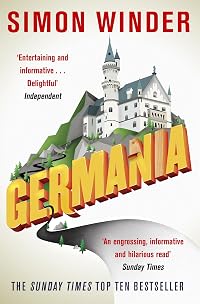
Germania: In Wayward Pursuit of the Germans and Their History
by Simon Winder
On This Page
Description
"Germania" explores how people are misled by history, how they twist history, and how sometimes it is best to know no history at all. The work is full of curiosities, odd food, castles, mad princes, and fairy tales--the unseen sides of Germany.Tags
Recommendations











Member Reviews
Pungent, witty, sometimes hilarious, deftly satirical, but written from a place of deep love and affection if also exasperation and, as you might well imagine when the twentieth century comes around, borderline despair. Personalities, politics, instiutions, geography, borders, customs and endless little museums, displays, historical folk-park nonsense, often appalling monuments and frescos, meander through this exploration of place and history and, not incidentally, the mindset of the writer for whom it is all a sort of resigned obsession.
I enjoyed Simon Winder’s book Danubia enough to seek out his earlier combination travelogue/history, Germania - a "personal response," as he calls it, to German history.
Writing “German” history prior to 1871 presents a daunting task because before that date there was no country known as “Germany.” The land we think of as Germany was composed of numerous principalities, dukedoms, bishoprics, and independent city-states that popped in and out of existence owing to the vagaries of hereditary suzerainty and noble marriages. Winder notes that successive historical maps of the country resemble nothing so much as "an explosion in a jigsaw factory." He does not undertake to present a chronological narrative; rather, he travels around show more the countryside and regales the reader with stories relevant to the place he is visiting, although the history still manages to be presented in roughly chronological order.
Winder is not one to make heroes of long-gone historical characters. Of Charlemagne he writes:
"As usual with such leaders, historians – who are generally rather introverted and mild individuals – tend to wish Charlemagne to be at heart keen on jewels, saints’ relics and spreading literacy, whereas an argument might be made for his core competence being the efficient piling-up of immense numbers of dead Saxons.”
Rather, the “heroes” of Winder’s story are the Free Imperial Cities such as Strasburg , Nuremberg, and the Hanseatic League that endured the middle ages as independent entities fostering trade and cosmopolitan values.
Winder breaks off his history in 1933 with the rise of the Nazis, avoiding not only the nastiest period in German history, but also its remarkable economic recovery after World War II. But he does manage to get in a few jabs at modern Germany, as with his exploration of what it means to “be” German, spoofing the Nazi’s efforts to create a pure Aryan race. After a short summary of the shifts of various unrelated tribes over the territory for about a thousand years, he says, “In practice Germany is a chaotic ethnic lost-property office, and the last place to be looking for ‘pure blood.’” Indeed, he sees German reverence for their deep past as having a corrosive and disastrous effect:
"There can be few stronger arguments for the damage that can be done by paying too much attention to history than how Germany has understood and taught its ancient past, however aesthetically pleasurable it can be in operas."
Winder livens up his sweep of German history with a tourist’s eye for the unique and noteworthy in his travels, describing the Christmas markets, the Ratskellers (with their massive glasses for serving beer), the ubiquitous castles, dense forests, flower-bedecked windows on half-timbered houses, marzipan in a variety of shapes (including, in one Lübeck shop, models of the Brandenburg Gate, the Eiffel Tower, and the Houses of Parliament) and “endless sausages.” He quips, “There is always a pig and a potato just around the next corner…..”
Evaluation: Germania, like Danubia, is a quirky book that could hardly be classified as serious history, although it contains a lot of factual information on an important topic. ("Germany," the author writes, "is a place without which European culture makes no sense.”) Perhaps “travelogue with historical background” might be a more apt description. The writing is sprightly and entertaining, and the book presents an often delightful and decidedly unique guide to the region.
(JAB) show less
Writing “German” history prior to 1871 presents a daunting task because before that date there was no country known as “Germany.” The land we think of as Germany was composed of numerous principalities, dukedoms, bishoprics, and independent city-states that popped in and out of existence owing to the vagaries of hereditary suzerainty and noble marriages. Winder notes that successive historical maps of the country resemble nothing so much as "an explosion in a jigsaw factory." He does not undertake to present a chronological narrative; rather, he travels around show more the countryside and regales the reader with stories relevant to the place he is visiting, although the history still manages to be presented in roughly chronological order.
Winder is not one to make heroes of long-gone historical characters. Of Charlemagne he writes:
"As usual with such leaders, historians – who are generally rather introverted and mild individuals – tend to wish Charlemagne to be at heart keen on jewels, saints’ relics and spreading literacy, whereas an argument might be made for his core competence being the efficient piling-up of immense numbers of dead Saxons.”
Rather, the “heroes” of Winder’s story are the Free Imperial Cities such as Strasburg , Nuremberg, and the Hanseatic League that endured the middle ages as independent entities fostering trade and cosmopolitan values.
Winder breaks off his history in 1933 with the rise of the Nazis, avoiding not only the nastiest period in German history, but also its remarkable economic recovery after World War II. But he does manage to get in a few jabs at modern Germany, as with his exploration of what it means to “be” German, spoofing the Nazi’s efforts to create a pure Aryan race. After a short summary of the shifts of various unrelated tribes over the territory for about a thousand years, he says, “In practice Germany is a chaotic ethnic lost-property office, and the last place to be looking for ‘pure blood.’” Indeed, he sees German reverence for their deep past as having a corrosive and disastrous effect:
"There can be few stronger arguments for the damage that can be done by paying too much attention to history than how Germany has understood and taught its ancient past, however aesthetically pleasurable it can be in operas."
Winder livens up his sweep of German history with a tourist’s eye for the unique and noteworthy in his travels, describing the Christmas markets, the Ratskellers (with their massive glasses for serving beer), the ubiquitous castles, dense forests, flower-bedecked windows on half-timbered houses, marzipan in a variety of shapes (including, in one Lübeck shop, models of the Brandenburg Gate, the Eiffel Tower, and the Houses of Parliament) and “endless sausages.” He quips, “There is always a pig and a potato just around the next corner…..”
Evaluation: Germania, like Danubia, is a quirky book that could hardly be classified as serious history, although it contains a lot of factual information on an important topic. ("Germany," the author writes, "is a place without which European culture makes no sense.”) Perhaps “travelogue with historical background” might be a more apt description. The writing is sprightly and entertaining, and the book presents an often delightful and decidedly unique guide to the region.
(JAB) show less
This is an early review of a book I have just purchased; a fuller review will follow.
The author claims this to be a 'personal history' and it consists of a roughly chronological dip into events and personalities of German history. I saw it and it was a book right up my street, but I have two cautions. Firstly, it breaks off roughly at the outbreak of the Second World War; and whilst the author does address some of the issues around Nazism, it becomes clear that he only feels able to address it on his own terms. He has attempted no analysis or explanation. I could say that as he is not a professional historian, then this doesn't matter. But I can't say that. I'm not a professional historian either, and I've grappled with this issue show more myself.
Secondly, he lumps Austria in with Germany.
I know some Austrians who would be enraged at this. At best, it's like including Britain in a history of the USA. Winder himself says "Historically, the areas now called Germany and Austria have been so entangled that generally I do not differentiate between them." No, no, NO! Their histories have at times been closely connected, but not to the extent that the author suggests. It would be possible - very interesting, in fact - to write a similar book about the German-speaking peoples, but it should not and could not be called 'Germania'. In doing this, Winder has merely perpetuated a myth and a misunderstanding and does little to bring enlightenment to this issue. This will influence my star rating when I finally read the book, which otherwise looks very good. show less
The author claims this to be a 'personal history' and it consists of a roughly chronological dip into events and personalities of German history. I saw it and it was a book right up my street, but I have two cautions. Firstly, it breaks off roughly at the outbreak of the Second World War; and whilst the author does address some of the issues around Nazism, it becomes clear that he only feels able to address it on his own terms. He has attempted no analysis or explanation. I could say that as he is not a professional historian, then this doesn't matter. But I can't say that. I'm not a professional historian either, and I've grappled with this issue show more myself.
Secondly, he lumps Austria in with Germany.
I know some Austrians who would be enraged at this. At best, it's like including Britain in a history of the USA. Winder himself says "Historically, the areas now called Germany and Austria have been so entangled that generally I do not differentiate between them." No, no, NO! Their histories have at times been closely connected, but not to the extent that the author suggests. It would be possible - very interesting, in fact - to write a similar book about the German-speaking peoples, but it should not and could not be called 'Germania'. In doing this, Winder has merely perpetuated a myth and a misunderstanding and does little to bring enlightenment to this issue. This will influence my star rating when I finally read the book, which otherwise looks very good. show less
In this delightful romp through German culture and history, Simon Winder does two unexpected things: admits that he can’t speak German; and ends the narrative in 1933. Winder overcomes these potentially fatal handicaps, and his book Germania gives a solid overview of the history and culture of the Germans.
Winder, an Englishman and frequent traveller to Germany, naturally takes a travelogue approach. It’s a personal story of discovery as much as anything. I was put in mind of A Short History of Nearly Everything, by Bill Bryson, or Blue Latitudes by Tony Horwitz (both of which I also thoroughly enjoyed). There is humour throughout, but Winder also skilfully includes the serious side of things, and even hints at the dark side of show more German history. His choice to end the narrative when he does allows him to only ever hint at *that* dark part of the country’s history.
The great success of this book is that it brings all the incredible stories of German history to light for English-speakers in an accessible and enjoyable book.
Winder has actually done a “central European” trilogy, and I must get on to the other two volumes, which deal with the former Habsburg Empire and the Benelux nations respectively. show less
Winder, an Englishman and frequent traveller to Germany, naturally takes a travelogue approach. It’s a personal story of discovery as much as anything. I was put in mind of A Short History of Nearly Everything, by Bill Bryson, or Blue Latitudes by Tony Horwitz (both of which I also thoroughly enjoyed). There is humour throughout, but Winder also skilfully includes the serious side of things, and even hints at the dark side of show more German history. His choice to end the narrative when he does allows him to only ever hint at *that* dark part of the country’s history.
The great success of this book is that it brings all the incredible stories of German history to light for English-speakers in an accessible and enjoyable book.
Winder has actually done a “central European” trilogy, and I must get on to the other two volumes, which deal with the former Habsburg Empire and the Benelux nations respectively. show less
Germania is a book that only a middle aged British man could write. That doesn't make it bad; it just explains things like the book's seeming obsession with Nazis and an oddly phrased remark that Handel wasn't German. Remarkably, the closer one gets to the Nazi Era, the less he talks about Nazis, so while I almost gave the book up because it seemed that every aspect of early and medieval Germany was related to or foreshadowed the Nazis, I'm glad I stuck with it because it did get better. Winder's work is an overview of German history from the beginning through 1933 told through the filter of his travels around Germany seeking out the historic and the eccentric. And he gets to spend a lot of time complaining about the French—a favorite show more pastime of Britons and Germans. If you like obscure German microstates, questionable street food, or ridiculous provincial museums, this book is for you, because Winder does too. And he travels the length and breadth of Germany in his quest for the next juicy tidbit. But he also spends time on serious matters: his thoughts about the fall of pre-1914 European civilization especially is worth the effort of finishing the book.
Overall, it's a fun, accessible read written in a style that lets the author's personality and humor shine through. Although he does offer references/further reading at the end, this should not be confused an academic history and was never meant to be one.
Recommended for Germanophiles looking for a fun read; the follow-up Danubia, about Austria-Hungary, is even better. show less
Overall, it's a fun, accessible read written in a style that lets the author's personality and humor shine through. Although he does offer references/further reading at the end, this should not be confused an academic history and was never meant to be one.
Recommended for Germanophiles looking for a fun read; the follow-up Danubia, about Austria-Hungary, is even better. show less
I lived on the Mosel in Germany for three years. During that time I wondered at all the history that surrounded me - castles, schlosses, cathedrals, walled cities, and even Roman ruins (e.g., Trier). I could never get a cohesive handle on German history because it seemed so compartmentalized and fractionated. Simon embraces the fact that Germany, until at least the twentieth century, in fact did not have a cohesive history. He presents an extremely readable history of Germany from Roman times to WWII. The narrative is chronological and he tells the story through his own personal travels to small towns and cities throughout Germany and Austria. His writing is humorous, be it poking fun at the ugly art, failed architecture, mundane show more cuisine, ponderous music, and innumerable, dysfunctional and incompetent minor nobility who ruled hundreds of small, disjunctive, and unimportant principalities. show less
A wayward book indeed, which starts out seeming like an eccentric (and very British) travelogue but ends up as an often perceptive overview of German history. He starts at the beginning, with the Germania described by Tacitus, and ends in 1933 -- because, it seems,,he could not bear to go further. Some of the book verges on cutsey see-how-quaint the pre-Prussian statelets were, but some is perceptive history and powerful writing (the section on the 30 Years War is hard to forget). He doesn't answer The Question about German history -- who can -- but does look behind it, around it, beside it, and through it. Well worth reading, and I would guess very helpful as a travelling companion.
Members
- Recently Added By
Published Reviews
ThingScore 67
While the British generally contemplate their European neighbours with puzzlement, none arouses a greater sense of bafflement than the Germans
added by r.orrison
Early on in the book, he confesses that he has never really managed to get his head around the compound nouns and modal particles of the German language ("I reeled into my adult life with a virtual language blank, beyond an ability to order beer or ask for platform numbers"). Which in itself is fine, but is it really an excuse for the fact that in over 400 pages, Winder doesn't manage to have show more one proper conversation with a German? Some of them speak English, apparently. It makes the "personal history" bit seem like little more than a publishing fad, and adds a cheap gloss to an otherwise rewarding read. show less
added by passion4reading
added by r.orrison
Lists

Top Five Books of 2022
736 works; 272 members

Recommend the 20 best books you've read in the last five years
2,168 works; 609 members

Non-Fiction Worth Reading
1,025 works; 264 members

Books Read in 2014
2,344 works; 86 members
Author Information

Some Editions
Awards and Honors
Awards
Series
Belongs to Publisher Series
Rainbow pocketboeken (1402)
Common Knowledge
- Canonical title*
- Germania
- Original title
- Germania
- Original publication date
- 2010
- Important places
- Germany
- Epigraph*
- 'Wat we allemaal niet te zien krijgen als we de huiselijke aard verlaten!'
Joseph von Eichendorff, Uit het leven van een nietsnut
'Pas op! Historische voetstappen!'
Bordje bij een enigszins ongelijke trap in Luthers geboortehuis in Eisleben - Dedication
- For Felix
- First words
- I have spent many years chewing over German history and this book is an entirely personal response to it.
- Last words
- (Click to show. Warning: May contain spoilers.)But the band was now playing 'The Bonnie Banks of o' Loch Lomond' and it was time to take the ill-judged decision to have another drink.
*Some information comes from Common Knowledge in other languages. Click "Edit" for more information.
Classifications
- Genres
- Nonfiction, Travel, General Nonfiction, History
- DDC/MDS
- 943 — History & geography History of Europe Central Europe: Germany, Austria, Switzerland, Czech, Poland, Hungary
- LCC
- DD61 .W545 — History of Europe, Asia, Africa and Oceania Germany History of Germany Antiquities. Social life and customs. Ethnography
- BISAC
Statistics
- Members
- 783
- Popularity
- 35,816
- Reviews
- 23
- Rating
- (3.50)
- Languages
- Dutch, English, German
- Media
- Paper, Audiobook, Ebook
- ISBNs
- 20
- ASINs
- 7