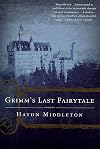
Grimm's Last Fairytale
by Haydn Middleton
On This Page
Description
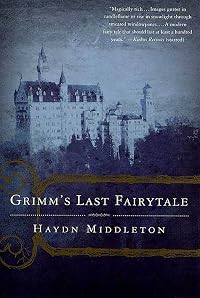
In his compelling new historical novel, Haydn Middleton re-creates the life-story of literature's most famous brothers. It is a history that could almost be a fairytale itself, with its fabulous changes of fortune, tests of duty and honour, arrogant princes, lost loves and twisted family relationships - all unfolding in a world of dark forests and even darker politics. In September 1863 Jacob Grimm travels through rustic western Germany with his devoted niece, Auguste, who longs to learn at show more last the emotional truth about her family. They are accompanied by Kummel, their enigmatic manservant. As relations between the three reach crisis point, vivid flashbacks tell of Jacob's traumas and heartbreaks here in his original homeland. Old now, Jacob resists Auguste's attempts to make him take stock of his life. But memories that are repressed have a tendency to reappear in other places, and in other guises... show lessTags
Recommendations







Member Reviews
Three interwoven stories.
The main plot deals with the folklorist Jacob Grimm, nearing the end of his life and in failing health. He is cared for by his niece, Auguste, and a servingman, Kummel. The relationships between all three are fraught with tension and secrets.
In flashback-style, we also learn about the young Jacob and his (rather unhealthy, interdependent) relationship with his younger brother, Willi.
Interspersed with these two segments is a retelling of the story of Sleeping Beauty, mixed with elements of other fairytales and some entirely new additions.
By an Oxford grad, the book is surely not without literary merit, but I wished that the story had focused less on Auguste's angst and more on the historical details of the show more Grimms' lives and work. I had hoped to come away from reading this book feeling that I knew much more about the brothers – but I didn't.
I liked the ‘fairytale' segment, but its function seemed, to me, to mostly be illustrative – to show an ‘unsanitized' version of an old story. The issues brought up thematically in that section, I felt, should have related back to the story going on in the other segments – but they really didn't.
I also couldn't help feeling that Middleton wasn't really inside the heads of his characters. A sense of time and place (Germany, 19th century) was established by throwing in stuff like gratuitous references to "schnitzels" rather than through the characters. And finally, I found Middleton's indirectly-implied thesis that German fairytales are somehow related to Nazism to be annoying and offensive (he makes a comment about how the German versions of fairytales were distinctly ‘nastier' than, say, the French versions – which I think is definitely arguable and probably untrue.) The author also uses Grimm's belief in folklore being an important part of our heritage to imply that the ‘nastiness' of the stories says something about the German people as a whole. The character of Kummel, who is entirely fictional, is included merely to give the author a chance to bring up anti-Semitism, and I found it totally irrelevant to bring up, in the afterword, that Hitler used versions of Grimm's book to promote the ‘German folk community.'
The Grimms were not anti-Semites, they died well before the rise of Nazism, and I don't believe that fairytales have any culpability for or connection to fascism in any form.
This theme is not by any means the largest part of the book, I think it's just something that I'm personally sensitive to." show less
The main plot deals with the folklorist Jacob Grimm, nearing the end of his life and in failing health. He is cared for by his niece, Auguste, and a servingman, Kummel. The relationships between all three are fraught with tension and secrets.
In flashback-style, we also learn about the young Jacob and his (rather unhealthy, interdependent) relationship with his younger brother, Willi.
Interspersed with these two segments is a retelling of the story of Sleeping Beauty, mixed with elements of other fairytales and some entirely new additions.
By an Oxford grad, the book is surely not without literary merit, but I wished that the story had focused less on Auguste's angst and more on the historical details of the show more Grimms' lives and work. I had hoped to come away from reading this book feeling that I knew much more about the brothers – but I didn't.
I liked the ‘fairytale' segment, but its function seemed, to me, to mostly be illustrative – to show an ‘unsanitized' version of an old story. The issues brought up thematically in that section, I felt, should have related back to the story going on in the other segments – but they really didn't.
I also couldn't help feeling that Middleton wasn't really inside the heads of his characters. A sense of time and place (Germany, 19th century) was established by throwing in stuff like gratuitous references to "schnitzels" rather than through the characters. And finally, I found Middleton's indirectly-implied thesis that German fairytales are somehow related to Nazism to be annoying and offensive (he makes a comment about how the German versions of fairytales were distinctly ‘nastier' than, say, the French versions – which I think is definitely arguable and probably untrue.) The author also uses Grimm's belief in folklore being an important part of our heritage to imply that the ‘nastiness' of the stories says something about the German people as a whole. The character of Kummel, who is entirely fictional, is included merely to give the author a chance to bring up anti-Semitism, and I found it totally irrelevant to bring up, in the afterword, that Hitler used versions of Grimm's book to promote the ‘German folk community.'
The Grimms were not anti-Semites, they died well before the rise of Nazism, and I don't believe that fairytales have any culpability for or connection to fascism in any form.
This theme is not by any means the largest part of the book, I think it's just something that I'm personally sensitive to." show less
Ratings
Members
- Recently Added By
Lists

Lives of the Poets (and Philosophers)
110 works; 5 members
Author Information

130+ Works 1,151 Members
Common Knowledge
- Canonical title
- Grimm's Last Fairytale
- Original publication date
- 1999
- People/Characters
- Jacob Grimm
- Epigraph
- Once upon a time, there was no Germany.
For centuries the German people lived in a patchwork of principalities, duchies and kingdoms, some of them so small that one ruling prince was said to have accidentally dropped hi... (show all)s realm from his pocket and lost it forever while out on an afternoon stroll. At the other end of the scale stood militaristic Prussia, with its capital at Berlin.
But as the age of the railway and the factory dawned, there lay beyond the map another Germany: a timeless land of the heart and mind, full of dark forests and sometimes even darker fairytales. - Dedication
- To my children and my parents
Classifications
Statistics
- Members
- 142
- Popularity
- 231,024
- Reviews
- 1
- Rating
- (3.36)
- Languages
- English, Italian
- Media
- Paper, Ebook
- ISBNs
- 6
- ASINs
- 3