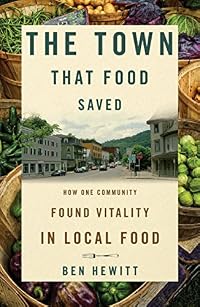
The Town That Food Saved: How One Community Found Vitality in Local Food
by Ben Hewitt
On This Page
Description
The captivating story of a small town coming back to life, grounded in an idea that will revolutionize the way we eat. Over the past 3 years, Hardwick, Vermont, a typical hardscrabble farming community of 3,000 residents, has jump-started its economy and redefined its self-image through a local, self-sustaining food system unlike anything else in America. Even as the recent financial downturn threatens to cripple small businesses and privately owned farms, a stunning number of food-based show more businesses have grown in the region. The mostly young entrepreneurs have created a network of community support; they meet regularly to share advice, equipment, and business plans, and to loan each other capital. Hardwick is fast becoming a model for other communities to replicate its success.--From publisher description. show lessTags
Recommendations











Member Reviews
This is a book I have been meaning to read for a long time. My immersion in the local food movement came the year after I graduated from high school, at Maggie's Farm, a year-long small-scale sustainable ag and homesteading intensive in my community. I was touring Hardwick while Ben was doing the research for this book [walking around Jasper Hill Cellars and such].
To make things even more intimate, my family has been going on vacation up in the Northeast Kingdom for the past decade or more [my mom's from VT], and we had dinner at Claire's shortly after it opened.
In 2010, I got introduced to Slow Money, the intersection of local food and local economy, and haven't looked back since. So Ben's questions of what underlies the adoption and show more long-term viability of local food systems and a local economy couldn't be more pertinent for me. I actually live in a community not unlike Hardwick [a comparatively strong local food system in an economically depressed rural area], in North Central MA.
This book is excellent. It's a snapshot of a place, a place, and a movement. Ben works his way through a series of portraits, looking at various facets of this picture: the entrepreneurs, the old-timers, the hippies. Many perspectives are captured.
This book is not the decisive map for how to save a town. But I wouldn't want to read such a book anyways. Ben as the vital questions that underlie culture and history. Regenerating a community is a process, not a product. show less
To make things even more intimate, my family has been going on vacation up in the Northeast Kingdom for the past decade or more [my mom's from VT], and we had dinner at Claire's shortly after it opened.
In 2010, I got introduced to Slow Money, the intersection of local food and local economy, and haven't looked back since. So Ben's questions of what underlies the adoption and show more long-term viability of local food systems and a local economy couldn't be more pertinent for me. I actually live in a community not unlike Hardwick [a comparatively strong local food system in an economically depressed rural area], in North Central MA.
This book is excellent. It's a snapshot of a place, a place, and a movement. Ben works his way through a series of portraits, looking at various facets of this picture: the entrepreneurs, the old-timers, the hippies. Many perspectives are captured.
This book is not the decisive map for how to save a town. But I wouldn't want to read such a book anyways. Ben as the vital questions that underlie culture and history. Regenerating a community is a process, not a product. show less
From the title, it sounds like a celebration of the new locavore culture, right? Well, kind of. It’s more of a balanced consideration of the changes happening in a community based in a historical agricultural context. There is an exciting new agripreneurial in Hardwick, VT, but Ben Hewitt spends some time appreciating the sturdy, older food culture that makes the new possible. It’s a fascinating look at how personality and drive can create dynamic change.
I confess I had never heard of Hardwick, Vermont before picking up Ben Hewitt's book The Town That Food Saved. The anecdotal nonfiction work tells about the history of the town built upon the industry of granite that suffered a severe economic downturn and looked to a local stimulus of food and agricultural business to provide jobs while promoting healthy food, organic farming and sustainability.
It's hard to describe the width and depth of food related businesses that this book covers, but I found the whole work remarkably fascinating. From exploring the simple but profound work of banking seeds to the impact of hormone use in the world of dairy farming, this work is one that will make anyone think twice about the everyday food we buy, show more prepare and eat.
It is the people of Hardwick, as well as their strides towards a system of local food production, that make Hewitt's book an engaging and entertaining read. The various interviews of farmers, businesspeople, restaurateurs, and politicians - many classified by Hewitt's invented portmanteau "agripreneurs" meaning agricultural entrepreneurs - lend a charming readability to the narrative. Hewitt presents the problems and conflicts openly and admits that there are not concrete solutions to the dilemmas Hardwick (and many towns like it) faced yet the positive economic and environmental strides being made are heralded. Overall, this is an interesting book for anyone whose curiosity is piqued by the origins of the meals on their plate and wants a deeper look at the ingenuity of Hardwick's people and the impact they could have on the food culture of an entire nation. show less
It's hard to describe the width and depth of food related businesses that this book covers, but I found the whole work remarkably fascinating. From exploring the simple but profound work of banking seeds to the impact of hormone use in the world of dairy farming, this work is one that will make anyone think twice about the everyday food we buy, show more prepare and eat.
It is the people of Hardwick, as well as their strides towards a system of local food production, that make Hewitt's book an engaging and entertaining read. The various interviews of farmers, businesspeople, restaurateurs, and politicians - many classified by Hewitt's invented portmanteau "agripreneurs" meaning agricultural entrepreneurs - lend a charming readability to the narrative. Hewitt presents the problems and conflicts openly and admits that there are not concrete solutions to the dilemmas Hardwick (and many towns like it) faced yet the positive economic and environmental strides being made are heralded. Overall, this is an interesting book for anyone whose curiosity is piqued by the origins of the meals on their plate and wants a deeper look at the ingenuity of Hardwick's people and the impact they could have on the food culture of an entire nation. show less
The Town that Food Saved tells of Hardwick, Vermont, a small town that falls on hard times with high unemployment and a low median income. As the traditional jobs dry up in Hardwick a group of young entrepreneurs come to town and imagine a revitalized economy based on local, specialty food businesses like Vermont Soy and Pete's Greens. The unusual and interesting part of this book is that Hewitt careful addresses the issues of how local is local (10miles? 100?) and when does a company get too big to be retain the personality and benefits of a small, independent operation? One of the big conflicts in Hardwick comes from the tension between the small farmers who have quietly been operating local, organic, sustainable farms for decades and show more the brash, vocal new entrepreneurs who envision a bigger, richer future for the small town. Hewitt talks a hard look at these two groups, compares the similarities and differences in their goals, and provides an interesting, unbiased analysis of the situation.
The Town That Food Saved succeeds best when Hewitt is focused on the quirky characters, unique businesses, and attention grabbing anecdotes that he delivers throughout the book. Too often he gets mired down in historic details or pedantic discussions about terminology or methods. Still, the book is worth reading for the in depth exploration of issues about what constitutes local and sustainable and why those are important ideas in our food sources.
I listened to The Town That Food Saved on audio, read by Arthur Morey. He has a lovely, deep, sonorous voice that, at first, made the dull parts of the book even harder to pay attention to. As the pace quickened in the story and more personalities were introduced, his resonant tones added a pleasant dimension to the story. show less
The Town That Food Saved succeeds best when Hewitt is focused on the quirky characters, unique businesses, and attention grabbing anecdotes that he delivers throughout the book. Too often he gets mired down in historic details or pedantic discussions about terminology or methods. Still, the book is worth reading for the in depth exploration of issues about what constitutes local and sustainable and why those are important ideas in our food sources.
I listened to The Town That Food Saved on audio, read by Arthur Morey. He has a lovely, deep, sonorous voice that, at first, made the dull parts of the book even harder to pay attention to. As the pace quickened in the story and more personalities were introduced, his resonant tones added a pleasant dimension to the story. show less
Mr Hewitt presents some very valuable information and insights regarding Hardwick, Vermont, and their burgeoning local foods movement. Unfortunately, he dilutes the impact of his text by excessively interjecting internalized questions that occur to him during interviews, farm visits, etc, even when he has no means to answer them later on. Bottom Line: If you line out 50% or more of the sentences ending in a question mark, you'll get all the important information he presents in half the time and you won't lose any critical facts/perspectives.
This is the story of Hardwick, Vermont, a small rural town with a mixed history. During the past few years, though, things have been changing and suddenly this sleepy little town finds itself on the forefront of the local food movement. A number of agri-businesses have sprung up bringing jobs and a new mission: making local food a viable capitalistic endeavor.
The author investigates each of these businesses in turn and does an excellent job of placing them each in the complex landscape of US food production.
The author investigates each of these businesses in turn and does an excellent job of placing them each in the complex landscape of US food production.
A quick-read case study on the "local" food movement in the town of Hardwick, Vermont. Hewitt does a nice job balancing perspectives and tensions between the new breed of ego-driven, big-thinking agripreneurs and the decades-old, rustic, off-the-grid local food movement that had already existed.
The journalistic writing style turned me off a bit. It reads like a long literary magazine story, populated with interesting characters, but I guess wanted more data, more detailed examination, and more dialectic.
The journalistic writing style turned me off a bit. It reads like a long literary magazine story, populated with interesting characters, but I guess wanted more data, more detailed examination, and more dialectic.
Members
- Recently Added By
Author Information
18+ Works 787 Members
Ben And Penny Hewitt are the authors of The Nourishing Homestead. Ben has written for magazines such as Outside, Discover, National Geographic Adventure, Gourmet, Men's Journal, The New York Times Magazine, and many others. They live with their two sons in a self-built house in northern Vermont.
Classifications
- Genres
- Economics, Nonfiction, General Nonfiction, Business, Science & Nature, Food & Cooking
- DDC/MDS
- 338.1 — Society, Government, and Culture Economics Production Agricultural products
- LCC
- HD9008 .H37 .H49 — Social sciences Industries. Land use. Labor Industries. Land use. Labor Special industries and trades Agricultural industries
- BISAC
Statistics
- Members
- 215
- Popularity
- 151,352
- Reviews
- 11
- Rating
- (3.60)
- Languages
- English
- Media
- Paper, Audiobook, Ebook
- ISBNs
- 10
- ASINs
- 6