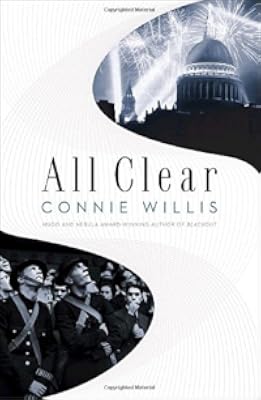
On This Page
Description
When three Oxford historians become unexpectedly trapped in 1940, they struggle not only to find their way home but to survive as Hitler's bombers attempt to pummel London into submission. Meanwhile, in 2060 Oxford, the historians' supervisor and seventeen-year-old Colin Templer are engaged in a frantic and seemingly impossible struggle to find them.Tags
Recommendations







Member Recommendations
Member Reviews
"… too bone-weary to sit in the pub room nursing a watered-down pint and spreading false rumours…" (pg. 524)
Given how awful, amateurish and interminable Blackout was, there would usually be no way in hell I'd choose to read its even longer follow-up, All Clear. But as it was obvious that Blackout/All Clear was one book cleaved into two, I felt obligated to 'finish' the story. Perhaps, as I wrote in my critical review of Blackout, the story would redeem itself in the end. Unfortunately, a further eight hundred (!) pages later, it turns out that definitely wasn't the case.
I don't say this lightly, but reading this book there were times where it was hard to believe Connie Willis is a professional writer. All Clear is alarmingly bad. show more The plot is contrived and the characterisation superficial; the book as a whole is just waffle. All the errors of Blackout return in this second volume: I suggested in my previous review that Blackout could easily be retitled Fake-Out, and the same is true here. The writer is trying to confuse the reader with cheap tricks – name changes, red herrings, melodramatic cliff-hangers, false reveals – all done with such clunkiness that the reader feels insulted and shabbily confused, rather than thrilled or intrigued.
Labouring through this 800-page book, the unlucky reader is stunned to realise that not a single character has ever been in real peril, or come to any harm. They have only been inconvenienced. Just about every chapter involves someone believing themselves trapped, or in danger, or having the sense that they've altered history for the worse (causing the Allies to lose the Second World War), only for the end result to be a complacent shrug and a pat on the head for the reader. Every 'death' is a fake-out; every plot 'reveal' proves (sometimes immediately) to have been a misunderstanding. And yet, for 800 pages (1,400 if you consider Blackout/All Clear to be one book), we're inflicted with the contrived neuroses of multiple characters and the hysterical waffling of the storyteller. It's maddening, and not in a good way.
Consider that All Clear begins by continuing a plot point from the first book: Eileen, one of our protagonists, can't remember the name of an airfield beginning with 'B' that might prove important to getting home (a fellow time-traveller is said to be on an assignment there). Now, let's leave aside the contrived remembrance gambit ("hey, I remember something I overheard, it began with 'B'"). Let's leave aside the fact that we spend the first 100 pages of All Clear resolving this (including running an errand to find an A-to-Z map). Let's leave aside the fact that after we find out the name of the place, we spend some more hundreds of pages there, and let's even leave aside that the whole charade proves to be yet another red herring (it turns out much later in the story that the fellow time-traveller was never there at all). Even leaving all that aside, consider this: Eileen eventually remembers that the place beginning with 'B' was not an airfield (another another another fake-out!), but Bletchley Park. Bletchley Park. She is an Oxford historian from the year 2060. Bletchley Park is one of the most famous place names in any WWII history. As with the 'Anderson shelter' nugget I mentioned in my review of Blackout, you have to ask: where in the hell had this 'historian' built up her working knowledge? She wouldn't pass History GCSE. It's like being trapped in Ancient Rome and saying, "I remember, it began with a 'C'," and then, one hundred pages later, saying, "Oh, I remember, it's the Colosseum." We spend *hundreds* of pages on this Bletchley Park red herring (and it's not entertaining writing, either), only for Eileen to say: "Isn't it an airfield?" (pg. 122). Imagine I could reach through your screen from this review and wave my hand in front of your face for a few moments, and then I just slapped you hard in the face. That would give you a sense of what it's like to read this book.
It's far from the only example in this tedious pantomime. We have a parrot who can imitate an air-raid siren (pg. 106), only there to provide yet another contrived cliff-hanger chapter ending as our characters think an attack is about to happen and they're in danger. We have characters going by pseudonyms, for no other reason than so that the reader doesn't find out they are alive in different times/storylines, which is such a cheap trick it makes me hate the author. We have a character who has spent two full books worrying that he is altering history, who then decides that he should tell two characters, who are at real risk of being captured by the Germans, the real date of the upcoming D-Day invasion. Why? Because he liked them and he "owed them the truth" (pg. 540). To make it worse, this character is someone working on the Fortitude intelligence operation designed to mislead the Germans about D-Day, and who later freaks out that he himself has been captured by the Germans and that because of this, they'll find out the real date of the invasion (pg. 675). If there had been a cat around when I was reading this book, I would have kicked it, and I wouldn't be sorry. You won't be surprised to learn that this 'capture' is another another another fake-out, though. I don't know what's worse; the contrived nature of the hysteria, the flip-flopping on the characterisation, or the fact that none of it makes a mouse-fart of difference to subsequent events in the plot.
I could provide dozens more examples, but suffice to say the book a ridiculous and contemptible mess. All the fake-outs and plot coincidences are amateurish, but they all pile up to such an extent that the book (and the writer) begin to seem grossly incompetent. As a reader, it's hard to pay attention to any of the turns the book makes, simply because so many of them prove to be fake-outs. After the first few hundred times, it's impossible to take the time to process a character beat, or digest a new piece of information they've learned, or listen to their theories, or even grieve their death, because you know that you only have to turn the page to learn that it's wrong; a misunderstanding, a red herring, or an amateurishly-written piece of suspense.
All of this is a continuation of Blackout's metaphorical bed-wetting, of course, but the truly unforgivable thing about All Clear is that the ending does not, after all, redeem the story. Quite the opposite: it's a clumsy and woolly piece of hand-waving. Without revealing any spoilers for those dumb enough to follow me down Connie Willis' poorly-dug rabbit-hole (particularly after the warning provided by this review), I have to say that the ending doesn't provide any catharsis, nor does it make any sense as to why certain people were saved for a purpose we still don't know, or what the time-travel force was (God?) that was manipulating the continuum and closing the drops and orchestrating events.
For any book, this would be a poor show; for such a lengthy book which insults the reader's intelligence and tests their patience on every page, it's an abominable crime. All the allusions to a 'pandemic' and to a 'pinpoint bomb' destroying St. Paul's before the year 2060 are also confusing: they prove to have no bearing on the plot. I kept thinking there would be an ingenious connection between the St. Paul's of the Blitz and the destroyed one of the future, some plot that was uncovered or some time rift healed, but it never comes up. From what I've heard, it seems to be something reflected in the author's other time-travel stories, but I'm certainly not going to read them to find out what. Blackout/All Clear isn't a good advert for any other titles Connie Willis might be offering.
This has turned into a bit of a rant, rather than a review, but it's hard to assess a piece of writing that is so far below any objective standard of storytelling, or even of comprehensibility. It's infuriating to try to figure out how a respected author could write this and be happy with it, how an editor could sign off on it, and not least how this scatter-brained piece of incoherent, self-indulgent waffle could win both the Hugo and the Nebula awards. I almost wish Connie Willis had been trolling us: "if we should happen to get separated, we can't afford to waste time running around looking for one another," one character says on page 311, in a two-book combo that spends 1,400 pages doing precisely that. Let me reach through the screen and slap you in the face again.
I've read God knows how many books, and written reviews on just under nine hundred, and this is one of the few where my confidence in the author bottomed out completely, and irretrievably. This is woeful. The fake-outs, the amateurish writing, and the lack of even simple, coherent thought all destroy the story experience. It's an appalling excuse for a novel. There may have been a passable 300-page story in here at one point, in the initial embryo of the idea, but why Connie Willis and her editor decided it should be a two-volume, 1,400-page tub of bilge is something that is not at all clear. show less
Given how awful, amateurish and interminable Blackout was, there would usually be no way in hell I'd choose to read its even longer follow-up, All Clear. But as it was obvious that Blackout/All Clear was one book cleaved into two, I felt obligated to 'finish' the story. Perhaps, as I wrote in my critical review of Blackout, the story would redeem itself in the end. Unfortunately, a further eight hundred (!) pages later, it turns out that definitely wasn't the case.
I don't say this lightly, but reading this book there were times where it was hard to believe Connie Willis is a professional writer. All Clear is alarmingly bad. show more The plot is contrived and the characterisation superficial; the book as a whole is just waffle. All the errors of Blackout return in this second volume: I suggested in my previous review that Blackout could easily be retitled Fake-Out, and the same is true here. The writer is trying to confuse the reader with cheap tricks – name changes, red herrings, melodramatic cliff-hangers, false reveals – all done with such clunkiness that the reader feels insulted and shabbily confused, rather than thrilled or intrigued.
Labouring through this 800-page book, the unlucky reader is stunned to realise that not a single character has ever been in real peril, or come to any harm. They have only been inconvenienced. Just about every chapter involves someone believing themselves trapped, or in danger, or having the sense that they've altered history for the worse (causing the Allies to lose the Second World War), only for the end result to be a complacent shrug and a pat on the head for the reader. Every 'death' is a fake-out; every plot 'reveal' proves (sometimes immediately) to have been a misunderstanding. And yet, for 800 pages (1,400 if you consider Blackout/All Clear to be one book), we're inflicted with the contrived neuroses of multiple characters and the hysterical waffling of the storyteller. It's maddening, and not in a good way.
Consider that All Clear begins by continuing a plot point from the first book: Eileen, one of our protagonists, can't remember the name of an airfield beginning with 'B' that might prove important to getting home (a fellow time-traveller is said to be on an assignment there). Now, let's leave aside the contrived remembrance gambit ("hey, I remember something I overheard, it began with 'B'"). Let's leave aside the fact that we spend the first 100 pages of All Clear resolving this (including running an errand to find an A-to-Z map). Let's leave aside the fact that after we find out the name of the place, we spend some more hundreds of pages there, and let's even leave aside that the whole charade proves to be yet another red herring (it turns out much later in the story that the fellow time-traveller was never there at all). Even leaving all that aside, consider this: Eileen eventually remembers that the place beginning with 'B' was not an airfield (another another another fake-out!), but Bletchley Park. Bletchley Park. She is an Oxford historian from the year 2060. Bletchley Park is one of the most famous place names in any WWII history. As with the 'Anderson shelter' nugget I mentioned in my review of Blackout, you have to ask: where in the hell had this 'historian' built up her working knowledge? She wouldn't pass History GCSE. It's like being trapped in Ancient Rome and saying, "I remember, it began with a 'C'," and then, one hundred pages later, saying, "Oh, I remember, it's the Colosseum." We spend *hundreds* of pages on this Bletchley Park red herring (and it's not entertaining writing, either), only for Eileen to say: "Isn't it an airfield?" (pg. 122). Imagine I could reach through your screen from this review and wave my hand in front of your face for a few moments, and then I just slapped you hard in the face. That would give you a sense of what it's like to read this book.
It's far from the only example in this tedious pantomime. We have a parrot who can imitate an air-raid siren (pg. 106), only there to provide yet another contrived cliff-hanger chapter ending as our characters think an attack is about to happen and they're in danger. We have characters going by pseudonyms, for no other reason than so that the reader doesn't find out they are alive in different times/storylines, which is such a cheap trick it makes me hate the author. We have a character who has spent two full books worrying that he is altering history, who then decides that he should tell two characters, who are at real risk of being captured by the Germans, the real date of the upcoming D-Day invasion. Why? Because he liked them and he "owed them the truth" (pg. 540). To make it worse, this character is someone working on the Fortitude intelligence operation designed to mislead the Germans about D-Day, and who later freaks out that he himself has been captured by the Germans and that because of this, they'll find out the real date of the invasion (pg. 675). If there had been a cat around when I was reading this book, I would have kicked it, and I wouldn't be sorry. You won't be surprised to learn that this 'capture' is another another another fake-out, though. I don't know what's worse; the contrived nature of the hysteria, the flip-flopping on the characterisation, or the fact that none of it makes a mouse-fart of difference to subsequent events in the plot.
I could provide dozens more examples, but suffice to say the book a ridiculous and contemptible mess. All the fake-outs and plot coincidences are amateurish, but they all pile up to such an extent that the book (and the writer) begin to seem grossly incompetent. As a reader, it's hard to pay attention to any of the turns the book makes, simply because so many of them prove to be fake-outs. After the first few hundred times, it's impossible to take the time to process a character beat, or digest a new piece of information they've learned, or listen to their theories, or even grieve their death, because you know that you only have to turn the page to learn that it's wrong; a misunderstanding, a red herring, or an amateurishly-written piece of suspense.
All of this is a continuation of Blackout's metaphorical bed-wetting, of course, but the truly unforgivable thing about All Clear is that the ending does not, after all, redeem the story. Quite the opposite: it's a clumsy and woolly piece of hand-waving. Without revealing any spoilers for those dumb enough to follow me down Connie Willis' poorly-dug rabbit-hole (particularly after the warning provided by this review), I have to say that the ending doesn't provide any catharsis, nor does it make any sense as to why certain people were saved for a purpose we still don't know, or what the time-travel force was (God?) that was manipulating the continuum and closing the drops and orchestrating events.
For any book, this would be a poor show; for such a lengthy book which insults the reader's intelligence and tests their patience on every page, it's an abominable crime. All the allusions to a 'pandemic' and to a 'pinpoint bomb' destroying St. Paul's before the year 2060 are also confusing: they prove to have no bearing on the plot. I kept thinking there would be an ingenious connection between the St. Paul's of the Blitz and the destroyed one of the future, some plot that was uncovered or some time rift healed, but it never comes up. From what I've heard, it seems to be something reflected in the author's other time-travel stories, but I'm certainly not going to read them to find out what. Blackout/All Clear isn't a good advert for any other titles Connie Willis might be offering.
This has turned into a bit of a rant, rather than a review, but it's hard to assess a piece of writing that is so far below any objective standard of storytelling, or even of comprehensibility. It's infuriating to try to figure out how a respected author could write this and be happy with it, how an editor could sign off on it, and not least how this scatter-brained piece of incoherent, self-indulgent waffle could win both the Hugo and the Nebula awards. I almost wish Connie Willis had been trolling us: "if we should happen to get separated, we can't afford to waste time running around looking for one another," one character says on page 311, in a two-book combo that spends 1,400 pages doing precisely that. Let me reach through the screen and slap you in the face again.
I've read God knows how many books, and written reviews on just under nine hundred, and this is one of the few where my confidence in the author bottomed out completely, and irretrievably. This is woeful. The fake-outs, the amateurish writing, and the lack of even simple, coherent thought all destroy the story experience. It's an appalling excuse for a novel. There may have been a passable 300-page story in here at one point, in the initial embryo of the idea, but why Connie Willis and her editor decided it should be a two-volume, 1,400-page tub of bilge is something that is not at all clear. show less
In the year 2060, time travel is not only possible, but it’s the preferred method of historical research. Instead of digging through old records to get a sense of a particular time period, why not just go there in person and see for yourself? Mike, Polly, and Eileen are three such historians who have all been assigned to World War II. Mike is going to Dover, where he’ll pose as a journalist and interview the heroes of the evacuation of Dunkirk. Polly will be a London shopgirl in the midst of the Blitz, and Eileen will be observing evacuees in the English countryside. Soon after they arrive at their assignments, however, things begin to go wrong. Minor discrepancies in the historical record start showing up — which ought to be show more impossible, because everyone knows that historians can’t affect the outcome of events. Then all three of their “drops” (the portals through which they can return to their own time) mysteriously close, leaving them stranded in World War II. As Mike, Polly, and Eileen try every possible method of reopening the drops, they’re forced to conclude that they might be trapped in the wrong time forever.
Although Blackout and All Clear were published in two volumes, they’re really just one novel, so I’m reviewing them together. My overall feeling about this book is one of awe. This was obviously a labor of love for Connie Willis, and it is truly epic in scope. The time period is meticulously researched, and I really felt like I was there in World War II, seeing how ordinary people reacted to the war and especially to the Blitz. That said, the book is extremely long (over 1,000 pages if you count both volumes), and it probably could have been trimmed substantially. Additionally, there were several confusing plot threads that jumped between different characters and different time periods. These were all resolved by the end of the book, but it made the reading experience a bit difficult at times. On the other hand, there were so many little diversions that I loved — the allusions to Shakespeare and Agatha Christie, for example, as well as the segment where every character was named after someone in The Importance of Being Earnest. So I have mixed feelings about this novel, but overall I have a lot of respect for what Willis accomplished here. Definitely recommended for people interested in WWII! show less
Although Blackout and All Clear were published in two volumes, they’re really just one novel, so I’m reviewing them together. My overall feeling about this book is one of awe. This was obviously a labor of love for Connie Willis, and it is truly epic in scope. The time period is meticulously researched, and I really felt like I was there in World War II, seeing how ordinary people reacted to the war and especially to the Blitz. That said, the book is extremely long (over 1,000 pages if you count both volumes), and it probably could have been trimmed substantially. Additionally, there were several confusing plot threads that jumped between different characters and different time periods. These were all resolved by the end of the book, but it made the reading experience a bit difficult at times. On the other hand, there were so many little diversions that I loved — the allusions to Shakespeare and Agatha Christie, for example, as well as the segment where every character was named after someone in The Importance of Being Earnest. So I have mixed feelings about this novel, but overall I have a lot of respect for what Willis accomplished here. Definitely recommended for people interested in WWII! show less
All Clear picks up right where Blackout left off, with three time-traveling historians trapped in London during the Blitz. Optimistic Eileen (Merope), on her first time travel assignment, has assumed responsibility for the horrible Hodbin siblings while she waits on the retrieval team. Mike assumes the role of protector for his female colleagues. Polly has found a family of sorts in her shelter partners, who have formed a (mostly) amateur acting troupe, as her hope gradually fades that her 17-year-old devoted admirer, Colin, will find her and take her home as he promised to do if anything went wrong.
Willis masterfully pulls off a complex plot with threads in multiple time periods. Even the minor characters are well-rounded, and they show more remind me of the kinds of characters Dickens created. (And Dickens’ characters are the reason I love his books so much.) I suffered with the characters during the bombings and felt their growing despair as the retrieval team didn’t make its appearance. I rejoiced with each small victory. Even though I guessed where some of the plot threads were leading, Willis surprised me with her storytelling and its emotional impact. The books together number more than 1,000 pages, yet it seemed too short. I did not want to say goodbye to the characters I had grown to love. show less
Willis masterfully pulls off a complex plot with threads in multiple time periods. Even the minor characters are well-rounded, and they show more remind me of the kinds of characters Dickens created. (And Dickens’ characters are the reason I love his books so much.) I suffered with the characters during the bombings and felt their growing despair as the retrieval team didn’t make its appearance. I rejoiced with each small victory. Even though I guessed where some of the plot threads were leading, Willis surprised me with her storytelling and its emotional impact. The books together number more than 1,000 pages, yet it seemed too short. I did not want to say goodbye to the characters I had grown to love. show less
Blackout and All Clear are amazing works of speculative fiction. Anyone interested in time travel or WWII history will love them. You really connect to the characters, and you can't guess what will happen next.
If you plan to read one of them, plan to read both, and have All Clear on hand because you won't want to stop between books. Like The Lord of the Rings, it's all one story.
I was in tears both times I thought Sir Godfrey had died, and part of me wishes he and Polly had ended up together, despite Colin. I was ecstatic when I realized the vicar ended up with Eileen (even though I'm not religious and I typically don't like organized religion).
I want more. I will definitely keep an eye on Connie Willis, sequel or no sequel (though I show more hope there will be a direct sequel). As things stand, I plan to go back and read Doomsday Book and To Say Nothing of the Dog, as they take place in the same time continuum, and I hope by the time I've gotten through her other works she'll have released a new one. show less
If you plan to read one of them, plan to read both, and have All Clear on hand because you won't want to stop between books. Like The Lord of the Rings, it's all one story.
I want more. I will definitely keep an eye on Connie Willis, sequel or no sequel (though I show more hope there will be a direct sequel). As things stand, I plan to go back and read Doomsday Book and To Say Nothing of the Dog, as they take place in the same time continuum, and I hope by the time I've gotten through her other works she'll have released a new one. show less
This book gave me goosebumps. It is a fabulous ending to Connie Willis' two-parter and kept me ripping through the pages from beginning to end. Not only is it an entertaining story with full-blooded characters, it also makes you think about the nature of life and the choices we make. The only thing that kept me from giving All Clear five stars was the recurring blasphemy, which wasn't extreme, but still bothered me. Fortunately this came mostly from one character.
(This is a review for both Blackout and All Clear, because they are really one book)
Connie Willis is one of my favorite writers, mainly because she combines history and science fiction so very well. What also helps is that her novels are sort of wish-fulfillment for me, because they have historians from the now (well, the future now) travel to the past to study it, even if the historians usually get into trouble. The first book I read by Willis was "Doomsday Book", which takes place in 1300s/2060, well in my favorite historic period, the middle ages. The second book was "To Say Nothing Of the Dog", taking place in 1800s/2060, not my favorite period, but the Victorians are still interesting and entertaining. The latest time travelling show more historians book(s) is/are "Blackout" and "All Clear", two novels that are one story (they cannot be read out-of-order or separately). This story takes place in 1940/45 and 2060, the Second World War in England. Definitely not my favorite period, too close to home. Because of that I was hesitant to read this story. Eventually the fact that it was by Willis won out over my non-love (not hate) for the period. And I am so glad I did, because this story was terrific.
We're back with the Oxford historians in the 2060s. Several students have trips planned to the past for their research. However, the lab is canceling trips left and right and switching schedules around. Michael, Polly and Merope try their best to have their trips to the past happen anyway, despite being less than well prepared. Merope goes to the English countryside in WWII, as a servant at a country house that has taken in evacuated children from London. Polly is in London during the Blitz, safe because she knows where the bombs will hit. And Michael is near Dover to experience the evacuation of British soldiers from France by the local fishermen.
But the lab had its reasons for being so panicky with regards to the time-travel trips. Because things don't seem to happen as they should. And our students are doing things that seem to affect the past. Could they, by saving one of their local friends or by being caught up in the moment, change the outcome of the Battle of Britain? And how will they return to Oxford, now that the drop sites seem disabled? And is Professor Dunworthy just going to leave them stuck in the past?
Because the historians in these stories are remarkably similar to us (living in relative peace, with advanced technology) their observations of the period of WWII and the people living through that time are very relatable. Even for me, someone who rather avoids any 'entertainment' to do with WWII, these two books were great. I think the fact that the story is contained in England (mostly London and surroundings) and because the people who Merope, Polly and Michael meet are just the regular people from the street, it makes it hit home. People working in a store, trying to keep their daily lives going despite nightly bombing raids. The time-travel adventure (will they return home, have they ruined the future, will they die in the past?) is very good too, and you feel the sense of urgency in the story. Simply terrific, and I really understand why this book has already won the big three awards of science fiction (Hugo, Nebula and Locus) and was nominated for one more (Campbell memorial award). For me, both parts are five out of five stars. show less
Connie Willis is one of my favorite writers, mainly because she combines history and science fiction so very well. What also helps is that her novels are sort of wish-fulfillment for me, because they have historians from the now (well, the future now) travel to the past to study it, even if the historians usually get into trouble. The first book I read by Willis was "Doomsday Book", which takes place in 1300s/2060, well in my favorite historic period, the middle ages. The second book was "To Say Nothing Of the Dog", taking place in 1800s/2060, not my favorite period, but the Victorians are still interesting and entertaining. The latest time travelling show more historians book(s) is/are "Blackout" and "All Clear", two novels that are one story (they cannot be read out-of-order or separately). This story takes place in 1940/45 and 2060, the Second World War in England. Definitely not my favorite period, too close to home. Because of that I was hesitant to read this story. Eventually the fact that it was by Willis won out over my non-love (not hate) for the period. And I am so glad I did, because this story was terrific.
We're back with the Oxford historians in the 2060s. Several students have trips planned to the past for their research. However, the lab is canceling trips left and right and switching schedules around. Michael, Polly and Merope try their best to have their trips to the past happen anyway, despite being less than well prepared. Merope goes to the English countryside in WWII, as a servant at a country house that has taken in evacuated children from London. Polly is in London during the Blitz, safe because she knows where the bombs will hit. And Michael is near Dover to experience the evacuation of British soldiers from France by the local fishermen.
But the lab had its reasons for being so panicky with regards to the time-travel trips. Because things don't seem to happen as they should. And our students are doing things that seem to affect the past. Could they, by saving one of their local friends or by being caught up in the moment, change the outcome of the Battle of Britain? And how will they return to Oxford, now that the drop sites seem disabled? And is Professor Dunworthy just going to leave them stuck in the past?
Because the historians in these stories are remarkably similar to us (living in relative peace, with advanced technology) their observations of the period of WWII and the people living through that time are very relatable. Even for me, someone who rather avoids any 'entertainment' to do with WWII, these two books were great. I think the fact that the story is contained in England (mostly London and surroundings) and because the people who Merope, Polly and Michael meet are just the regular people from the street, it makes it hit home. People working in a store, trying to keep their daily lives going despite nightly bombing raids. The time-travel adventure (will they return home, have they ruined the future, will they die in the past?) is very good too, and you feel the sense of urgency in the story. Simply terrific, and I really understand why this book has already won the big three awards of science fiction (Hugo, Nebula and Locus) and was nominated for one more (Campbell memorial award). For me, both parts are five out of five stars. show less
Willis has a very clearly thought through framework for time travel, and develops fascinating characters to explore the implications of this theory and the idea of heroism. Her heroes are bumbling and make mistake after mistake, which Willis uses to highlight the greater forces at play acting to protect continuity - are their actions, and those of the every day people they are studying, fate or heroism? Or both?
Members
- Recently Added By
Published Reviews
ThingScore 100
For this reviewer, it’s not every day these days that a book arrives that makes you want to jump in the minute it lands at the doorstep. However, after my review of Black Out (the first part of this duology, reviewed HERE) this is one for me. Like many other Connie Willis fans, this book’s been a long time a-waiting for.
After the cliff-hanger ending of the first part, we get straight back show more into the tale. There’s a little bit of reminding of what went before (note: do read the first book first!) but pretty soon we’re back into the WW2 dilemma of Polly, Mary, and Mike. This can be a little confusing if it’s been a while since you read Black Out: you really do need to read this as one continuous novel.
The complexities of the time travel element become a little more involved here as the apparent changes in Black Out have their effect. We now find that there is a great deal of slippage: over four years, when the longest previously was about six months. Mr Dunworthy finds himself entering the fray from 2060, Mary finds herself involved with an RAF officer, whilst Mike, in his search for Gerald Phipps, finds himself at Bletchley Park and intermixing with the mathematicians involved in the ultra-secret Enigma code-breaking project. There’s also the welcome return of a character from the beginning of Black Out who has a pivotal part to play in this tale.
So we’re combining Enigma or Cryptonomicon with our previous tale. This gives Connie a chance to get away from the seemingly endless bombing of London and the London Underground shelters and tell of the quiet war, with Alan Turing and his team working in intense secret, on devising a computer/machine to be able to break the German’s unbreakable codes.
This is great fun. We also switch between times, as Phipps is in 1944 looking at the Normandy invasions and setting up false trails for the Germans.
However, by this stage it’s not easy to keep all those plot threads going. The Enigma tale is soon forgotten as we look to wider issues and the future. Managing that great balance between telling a tale in a historical context and giving readers a feel of what the place was like in the 1940’s is not easy. To say that Willis manages this is a great achievement.
On the negative side there’s a lot more running from place to place and an increasingly frustrating inability to get to drop zones. This is explained as the tale progresses - it’s all part of the book’s plan – but at times, whilst entertaining, it all seems (until the end) as a little unnecessary.
I’m also not sure that all this running around during bombing raids, and leaving messages for people about V1 and V2 attacks could have been got away with without someone becoming suspicious.
Nevertheless, by that end, the reader may feel, as I did, that they have been through a lot. There is love, death, sacrifice and complications within complications, and yet, in the end, the overall feeling is one of optimism and hope. The difficulties of the war in 1940’s England may have been replaced by bombings and global change in 2060, yet the endurance of the human condition comes through. This is a book that not only appreciates the sacrifices of the past but is a testament to endurance against crushing difficulties. What this book celebrates is that heroism comes in many ways, and not just the big heroic acts but the many minor actions often overlooked.
Whilst it is rather long – clearly a tale that grew in the telling – it is still a wonderfully worthwhile read. Most fans of Connie Willis will not be disappointed. This is a pleasure, from a formidable writer whose storytelling skills are still a treat. I’m very pleased to write that this book sustains its tale for over 1000 pages and it is a wonderfully thrilling and compelling immersive story with characters you care about.
Please don’t leave it so long before the next tale, Connie. show less
After the cliff-hanger ending of the first part, we get straight back show more into the tale. There’s a little bit of reminding of what went before (note: do read the first book first!) but pretty soon we’re back into the WW2 dilemma of Polly, Mary, and Mike. This can be a little confusing if it’s been a while since you read Black Out: you really do need to read this as one continuous novel.
The complexities of the time travel element become a little more involved here as the apparent changes in Black Out have their effect. We now find that there is a great deal of slippage: over four years, when the longest previously was about six months. Mr Dunworthy finds himself entering the fray from 2060, Mary finds herself involved with an RAF officer, whilst Mike, in his search for Gerald Phipps, finds himself at Bletchley Park and intermixing with the mathematicians involved in the ultra-secret Enigma code-breaking project. There’s also the welcome return of a character from the beginning of Black Out who has a pivotal part to play in this tale.
So we’re combining Enigma or Cryptonomicon with our previous tale. This gives Connie a chance to get away from the seemingly endless bombing of London and the London Underground shelters and tell of the quiet war, with Alan Turing and his team working in intense secret, on devising a computer/machine to be able to break the German’s unbreakable codes.
This is great fun. We also switch between times, as Phipps is in 1944 looking at the Normandy invasions and setting up false trails for the Germans.
However, by this stage it’s not easy to keep all those plot threads going. The Enigma tale is soon forgotten as we look to wider issues and the future. Managing that great balance between telling a tale in a historical context and giving readers a feel of what the place was like in the 1940’s is not easy. To say that Willis manages this is a great achievement.
On the negative side there’s a lot more running from place to place and an increasingly frustrating inability to get to drop zones. This is explained as the tale progresses - it’s all part of the book’s plan – but at times, whilst entertaining, it all seems (until the end) as a little unnecessary.
I’m also not sure that all this running around during bombing raids, and leaving messages for people about V1 and V2 attacks could have been got away with without someone becoming suspicious.
Nevertheless, by that end, the reader may feel, as I did, that they have been through a lot. There is love, death, sacrifice and complications within complications, and yet, in the end, the overall feeling is one of optimism and hope. The difficulties of the war in 1940’s England may have been replaced by bombings and global change in 2060, yet the endurance of the human condition comes through. This is a book that not only appreciates the sacrifices of the past but is a testament to endurance against crushing difficulties. What this book celebrates is that heroism comes in many ways, and not just the big heroic acts but the many minor actions often overlooked.
Whilst it is rather long – clearly a tale that grew in the telling – it is still a wonderfully worthwhile read. Most fans of Connie Willis will not be disappointed. This is a pleasure, from a formidable writer whose storytelling skills are still a treat. I’m very pleased to write that this book sustains its tale for over 1000 pages and it is a wonderfully thrilling and compelling immersive story with characters you care about.
Please don’t leave it so long before the next tale, Connie. show less
added by PLReader
Lists

Best Science Fiction Novels
816 works; 426 members

Best Time Travel Novels
165 works; 125 members

Science fiction novels with a female protagonist
105 works; 30 members

Women in War
148 works; 30 members

Best time travel books
56 works; 22 members

Female Author
1,234 works; 65 members

Best 21st Century Books (So Far)
679 works; 85 members

Top Five Books of 2021
604 works; 180 members

Nebula Award
111 works; 14 members

Books Set in Great Britain
191 works; 13 members

Favourite Books
1,820 works; 311 members

Best Books Set in London
157 works; 42 members

Top Five Books of 2016
795 works; 229 members

Books I've Read More Than Once
602 works; 49 members
Literature About Women and Girls
426 works; 40 members

Speculative Fiction to Read
706 works; 31 members

Speculative Fiction: The Award Winners
27 works; 6 members

World War II Novels
28 works; 3 members

Book Review Roundup
254 works; 2 members
Books We Want To Read Again For The First Time
384 works; 160 members
Time Travel Stories
64 works; 6 members

Top Five Books of 2025
954 works; 304 members

Books Read in 2026
2,142 works; 70 members

Books Read in 2023
5,638 works; 147 members

Biggest Disappointments
606 works; 168 members

Books Read in 2021
5,361 works; 114 members

Books Read in 2019
4,052 works; 108 members

Books Read in 2017
4,249 works; 129 members

Books Read in 2016
4,666 works; 197 members

Allie's Wishlist
217 works; 2 members

io9 Book Club
70 works; 4 members

Books Read in 2012
816 works; 31 members
Favorite Science Fiction
457 works; 223 members

Best Historical Fiction
620 works; 262 members
Author Information

97+ Works 40,924 Members
Connie Willis lives in Greeley, Colorado, with her family. (Publisher Provided) Connie Willis was born on December 31, 1945. She graduated from Colorado State College in 1967. Her first story, The Secret of Santa Titicaca, was published in Worlds of Fantasy in 1971. After receiving an NEA grant in 1982, she left her teaching job to become a show more full-time writer. Her works include Doomsday Book, Lincoln's Dreams, Bellwether, To Say Nothing of the Dog, Fire Watch, Blackout, and All Clear. She has received 10 Hugo Awards, 11 Locus Poll Awards and 6 Nebula Awards. In 2009, she was inducted into the Science Fiction Hall of Fame. (Bowker Author Biography) show less
Some Editions
Awards and Honors
Awards
Distinctions
Notable Lists
Series


Work Relationships
Is contained in
Common Knowledge
- Canonical title*
- All clear
- Original title
- All Clear
- Original publication date
- 2010
- People/Characters
- Polly Churchill; Michael Davies; Merope Ward; Colin Templer; James Dunworthy; Binnie Hodbin (show all 87); Alf Hodbin; Sir Godfrey Kingsman; John Bartholomew; Ann Perry; Alan Turing; Badri Chaudhuri; Bess Brightford; Bob; Brenda; Captain Maitland; Cecily (Cess); Chasuble; Colonel Abrams; Colonel von Sprecht; Commander Harold; Cora Holland; Daphne (Butcher); Deborah "Trot" Brightford; Dilly Knox; Doreen Timmons; Dr. Cross; Dr. Ishiwaka; Eddritch; Elspeth; Ethel; Ferguson; Flight Officer Stephen Lang; Flying Officer Fordham; General Patton; Gordon Welchman; Grenville; Hattie; Hunter; Irene Brightford; Joan; Jonathan; Joyce; Lady Bracknell; Lady Darforth; Lieutenant Cynthia Camberley; Lieutenant Hugh Tensing; Lieutenant Lady Diana Brenfell Reed; Lieutenant Paige Fairchild; Lila; Linna; Louise Talbot; Major Denewell; Margaret Fortis; Marjorie Hayes; Mavis; Miss Hibbard; Miss Laburnum; Miss Snelgrove; Moncrieff; Mr. Dorming; Vicar Goode; Mr. Humphreys; Mr. Simms; Mr. Tabbitt; Mr. Witherell; Agatha Christie (Mallowan); Mrs. Bascombe; Mrs. Brightford; Mrs. Jolsom; Mrs. Leary; Mrs. Rickett; Mrs. Sentry; Mrs. Willett; Mrs. Wyvern; Mutchins; Nora; Paige; Parrish; Prism; Reardon; Reggie; Sarah Steinberg; Sutcliffe-Hythe; Theodore Willett; Viv; Wendy Armitage
- Important places
- London, England, UK; Notting Hill, London, England, UK; St Paul's Cathedral, London, England, UK; University of Oxford, Oxford, Oxfordshire, England, UK; England, UK; Oxford, Oxfordshire, England, UK (show all 15); Oxfordshire, England, UK; Balliol College, University of Oxford, Oxford, Oxfordshire, England, UK; Dulwich, Surrey, England, UK; Surrey, England, UK; Kent, England, UK; Bletchley Park, Bletchley, Buckinghamshire, England, UK; Bletchley, Buckinghamshire, England, UK; Buckinghamshire, England, UK; Saltram-on-Sea, Kent, England, UK
- Important events
- World War II (1939 | 1945); The Blitz (1940 | 1941)
- Epigraph
- You will make all kinds of mistakes; but as long as you are generous and true, and also fierce, you cannot hurt the world or even seriously distress her. --Winston Churchill
- Dedication
- To all the ambulance drivers, firewatchers, air-raid wardens, nurses, canteen workers, airplane spotters, rescue workere, mathematicians, vicars, vergers, shopgirls, chorus girls, librarians, debutantes, spinsters, fishermen,... (show all) retired sailors, servants, evacuees, Shakespearean actors, and mystery novelists who won the war.
- First words
- By noon Michael and Merope still hadn't returned from Stepney, and Polly was beginning to get really worried.
- Last words
- (Click to show. Warning: May contain spoilers.)" ' Behold, I stand at the door and knock,' " she said, and the drop opened.
- Publisher's editor
- Groell, Anne
- Blurbers
- Moorcock, Michael
- Original language
- English
*Some information comes from Common Knowledge in other languages. Click "Edit" for more information.
Classifications
Statistics
- Members
- 2,516
- Popularity
- 7,685
- Reviews
- 165
- Rating
- (4.07)
- Languages
- 5 — Dutch, English, French, German, Spanish
- Media
- Paper, Audiobook, Ebook
- ISBNs
- 28
- UPCs
- 1
- ASINs
- 11