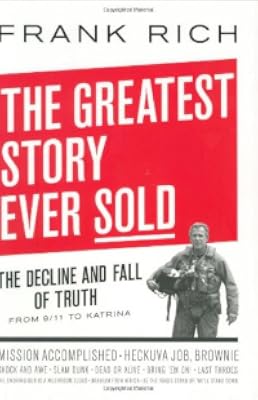
The Greatest Story Ever Sold: The Decline and Fall of Truth from 9/11 to Katrina
by Frank Rich
On This Page
Description
Reveals the spin campaign of the Bush administration that the author contends enabled the support of a war against a non-September 11 enemy, furthered conservative agendas, and consolidated presidential power.Tags
Recommendations

Member Reviews
This book is subtitled "The Decline and Fall of Truth From 9/11 to Katrina" and is a point by point explanation of each and every time the Bush administration has lied to us in order to further its agenda at the expense of the American people. It's not new news, but it may be one of the first times the timeline of manipulation has been laid out so clearly and effectively. Reading it made me sick to my stomach. I know that history shows us this isn't the first time our elected leaders have proven unethical, but that this particular administration is blatantly so, and expects us to follow along with its wishes like lambs to the slaughter, makes my blood boil.
The best bit in this book comes in the epilogue and reads as follows:
...the Bush show more presidency could well prove, as its most severe critics have maintained, the worst ever. Its legacy will include the destruction of America's image, credibility, and prestige abroad; record budget deficits produced by unchecked spending and tax cuts; an abused and broken military; a subversion of the Constitution achieved by rigidly ideological judicial appointments, the abridgment of civil liberties, and outright lawbreaking in the White House; an indifference to environmental imperatives, including the energy conservation urgently needed to end America's chronic economic dependence on the congenitally unstable Middle East; and the promotion of America's homegrown religious fundamentalism with both official and political assaults on medical and earth science (including evolution) and the rights of gay Americans. (And that's just the short list.)
Well said, Mr. Rich, well said. show less
The best bit in this book comes in the epilogue and reads as follows:
...the Bush show more presidency could well prove, as its most severe critics have maintained, the worst ever. Its legacy will include the destruction of America's image, credibility, and prestige abroad; record budget deficits produced by unchecked spending and tax cuts; an abused and broken military; a subversion of the Constitution achieved by rigidly ideological judicial appointments, the abridgment of civil liberties, and outright lawbreaking in the White House; an indifference to environmental imperatives, including the energy conservation urgently needed to end America's chronic economic dependence on the congenitally unstable Middle East; and the promotion of America's homegrown religious fundamentalism with both official and political assaults on medical and earth science (including evolution) and the rights of gay Americans. (And that's just the short list.)
Well said, Mr. Rich, well said. show less
To say that the Grumpy Vegan is a fan of author and New York Times columnist Frank Rich is to understate it. His Sunday column was a must-read -- indeed, the only reason to buy the paper -- until, well, NYT decided to hide it only to paying subscribers in its Times Select boutique. The toes curled, the wry grin smiled and the brain was amused and stimulated by Frank's satirical writing style. That's why all summer I waited patiently for his Greatest Story Ever Sold.
What could be more delicious than an entire book of biting commentary on politics inflamed by a scathing critique of mainstream culture? Greatest Story is a must-read. But it is written in a writing style unlike his columns.
Frank describes how Bush et al took us to war with show more Iraq. The twist in his narrative is that this is a story of how an administration packaged and marketed the war while it was saying one thing but secretly knew the truth was something else. For example,
"That cynical priority was what had dictated the timing of the rollout of the product in the first place: it wasn't a mushroom cloud that imminent as the White House pressed for a congressional resolution in the fall of 2002, it was the midterms."
And, again,
"Reeling from the criticism, Bush pleaded to ABC's Diane Sawyer that people not "play politics during this period of time." But just months earlier the president had flown from Crawford to Washington overnight to sign a symbolic bill intervening in the case of Terri Schiavo, a brain-dead hospice patient flogged as a right-to-life cause by the Christian right. He was in no position now to lecture anyone about playing politics with tragedy."
To say that I wished I could write like Frank Rich -- specially in the style of his NYT columns -- is to understate it. show less
What could be more delicious than an entire book of biting commentary on politics inflamed by a scathing critique of mainstream culture? Greatest Story is a must-read. But it is written in a writing style unlike his columns.
Frank describes how Bush et al took us to war with show more Iraq. The twist in his narrative is that this is a story of how an administration packaged and marketed the war while it was saying one thing but secretly knew the truth was something else. For example,
"That cynical priority was what had dictated the timing of the rollout of the product in the first place: it wasn't a mushroom cloud that imminent as the White House pressed for a congressional resolution in the fall of 2002, it was the midterms."
And, again,
"Reeling from the criticism, Bush pleaded to ABC's Diane Sawyer that people not "play politics during this period of time." But just months earlier the president had flown from Crawford to Washington overnight to sign a symbolic bill intervening in the case of Terri Schiavo, a brain-dead hospice patient flogged as a right-to-life cause by the Christian right. He was in no position now to lecture anyone about playing politics with tragedy."
To say that I wished I could write like Frank Rich -- specially in the style of his NYT columns -- is to understate it. show less
I really only picked up the book because I'm such a fan of his columns. One thing I really appreciate about him is that he can contextualize all of the events with other stuff that was in the public consciousness at the time, so when you smack your forehead and say, "How did we let them get away with that?" you can also beat yourself up over the sheer stupidity of what was front page news coverage.
I saw Frank Rich speak last night in a venue that is very much a San Francisco institution. The format is a "conversation", in which someone with appropriate context for the speaker (in this instance, Steven Winn, an arts & culture critic for the SF Chronicle) engages the speaker in conversation for about an hour and then there are about 20 - show more 30 minutes of audience questions, direct from the audience members who are handed microphones without any prior screening.
I also had read Rich's book over the weekend and of course have read his columns intermittently for some years.
Rich is great. Nothing is sacred. He's as critical of the Dems as he is of the GOP. As far as I can see, the only person or institution that gets his full approval is Seymour Hersh (who is indeed a kind of God among men). I had a sense that he would be a good speaker, because his writing (both in his book and in his column) is very engaging and almost conversational, but he exceeded my expectations.
Someone in the audience asked him about whether we need to change the system, given that it has been completely railroaded by one man and his agenda, and Rich was like, you know, the system is good, but you can't abdicate power. He cited the number of Congresspeople who had actually read the National Intelligence Estimate prior to the vote in late 02 about going to war against Iraq, and it's like 6 or 8.
And then someone said, well, you say that the nation was unduly credulous and you also talk about the amalgamation of news with entertainment networks/companies, but isn't it really the Chomskyan reality that it's just the venality of corporations that we're facing here? And Rich was like, you can't oversimplify it like that. Halliburton did horrible things and they have profited greatly from the war, but they didn't start it. And the NY Times and the Washington Post are not owned by corporations -- they're family dynasty newspapers -- and yet they too dropped the ball. So you can't just say, oh bad corporations, and think you've made sense.
I really really appreciate him. I strongly recommend his book, which is a fair accounting of what was known when and by whom, what was told to the American public, and how and when the news organizations and Congress failed in their responsibility to question the Bush Administration on our behalf. But don't expect the Dems to get off lightly here. Nuh uh.
Again, one of Rich's strengths is his understanding of popular culture and how it feeds into politics. So he constantly offsets the political with the cultural and gives a very broad picture of what we were watching when we weren't watching Bush. show less
I saw Frank Rich speak last night in a venue that is very much a San Francisco institution. The format is a "conversation", in which someone with appropriate context for the speaker (in this instance, Steven Winn, an arts & culture critic for the SF Chronicle) engages the speaker in conversation for about an hour and then there are about 20 - show more 30 minutes of audience questions, direct from the audience members who are handed microphones without any prior screening.
I also had read Rich's book over the weekend and of course have read his columns intermittently for some years.
Rich is great. Nothing is sacred. He's as critical of the Dems as he is of the GOP. As far as I can see, the only person or institution that gets his full approval is Seymour Hersh (who is indeed a kind of God among men). I had a sense that he would be a good speaker, because his writing (both in his book and in his column) is very engaging and almost conversational, but he exceeded my expectations.
Someone in the audience asked him about whether we need to change the system, given that it has been completely railroaded by one man and his agenda, and Rich was like, you know, the system is good, but you can't abdicate power. He cited the number of Congresspeople who had actually read the National Intelligence Estimate prior to the vote in late 02 about going to war against Iraq, and it's like 6 or 8.
And then someone said, well, you say that the nation was unduly credulous and you also talk about the amalgamation of news with entertainment networks/companies, but isn't it really the Chomskyan reality that it's just the venality of corporations that we're facing here? And Rich was like, you can't oversimplify it like that. Halliburton did horrible things and they have profited greatly from the war, but they didn't start it. And the NY Times and the Washington Post are not owned by corporations -- they're family dynasty newspapers -- and yet they too dropped the ball. So you can't just say, oh bad corporations, and think you've made sense.
I really really appreciate him. I strongly recommend his book, which is a fair accounting of what was known when and by whom, what was told to the American public, and how and when the news organizations and Congress failed in their responsibility to question the Bush Administration on our behalf. But don't expect the Dems to get off lightly here. Nuh uh.
Again, one of Rich's strengths is his understanding of popular culture and how it feeds into politics. So he constantly offsets the political with the cultural and gives a very broad picture of what we were watching when we weren't watching Bush. show less
This isn’t just a rant by an anti-Bush writer with an ax to grind—Frank Rich has been a respected columnist for the NY times for years…as a film and drama critic. Who better to critique the stagecraft of this administration? The book details the many deceptions and blunders—from the wars in Afghanistan and Iraq to the holding of uncharged detainees at Guantanamo, among many others. Rich’s greatest acrimony is saved for his peers in the media, especially at his own newspaper—for buying into the White House’s scripted pronouncements without question or analysis, for being afraid of being banned from access or being labeled unpatriotic. This book shows how the Bush administration’s primary interest is in controlling—and show more selling—the story, preserving its power while lining the pockets of its supporters.
Reviewed by: Bryan show less
Reviewed by: Bryan show less
I found this a useful book - as far as it goes - which is not very far.
Rich gives an interesting blow by blow account of the media sales spin applied to the WMD and Iraq/Al Qaeda lies used by the American government to justify its invasion of Iraq.
What he leaves to a much smaller section in the epilogue is the obvious question, " ... what really did trigger the war in Iraq?"
His answer, is that in 1992, what were to become the neocons "...conceived a controversial manifesto preaching the importance of asserting unilateral American military power after the cold war. Well before the next Bush took office, these and other neocons fated to join his camp had become fixated on Iraq, though for reasons having much to do with their own ideas show more about exerting American force to jump-start a realignment of the Middle East and little or nothing to do with the stateless terrorism of Al Qaeda or with nation building." and he essentially leaves it at that.
I found a detailed explanation of the missing part of the story in Sniegoski's, "The Transparent Cabal". He shows how hard line Likudnik Jews in the Bush administration and the American Enterprise Institute, JINSA (Jewish Institute for National Security Affairs) and CSP (Centre for Security Policy) successfully hijacked American foreign policy at a critical point in history.
Colonel Lawrence Wilkerson, who served as Secretary of State Powell's chief of staff and was well aware of Feith's Israel orientation, stated in regard to him and his neocon associate David Wurmser:
"A lot of these guys, including Wurmser, I looked at as card-carrying members of the Likud party, as I did with Feith. You wouldn't open their wallet and find a card, but often I wondered if their primary allegiance was to their own country or to Israel. That was the thing that troubled me, because there was so much they said and did that looked like it was more reflective of Isreal's interest than our own."
In this unbalanced book, Rich doesn't look at the cost of the Iraq and Afghanistan (Israel related) wars but to date (January 2010) they have cost the American taxpayer $ 950.322.000.000 and about 4.500 dead. The Iraqi figure is about 151.000 completely unneccessary fatalities and a wrecked country.
He is only choosing to tell half the story while presenting it as the full story - which is a rather deceptive sales job in itself. If the reader doesn't bother with the epilogue and find a single vague paragraph there, it appears that George Bush invented the Iraq war all by himself. show less
Rich gives an interesting blow by blow account of the media sales spin applied to the WMD and Iraq/Al Qaeda lies used by the American government to justify its invasion of Iraq.
What he leaves to a much smaller section in the epilogue is the obvious question, " ... what really did trigger the war in Iraq?"
His answer, is that in 1992, what were to become the neocons "...conceived a controversial manifesto preaching the importance of asserting unilateral American military power after the cold war. Well before the next Bush took office, these and other neocons fated to join his camp had become fixated on Iraq, though for reasons having much to do with their own ideas show more about exerting American force to jump-start a realignment of the Middle East and little or nothing to do with the stateless terrorism of Al Qaeda or with nation building." and he essentially leaves it at that.
I found a detailed explanation of the missing part of the story in Sniegoski's, "The Transparent Cabal". He shows how hard line Likudnik Jews in the Bush administration and the American Enterprise Institute, JINSA (Jewish Institute for National Security Affairs) and CSP (Centre for Security Policy) successfully hijacked American foreign policy at a critical point in history.
Colonel Lawrence Wilkerson, who served as Secretary of State Powell's chief of staff and was well aware of Feith's Israel orientation, stated in regard to him and his neocon associate David Wurmser:
"A lot of these guys, including Wurmser, I looked at as card-carrying members of the Likud party, as I did with Feith. You wouldn't open their wallet and find a card, but often I wondered if their primary allegiance was to their own country or to Israel. That was the thing that troubled me, because there was so much they said and did that looked like it was more reflective of Isreal's interest than our own."
In this unbalanced book, Rich doesn't look at the cost of the Iraq and Afghanistan (Israel related) wars but to date (January 2010) they have cost the American taxpayer $ 950.322.000.000 and about 4.500 dead. The Iraqi figure is about 151.000 completely unneccessary fatalities and a wrecked country.
He is only choosing to tell half the story while presenting it as the full story - which is a rather deceptive sales job in itself. If the reader doesn't bother with the epilogue and find a single vague paragraph there, it appears that George Bush invented the Iraq war all by himself. show less
I put off reading this book for a year, for no good reason. Frank Rich has written an excellent account of the use of communications tools--the media and media techniques, basic public relations principles, and so forth--in government. Although focused on the Bush administration, Rich looks at the Clinton Administration, the US news media and news outlets and the broader social context of the first years of the twenty-first century in America. Well-researched, this book offers perceptive analysis in a very readable narrative.
Ah, truthiness where is thy sting? This examination of politics-as- theater, which reads like a collection of newspaper columns, was great comfort food for liberals in the last years of the Bush Administration. Now, one fears that it may still be pertinent.
Members
- Recently Added By
Published Reviews
ThingScore 75
The most original and thought-provoking insights in “The Greatest Story Ever Sold: The Decline and Fall of Truth from 9/11 to Katrina,” Frank Rich’s meticulously researched chronicle of the Bush administration’s exploits, come in his searing analysis of the role that the “new mediathon” has played in the demise of fact-driven public discourse.
added by jlelliott
Author Information

10+ Works 1,138 Members
Frank Rich served from 1980 to 1993 as the chief drama critic for The New York Times and since 1994 has been an op-ed columnist at the paper. He lives in New York City with his wife, the writer Alex Witchel. (Bowker Author Biography)
Awards and Honors
Common Knowledge
- People/Characters
- George W. Bush
Classifications
- Genres
- Nonfiction, General Nonfiction, History, Politics and Government
- DDC/MDS
- 973.931 — History & geography History of North America United States 1901- New Millennium, Post 9/11 (2001-Present) George W. Bush (2001-2009) Sept 11 Attacks, Iraq War, Patriot Act
- LCC
- E902 .R53 — History of the United States George W. Bush's administrations, 2001-2009
- BISAC
Statistics
- Members
- 755
- Popularity
- 37,127
- Reviews
- 14
- Rating
- (3.90)
- Languages
- English
- Media
- Paper, Audiobook, Ebook
- ISBNs
- 12
- ASINs
- 7