Many Moons
by James Thurber
On This Page
Description
Though many try, only the court jester is able to fulfill Princess Lenore's wish for the moon.Tags
Recommendations






Member Reviews
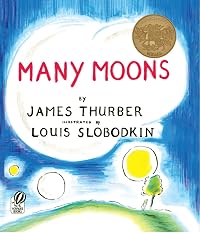
Many Moons, illustrated by Louis Slobodkin.
Wonderful, wise, heartwarming and humorous, this original fairy-tale from James Thurber, celebrated cartoonist and short-story writer, as well as author of a number of (other) classic children's books - The Thirteen Clocks, The Wonderful O - follows the story of a sick little princess who wishes for the moon. Her indulgent father, determined that she shall become well, summons his Lord High Chamberlain, Royal Magician, and Royal Mathematician, but each in turn tells him that the idea is impossible: the moon cannot be brought to the princess. It falls to the Court Jester, consoling his sovereign in his distress, to observe that the moon means different things to different people, and to suggest show more that they ask the Princess Lenore what it means to her...
Originally published in 1943, Many Moons won illustrator Louis Slobodkin the prestigious Caldecott Medal in 1944.** The artwork, done in black and white, and then colored in with blue, pink and yellow accents, is quirky and engaging. The style is a little "scribbly," composed with lots of wiggling lines, but it is also very expressive, perfectly capturing the king's exasperation and despair, and the princess's solitude, lying in her bed. I love how Slobodkin captures the humor of the scenes in which the various royal advisers list all that they had done for the king, as the items they mention parade around the edge of the page, in a sort of informal decorative border. All that said, although the artwork is appealing, the real star here is the story, which had me chuckling in appreciation at a number of points - the long list that each adviser pulls out! the king's growing frustration! - and happily engrossed by the clever and witty wordplay at others. Highly recommended to young readers who enjoy fairy-tales, as well as to fans of James Thurber's wonderful work.
**Note: I understand that there is also a newer edition of this story that is illustrated by Marc Simont, who worked on Thurber's The Thirteen Clocks. I will have to pick that version up, to see how a different artist has interpreted this tale. show less
Wonderful, wise, heartwarming and humorous, this original fairy-tale from James Thurber, celebrated cartoonist and short-story writer, as well as author of a number of (other) classic children's books - The Thirteen Clocks, The Wonderful O - follows the story of a sick little princess who wishes for the moon. Her indulgent father, determined that she shall become well, summons his Lord High Chamberlain, Royal Magician, and Royal Mathematician, but each in turn tells him that the idea is impossible: the moon cannot be brought to the princess. It falls to the Court Jester, consoling his sovereign in his distress, to observe that the moon means different things to different people, and to suggest show more that they ask the Princess Lenore what it means to her...
Originally published in 1943, Many Moons won illustrator Louis Slobodkin the prestigious Caldecott Medal in 1944.** The artwork, done in black and white, and then colored in with blue, pink and yellow accents, is quirky and engaging. The style is a little "scribbly," composed with lots of wiggling lines, but it is also very expressive, perfectly capturing the king's exasperation and despair, and the princess's solitude, lying in her bed. I love how Slobodkin captures the humor of the scenes in which the various royal advisers list all that they had done for the king, as the items they mention parade around the edge of the page, in a sort of informal decorative border. All that said, although the artwork is appealing, the real star here is the story, which had me chuckling in appreciation at a number of points - the long list that each adviser pulls out! the king's growing frustration! - and happily engrossed by the clever and witty wordplay at others. Highly recommended to young readers who enjoy fairy-tales, as well as to fans of James Thurber's wonderful work.
**Note: I understand that there is also a newer edition of this story that is illustrated by Marc Simont, who worked on Thurber's The Thirteen Clocks. I will have to pick that version up, to see how a different artist has interpreted this tale. show less
When his ill daughter asks for the moon -- literally -- a king turns to his wise men for advice on how to fulfill her wish. While the chamberlain, wizard, and mathematician dither and obfuscate, the jester cuts to the heart of the matter in a clever way.
It's a bit too wordy and repetitive, but humor and imagination win the day.
This version is illustrated by Marc Simont. It seems a bit silly or greedy to have a new artist give the illustrations a go when the original one, Louis Slobodkin, won a Caldecott Medal, but hey, capitalists gonna capitalize and the author's great grandkids are gonna need funds for college someday.
I can't say Simont's pictures are better, but they sure are brighter and better defined than Slobodkin's sketchy, show more minimalist style. And well, hey, maybe he does get the edge because his princess is cuter and his jester a little more human and a little less like he stepped out of a deck of cards. show less
It's a bit too wordy and repetitive, but humor and imagination win the day.
This version is illustrated by Marc Simont. It seems a bit silly or greedy to have a new artist give the illustrations a go when the original one, Louis Slobodkin, won a Caldecott Medal, but hey, capitalists gonna capitalize and the author's great grandkids are gonna need funds for college someday.
I can't say Simont's pictures are better, but they sure are brighter and better defined than Slobodkin's sketchy, show more minimalist style. And well, hey, maybe he does get the edge because his princess is cuter and his jester a little more human and a little less like he stepped out of a deck of cards. show less
Illustrated by Marc Simont
The Princess Lenore isn’t feeling well, and she asks for just one thing – the moon. She is certain this is the only thing that will make her well again. Her father, the King, summons his most trusted advisors, and tasks them with securing the moon for the Princess. But to a man, they declare this impossible. Until the Jester arrives and looks at the problem from a different angle.
I love Thurber’s story-telling. I’ve previously read another of his fables for children, and I’m equally delighted with this one. Marc Simont’s illustrations are whimsical and perfectly fit Thurber’s text. I found myself poring over them, trying to find all the references in the text … “blood from a turnip,” “a show more rabbit out of a hat, and a hat out of a rabbit” et al. The fact that the Princess holds the key to the great puzzle no adult can solve will especially delight children, but adults can learn an important lesson as well.
The book was originally published with illustrations by Louis Slobodkin; it remains in print along with this newer version which I read. I’ll have to try to find that original edition to see Slobodkin’s Caldecott-Award-winning work. show less
The Princess Lenore isn’t feeling well, and she asks for just one thing – the moon. She is certain this is the only thing that will make her well again. Her father, the King, summons his most trusted advisors, and tasks them with securing the moon for the Princess. But to a man, they declare this impossible. Until the Jester arrives and looks at the problem from a different angle.
I love Thurber’s story-telling. I’ve previously read another of his fables for children, and I’m equally delighted with this one. Marc Simont’s illustrations are whimsical and perfectly fit Thurber’s text. I found myself poring over them, trying to find all the references in the text … “blood from a turnip,” “a show more rabbit out of a hat, and a hat out of a rabbit” et al. The fact that the Princess holds the key to the great puzzle no adult can solve will especially delight children, but adults can learn an important lesson as well.
The book was originally published with illustrations by Louis Slobodkin; it remains in print along with this newer version which I read. I’ll have to try to find that original edition to see Slobodkin’s Caldecott-Award-winning work. show less
Many Moons is a hilarious version of the classic tale of a princess who wanted the moon and got it. When the king discovers she will be ill until given the moon, he asks his chamberlain, wizard and court mathematician to help him get the moon. Each member of the court has a comedic but worthless response that brings him no closer. Finally, the court Jester is able to produce the moon for the princess by finding out what the moon means to her.
I purchased this book because it is a classic fantasy and I saw the Caldecott medal on the cover but I was skeptical about the ratio of small pictures versus the abundant text. At first afraid it would not hold the attention of today’s contemporary audience, after reading it aloud I found it so show more funny that it’s bound to be enjoyed by my family for years to come.
The conversations between the king and his court read like a comedy routine and the intricate plot builds up so well I was full of anticipation for how the story will be resolved. The illustrations, though few and far between compared with the amount of text, are marvelously whimsical, in a sketchy and lightly colorful manner that makes them seem to float on the page like a Klee painting. Ultimately, I think this is a story to be read aloud with dramatic flair- a story that will entertain all ages of readers with its humor, plot development, and creative dialogue. show less
I purchased this book because it is a classic fantasy and I saw the Caldecott medal on the cover but I was skeptical about the ratio of small pictures versus the abundant text. At first afraid it would not hold the attention of today’s contemporary audience, after reading it aloud I found it so show more funny that it’s bound to be enjoyed by my family for years to come.
The conversations between the king and his court read like a comedy routine and the intricate plot builds up so well I was full of anticipation for how the story will be resolved. The illustrations, though few and far between compared with the amount of text, are marvelously whimsical, in a sketchy and lightly colorful manner that makes them seem to float on the page like a Klee painting. Ultimately, I think this is a story to be read aloud with dramatic flair- a story that will entertain all ages of readers with its humor, plot development, and creative dialogue. show less
When his ill daughter asks for the moon -- literally -- a king turns to his wise men for advice on how to fulfill her wish. While the chamberlain, wizard, and mathematician dither and obfuscate, the jester cuts to the heart of the matter in a clever way.
It's a bit too wordy and repetitive, but humor and imagination win the day.
This Caldecott Medal-winning version is illustrated by Louis Slobodkin with barely there ink drawings that are ridiculously minimalist but still charming enough to help offset all the words.
It's a bit too wordy and repetitive, but humor and imagination win the day.
This Caldecott Medal-winning version is illustrated by Louis Slobodkin with barely there ink drawings that are ridiculously minimalist but still charming enough to help offset all the words.
Many Moons, illustrated by Marc Simont.
This original fairy-tale from James Thurber, in which the young Princess Lenore becomes ill after eating too many raspberry tarts, and asks her concerned father for the moon, was initially published in 1943, and won its original illustrator, Louis Slobodkin, a Caldecott Medal in 1944. This newer edition, published in 1990, features the artwork of Marc Simont, who also worked on Thurber's The Thirteen Clocks and The Wonderful O. The text itself has not been changed.
I enjoyed this newer version of Thurber's classic story as much as the original. The word-play was as engaging, the humor as entertaining, and Simont's watercolor illustrations were charming. Slobodkin's were more cartoon-like and quirky, show more I think, and these more lyrical, but both have their appeal. I particularly liked the scene here in which we see (or don't see, as the case may be) the King as he knocks things over, while wearing the invisibility cloak made for him by the Royal Magician. Hilarious! Recommended to young fairy-tale readers, and to fans of Marc Simont's work. show less
This original fairy-tale from James Thurber, in which the young Princess Lenore becomes ill after eating too many raspberry tarts, and asks her concerned father for the moon, was initially published in 1943, and won its original illustrator, Louis Slobodkin, a Caldecott Medal in 1944. This newer edition, published in 1990, features the artwork of Marc Simont, who also worked on Thurber's The Thirteen Clocks and The Wonderful O. The text itself has not been changed.
I enjoyed this newer version of Thurber's classic story as much as the original. The word-play was as engaging, the humor as entertaining, and Simont's watercolor illustrations were charming. Slobodkin's were more cartoon-like and quirky, show more I think, and these more lyrical, but both have their appeal. I particularly liked the scene here in which we see (or don't see, as the case may be) the King as he knocks things over, while wearing the invisibility cloak made for him by the Royal Magician. Hilarious! Recommended to young fairy-tale readers, and to fans of Marc Simont's work. show less
Princess Lenore is ill from eating too many raspberry tarts. She believes that possessing the moon is the only thing that will cure her. Despite a command from the King, neither the Lord High Chamberlain nor the Royal Wizard nor the Royal Mathematician can get the moon for her. Only when the clever Court Jester consults the Princess herself is the problem solved - with characteristic Thurber wit.
Members
- Recently Added By
Lists

Favorite Childhood Books
1,651 works; 515 members

Caldecott Medal Books
91 works; 15 members
Honey For a Child's Heart
1,152 works; 25 members

CCE 1000 Good Books List
1,033 works; 12 members

Romalda Spalding's Writing Road To Reading
213 works; 3 members

I See the Moon and the Moon Sees Me
24 works; 7 members

Before Austen Comes Aesop
318 works; 9 members
Author Information

136+ Works 18,328 Members
Born in Columbus, Ohio, Thurber was blinded in one eye in a childhood accident. He attended Ohio State University but left without earning a degree. In 1925 he moved to New York City, where he joined the staff of the New Yorker in 1927 at the urging of his friend E. B. White. For the rest of his lifetime, Thurber contributed to the magazine his show more highly individual pieces and those strange, wry, and disturbing pen-and-ink drawings of "huge, resigned dogs, the determined and sometimes frightening women, the globular men who try so hard to think so unsuccessfully." The period from 1925, when the New Yorker was founded, until the death of its creator-editor, Harold Ross, in 1951, was described by Thurber in delicious and absorbing detail in The Years with Ross (1959). Of his two great talents, Thurber preferred to think of himself primarily as a writer, illustrating his own books. He published "fables" in the style of Aesop (see Vol. 2) and La Fontaine (see Vol. 2)---usually with a "barbed tip of contemporary significance"---children's books, several plays (two Broadway hits, one successful musical revue), and endless satires and parodies in short stories or full-length works. "The Secret Life of Walter Mitty," included in My World---and Welcome to It (1942), is probably his best-known story and continues to be frequently anthologized. T. S. Eliot described Thurber's work as "a form of humor which is also a way of saying something serious." (Bowker Author Biography) show less
Some Editions
Awards and Honors
Work Relationships
Is contained in
Common Knowledge
- Canonical title
- Many Moons
- Original title
- Many Moons
- Original publication date
- 1943
- People/Characters
- Princess Lenore
- Important places
- The Moon
- First words
- Once upon a time, in a kingdom by the sea, there lived a little Princess named Lenore.
- Last words
- (Click to show. Warning: May contain spoilers.)But before he left the room, he went over to the window and winked at the moon, for it seemed to the Court Jester that the moon had winked at him.
- Original language
- English
Classifications
Statistics
- Members
- 2,052
- Popularity
- 10,216
- Reviews
- 58
- Rating
- (4.25)
- Languages
- 7 — Chinese, English, French, German, Portuguese, Spanish, Swedish
- Media
- Paper
- ISBNs
- 24
- ASINs
- 17