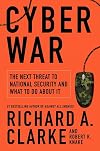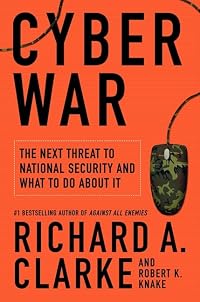
Cyber War: The Next Threat to National Security and What to Do About It
by Richard A. Clarke, Robert K. Knake (Author)
On This Page
Description
Security expert Richard A. Clarke goes beyond "geek talk" to succinctly explain how cyber weapons work and how vulnerable America is to the new world of nearly untraceable cyber criminals and spies. This sobering story of technology, government, and military strategy involving criminals, spies, soldiers, and hackers begins the much needed public policy debate about what America's doctrine and strategy should be, not just for waging, but for preventing the First Cyber War.Tags
Recommendations



Member Reviews
I was really looking forward to reading this book, and really conflicted in my opinions while reading it.
Mr. Clarke clearly knows enough to be dangerous, but I couldn't shake a feeling throughout the book that something about this book was just *wrong*. One one hand it has some insightful commentary on the sticky situations involved with cyberwarfare, and on the other completely lacks a bibliography or references to back up his claims regarding the current state of affairs.
The author's experience in government has definitely shaped a good portion of this book, but at times it seemed like he had a heavy axe to grind and was trying to right past slights to his policies.
There is definitely room in the genre for an accessible book show more detailing the new reality of cyberwarfare, but it's hard to say this is the one when every single one of the authors claims come devoid of any sort of reference material. By gutting his factual arguments of any accessible means of verification, it undermined his overall argument for the proposed solution. show less
Mr. Clarke clearly knows enough to be dangerous, but I couldn't shake a feeling throughout the book that something about this book was just *wrong*. One one hand it has some insightful commentary on the sticky situations involved with cyberwarfare, and on the other completely lacks a bibliography or references to back up his claims regarding the current state of affairs.
The author's experience in government has definitely shaped a good portion of this book, but at times it seemed like he had a heavy axe to grind and was trying to right past slights to his policies.
There is definitely room in the genre for an accessible book show more detailing the new reality of cyberwarfare, but it's hard to say this is the one when every single one of the authors claims come devoid of any sort of reference material. By gutting his factual arguments of any accessible means of verification, it undermined his overall argument for the proposed solution. show less
Disclaimer: I received my copy of this book from GoodReads.
This book is an interesting look at the possibilities and probabilities of internet hacking techniques in warfare. What seemed like science fiction a few years ago is now possible and can be exploited by not only the usual suspects (USA, Russia, China), but many smaller countries as well. What's particularly eye-opening is that the USA is one of the most vulnerable countries in the world due to our heavy reliance on net connectivity in every aspect of our lives. Written by a former staff member of the Clinton and Bush administrations, this book is extremely well written and informative. It is not for the easily frightened, though. Highly recommended.
This book is an interesting look at the possibilities and probabilities of internet hacking techniques in warfare. What seemed like science fiction a few years ago is now possible and can be exploited by not only the usual suspects (USA, Russia, China), but many smaller countries as well. What's particularly eye-opening is that the USA is one of the most vulnerable countries in the world due to our heavy reliance on net connectivity in every aspect of our lives. Written by a former staff member of the Clinton and Bush administrations, this book is extremely well written and informative. It is not for the easily frightened, though. Highly recommended.
Well, I used to worry that climate change was going to be the end of human civilization. Now I know we aren't going to make it that far for this to be a legitimate worry. All of our systems are going to come crashing down around our ears from compromised computer networks. A freightening book that proves China is going to inherit the Earth, if only because they can disconnect from the Internet and still carry on when everything goes South. The denial of service attacks on MasterCard and VISA this week are only the tip of the iceberg, according to this book.
A good start ...
Richard Clarke's Cyber War does a good job of placing cyber warfare in the context of cyber attacks and espionage generally. He also has specific, realistic and comprehensive policy recommendations. But the book seems thin and watered down. Perhaps this has more to say about what this consummate insider is not at liberty to discuss than it does about cyber war.
Richard Clarke's Cyber War does a good job of placing cyber warfare in the context of cyber attacks and espionage generally. He also has specific, realistic and comprehensive policy recommendations. But the book seems thin and watered down. Perhaps this has more to say about what this consummate insider is not at liberty to discuss than it does about cyber war.
This is a very American centric book, which is fair enough, the primary author has been on various policy committees in the US administration.
There is a fair amount of detail, and he spends quite a lot of time looking at the parts of American policy that have huge gaps, and the fact that successive governments have failed to address key infrastructure points and are wide open to logic bombs and attacks from hackers.
It is very readable, especially as some of the networking stuff is way above my head. It does make you wonder how the UK would be affected by all of this.
There is a fair amount of detail, and he spends quite a lot of time looking at the parts of American policy that have huge gaps, and the fact that successive governments have failed to address key infrastructure points and are wide open to logic bombs and attacks from hackers.
It is very readable, especially as some of the networking stuff is way above my head. It does make you wonder how the UK would be affected by all of this.
Clarke is a level-headed guy and runs done the options, challenges and capabilites in cyber defense and offense. He make a couple of minor factual errors, but none that are germane to his thesis, which is that the U.S. is highly vulnerable to cyber attack.
Reading this book scared me, because we rely on computers everyday for many important things and that the security is not what it should be. As evidenced in the numerous data breaches across the country continue to show us. Financial and the power grid are just a couple of the vulnerable places mentioned in this book.
Members
- Recently Added By
Lists

Cybersecurity Canon (award winners)
24 works; 2 members
Author Information

14 Works 3,728 Members
Richard A. Clarke is an American, born in 1951. He worked in national security for thirty years. He served under presidents Bill Clinton and George W. Bush. He has served as a consultant for ABC News, and taught at the Kennedy School of Government at Harvard University. Currently he is the CEO of a cyber-security consulting firm. He is also an show more author. His fiction books include The Scorpion's Gate, Breakpoint, Sting of the Drone, and Pinnacle Event. His nonfiction books include Your Government Failed You, Against All Enemies, Cyber War (with Robert K. Knake), and The NSA Report (with Michael J. Morell, Geoffrey R. Stone, Cass R. Sunstein, and Peter Swire), Warnings: Finding Cassandras to Stop Catastrophes (with R. P. Eddy). (Bowker Author Biography) show less

Series
Belongs to Publisher Series
Ariel Actual (6)
Common Knowledge
- Original publication date
- 2012-04-01
Classifications
- Genres
- Technology, Nonfiction, General Nonfiction, History
- DDC/MDS
- 355.343 — Society, Government, and Culture Public administration & military science The Military - Land, Air & Sea / Warfare Organization and personnel of military forces Special service Military Intelligence & Special Warfare
- LCC
- HV6773.2 .C57 — Social sciences Social pathology. Social and public welfare. Criminology Social pathology. Social and public welfare. Criminology Crimes and offenses
- BISAC
Statistics
- Members
- 458
- Popularity
- 66,364
- Reviews
- 12
- Rating
- (3.53)
- Languages
- English, German, Portuguese, Spanish
- Media
- Paper, Audiobook, Ebook
- ISBNs
- 14
- UPCs
- 1
- ASINs
- 9