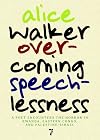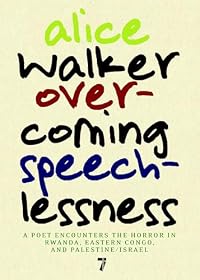
Overcoming Speechlessness: A Poet Encounters the Horror in Rwanda, Eastern Congo, and Palestine/Israel
by Alice Walker
On This Page
Description
"In 2006, Alice Walker, working with Women for Women International, visited Rwanda and the eastern Congo to witness the aftermath of the genocide in Kigali. Invited by Code Pink, an antiwar group working to end the Iraq War, Walker traveled to Palestine/Israel three years later to view the devastation on the Gaza Strip. Here is her testimony"--Publisher description.Tags
Recommendations










Member Reviews
A short, but moving, book illustrating the power of a gentle voice speaking the truth. Using stories of her visits to Rwanda, Eastern Congo, and Palestine/Israel, Alice Walker tries to answer the question "What has happened to humanity?"
I always think I'm prepared to read yet another story about the atrocities people do to each other, but of course, I am always amazed/ashamed anew. I was impressed by the way Walker used very short vignettes to illustrate these atrocities. In fact, the whole book reads a bit like a series of postcards, giving us a glimpse into other people's experiences while at the same time not allowing us to remain removed from our own role, historically and/or currently, in these stories.
Even more amazing was show more Walker's ability to move us beyond the atrocities to see and hear the inspiring stories of the sacrifices people have made in response to injustice done to others, seemingly unlike themselves; people who are able to see beyond difference to our shared humanity.
Finally, the stories of the survivors provide the remedy for the speechlessness of the title. In the midst of "overwhelm", there is "Nothing to do, finally, but dance." And speak out; find a way to voice the truth. Because "allowing freedom to others brings freedom to ourselves." show less
I always think I'm prepared to read yet another story about the atrocities people do to each other, but of course, I am always amazed/ashamed anew. I was impressed by the way Walker used very short vignettes to illustrate these atrocities. In fact, the whole book reads a bit like a series of postcards, giving us a glimpse into other people's experiences while at the same time not allowing us to remain removed from our own role, historically and/or currently, in these stories.
Even more amazing was show more Walker's ability to move us beyond the atrocities to see and hear the inspiring stories of the sacrifices people have made in response to injustice done to others, seemingly unlike themselves; people who are able to see beyond difference to our shared humanity.
Finally, the stories of the survivors provide the remedy for the speechlessness of the title. In the midst of "overwhelm", there is "Nothing to do, finally, but dance." And speak out; find a way to voice the truth. Because "allowing freedom to others brings freedom to ourselves." show less
 This review was written for LibraryThing Early Reviewers.
While those of us who sit comfortably in front of our televisions to learn of the devastation occurring in the areas of focus in Overcoming Speechlessness, Walker was on the front lines sharing in the pain and the healing of those affected. She believes "whatever is currently happening to humanity, it is happening o all of us." This is the essence of this very brief work. But its brevity reveals the real meaning of humanity. Walker allows her voice to be that of the survivors of these tragedies. Overcoming Speechlessness also gives us glimpses of humanity in persons like the woman she meets in Kigali who was a sex slave and claims that Women for Women International "saved" her or the sacrifice of life made by a young woman attempting to show more save the home of her Palestinian friends from demolish. It's a moving piece that should force any reader to re-think remaining silent about atrocities committed against our global mothers, fathers, brothers, sisters, and children. show less
This review was written for LibraryThing Early Reviewers.Very short, very righteous, and very much preaching to the choir.
Although we all need to hear much more about crimes against humanity in Rwanda, the Congo, and Palestine/Israel, this book presents mostly individual stories and the author's reactions. Political horrors are made of individual horrors, to be sure, but without exploring a far greater context, we're left only with mysteriously occurring atrocities and brave survivors.
Walker refers to herself as a poet several times, including in the book subtitle, but there is nothing whatsoever poetic in this volume. Speaking hard truths may be done poetically, but it is not poetic by default. Exhortations, while they may also be done poetically, are not poetic in themselves. Using lofty show more abstract nouns-- Hate, Justice, Healing-- does not make an essay poetic.
Three stars for the topic and good intentions. show less
Although we all need to hear much more about crimes against humanity in Rwanda, the Congo, and Palestine/Israel, this book presents mostly individual stories and the author's reactions. Political horrors are made of individual horrors, to be sure, but without exploring a far greater context, we're left only with mysteriously occurring atrocities and brave survivors.
Walker refers to herself as a poet several times, including in the book subtitle, but there is nothing whatsoever poetic in this volume. Speaking hard truths may be done poetically, but it is not poetic by default. Exhortations, while they may also be done poetically, are not poetic in themselves. Using lofty show more abstract nouns-- Hate, Justice, Healing-- does not make an essay poetic.
Three stars for the topic and good intentions. show less
This review was written for LibraryThing Early Reviewers.This is a very small book that packs a wallop. It is well written and an important book. Did I like it? Mixed feelings. It is upsetting to read and I had to put it aside at one point. Walker has taken a complicated issue and made it very simple by speaking of her own experiences on trips she has made to the Gaza, Rwanda and the Congo. She reflects on her own upbringing in the American South and draws comparisons. I do think that personal experiences are one of the most thoughtful ways to look at the effects of war. I will confess that as a Jew, it was hard to read this. Only one side is presented, but I have no doubt that what she saw and experienced in the Gaza Strip is truly happening. But Walker lost some credibility with me when I show more read her daughter's book Black White and Jewish. I think that if you read and like Alice Walker, you should also read her daughter's book.
So with mixed feelings, I can't help but say that this book is worth reading. It won't take you long and it will surely have an impact in some way. I am glad that I read it, but it made me very sad in more ways than I thought it would. show less
So with mixed feelings, I can't help but say that this book is worth reading. It won't take you long and it will surely have an impact in some way. I am glad that I read it, but it made me very sad in more ways than I thought it would. show less
This review was written for LibraryThing Early Reviewers.Alice Walker's latest work is a series of short essays about her travels and experiences in Rwanda, Congo, and the Gaza Strip. Working with Women for Women International and CODEPINK, Walker’s trips reveal a side of war and conflict that many are not aware of, specifically how everyday people are devastated and how in the direst circumstances they are able to rebuild their lives and their spirits.
After seeing the unthinkable Walker writes that she was thrust into a state of speechlessness. And more generally it seems that the world has been overcome with speechlessness and the inability to act; we are constantly bombarded with wars, conflicts, a mountain of ‘isms’, and environmental assault.
Whether it is because of media or our show more own shielding of the eyes Walker revealed for me that truth is relative to what you see and what you feel, what you allow yourself to see and feel. I find it an act of bravery for one person to reach in deep and pull out these stories, to start a dialogue so that we can un-shield our eyes and discuss. I’m sure others are doing similar work, I only hope that we will hear their voices.
Sharing these stories Walker is able to overcome speechlessness, to reclaim her voice and perhaps to give voice to others who are victims or who will propel change forward.
This review has been crossposted on my blog http://leaningtowardthesun.wordpress.com/ show less
After seeing the unthinkable Walker writes that she was thrust into a state of speechlessness. And more generally it seems that the world has been overcome with speechlessness and the inability to act; we are constantly bombarded with wars, conflicts, a mountain of ‘isms’, and environmental assault.
Whether it is because of media or our show more own shielding of the eyes Walker revealed for me that truth is relative to what you see and what you feel, what you allow yourself to see and feel. I find it an act of bravery for one person to reach in deep and pull out these stories, to start a dialogue so that we can un-shield our eyes and discuss. I’m sure others are doing similar work, I only hope that we will hear their voices.
Sharing these stories Walker is able to overcome speechlessness, to reclaim her voice and perhaps to give voice to others who are victims or who will propel change forward.
This review has been crossposted on my blog http://leaningtowardthesun.wordpress.com/ show less
This review was written for LibraryThing Early Reviewers.Overcoming Speechlessness is a series of short vignettes focusing on Alice Walker's experiences in Rwanda, Congo and the Gaza Strip. She draws on parallels between the current struggles for freedom and the civil rights movement that she was a part of in the 1960s. Ultimately, this book is neither depressing nor upbeat, but just is, leaving the reader to dwell on the current sad state of affairs.
This review was written for LibraryThing Early Reviewers.This is a very slim (too slim) volume about being able to speak about the atrocities that go on all over the world. After touching on the horrors of Rwanda and Eastern Congo, Walker turns her eyes to Gaza in order to reveal some of the stories of the people who live there. As she points out, these stories are not easy for Americans to come by and she wants to change that by her visit there. However, because I was looking forward to hearing these stories, I felt that Walker shortchanged her subjects by spending a large part of these very few pages talking about the Civil Rights movement. It's a somewhat apt comparison, but it doesn't really say much about current conditions in Gaza. Also, she spend even more pages talking about how much show more time she spent entering the area, filling out paperwork and waiting at the border. Again, an apt description - Israel is normally a hard country to enter for obvious reasons - but, again, it means that this thin volume is left with very few actual stories from the population of Gaza. Perhaps it would have been a successful attempt had it been longer than 80 pages, but as it is, this volume is severely lacking in detail and background information. show less
This review was written for LibraryThing Early Reviewers.Members
- Recently Added By
Lists

Seven Stories Press
18 works; 1 member
Author Information

96+ Works 40,776 Members
Alice Walker won the Pulitzer Prize and the American Book Award for her novel The Color Purple. Her other bestselling novels include By the Light of My Father's Smile, Possessing the Secret of Joy, and The Temple of My Familiar. She is also the author of two collections of short stories, three collections of essays, five volumes of poetry, and show more several children's books. Her books have been translated into more than two dozen languages. Born in Eaton, Georgia, Walker now lives in Northern California. Like so many characters in her fiction, Alice Walker was born into a family of sharecroppers in Eaton, Georgia. She began Spelman College on a scholarship and graduated from Sarah Lawrence College in 1965. While still in college, Walker became active in the civil rights movement and continued her involvement after she graduated, serving as a voter registration worker in Georgia. She also worked in a Head Start program in Mississippi and was on the staff of the New York City welfare department. She has lectured and taught at several colleges and universities and currently operates a publishing house, Wild Trees Press, of which she is a co-founder. Walker began her literary career as a poet, publishing Once: Poems in 1968. The collection reflects her experiences in the civil rights movement and her travels in Africa. Her second collection of poetry, Revolutionary Petunias and Other Poems (1973), is a celebration of the struggle against oppression and racism. In between these two collections, she published her first novel, The Third Life of Grange Copeland (1970), the story of Ruth Copeland, a young black girl, and her grandfather, Grange, who brutalizes his own family out of the frustrations of racial prejudice and his own sense of inadequacy. Walker's first collection of short stories, In Love and Trouble: Stories of Black Women (1973), established her special concern for the struggles, hardships, loyalties, and triumphs of black women, a powerful force in the rest of her fiction. Meridian (1976), her second novel, is the story of Meridian Hill, a civil rights worker. In her second collection of short stories, You Can't Keep A Good Woman Down (1981), Walker again portrays black women struggling against sexual, racial, and economic oppression. Walker's third novel, The Color Purple (1982), brought her the national recognition denied her earlier works. Through this story of the sharecropper Celie and the abuses she endures, Walker draws together the themes that have run through her earlier work into a concentrated and powerful attack on racism and sexism, and produces a triumphant celebration of the spirit and endurance of black women. The book received the Pulitzer Prize and was made into a successful film. Walker describes her most recent novel, The Temple of My Familiar (1989) as "a romance of the last 500,000 years." The book is a blend of myth and history revolving around three marriages. As the married couples tell their stories, they explore both their origins and the inner life of modern African Americans. (Bowker Author Biography) show less
Common Knowledge
- Original publication date
- 2010
- Important places
- Rwanda; Congo; Gaza Strip
- Epigraph
- Three things cannot be hidden: the sun, the moon, and the truth.
- Buddha - First words
- Three years ago I visited Rwanda and eastern Congo.
- Last words
- (Click to show. Warning: May contain spoilers.)And, because almost everyone on the planet now acknowledges our collective slide into global disaster unless we profoundly change our ways, we will be heard.
- Blurbers
- Zinn, Howard; Benjamin, Medea; Makdisi, Saree
Classifications
- Genres
- Nonfiction, History, Biography & Memoir
- DDC/MDS
- 306.6 — Society, Government, and Culture Social sciences, sociology & anthropology Social Behavior - Dating, Marriage, Divorce Religious institutions
- LCC
- PS3573 .A425 .Z469 — Language and Literature American literature American literature Individual authors 1961-
- BISAC
Statistics
- Members
- 103
- Popularity
- 312,901
- Reviews
- 8
- Rating
- (3.41)
- Languages
- English, French, Portuguese
- Media
- Paper, Ebook
- ISBNs
- 4
- ASINs
- 2