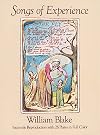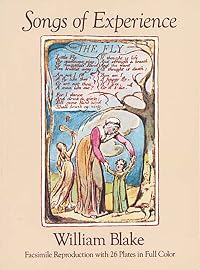
Songs of Experience
by William Blake
On This Page
Description
This facsimile of Blake's original "Illuminated Book" reproduces 26 full-color plates from a rare 1826 edition. Includes "The Tyger," "London," "Holy Thursday," and other immortal poems. 26 color plates. Printed text of poems.Tags
Recommendations














Member Recommendations
Member Reviews
The first poetry book I bought of my own free will. I bought it since it had "The Tyger" included in it, as well as the illustrations. The text on the plates of the illustrations are hard to read, but the pictures bring the poetry to life. Blake's poetry didn't leap out at me at first, as I first encountered it in a forced Poetry school assignment unit, however reading Blake with no obligations to do so brings the most enjoyment, you should be able to study it as much or as little as you like. Reading this makes you realise how much Alan Moore bases his classic 1980s comics on Blake's wordsmithing. An enjoyable read.
I liked the pictures in Songs of Experience better than those in Songs of Innocence-- at least in the originals used for my Dover facsimile edition, the colors are much richer and darker.
Okay, Blake, you Blake my world. Blake lively. Blakeguard! Blake-eyed ravens spiral down. Finnegan's Blake (is liking this book more than Songs of Innocence like liking Ulysses more than Portrait of the Artist, i.e., utterly fucking safe and obvious and predictable? Blake, Blake, Blake, on thy cold grey stones, o sea. And what rough Blake, its Blake blake at Blake, Blaeckckclrkclrkclrklbbbbbkkkkhhhhh?
This is some art brut shit. Next stop, Orcus and Urizen.
This is some art brut shit. Next stop, Orcus and Urizen.
CANTOS DE LA EXPERIENCIA
"Imaginamos el horror y la indignación
que debió producir, en su época, este libro
De allí su reducido tiraje, la indiferencia con
que se lo castigó. Pero, aun hoy, "Cantos de
la experiencia" es, en su idioma, tal vez lo
más desnudado de una raza no muy afectaa
este tipo de sinceridad verbal. Y lo
sorprendente es que su lenguaje
imprecatorio no pierde majestad ni belleza
por lo contrario, si hay algo plausible en
Blake es su romanticismo, esas ondas
musicales con las que nutría sus estrofas y
sintetizaba su profunda exaltación."
"Imaginamos el horror y la indignación
que debió producir, en su época, este libro
De allí su reducido tiraje, la indiferencia con
que se lo castigó. Pero, aun hoy, "Cantos de
la experiencia" es, en su idioma, tal vez lo
más desnudado de una raza no muy afectaa
este tipo de sinceridad verbal. Y lo
sorprendente es que su lenguaje
imprecatorio no pierde majestad ni belleza
por lo contrario, si hay algo plausible en
Blake es su romanticismo, esas ondas
musicales con las que nutría sus estrofas y
sintetizaba su profunda exaltación."
Sep 8, 2018Spanish
Ratings
Members
- Recently Added By
Lists

Autodidacts
15 works; 4 members

Favourite Books
1,819 works; 308 members

18th Century
42 works; 11 members

Poetry Collections
79 works; 6 members

100 Books to Read in a Lifetime (That Are Older Than 200 Years)
415 works; 173 members
Author Information

501+ Works 20,199 Members
William Blake's poems, prophecies, and engravings represent his strong vision and voice for rebellion against orthodoxy and all forms of repression. Born in London in November 1757; his father, a hosier of limited means, could do little for the boy's education. However, when the young Blake's talent for design became apparent, his wise father sent show more him to drawing school at the age of 10. In 1771 Blake was apprenticed to an engraver. Blake went on to develop his own technique, a method he claimed that came to him in a vision of his deceased younger brother. In this, as in so many other areas of his life, Blake was an iconoclast; his blend of printing and engraving gave his works a unique and striking illumination. Blake joined with other young men in support of the Revolutions in France and America. He also lived his own revolt against established rules of conduct, even in his own home. One of his first acts after marrying his lifetime companion, Catherine Boucher, was to teach her to read and write, rare for a woman at that time. Blake's writings were increasingly styled after the Hebrew prophets. His engravings and poetry give form and substance to the conflicts and passions of the elemental human heart, made real as actual characters in his later work. Although he was ignored by the British literary community through most of his life, interest and study of his work has never waned. Blake's creativity and original thinking mark him as one of the earliest Romantic poets, best known for his Songs of Innocence (1789) and Songs of Experience (1794) and The Tiger. Blake died in London in 1827. (Bowker Author Biography) show less
Series
Belongs to Publisher Series
Work Relationships
Is contained in
The Marriage of Heaven and Hell; Songs of Innocence; Songs of Experience by William Blake (indirect)
The poems: Comprising Songs of innocence and of experience, together with Poetical sketches and some copyright poems not by William Blake (indirect)
Works of William Blake. (80 Works) Includes Songs of Innocence and Experience, The Marriage of Heaven and Hell, Poetical Sketches and more. FREE Author's biography and poems in the trial version. by William Blake (indirect)
Common Knowledge
- Canonical title
- Songs of Experience
- Original publication date
- 1826
- First words
- Hear the voice of the Bard!
Who Present, Past, & Future sees
Whose ears have heard,
The Holy Word,
That walk'd among the ancient trees. - Disambiguation notice
- This edition (usually the Dover facsimile edition) contains ONLY the Songs of Experience. Do not combine with editions of both Innocence and Experience or with Songs of Innocence only.
Classifications
Statistics
- Members
- 393
- Popularity
- 79,299
- Reviews
- 5
- Rating
- (4.37)
- Languages
- Czech, English, French, Spanish
- Media
- Paper, Ebook
- ISBNs
- 5
- UPCs
- 2
- ASINs
- 4