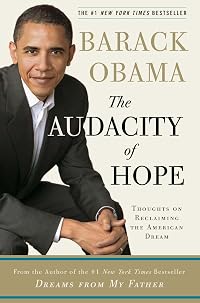
The Audacity of Hope: Thoughts on Reclaiming the American Dream
by Barack Obama
On This Page
Description
Senator Obama calls for a different brand of politics--a politics for those weary of bitter partisanship and alienated by the "endless clash of armies" we see in Congress and on the campaign trail; a politics rooted in the faith, inclusiveness, and nobility of spirit at the heart of our democracy. He explores those forces--from the fear of losing, to the perpetual need to raise money, to the power of the media--that can stifle even the best-intentioned politician. He examines the growing show more economic insecurity of American families, the racial and religious tensions within the body politic, and the transnational threats--from terrorism to pandemic--that gather beyond our shores. And he grapples with the role that faith plays in a democracy. Only by returning to the principles that gave birth to our Constitution, he says, can Americans repair a broken political process, and restore to working order a government dangerously out of touch with millions of ordinary Americans.--From publisher description. show lessTags
Recommendations





Member Recommendations

foof2you This is Obama's life story and how became the man he is today.

Member Reviews
Okay so I've always been a huge Obama fan. I went door-to-door for him in 2008 and 2012, I took my son to one of his rallies (my first political rally and his), but even after that I was totally blown away by this book. I swear I wanted to quote 90% of the lines in the book on FB.
He's a brilliant man and so it's bittersweet to be driving around in my car listening to him speak while knowing the current president speaks like a fifth-grader (sorry fifth graders).
I would definitely recommend this book to conservatives who might think it would be a book constantly bashing them. In the book he blasts both sides about equally. He talks about his opinions but also makes sure to talk about what he DOES agree with about the other side's show more argument. In fact, much of the books is devoted to trying to show how alike people are and how the answer is in rising above the hype and being able to see both "sides". show less
He's a brilliant man and so it's bittersweet to be driving around in my car listening to him speak while knowing the current president speaks like a fifth-grader (sorry fifth graders).
I would definitely recommend this book to conservatives who might think it would be a book constantly bashing them. In the book he blasts both sides about equally. He talks about his opinions but also makes sure to talk about what he DOES agree with about the other side's show more argument. In fact, much of the books is devoted to trying to show how alike people are and how the answer is in rising above the hype and being able to see both "sides". show less
I had to. I just had to. After the horribly awful election last week, I had to listen to this book. I had bought it years ago but it had sat on my shelf. After the election, I grabbed the audiobook from my library's OverDrive site and sped through Oklahoma, Texas, and New Mexico listening to it.
My first reaction was incredible sadness that this man will no longer be our president in a few short months. His thoughts on government, politics, and America are uniquely intelligent, empathetic, measured, and reasonable. They make sense, and I dearly needed some sense this past week.
Ultimately, I also felt hope, because this man is and was my president, and had worked to make our country better -- not just for the rich and privileged, but show more for everybody. And I have hope because he showed that most people just want the same things, and that we can all find common ground. show less
My first reaction was incredible sadness that this man will no longer be our president in a few short months. His thoughts on government, politics, and America are uniquely intelligent, empathetic, measured, and reasonable. They make sense, and I dearly needed some sense this past week.
Ultimately, I also felt hope, because this man is and was my president, and had worked to make our country better -- not just for the rich and privileged, but show more for everybody. And I have hope because he showed that most people just want the same things, and that we can all find common ground. show less
This book stayed on my back burner, as I assumed it was outdated (2006). Especially the "hope" part! So much has happened since 2006. But, surprise -- the book felt very current. The split in our country goes way back before Trump, and Obama addressed this fairly well. He seemed to vacillate on a lot of issues with "on the other hand..." and I wondered if his middle-of-the-road stance was laying the groundwork for a presidential run. Of course, since he was elected president two years later.
His personal stories were a delight since I'd just read Michelle's "Becoming" and got his point of view of some of her family tales.
So, why was I finally prompted to read this one? Because the Goodreads History Club is about to start his "A Promised show more Land" and I like to go in order. And I'd already read his first book, "Dreams of my Father." Now I'm looking forward to his latest book, to see if he still has hope! Of course, he does. That's his brand! show less
His personal stories were a delight since I'd just read Michelle's "Becoming" and got his point of view of some of her family tales.
So, why was I finally prompted to read this one? Because the Goodreads History Club is about to start his "A Promised show more Land" and I like to go in order. And I'd already read his first book, "Dreams of my Father." Now I'm looking forward to his latest book, to see if he still has hope! Of course, he does. That's his brand! show less
Две реалности се преплитат в тази книга.
След първата половина - вижданията на Обама за политиката и икономиката - мислех да я захвърля и да й сложа една звездичка. Знатете какво е булшит - как някой се опитва да ви забълбуква, с красиви думички и дълги, увъртяни и красиво звучащи, но нищо конкретно не значещи изречения да прикрие какво наистина мисли, да се хареса на всички, да извика емоциите ви, вместо show more разума.
Обама много, ама много внимава думите му да не противоречат кардинално на ничие мнение, което прави на места жалък и смешен опитът му да удовлетвори и да се хареса на радикално противоположни типове избиратели. Защото за икономика и политика той пише като истински, закоравял политик - точно като тия, като които декларира, че никога няма да стане - гладко, мазно, фалшиво.
Втората половина от книгата обаче, е тотално различна. Там той говори за неща, които очевидно са фокусът на вниманието и работата му като политик - социална политика, здравеопазване, образование, религия. Логично, по тия въпроси, той се аргументира доста добре (освен за училищните ваучери - защо ги мрази така и не обясни) и не се страхува да изкаже твърдо мнението си, да опише визията си за това какво трябва да бъде и какво конкретно трябва да се направи. Макар да не съм съгласен с доста от идеите му, хареса ми енергията, с която говори за тях и разбирането в дълбочина на проблемите, които се опитва да пребори.
Общо взето (това личи във всяко изречение в книгата) Обама е типичен представител на Прогресивните Демократи в САЩ - това са идейните наследници на Рузвелт и Кейнс, които смятат, че хората просто не знаят какво искат и какво е добро за тях - и затова правителството е призвано да се грижи за всички аспекти от живота на гражданите си, да регулира и да се намесва с твърда ръка икономиката, да създава заетост, да обгрижва хората със щедри социални програми, да прибира големи данъци и всичко това - с помощта на армия бюрократи.
Един вид, лозунгът, познат твърде добре от близкото минало на България: "Дайте да дадем!" show less
След първата половина - вижданията на Обама за политиката и икономиката - мислех да я захвърля и да й сложа една звездичка. Знатете какво е булшит - как някой се опитва да ви забълбуква, с красиви думички и дълги, увъртяни и красиво звучащи, но нищо конкретно не значещи изречения да прикрие какво наистина мисли, да се хареса на всички, да извика емоциите ви, вместо show more разума.
Обама много, ама много внимава думите му да не противоречат кардинално на ничие мнение, което прави на места жалък и смешен опитът му да удовлетвори и да се хареса на радикално противоположни типове избиратели. Защото за икономика и политика той пише като истински, закоравял политик - точно като тия, като които декларира, че никога няма да стане - гладко, мазно, фалшиво.
Втората половина от книгата обаче, е тотално различна. Там той говори за неща, които очевидно са фокусът на вниманието и работата му като политик - социална политика, здравеопазване, образование, религия. Логично, по тия въпроси, той се аргументира доста добре (освен за училищните ваучери - защо ги мрази така и не обясни) и не се страхува да изкаже твърдо мнението си, да опише визията си за това какво трябва да бъде и какво конкретно трябва да се направи. Макар да не съм съгласен с доста от идеите му, хареса ми енергията, с която говори за тях и разбирането в дълбочина на проблемите, които се опитва да пребори.
Общо взето (това личи във всяко изречение в книгата) Обама е типичен представител на Прогресивните Демократи в САЩ - това са идейните наследници на Рузвелт и Кейнс, които смятат, че хората просто не знаят какво искат и какво е добро за тях - и затова правителството е призвано да се грижи за всички аспекти от живота на гражданите си, да регулира и да се намесва с твърда ръка икономиката, да създава заетост, да обгрижва хората със щедри социални програми, да прибира големи данъци и всичко това - с помощта на армия бюрократи.
Един вид, лозунгът, познат твърде добре от близкото минало на България: "Дайте да дадем!" show less
The Audacity of Hope: Thoughts on Reclaiming the American Dream (Vintage)
Better late than never, but obviously should have read this book when published. If you want to know what a candidate is going to do, read his book. But I'm not sure how true that is for this one. You definitely know he's going to push through health care reform with a push toward universal coverage, but that's the only obvious policy in this book.
I should say that reading this book would have lowered my esteem of Candidate Obama. It was evident to me from interviews he gave through the campaign that he was very knowledgeable about health care, philosophy, and even some economics relative to other politicians. I liked his intelligence and pragmatic introspection show more very much. It does not show up in this book. The book shifts between Obama's sociological musings, autobiographical reflection, and some stories from his political life. These are roughly divided into categories: "Faith, Race, Our Constitution," etc. but there is a lot of spillover.
Obama begins by bemoaning the state of politics, and says he aimed his Senate campaign at people who didn't fit neatly into stereotypes:
"I imagine the white Southerner who growing up heard his dad talk about niggers this and niggers that but who has struck up a friendship with the black guys at the office and is trying to teach his own son different, who thinks discrimination is wrong but doesn’t see why the son of a black doctor should get admitted into law school ahead of his own son. Or the former Black Panther who decided to go into real estate, bought a few buildings in the neighborhood, and is just as tired of the drug dealers in front of those buildings as he is of the bankers who won’t give him a loan to expand his business. There’s the middle-aged feminist who still mourns her abortion, and the Christian woman who paid for her teenager’s abortion, and the millions of waitresses and temp secretaries and nurse’s assistants and Wal-Mart associates who hold their breath every single month in the hope that they’ll have enough money to support the children that they did bring into the world.
I imagine they are waiting for a politics with the maturity to balance idealism and realism, to distinguish between what can and cannot be compromised, to admit the possibility that the other side might sometimes have a point."
But he seems to put too much faith in the rationality of the voters, while at the same time admitting that people mostly vote for their "Red Team" or "Blue Team" regardless of the merits or policies. Then he himself repeats the broken record of the Democratic stereotypes, blasting certain Republican policies without examining either the merits or economic analysis behind them. He resorts to the same old "they're sticking it to labor" or "giving tax breaks to millionaires," etc. Even writing in late 2007, he brings out the canard of "Bush squandered the surplus"-- the surplus mythology has been debunked by even very left-leaning Democratic economists. He has some straw men of the religious right that he tears down--namely that most white religious conservatives want to establish a theocracy. That is disappointing.
Where Obama differs from "stereotypical" Democrat in this book is his praising Reagan for having a point-- that government programs had overreached and needed to be scaled back or reexamined. For praising Clinton and Republican's welfare reform in the 1990s and even mentioning the "failures" of Lyndon Johnson's War on Poverty. He advocates EITC expansion and doesn't mention minimum wage as that important.
He agrees with social conservatives about "values" and "faith" being important in helping prevent teen pregnancy and promoting marriage. For hailing all the progress that has been made in reducing racial inequality. Much in this book showed up again in his DNC acceptance speech in Colorado, a speech I liked.
He states his belief in competition, free markets, and entrepreneurship. But later in the book he criticizes gains from trade. He espouses himself as a Hamiltonian, or a late 1800s Republican (a la Lincoln)-- a strong national government is needed to protect and grow industry (tariffs, subsidies where needed) and Progressive labor policies are needed to strengthen unions and raise wages and working conditions at the bottom. I would say Obama has lived up to this in office, he has often trumpeted his "pro-business" policies, which I would argue favor the large monopolies much more than a wide base-- they're not pro-market policies.
More frustrating is the naivete found in paragraphs like the one below. "We should be guided by what works" as if there is broad agreement on what "works"(!):
"America can’t compete with China and India simply by cutting costs and shrinking government—unless we’re willing to tolerate a drastic decline in American living standards, with smog-choked cities and beggars lining the streets. Nor can America compete simply by erecting trade barriers and raising the minimum wage—unless we’re willing to confiscate all the world’s computers.
But our history should give us confidence that we don’t have to choose between an oppressive, government-run economy and a chaotic and unforgiving capitalism. It tells us that we can emerge from great economic upheavals stronger, not weaker. Like those who came before us, we should be asking ourselves what mix of policies will lead to a dynamic free market and widespread economic security, entrepreneurial innovation and upward mobility. And we can be guided throughout by Lincoln’s simple maxim: that we will do collectively, through our government, only those things that we cannot do as well or at all individually and privately.
In other words, we should be guided by what works."
That paragraph is about the emptiest political rhetoric I've read.
Most disappointing to me are his comments about inner city poverty and unemployment. Instead of looking at the benefits of gentrification, he advocates more government spending on vague housing renovation and laying fiber optic cable--only for the hope of it increasing the chance that the unemployed men in these areas can do those jobs as unskilled labor.
Obama gives some very broad overviews of his political campaigns. When Obama gets to the U.S. Senate he meets with Robert Byrd, who lectures him on the importance of studying the history and rules of the Senate. Byrd claims to be "saving the Republic." This inspires Obama to get back to the Constitution and other founding documents (the man is well-read, there is no doubting this). But Obama neglects to mention all the pork that Byrd brought to West Virginia at the expense of the rest of Americans. That is out of character with the criticisms of others, particularly Republicans, he mentions in the book.
Obama takes the time to articulate his own Christian faith experience and why he resonates with the historically Black church. Black churches tend to be more of the center of their community, and minister to the "whole man." They also tend to be more open-minded and allow for "doubts" and rational thinking. I predict the time will come when conservative Christians in America will remember Obama's faith and family values more fondly than they esteem them currently.
Barack Obama closes his book with some stories of his development as a husband and a father. When he started in public office, Michelle was both the career woman and homemaker, which stressed her out and caused friction in their marriage that it took Obama years to appreciate. He reflects on his desire to be a better father than the male figures he had in his life, and explains their shortcomings. He remains aware of how many more resources his family has to deal with career and family issues than many families. Obama's family life has always been a positive for him in my eyes. His diverse upbringing is important to me as well.
There is no foreign policy in this book.
Overall, I give it 2 stars out of 5. I hope for many thoughtful memoirs from President Obama after the White House. I sincerely hope this book will not be considered one of his best works. show less
Better late than never, but obviously should have read this book when published. If you want to know what a candidate is going to do, read his book. But I'm not sure how true that is for this one. You definitely know he's going to push through health care reform with a push toward universal coverage, but that's the only obvious policy in this book.
I should say that reading this book would have lowered my esteem of Candidate Obama. It was evident to me from interviews he gave through the campaign that he was very knowledgeable about health care, philosophy, and even some economics relative to other politicians. I liked his intelligence and pragmatic introspection show more very much. It does not show up in this book. The book shifts between Obama's sociological musings, autobiographical reflection, and some stories from his political life. These are roughly divided into categories: "Faith, Race, Our Constitution," etc. but there is a lot of spillover.
Obama begins by bemoaning the state of politics, and says he aimed his Senate campaign at people who didn't fit neatly into stereotypes:
"I imagine the white Southerner who growing up heard his dad talk about niggers this and niggers that but who has struck up a friendship with the black guys at the office and is trying to teach his own son different, who thinks discrimination is wrong but doesn’t see why the son of a black doctor should get admitted into law school ahead of his own son. Or the former Black Panther who decided to go into real estate, bought a few buildings in the neighborhood, and is just as tired of the drug dealers in front of those buildings as he is of the bankers who won’t give him a loan to expand his business. There’s the middle-aged feminist who still mourns her abortion, and the Christian woman who paid for her teenager’s abortion, and the millions of waitresses and temp secretaries and nurse’s assistants and Wal-Mart associates who hold their breath every single month in the hope that they’ll have enough money to support the children that they did bring into the world.
I imagine they are waiting for a politics with the maturity to balance idealism and realism, to distinguish between what can and cannot be compromised, to admit the possibility that the other side might sometimes have a point."
But he seems to put too much faith in the rationality of the voters, while at the same time admitting that people mostly vote for their "Red Team" or "Blue Team" regardless of the merits or policies. Then he himself repeats the broken record of the Democratic stereotypes, blasting certain Republican policies without examining either the merits or economic analysis behind them. He resorts to the same old "they're sticking it to labor" or "giving tax breaks to millionaires," etc. Even writing in late 2007, he brings out the canard of "Bush squandered the surplus"-- the surplus mythology has been debunked by even very left-leaning Democratic economists. He has some straw men of the religious right that he tears down--namely that most white religious conservatives want to establish a theocracy. That is disappointing.
Where Obama differs from "stereotypical" Democrat in this book is his praising Reagan for having a point-- that government programs had overreached and needed to be scaled back or reexamined. For praising Clinton and Republican's welfare reform in the 1990s and even mentioning the "failures" of Lyndon Johnson's War on Poverty. He advocates EITC expansion and doesn't mention minimum wage as that important.
He agrees with social conservatives about "values" and "faith" being important in helping prevent teen pregnancy and promoting marriage. For hailing all the progress that has been made in reducing racial inequality. Much in this book showed up again in his DNC acceptance speech in Colorado, a speech I liked.
He states his belief in competition, free markets, and entrepreneurship. But later in the book he criticizes gains from trade. He espouses himself as a Hamiltonian, or a late 1800s Republican (a la Lincoln)-- a strong national government is needed to protect and grow industry (tariffs, subsidies where needed) and Progressive labor policies are needed to strengthen unions and raise wages and working conditions at the bottom. I would say Obama has lived up to this in office, he has often trumpeted his "pro-business" policies, which I would argue favor the large monopolies much more than a wide base-- they're not pro-market policies.
More frustrating is the naivete found in paragraphs like the one below. "We should be guided by what works" as if there is broad agreement on what "works"(!):
"America can’t compete with China and India simply by cutting costs and shrinking government—unless we’re willing to tolerate a drastic decline in American living standards, with smog-choked cities and beggars lining the streets. Nor can America compete simply by erecting trade barriers and raising the minimum wage—unless we’re willing to confiscate all the world’s computers.
But our history should give us confidence that we don’t have to choose between an oppressive, government-run economy and a chaotic and unforgiving capitalism. It tells us that we can emerge from great economic upheavals stronger, not weaker. Like those who came before us, we should be asking ourselves what mix of policies will lead to a dynamic free market and widespread economic security, entrepreneurial innovation and upward mobility. And we can be guided throughout by Lincoln’s simple maxim: that we will do collectively, through our government, only those things that we cannot do as well or at all individually and privately.
In other words, we should be guided by what works."
That paragraph is about the emptiest political rhetoric I've read.
Most disappointing to me are his comments about inner city poverty and unemployment. Instead of looking at the benefits of gentrification, he advocates more government spending on vague housing renovation and laying fiber optic cable--only for the hope of it increasing the chance that the unemployed men in these areas can do those jobs as unskilled labor.
Obama gives some very broad overviews of his political campaigns. When Obama gets to the U.S. Senate he meets with Robert Byrd, who lectures him on the importance of studying the history and rules of the Senate. Byrd claims to be "saving the Republic." This inspires Obama to get back to the Constitution and other founding documents (the man is well-read, there is no doubting this). But Obama neglects to mention all the pork that Byrd brought to West Virginia at the expense of the rest of Americans. That is out of character with the criticisms of others, particularly Republicans, he mentions in the book.
Obama takes the time to articulate his own Christian faith experience and why he resonates with the historically Black church. Black churches tend to be more of the center of their community, and minister to the "whole man." They also tend to be more open-minded and allow for "doubts" and rational thinking. I predict the time will come when conservative Christians in America will remember Obama's faith and family values more fondly than they esteem them currently.
Barack Obama closes his book with some stories of his development as a husband and a father. When he started in public office, Michelle was both the career woman and homemaker, which stressed her out and caused friction in their marriage that it took Obama years to appreciate. He reflects on his desire to be a better father than the male figures he had in his life, and explains their shortcomings. He remains aware of how many more resources his family has to deal with career and family issues than many families. Obama's family life has always been a positive for him in my eyes. His diverse upbringing is important to me as well.
There is no foreign policy in this book.
Overall, I give it 2 stars out of 5. I hope for many thoughtful memoirs from President Obama after the White House. I sincerely hope this book will not be considered one of his best works. show less
My general opinion of Barack Obama is quite favorable, and since I fully enjoyed his first book, Dreams from My Father, I expected I would also like his second and newest work, The Audacity of Hope (Crown, 2006). It had been sitting on my shelf waiting for me since November and I finally pulled it off this week and had a read. It was not a disappointment. Once again Obama's elegant writing style is on full display, as is his knack for turning a good phrase. While he does not turn the book into a policy handbook full of detailed proposals or concrete plans for change, he offers something that I would argue may be even more important: a different way of approaching politics and shaping political debate.
If I picked out every excerpt from show more this book which spoke to me (and which I have jotted down in my reading notes) I'd be typing all day (and would entirely ruin the book for you). But I think this two-paragraph selection sums Obama's message up fairly well (p. 22):
"It's not simply that a gap exists between our professed ideals as a nation and the reality we witness every day. In one form or another, that gap has existed since America's birth. Wars have been fought, laws passed, systems reformed, unions organized, and protests staged to bring promise and practice into alignment.
No, what's troubling is the gap between the magnitude of our challenges and the smallness of our politics - the ease with which we are distracted by the petty and trivial, our chronic avoidance of tough decisions, our seeming inability to build a working consensus to tackle any big problem."
Obama's desire to refocus American priorities is one of the most refreshing things about the man. While it may come across as overly idealistic to call for increased funding for eduction, sci/tech research and energy independence, all these things are areas in which we must do better as a nation. As he notes after commenting on the recent pork-filled highway bill, "what's missing is not money, but a national sense of urgency." Difficult to argue with that, somehow. His analysis of various policy areas (from immigration to foreign policy to health care) is instructive without being boring; hopeful without seeming laughable.
The Audacity of Hope goes far beyond Obama's policy chapters, as lucid and useful as they are. He also discusses, in a very personal way, the adjustment process to becoming a senator of some celebrity. The difficulties it created for his family life - this is a man with two young children - come through loud and clear, and as in his first memoir, it's apparent that this man still carefully thinks about his actions and the impact they will have on those around him.
Barack Obama's hopeful optimism, and his certainty that we can do better as a nation if we're able to rise above petty grievances and slights to achieve meaningful results is a message I think Americans are yearning for in these times of turmoil and partisan bickering. His exposition of those beliefs in The Audacity of Hope is a good one, and I recommend it without reservation.
http://philobiblos.blogspot.com/2007/01/book-review-audacity-of-hope.html show less
If I picked out every excerpt from show more this book which spoke to me (and which I have jotted down in my reading notes) I'd be typing all day (and would entirely ruin the book for you). But I think this two-paragraph selection sums Obama's message up fairly well (p. 22):
"It's not simply that a gap exists between our professed ideals as a nation and the reality we witness every day. In one form or another, that gap has existed since America's birth. Wars have been fought, laws passed, systems reformed, unions organized, and protests staged to bring promise and practice into alignment.
No, what's troubling is the gap between the magnitude of our challenges and the smallness of our politics - the ease with which we are distracted by the petty and trivial, our chronic avoidance of tough decisions, our seeming inability to build a working consensus to tackle any big problem."
Obama's desire to refocus American priorities is one of the most refreshing things about the man. While it may come across as overly idealistic to call for increased funding for eduction, sci/tech research and energy independence, all these things are areas in which we must do better as a nation. As he notes after commenting on the recent pork-filled highway bill, "what's missing is not money, but a national sense of urgency." Difficult to argue with that, somehow. His analysis of various policy areas (from immigration to foreign policy to health care) is instructive without being boring; hopeful without seeming laughable.
The Audacity of Hope goes far beyond Obama's policy chapters, as lucid and useful as they are. He also discusses, in a very personal way, the adjustment process to becoming a senator of some celebrity. The difficulties it created for his family life - this is a man with two young children - come through loud and clear, and as in his first memoir, it's apparent that this man still carefully thinks about his actions and the impact they will have on those around him.
Barack Obama's hopeful optimism, and his certainty that we can do better as a nation if we're able to rise above petty grievances and slights to achieve meaningful results is a message I think Americans are yearning for in these times of turmoil and partisan bickering. His exposition of those beliefs in The Audacity of Hope is a good one, and I recommend it without reservation.
http://philobiblos.blogspot.com/2007/01/book-review-audacity-of-hope.html show less
It's interesting reading The Audacity of Hope six years later, in the run-up to Obama's second presidential race. In hindsight, what stands out most is how much of the book is pure rhetoric, having little to do with his actual agenda. For instance, at the time he was outspokenly critical of the federal government's massive deficit spending under the Bush administration---but in his own first term in office, far from working to change that, he has doubled down on it.
He specifically criticizes, for instance, Bush's "hugely expensive prescription drug benefit" which he says "has only made the problem worse"---and yet, his own healthcare reform package has done the same, only even more so. (To be fair, the ideas he presents in that regard show more in this book are actually not as bad as Obamacare ended up being---it was made even worse by being more closely modeled on Romneycare!) He writes, "The market alone can't solve our health-care woes---in part because the market has proven incapable of creating large enough insurance pools to keep costs to individuals affordable," but this has nothing to do with the market and there is no reason why it couldn't, and everything to do with government regulation of the insurance market such as restrictions on purchasing insurance across state lines. He continues, "in part because health care is not like other products or services (when your child gets sick, you don't go shopping for the best bargain)." But this is an equivocation---he switches from shopping for *insurance* to shopping for the actual healthcare, and when you think about it for a second it's obvious that even the latter is not the outlandish idea that he tries to suggest it is and healthcare really is mostly just like other products and services in that regard.
While some of Obama's criticisms of the Bush administration were fair (but apparently insincere), others are just nonsense. He accuses Bush of deregulating and dismantling the New Deal, which is not even close to an honest assessment of what was wrong with Bush's "Ownership Society". For instance, the Bush administration actually tried to use the federal government to encourage "ownership" through regulations and programs subsidizing risky loans (through, e.g., Fannie Mae and Freddie Mac). Predictably, this did not work---and equally predictably, Obama attempts to blame the outcome on "the failure of the free market", which had nothing to do with it seeing as how the market wasn't even close to free (the sectors of the economy that have the biggest problems---banking, wall street, housing, healthcare, etc.---are not coincidentally those that are the *most* regulated and have the most government interference in them, and that was just as true under Bush when Obama wrote this as it is now).
But the worst part of the book, to me, was the chapter on "Faith", in which Obama describes the country's and his own "movement toward a deepening religious commitment," which is especially disturbing in light of subsequent revelations about his pastor Reverend Wright (from a sermon of whose Obama took the title of this book). Many Americans may be reassured when he writes, "I felt God's spirit beckoning to me. I submitted myself to His will..." But to me, this is frighteningly reminiscent of how President Bush "routinely remark[ed] on how Christ changed his heart." I would much prefer politicians to keep their faith to themselves and be guided instead by reason in the public sphere. Obama does offer some criticism of the conservative assault on the separation of church and state, but he is only too happy to, for example, expand Bush's "faith-based initiatives" and continue DOMA.
In short, this book was clearly written basically as a campaign puff piece, designed to make Obama appear more moderate than he really is, while at the same time still trying to make him out to be a bold reformer---but across the board, what Obama advocates is the expansion of the federal government, increasing its role in every aspect of our lives. His previous book, Dreams from My Father, was more honest and better. The better parts of this book are those that are similarly autobiographical rather than straight political rhetoric, and from those I even get the impression that he's a decent guy personally, a good husband and father, and I might kind of like him if he weren't president.
It's also interesting reading this after having read Mitt Romney's book, No Apology---and the other thing that stood out most to me is how similar the two actually are (which is perhaps the biggest criticism I can make of Obama, as I think Romney is even worse). There are large chunks of the books, on topics from healthcare and education to regulation, that are virtually indistinguishable.
There's only one candidate in this race who offers a real, honest alternative, and that is Gary Johnson. I recommend reading all three of their books, including Johnson's Seven Principles of Good Government, and see for yourself. show less
He specifically criticizes, for instance, Bush's "hugely expensive prescription drug benefit" which he says "has only made the problem worse"---and yet, his own healthcare reform package has done the same, only even more so. (To be fair, the ideas he presents in that regard show more in this book are actually not as bad as Obamacare ended up being---it was made even worse by being more closely modeled on Romneycare!) He writes, "The market alone can't solve our health-care woes---in part because the market has proven incapable of creating large enough insurance pools to keep costs to individuals affordable," but this has nothing to do with the market and there is no reason why it couldn't, and everything to do with government regulation of the insurance market such as restrictions on purchasing insurance across state lines. He continues, "in part because health care is not like other products or services (when your child gets sick, you don't go shopping for the best bargain)." But this is an equivocation---he switches from shopping for *insurance* to shopping for the actual healthcare, and when you think about it for a second it's obvious that even the latter is not the outlandish idea that he tries to suggest it is and healthcare really is mostly just like other products and services in that regard.
While some of Obama's criticisms of the Bush administration were fair (but apparently insincere), others are just nonsense. He accuses Bush of deregulating and dismantling the New Deal, which is not even close to an honest assessment of what was wrong with Bush's "Ownership Society". For instance, the Bush administration actually tried to use the federal government to encourage "ownership" through regulations and programs subsidizing risky loans (through, e.g., Fannie Mae and Freddie Mac). Predictably, this did not work---and equally predictably, Obama attempts to blame the outcome on "the failure of the free market", which had nothing to do with it seeing as how the market wasn't even close to free (the sectors of the economy that have the biggest problems---banking, wall street, housing, healthcare, etc.---are not coincidentally those that are the *most* regulated and have the most government interference in them, and that was just as true under Bush when Obama wrote this as it is now).
But the worst part of the book, to me, was the chapter on "Faith", in which Obama describes the country's and his own "movement toward a deepening religious commitment," which is especially disturbing in light of subsequent revelations about his pastor Reverend Wright (from a sermon of whose Obama took the title of this book). Many Americans may be reassured when he writes, "I felt God's spirit beckoning to me. I submitted myself to His will..." But to me, this is frighteningly reminiscent of how President Bush "routinely remark[ed] on how Christ changed his heart." I would much prefer politicians to keep their faith to themselves and be guided instead by reason in the public sphere. Obama does offer some criticism of the conservative assault on the separation of church and state, but he is only too happy to, for example, expand Bush's "faith-based initiatives" and continue DOMA.
In short, this book was clearly written basically as a campaign puff piece, designed to make Obama appear more moderate than he really is, while at the same time still trying to make him out to be a bold reformer---but across the board, what Obama advocates is the expansion of the federal government, increasing its role in every aspect of our lives. His previous book, Dreams from My Father, was more honest and better. The better parts of this book are those that are similarly autobiographical rather than straight political rhetoric, and from those I even get the impression that he's a decent guy personally, a good husband and father, and I might kind of like him if he weren't president.
It's also interesting reading this after having read Mitt Romney's book, No Apology---and the other thing that stood out most to me is how similar the two actually are (which is perhaps the biggest criticism I can make of Obama, as I think Romney is even worse). There are large chunks of the books, on topics from healthcare and education to regulation, that are virtually indistinguishable.
There's only one candidate in this race who offers a real, honest alternative, and that is Gary Johnson. I recommend reading all three of their books, including Johnson's Seven Principles of Good Government, and see for yourself. show less
Members
- Recently Added By
Published Reviews
ThingScore 75
Barack Obama, the junior senator from Illinois and the Democratic Party’s new rock star, is that rare politician who can actually write — and write movingly and genuinely about himself.
added by jlelliott
Lists

LT picks: Blue Books
197 works; 44 members

Wishlist
10 works; 1 member

Unread books
1,063 works; 87 members

2000s decade
85 works; 7 members

Presidential Autobiographies
37 works; 3 members

Mind Expanding Books by hackerkid
581 works; 8 members

You Couldn't Pay Me to Read That (Take 2)
213 works; 87 members
Author Information

President Barack Obama was born in Honolulu, Hawaii on August 4, 1961. He graduated with a degree in political science from Columbia University in 1983. Before moving to Chicago in 1985, he worked at Business International Corporation and then at the New York Public Interest Research Group. In Chicago, he worked as a community organizer with show more low-income residents. He entered Harvard Law School in 1988, was elected editor of the Harvard Law Review in 1990, and graduated in 1991. After graduating law school, he returned to Chicago and became a civil rights lawyer. He also taught at the University of Chicago Law School from 1992 to 2004. In 1997, he was elected to the Illinois State Senate and served until 2004. In 2000, he made an unsuccessful bid for a seat in the U.S. House of Representatives. In 2005, he was elected to the U.S. Senate. In 2007, he announced his candidacy for the 2008 Democratic presidential nomination. On November 4, 2008, Obama defeated John McCain in the general election and became the first African-American to be elected President of the United States. He wrote Dreams from My Father: A Story of Race and Inheritance in 1995 and The Audacity of Hope: Thoughts on Reclaiming the American Dream in 2006. He won Best Spoken Word Album Grammy Awards in 2006 and 2008 for abridged audiobook versions of both books. He won the Nobel Peace Prize in 2009. His book Of Thee I Sing came out in 2010. (Bowker Author Biography) show less
Some Editions
Awards and Honors
Awards
Distinctions
Work Relationships
Is contained in
Contains
Common Knowledge
- Canonical title
- The Audacity of Hope: Thoughts on Reclaiming the American Dream
- Original publication date
- 2006-10
- People/Characters
- Barack Obama; Harry Reid; George W. Bush; Bill Clinton; Thomas Jefferson; Abraham Lincoln (show all 12); Ronald Reagan; Franklin Delano Roosevelt; Rosa Parks; Michelle Obama; Malia Obama; Sasha Obama
- Important places
- Illinois, USA; Chicago, Illinois, USA; Washington, D.C., USA
- Dedication
- To the women who raised me - my maternal grandmother, Tutu, who's been a rock of stability throughout my life, and my mother, whose loving spirit sustains me still.
- First words
- On most days, I enter the Capitol through the basement.
It's been almost ten years since I first ran for political office. - Last words
- (Click to show. Warning: May contain spoilers.)As usual, my wife is right.
(Click to show. Warning: May contain spoilers.)My heart is filled with love for this country. (Epilogue) - Blurbers
- Kakutani, Michiko; Balzar, John; Kazin, Michael; Dorning, Mike
- Original language
- English
Classifications
- Genres
- General Nonfiction, Biography & Memoir, Nonfiction, Politics and Government, History
- DDC/MDS
- 973.04960730092 — History & geography History of North America United States United States Ethnic And National Groups Other Groups African Americans African Americans
- LCC
- E901.1 .O23 .A3 — History of the United States Twenty-first century
- BISAC
Statistics
- Members
- 10,266
- Popularity
- 956
- Reviews
- 176
- Rating
- (3.82)
- Languages
- 22 — Arabic, Bengali, Catalan, Chinese, Czech, Danish, Dutch, English, Finnish, French, German, Hungarian, Indonesian, Italian, Korean, Norwegian (Bokmål), Farsi/Persian, Portuguese, Croatian, Spanish, Swedish, Turkish
- Media
- Paper, Audiobook, Ebook
- ISBNs
- 76
- ASINs
- 40