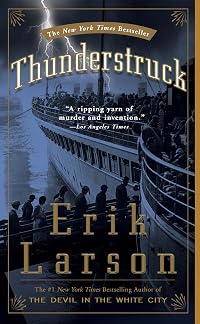
Thunderstruck
by Erik Larson
On This Page
Description
A true story of love, murder, and the end of the world's "great hush." In Thunderstruck, Erik Larson tells the interwoven stories of two men--Hawley Crippen, a very unlikely murderer, and Guglielmo Marconi, the obsessive creator of a seemingly supernatural means of communication--whose lives intersect during one of the greatest criminal chases of all time. Set in Edwardian London and on the stormy coasts of Cornwall, Cape Cod, and Nova Scotia, Thunderstruck evokes the dynamism of those show more years when great shipping companies competed to build the biggest, fastest ocean liners; scientific advances dazzled the public with visions of a world transformed; and the rich outdid one another with ostentatious displays of wealth. Against this background, Marconi races against incredible odds and relentless skepticism to perfect his invention: the wireless, a prime catalyst for the emergence of the world we know today. Meanwhile, Crippen, "the kindest of men," nearly commits the perfect murder. With his unparalleled narrative skills, Erik Larson guides us through a relentlessly suspenseful chase over the waters of the North Atlantic. Along the way, he tells of a sad and tragic love affair that was described on the front pages of newspapers around the world, a chief inspector who found himself strangely sympathetic to the killer and his lover, and a driven and compelling inventor who transformed the way we communicate. show lessTags
Recommendations










Member Recommendations
PghDragonMan Part history, part fiction and all together excellent historical fiction.

Member Reviews
An incredibly well written book with with two stories that I initially thought was connected by a very thin thread - but it all came together at the end. Erik Larson knows how to weave a story - one that is well researched, with interesting characters, and incredibly well written.
The story of Marconi, the son of an Italian aristocrat and an Irish woman, he is a man of obsession - the science of the time said wireless telegraphy (eg radiowaves) shouldn't work at great lengths, and Marconi was out to prove the scientists wrong. The other part of the story is of man name Crippen - a 'doctor' of the time, selling potions and tinctures, eventually marrying and moving from the US to London.
The two men never met nor did they even move in the show more same circles. However, Crippen's life was forever changed by Marconi's invention. This is a story that covers the lives of the two men, colliding at a point when the whole world was following the progression of a the boat, Montrose as Crippen was on the run after supposedly murdering his wife.
The writing is tight, interesting, and moves nicely. show less
The story of Marconi, the son of an Italian aristocrat and an Irish woman, he is a man of obsession - the science of the time said wireless telegraphy (eg radiowaves) shouldn't work at great lengths, and Marconi was out to prove the scientists wrong. The other part of the story is of man name Crippen - a 'doctor' of the time, selling potions and tinctures, eventually marrying and moving from the US to London.
The two men never met nor did they even move in the show more same circles. However, Crippen's life was forever changed by Marconi's invention. This is a story that covers the lives of the two men, colliding at a point when the whole world was following the progression of a the boat, Montrose as Crippen was on the run after supposedly murdering his wife.
The writing is tight, interesting, and moves nicely. show less
Where I got the book: purchased from my local indie bookstore at an author event*. Signed with a funny drawing!
Like The Devil in the White City, Thunderstruck tells two stories that have a meeting point. In this case, it's the (at the time) notorious case of Dr. Crippen, who murdered his wife, embraced by the larger story of the development of the wireless telegraph. It was wireless that enabled the British police to catch Crippen and his lover Ethel Le Neve, who were on a ship bound for Canada--Crippen knew by this time that they were fugitives from the law, but Le Neve probably didn't. And neither of them, apparently, knew that they had been spotted early in the voyage by the ship's captain, and that the world's press had picked up on show more the sensation and had newspaper readers on the edge of their chairs waiting to see if they would be captured.
The story of wireless centers on Guglielmo Marconi, who, although no scientist, was the first to put the emerging theories of wireless transmission to practical use, succeeding by a process of trial and error in stretching the distance over which wireless could be used until he was able to send messages over the Atlantic with a certain degree of success. It's a pretty good tale of industrial rivalry, piracy and sour grapes, and a man with an obsession--nowadays we'd probably diagnose Marconi with Asperger's, given his ability to subjugate everything, even his personal life, to his mania for his subject. And yet Marconi is a businessman, always intending to make money out of wireless, a sharp contrast to the scientists who seem to regard their experiments as a sort of amateur gentleman's pursuit and are furious with the Italian-Irish upstart for actually daring to cash in on them. It's a portrait of a world waking up to the power of technology as an essential weapon in the furtherance of business, the early days of the age where inventions, supported by business cash, began to succeed each other with increasing speed--we're still somewhere in the middle of that age, and heaven knows where it's all going to end up.
Of course the most human story is that of Crippen, the shy and retiring purveyor of homeopathic medicines who ends up married to a loud, exuberant, wannabe actress who henpecks him and spends all of his money. It's a story of the worm that turns, and you can take your pick whether his mild exterior hid the soul of a psychopath or whether he just--snapped.
Larson is a darn good storyteller, and although I felt my attention flagging just a little in the middle of the book, on the whole I found both tales entertaining. The last hundred or so pages, covering the murder and the chase, were riveting. Fifty pages of notes, bibliography and index ensure that this work of popular history can also stay on the bookshelf as a reference work, always a plus. I'd recommend Thunderstruck to readers who like a good true-life yarn.
*If you ever get the chance to hear Larson speak, take it. He's very entertaining. show less
Like The Devil in the White City, Thunderstruck tells two stories that have a meeting point. In this case, it's the (at the time) notorious case of Dr. Crippen, who murdered his wife, embraced by the larger story of the development of the wireless telegraph. It was wireless that enabled the British police to catch Crippen and his lover Ethel Le Neve, who were on a ship bound for Canada--Crippen knew by this time that they were fugitives from the law, but Le Neve probably didn't. And neither of them, apparently, knew that they had been spotted early in the voyage by the ship's captain, and that the world's press had picked up on show more the sensation and had newspaper readers on the edge of their chairs waiting to see if they would be captured.
The story of wireless centers on Guglielmo Marconi, who, although no scientist, was the first to put the emerging theories of wireless transmission to practical use, succeeding by a process of trial and error in stretching the distance over which wireless could be used until he was able to send messages over the Atlantic with a certain degree of success. It's a pretty good tale of industrial rivalry, piracy and sour grapes, and a man with an obsession--nowadays we'd probably diagnose Marconi with Asperger's, given his ability to subjugate everything, even his personal life, to his mania for his subject. And yet Marconi is a businessman, always intending to make money out of wireless, a sharp contrast to the scientists who seem to regard their experiments as a sort of amateur gentleman's pursuit and are furious with the Italian-Irish upstart for actually daring to cash in on them. It's a portrait of a world waking up to the power of technology as an essential weapon in the furtherance of business, the early days of the age where inventions, supported by business cash, began to succeed each other with increasing speed--we're still somewhere in the middle of that age, and heaven knows where it's all going to end up.
Of course the most human story is that of Crippen, the shy and retiring purveyor of homeopathic medicines who ends up married to a loud, exuberant, wannabe actress who henpecks him and spends all of his money. It's a story of the worm that turns, and you can take your pick whether his mild exterior hid the soul of a psychopath or whether he just--snapped.
Larson is a darn good storyteller, and although I felt my attention flagging just a little in the middle of the book, on the whole I found both tales entertaining. The last hundred or so pages, covering the murder and the chase, were riveting. Fifty pages of notes, bibliography and index ensure that this work of popular history can also stay on the bookshelf as a reference work, always a plus. I'd recommend Thunderstruck to readers who like a good true-life yarn.
*If you ever get the chance to hear Larson speak, take it. He's very entertaining. show less
Readable enough Dad History, which interleaves the story of Guglielmo Marconi's invention of ocean-spanning wireless telegraphy with the true crime story of Hawley Crippen's murder of his wife in London in 1910. It's mostly passable, although the Marconi half of the book is to a great extent there to provide some drama and heft to what is otherwise a rather thin story. Crippen killed and butchered his wife in a gruesome way, yes, and then tried to flee across the Atlantic with his much younger lover, Ethel Le Neve, in disguise as a boy. This makes for some dramatic moments. But there just aren't a lot of sources that give us much direct insight into Crippen, his motivations, thoughts, or feelings, nor does the state of the forensics at show more the time really let us reconstruct exactly what happened in the Crippen home that fateful night. All that we can know is sordid and also rather banal: man murders wife.
Which brings me to the biggest failing of the book for me, and that's Erik Larson's clear sympathy for Crippen—much is made of his meek and mild demeanour and how nice everyone thought of him—and the undercurrent that Cora Crippen somehow deserved her awful end. (An attitude which I see reflected in more than one GoodReads review, which is gross.) Cora Crippen had tacky taste in clothes, didn't care much about keeping the house tidy, and flirted with men who weren't her husband, yes—but being an arsehole isn't a capital crime. And being a Nice Guy doesn't mean that you're incapable of being a bad husband or being a murderer. Larson also seemed to take at face value the idea that Crippen's affair with Le Neve was the tale of two timid souls who found one another, whereas I'm much more sceptical about the power dynamics involved. Who's to say that if they'd made it across the Atlantic, Crippen wouldn't have tired of Le Neve in a few years and found himself wanting to dispose of her in order to move on yet again? show less
Which brings me to the biggest failing of the book for me, and that's Erik Larson's clear sympathy for Crippen—much is made of his meek and mild demeanour and how nice everyone thought of him—and the undercurrent that Cora Crippen somehow deserved her awful end. (An attitude which I see reflected in more than one GoodReads review, which is gross.) Cora Crippen had tacky taste in clothes, didn't care much about keeping the house tidy, and flirted with men who weren't her husband, yes—but being an arsehole isn't a capital crime. And being a Nice Guy doesn't mean that you're incapable of being a bad husband or being a murderer. Larson also seemed to take at face value the idea that Crippen's affair with Le Neve was the tale of two timid souls who found one another, whereas I'm much more sceptical about the power dynamics involved. Who's to say that if they'd made it across the Atlantic, Crippen wouldn't have tired of Le Neve in a few years and found himself wanting to dispose of her in order to move on yet again? show less
I have reached such a level of trust with Eric Larson that when I see one of his books at a sale, it goes in the cart. I don't read the flap, I don't consult reviews, just take my money. I consume a paltry number of non-fiction titles a year but Larson is always a good bet. He gives so much. I learn innumerable things from him and yet it's immensely entertaining. I'm stuck on the edge of my seat, knowing his magician's stagecraft is second to none.
So, I started reading and realized this selection was about Marconi. Ah, yes, telegraphs and ocean liner radio rooms and all that, right? Well, yes. This book is allllll that. It's a lot. And it makes you appreciate what it took to make wireless work. And I couldn't help but correlate that to show more cellular and wi-fi and all the magical technology we enjoy in our modern lives.
But wait! There's more. Then we are treated to a sordid tale of a missing wife, a mistress and parts of a body found in a London cellar. You see, wireless gave us the first real-time fugitive hunt and it captivated the entire world all at once. One could say after watching CourtTV and Law & Crime that the world has never gotten over the experience. How it forever changed our world, in so many ways. A fascinating tale.
To readers around the world, this report was magic. They knew what books the fugitives were reading. They knew about their contemplative moments, and how much they enjoyed the ship's concert. They saw Crippen laughing at the captain's jokes and Le Neve deploying her feminine manners to pluck fruit from a tray. The London Times said “There was something intensely thrilling , almost wierd, in the thought of these two passengers traveling across the Atlantic in the belief that their identity and their whereabouts were unknown while both were being flashed with certainty to all quarters of the civilized world.” From the moment of their departure, the paper said, the two “have been encased in waves of wireless telegraphy as securely as if they had been within the four walls of a prison.”
One newspaper invited W.W. Bradfield, one of Marconi's principal engineers, to write about the unfolding saga. Bradfield described the ship's Marconi room as resembling a “magician's cave” and said wireless had forever altered the prospects of criminals. “The suspect fugitive flying to another continent no longer finds immunity in mid-ocean. The very air around him may be quivering with accusatory messages which have apparently come up out of the void. The mystery of ‘wireless’, the impossibility of escaping it, the certainty that it will come out to meet a fugitive as well as follow him in his pursuit, will from henceforth weigh heavily on the person trying to escape from justice.” show less
So, I started reading and realized this selection was about Marconi. Ah, yes, telegraphs and ocean liner radio rooms and all that, right? Well, yes. This book is allllll that. It's a lot. And it makes you appreciate what it took to make wireless work. And I couldn't help but correlate that to show more cellular and wi-fi and all the magical technology we enjoy in our modern lives.
But wait! There's more. Then we are treated to a sordid tale of a missing wife, a mistress and parts of a body found in a London cellar. You see, wireless gave us the first real-time fugitive hunt and it captivated the entire world all at once. One could say after watching CourtTV and Law & Crime that the world has never gotten over the experience. How it forever changed our world, in so many ways. A fascinating tale.
To readers around the world, this report was magic. They knew what books the fugitives were reading. They knew about their contemplative moments, and how much they enjoyed the ship's concert. They saw Crippen laughing at the captain's jokes and Le Neve deploying her feminine manners to pluck fruit from a tray. The London Times said “There was something intensely thrilling , almost wierd, in the thought of these two passengers traveling across the Atlantic in the belief that their identity and their whereabouts were unknown while both were being flashed with certainty to all quarters of the civilized world.” From the moment of their departure, the paper said, the two “have been encased in waves of wireless telegraphy as securely as if they had been within the four walls of a prison.”
One newspaper invited W.W. Bradfield, one of Marconi's principal engineers, to write about the unfolding saga. Bradfield described the ship's Marconi room as resembling a “magician's cave” and said wireless had forever altered the prospects of criminals. “The suspect fugitive flying to another continent no longer finds immunity in mid-ocean. The very air around him may be quivering with accusatory messages which have apparently come up out of the void. The mystery of ‘wireless’, the impossibility of escaping it, the certainty that it will come out to meet a fugitive as well as follow him in his pursuit, will from henceforth weigh heavily on the person trying to escape from justice.” show less
It's an axiom that Great Men (and, one supposes, Great Women) are Unpleasant People. Larson's treatment of Guglielmo Marconi, great-great-great grandfather of the device you're reading this on, does nothing to dispel the miasma of meanness from him. What a rotten human being! How completely insensitive, how thoroughly obsessively devoted to his own self and comfort, what a complete rotter of a businessman!
Thank you, Guglielmo, for the gifts all that human wreckage you left behind have given us all. Rot in peace.
Then, at the precise opposite end of the emotional spectrum, lies the once-infamous, now largely forgotten, Dr. Hawley Crippen, who murdered his termagant of a wife (who *richly* deserved killing, being a female Marconi sans show more genius), so he could be with his little light-o-love. Didn't work out, needless to say, though if the Scotland Yard inspector had simply been told to go the hell away, the whole chase and capture and hanging might not have had to happen. There was no evidence of a killing, but the Inspector went on a fishing expedition in Crippen's basement--wouldn't be allowed today, not a chance!--and, well...he really did do it. Probably not alone, though....
Well, anyway, you've read The Devil in the White City and Isaac's Storm, so I needn't belabor the point that Larson has a magpie's eye for shiny things, bringing to the nest of the book a trove of odd and telling details about Edwardian London, about the nature of human relationships, about the science of radio waves as it was being discovered; most of all, he brings us characters we feel some connection to, and can really invest in. I know how the book ends before I pick it up, but I find myself wanting Crippen to get away with it and pulling for him and Ethel to make it to Canada *this time*.
They don't. Shame, that.
Wrap yourself in this big, warm greatcoat of a book that transports you back to an optimistic, doomed, bright summer afternoon of a time. It's oodles of fun, if you take it slowly and don't try to gulp it down. It's too big to swallow whole, and half the fun is setting the book down and savoring the images of this vanished world. Recommended to all but the most history-phobic. show less
Thank you, Guglielmo, for the gifts all that human wreckage you left behind have given us all. Rot in peace.
Then, at the precise opposite end of the emotional spectrum, lies the once-infamous, now largely forgotten, Dr. Hawley Crippen, who murdered his termagant of a wife (who *richly* deserved killing, being a female Marconi sans show more genius), so he could be with his little light-o-love. Didn't work out, needless to say, though if the Scotland Yard inspector had simply been told to go the hell away, the whole chase and capture and hanging might not have had to happen. There was no evidence of a killing, but the Inspector went on a fishing expedition in Crippen's basement--wouldn't be allowed today, not a chance!--and, well...he really did do it. Probably not alone, though....
Well, anyway, you've read The Devil in the White City and Isaac's Storm, so I needn't belabor the point that Larson has a magpie's eye for shiny things, bringing to the nest of the book a trove of odd and telling details about Edwardian London, about the nature of human relationships, about the science of radio waves as it was being discovered; most of all, he brings us characters we feel some connection to, and can really invest in. I know how the book ends before I pick it up, but I find myself wanting Crippen to get away with it and pulling for him and Ethel to make it to Canada *this time*.
They don't. Shame, that.
Wrap yourself in this big, warm greatcoat of a book that transports you back to an optimistic, doomed, bright summer afternoon of a time. It's oodles of fun, if you take it slowly and don't try to gulp it down. It's too big to swallow whole, and half the fun is setting the book down and savoring the images of this vanished world. Recommended to all but the most history-phobic. show less
Summary: The intersection of the lives of Guglielmo Marconi and Hawley Harvey Crippen occurs on a trans-Atlantic voyage with a Scotland Yard detective in pursuit.
Many of us still know who Guglielmo Marconi is. He was the most well-known pioneer of wireless telegraphy. But Dr. Hawley Harvey Crippen? In the early twentieth century, he was known as the mild-mannered doctor whose missing wife was found buried in a most grisly state. Erik Larson tells the story of the unlikely intersection of their two lives, culminating in a trans-Atlantic flight of Hawley and his mistress, with a Chief Inspector of Scotland Yard on a pursuing ship.
Larson does this through parallel accounts of the two men’s lives. With Marconi, it begins with the show more childhood tinkerer who kept experimenting with electronic transmission and who not only envisioned wireless transmissions from ship to shore but even across the Atlantic. Larson portrays a driven man who sacrifices marriage and collaborative relationships in his obsessions, unwilling to listen to others even when his designs for transmission arrays were evidently structurally unsound. With no theoretical training, he kept making mistakes until he found ways to make it work, eventually getting his equipment on many ocean-going vessels, even as competitors both in England and Germany encroached on this lucrative market.
Crippen began life in Coldwater Michigan. He trained in homeopathic medicine. After his first wife died of stroke, he married an aspiring but untalented stage actress Cora Turner, also know on the stage as Belle Elmore. He developed a career of selling patent medicines. In 1897 they moved to England where Belle briefly pursued a career on the stage. What she lacked in talent, she made up in friends. She was domineering and he was unfailingly accommodating. Then he met a woman, Ethel, at Drouet’s Institution for the Deaf. After a party during the winter of 1910 where Belle insulted him, she disappeared, and shortly after, Ethel moved in. He gave out the story that she had left him for America, then that she was ill, and finally that she’d died in California. And he might have gotten away with it were it not for her stage friends.
One went to Scotland Yard. Chief Inspector Dew was assigned. He liked Crippen but was troubled by the discrepancies in his story. As Crippen realizes he is under suspicion, he and Ethel flee to the continent, and then board a ship to Quebec. Meanwhile, Dew, investigating the house comes across a grisly burial in the basement. Marconi’s invention gets the word out to all points, including all the ships on the ocean. The captain of the Magenta suspects that the father and son traveling as the Robinsons are in reality the fugitives, finding confirming evidence. Dew gets the word via the wireless and pursues on a faster ship. But has he gone after the right suspects and will he catch them before they reach Quebec and disappear?
The first half of the account fills in the backgrounds. It’s not even clear, apart from the prologue, how the lives of Marconi and Crippen will intersect. The pace picks up in the second half as we discover the possible crime that connects Marconi’s invention to Crippen’s flight. Meanwhile, Larson fleshes out two very interesting characters. We, along with Dew, find ourselves wondering whether Crippen really was capable of what Dew found in his basement. And what part did the apparently innocent Ethel play?
This was my first encounter with Larson’s work. I have two of his other books, The Devil in the White City and The Splendid and the Vile on my TBR pile. What I discovered is a combination of historian, biographer, and true crime writer who could spin a great and true tale. I anticipate more happy hours with this author! show less
Many of us still know who Guglielmo Marconi is. He was the most well-known pioneer of wireless telegraphy. But Dr. Hawley Harvey Crippen? In the early twentieth century, he was known as the mild-mannered doctor whose missing wife was found buried in a most grisly state. Erik Larson tells the story of the unlikely intersection of their two lives, culminating in a trans-Atlantic flight of Hawley and his mistress, with a Chief Inspector of Scotland Yard on a pursuing ship.
Larson does this through parallel accounts of the two men’s lives. With Marconi, it begins with the show more childhood tinkerer who kept experimenting with electronic transmission and who not only envisioned wireless transmissions from ship to shore but even across the Atlantic. Larson portrays a driven man who sacrifices marriage and collaborative relationships in his obsessions, unwilling to listen to others even when his designs for transmission arrays were evidently structurally unsound. With no theoretical training, he kept making mistakes until he found ways to make it work, eventually getting his equipment on many ocean-going vessels, even as competitors both in England and Germany encroached on this lucrative market.
Crippen began life in Coldwater Michigan. He trained in homeopathic medicine. After his first wife died of stroke, he married an aspiring but untalented stage actress Cora Turner, also know on the stage as Belle Elmore. He developed a career of selling patent medicines. In 1897 they moved to England where Belle briefly pursued a career on the stage. What she lacked in talent, she made up in friends. She was domineering and he was unfailingly accommodating. Then he met a woman, Ethel, at Drouet’s Institution for the Deaf. After a party during the winter of 1910 where Belle insulted him, she disappeared, and shortly after, Ethel moved in. He gave out the story that she had left him for America, then that she was ill, and finally that she’d died in California. And he might have gotten away with it were it not for her stage friends.
One went to Scotland Yard. Chief Inspector Dew was assigned. He liked Crippen but was troubled by the discrepancies in his story. As Crippen realizes he is under suspicion, he and Ethel flee to the continent, and then board a ship to Quebec. Meanwhile, Dew, investigating the house comes across a grisly burial in the basement. Marconi’s invention gets the word out to all points, including all the ships on the ocean. The captain of the Magenta suspects that the father and son traveling as the Robinsons are in reality the fugitives, finding confirming evidence. Dew gets the word via the wireless and pursues on a faster ship. But has he gone after the right suspects and will he catch them before they reach Quebec and disappear?
The first half of the account fills in the backgrounds. It’s not even clear, apart from the prologue, how the lives of Marconi and Crippen will intersect. The pace picks up in the second half as we discover the possible crime that connects Marconi’s invention to Crippen’s flight. Meanwhile, Larson fleshes out two very interesting characters. We, along with Dew, find ourselves wondering whether Crippen really was capable of what Dew found in his basement. And what part did the apparently innocent Ethel play?
This was my first encounter with Larson’s work. I have two of his other books, The Devil in the White City and The Splendid and the Vile on my TBR pile. What I discovered is a combination of historian, biographer, and true crime writer who could spin a great and true tale. I anticipate more happy hours with this author! show less
This is the second book of Larson's that I have read and I enjoyed this one as much as the first (which was The Devil in the White City).
Larson writes non-fiction but is a master storyteller who makes his stories flow like a good novel. His style is to tell 2 seemingly unrelated stories, in alternating chapters, until they (the 2 stories) eventually intersect.
Thunderstruck tell the story of Marconi and his trans-Atlantic wireless and one of the most notorious murders in London, England of the day.
At nearly 400 pages, this is no quick read but I was rivetted. Larson does his homework and blends lots of historic fact with juicy and intriguing detail and character development. There is plenty of science (but not so much as to cause me show more to lose interest), mystery, even psychology, and humour. Yes, Larson's dry humour is one of the reasons he is such a delight to read.
Just a tiny sample, from the section after the story ended, entitled *Notes* (a section describing some of the research and travels he did for this book):
"Certain published sources proved especially useful to me. On the Marconi side of the story, the most valuable was Degna Marconi's memoir *My Father, Marconi*, one of the few works that provides a glimpse of Marconi's emotional life....In the special collections reading room of University College, London, I spent very pleasant days reading vitriolic back-chatter about Marconi and his claims, in letters that revealed that even the greatest intellects of the age were not above mean-spirited sniping. They just happened to be more articulate about it"
And from his Acknowledgments page:
"I owe my greatest debt to my wife, Christine Gleason, and my daughters and dog for keeping me sane and relatively stable. It is hard to take yourself too seriously when you have three daughters all in or near their teens, especially if two of them are learning to drive..." show less
Larson writes non-fiction but is a master storyteller who makes his stories flow like a good novel. His style is to tell 2 seemingly unrelated stories, in alternating chapters, until they (the 2 stories) eventually intersect.
Thunderstruck tell the story of Marconi and his trans-Atlantic wireless and one of the most notorious murders in London, England of the day.
At nearly 400 pages, this is no quick read but I was rivetted. Larson does his homework and blends lots of historic fact with juicy and intriguing detail and character development. There is plenty of science (but not so much as to cause me show more to lose interest), mystery, even psychology, and humour. Yes, Larson's dry humour is one of the reasons he is such a delight to read.
Just a tiny sample, from the section after the story ended, entitled *Notes* (a section describing some of the research and travels he did for this book):
"Certain published sources proved especially useful to me. On the Marconi side of the story, the most valuable was Degna Marconi's memoir *My Father, Marconi*, one of the few works that provides a glimpse of Marconi's emotional life....In the special collections reading room of University College, London, I spent very pleasant days reading vitriolic back-chatter about Marconi and his claims, in letters that revealed that even the greatest intellects of the age were not above mean-spirited sniping. They just happened to be more articulate about it"
And from his Acknowledgments page:
"I owe my greatest debt to my wife, Christine Gleason, and my daughters and dog for keeping me sane and relatively stable. It is hard to take yourself too seriously when you have three daughters all in or near their teens, especially if two of them are learning to drive..." show less
Members
- Recently Added By
Lists

True Crime
216 works; 16 members

Books Read in 2012
816 works; 34 members

Books Read in 2013
1,630 works; 51 members

Authors from the United States
245 works; 3 members

Books Read in 2019
4,052 works; 110 members
Author Information

15+ Works 57,038 Members
Erik Larson was born in Brooklyn on January 3, 1954. He graduated Summa Cum Laude from the University of Pennsylvania and went to graduate school at Columbia University. Larson worked for the Wall Street Journal and then began writing non-fiction books. He is the bestselling author of the National Book Award finalist and Edgar Award-winning, The show more Devil in the White City, which has been optioned for a feature film by Leonardo DiCaprio. He also wrote In the Garden of the Beasts, Issac's Storm, Thunderstruck and The Naked Consumer. Larson has taught non-fiction writing at San Francisco State University, the Johns Hopkins Writing Seminars, and the University of Oregon. (Bowker Author Biography) show less
Some Editions
Awards and Honors
Awards
Distinctions
Common Knowledge
- Canonical title
- Thunderstruck
- Original title
- Thunderstruck
- Original publication date
- 2006-10-24 (1e édition originale américaine) (1e édition originale américaine); 2014 (1e traduction et édition française, Le Cherche-midi) (1e traduction et édition française, Le Cherche-midi)
- People/Characters
- Hawley Harvey Crippen; Guglielmo Marconi; Captain Henry George Kendall; Oliver Lodge; Ambrose Fleming; Lenore Piper (show all 36); Ewald Jurgen von Kleist; Pieter van Musschenbroek; Heinrich Hertz; Kunigunde "Cora Turner" Mackamotzki; Charlotte Jane Bell; Alexander Bell Filson Young; Eusapia Palladino; William Preece; Kaider Wilhelm II; J.C. Graham; Jameson Davis; Adolf Slaby; Bruce Miller; Belle Elmore; Alexander Muirhead; George Kemp; Reginald Fessenden; Eugene Ducretet; John Ambrose Fleming; Josephine Bowden Holman; Ethel Clara Le Neve; Ed Cook; Nevil Maskelyne; Richard Vyvyan; George Kemp; Chief Inspector Walter Dew; John Nash; Beatrice O'Brien; Albert Rickward; Henry George Kendall
- Important places
- London, England, UK; Nova Scotia, Canada; Cape Cod, Massachusetts, USA; Cornwall, England, UK; Coldwater, Michigan, USA; Isle Roubaud, Mediterranean Sea
- Important events
- Panic of 1893 (1893 | 1897)
- Epigraph
- A safe but sometimes chilly way of recalling the past is to force open a crammed drawer. If you are searching for anything in particular you don't find it, but something falls out at the back that is often more interesting.
J.M. Barrie "Dedication" Peter Pan 1904
A safe but sometimes chilly way of recalling the past is to force open a crammed drawer. If you are searching for anything in particular you don't find it, but something falls out at the back that is often more interesting. Â... (show all) J. M. Barrie "Dedication" Peter Pan 1904 - Dedication
- For my wife and daughters, and in memory of my mother, who first told me about Crippen.
- First words
- On Wednesday, July 20, 1910, as a light fog drifted along the River Scheldt, Capt. Henry George Kendall prepares his ship, the SS Montrose, for what should have been the most routine of voyages, from Antwerp direct to Quebec ... (show all)City, Canada.
- Quotations
- There was a young fellow from Italy / Who diddled the public quite prettily
Now entertain conjecture of a time / When creeping murmur and the poring dark / Fills the wide vessel of the Universe. / From camp to camp through the foul womb of night / The hum of either army stilly sounds, / That the fix'... (show all)d sentinels almost recieve / The secret whispers of each other's watch - Last words
- (Click to show. Warning: May contain spoilers.)Ethel's answer came quickly.
- Publisher's editor
- Prashker, Betty
- Original language
- English
- Canonical DDC/MDS
- 364.152309421
- Canonical LCC
- HV6248.C75
Classifications
- Genres
- General Nonfiction, History, Nonfiction
- DDC/MDS
- 364.152309421 — Society, government, & culture Social problems and social services Crime Criminal offenses Offenses against the person Homicide Murder History, geographic treatment, biography Europe England & Wales London
- LCC
- HV6248 .C75 — Social sciences Social pathology. Social and public welfare. Criminology Social pathology. Social and public welfare. Criminology Criminal classes
- BISAC
Statistics
- Members
- 5,457
- Popularity
- 2,460
- Reviews
- 150
- Rating
- (3.61)
- Languages
- 6 — English, French, German, Italian, Polish, Portuguese
- Media
- Paper, Audiobook, Ebook
- ISBNs
- 30
- ASINs
- 11