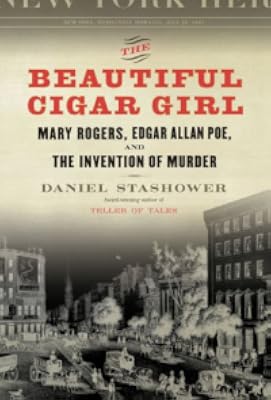
The Beautiful Cigar Girl: Mary Rogers, Edgar Allan Poe, and the Invention of Murder
by Daniel Stashower
On This Page
Description
History. Literary Criticism. True Crime. Nonfiction. On July 28, 1841, the body of Mary Rogers, a twenty-year-old cigar girl, was found floating in the Hudson-and New York's unregulated police force proved incapable of solving the crime. One year later, a struggling writer named Edgar Allan Poe decided to take on the case-and sent his fictional detective, C. Auguste Dupin, to solve the baffling murder of Mary Rogers in "The Mystery of Marie Rogt.".Tags
Recommendations









Member Recommendations
Member Reviews
Two books about notorious New York murder cases: Daniel Stashower’s about Mary Rogers’ (The Beautiful Cigar Girl) and Paula Uruburu’s about Stanford White (American Eve: Evelyn Nesbit, Stanford White, The Birth of the “It” Girl, and the Crime of the Century).
Mary Rogers’ death was a mystery; in fact, protoconspiracy-theorists claimed that despite identification by her mother and one of her suitors the body found floating in the Hudson on July 28 1841 wasn’t Mary Rogers at all. It was a hot day in New York City and several young men seeking temperature relief by strolling along the Jersey side spotted the object, borrowed a boat, lassoed it around the neck, towed it to shore, and, being unwilling to touch the thing, show more tethered it to a handy rock. A floating corpse was a novelty, and the curious showed up to poke it with sticks and comment on its appearance. Someone worked up enough courage to wade into the river and drag it ashore, and someone else peered between the legs and made rude comments to his friends. Albert Crommelin had been searching for his missing romantic interest for several days and feared the worst when he spotted the tangle of bystanders; sure enough, he identified the thing as Mary Rogers.
------------------------------------------------------------------------------------------------------------
Stanford White’s death was no mystery at all. It was a hot night in New York City and with many others he was seeking temperature relief attending the opening night of a musical comedy presented in the rooftop theater at Madison Square Garden (which he had designed). Millionaire and major loon Harry Thaw, attending the same performance, left his table, walked up behind White, and shot him three times in the back of the head. There were hundreds of witnesses, including actresses and chorus girls, theater patrons, and Thaw’s wife Evelyn. Unlike Ms. Rogers, there was no doubt who the victim was – although his face was no longer recognizable.
------------------------------------------------------------------------------------------------------------
Author Daniel Stashower turns Mary Rogers’ story into a history of 1840s NYC police practices, the newspaper business, and an excellent biography of Edgar Allan Poe. Those of us used to CSI will find 1840 police procedure a little disconcerting; the police were abysmally corrupt and most murder investigation was in the hands of judges and coroners. The Mary Rogers case was a godsend to the newspaper business; editorials lambasted the police, the mayor, the governor, the coroner, and each other. (William Gordon Bennett enthusiastically drubbed his competitors in the editorial pages of the New York Herald; New York Sun editor Moses Beach “had no more brains than an oyster and the New York Tribune’s Horace Greeley was less effective than “a large New England squash”). In the absence of any sort of police force, the newspapers took on the investigator role themselves and cheerfully accused just about everybody in the city, plus a good fraction of New Jersey. Poe comes into the picture because in his usual financial desperation he adapted the Mary Rogers story for the second of his C. Auguste Dupin detective mysteries, The Mystery of Marie Rogêt.
------------------------------------------------------------------------------------------------------------
Paula Uruburu concentrates on the title heroine, and Ms Uruburu is unhesitant in sympathizing with Ms. Nesbit (well, although I’m just a little suspicious of her veracity, I’m pretty sympathetic with Evelyn, too). Evelyn Nesbit lost her comfortable middle-class life when her father died, and quickly found herself supporting her family as an underage chorus girl and artist’s model (her mother was concerned, but took the money). Her Gibson-girl beauty attracted the attention of Stanford White, who had a reputation for this sort of thing (White is supposed to have coined the expression “Would you like to come up and see my etchings?” and invented the concept of having a girl jump out of a cake at a party (well, it was actually a pie, which in addition to four-and-twenty blackbirds contained a 14-year-old girl dressed in a blackbird hat and feathered toe rings)).
After some beating around the bush the 40ish White drugged and raped the 16-year-old Evelyn (there’s some question of how naïve Evelyn was. Uruburu glosses over it, but even in more innocent times you might expect that a girl from a theater background would realize that invitations to a much older man’s apartment to pose for lingerie art would eventually end badly). She acquiesced to the arrangement; Mom kept taking the money.
------------------------------------------------------------------------------------------------------------
Mary Rogers’ case was never solved. The evidence was hopelessly muddled; however, the best guess is that rather than being gang-raped and beaten to death as originally supposed, she died during a failed abortion and was beaten up and dumped in the Hudson post-mortem. The abortion theory caused major problems for Poe; he had promised that he would reveal the murderer in Marie Rogêt and had published two of three serializations when evidence for an abortion emerged. He had to quickly rewrite the final chapter.
------------------------------------------------------------------------------------------------------------
Stanford White eventually grew tired of Evelyn and moved on to other chorus girls. By now, however, Evelyn had attracted the attention of Harry Thaw, a Pittsburgh steel millionaire (or more correctly, the spoiled son of the widow of a Pittsburgh steel millionaire). Stanford White was a statutory rapist, but Thaw was a real piece of work. Already notorious for hiring ladies of the evening for whipping sessions (he did the whipping), he persuaded Evelyn and her mother to go on a European tour (interrupted briefly when Thaw whipped a bellboy in a London hotel). Mrs. Nesbit left her daughter in the middle of the trip and Evelyn found herself alone with Harry in (nope, not kidding, really this Gothic) a deserted German castle Harry had rented for a week. Harry persuaded Evelyn to tell her the story of her affair with White, and latter that evening forced open the door of her room, naked and carrying a riding crop. He spent several hours of admonishing Evelyn for her misbehavior, which left her so covered with lash marks that she couldn’t lie down for fear of the bedclothes sticking to the bloody cuts. Rather surprisingly, when the couple returned to the US Evelyn agreed to marry Thaw.
Thaw, however, couldn’t get over the fact that White had Evelyn first – he took Evelyn to his dentist and had all the dental work White had paid for removed and replaced. That wasn’t quite enough to satisfy him – hence the Madison Square Garden shooting. Thaw was utterly convinced that he would be found innocent – and was outraged when his family bought him a not-guilty-by-reason-of-insanity verdict. Once she had testified – pretty convincingly – that Thaw really was a nutcase, the Thaws immediately dumped Evelyn without a cent. (After getting out of the asylum the first time, Harry Thaw was picked up and committed again for another bellboy whipping incident; in fact, he spent more time in custody for whipping bellboys then did for shooting Stanford White).s She spent the rest of her life in a series of increasingly dreary nightclub and cabaret shows (although briefly regaining some notoriety as a consultant for The Girl in the Red Velvet Swing, where she’s played by Joan Collins, and, of course, posthumous recognition in Ragtime, this time played by Elizabeth McGovern).
I liked both of these – Stashower’s evocation of 1840s New York is compelling, as is the biographical material on Poe. I confess when I first picked it up I had Mary Rogers confused with Helen Jewett, another New York cause célèbre murder victim. Miss Jewett didn’t sell cigars, however). As far as Evelyn Nesbit goes, perhaps Uruburu takes a little too much of Nesbit’s testimony at face value. But it’s pretty clear that even if Evelyn stretched the truth a little what demonstrably happened to her was pretty grim. Besides, I’ve always had a weakness for Gibson girls. show less
Mary Rogers’ death was a mystery; in fact, protoconspiracy-theorists claimed that despite identification by her mother and one of her suitors the body found floating in the Hudson on July 28 1841 wasn’t Mary Rogers at all. It was a hot day in New York City and several young men seeking temperature relief by strolling along the Jersey side spotted the object, borrowed a boat, lassoed it around the neck, towed it to shore, and, being unwilling to touch the thing, show more tethered it to a handy rock. A floating corpse was a novelty, and the curious showed up to poke it with sticks and comment on its appearance. Someone worked up enough courage to wade into the river and drag it ashore, and someone else peered between the legs and made rude comments to his friends. Albert Crommelin had been searching for his missing romantic interest for several days and feared the worst when he spotted the tangle of bystanders; sure enough, he identified the thing as Mary Rogers.
------------------------------------------------------------------------------------------------------------
Stanford White’s death was no mystery at all. It was a hot night in New York City and with many others he was seeking temperature relief attending the opening night of a musical comedy presented in the rooftop theater at Madison Square Garden (which he had designed). Millionaire and major loon Harry Thaw, attending the same performance, left his table, walked up behind White, and shot him three times in the back of the head. There were hundreds of witnesses, including actresses and chorus girls, theater patrons, and Thaw’s wife Evelyn. Unlike Ms. Rogers, there was no doubt who the victim was – although his face was no longer recognizable.
------------------------------------------------------------------------------------------------------------
Author Daniel Stashower turns Mary Rogers’ story into a history of 1840s NYC police practices, the newspaper business, and an excellent biography of Edgar Allan Poe. Those of us used to CSI will find 1840 police procedure a little disconcerting; the police were abysmally corrupt and most murder investigation was in the hands of judges and coroners. The Mary Rogers case was a godsend to the newspaper business; editorials lambasted the police, the mayor, the governor, the coroner, and each other. (William Gordon Bennett enthusiastically drubbed his competitors in the editorial pages of the New York Herald; New York Sun editor Moses Beach “had no more brains than an oyster and the New York Tribune’s Horace Greeley was less effective than “a large New England squash”). In the absence of any sort of police force, the newspapers took on the investigator role themselves and cheerfully accused just about everybody in the city, plus a good fraction of New Jersey. Poe comes into the picture because in his usual financial desperation he adapted the Mary Rogers story for the second of his C. Auguste Dupin detective mysteries, The Mystery of Marie Rogêt.
------------------------------------------------------------------------------------------------------------
Paula Uruburu concentrates on the title heroine, and Ms Uruburu is unhesitant in sympathizing with Ms. Nesbit (well, although I’m just a little suspicious of her veracity, I’m pretty sympathetic with Evelyn, too). Evelyn Nesbit lost her comfortable middle-class life when her father died, and quickly found herself supporting her family as an underage chorus girl and artist’s model (her mother was concerned, but took the money). Her Gibson-girl beauty attracted the attention of Stanford White, who had a reputation for this sort of thing (White is supposed to have coined the expression “Would you like to come up and see my etchings?” and invented the concept of having a girl jump out of a cake at a party (well, it was actually a pie, which in addition to four-and-twenty blackbirds contained a 14-year-old girl dressed in a blackbird hat and feathered toe rings)).
After some beating around the bush the 40ish White drugged and raped the 16-year-old Evelyn (there’s some question of how naïve Evelyn was. Uruburu glosses over it, but even in more innocent times you might expect that a girl from a theater background would realize that invitations to a much older man’s apartment to pose for lingerie art would eventually end badly). She acquiesced to the arrangement; Mom kept taking the money.
------------------------------------------------------------------------------------------------------------
Mary Rogers’ case was never solved. The evidence was hopelessly muddled; however, the best guess is that rather than being gang-raped and beaten to death as originally supposed, she died during a failed abortion and was beaten up and dumped in the Hudson post-mortem. The abortion theory caused major problems for Poe; he had promised that he would reveal the murderer in Marie Rogêt and had published two of three serializations when evidence for an abortion emerged. He had to quickly rewrite the final chapter.
------------------------------------------------------------------------------------------------------------
Stanford White eventually grew tired of Evelyn and moved on to other chorus girls. By now, however, Evelyn had attracted the attention of Harry Thaw, a Pittsburgh steel millionaire (or more correctly, the spoiled son of the widow of a Pittsburgh steel millionaire). Stanford White was a statutory rapist, but Thaw was a real piece of work. Already notorious for hiring ladies of the evening for whipping sessions (he did the whipping), he persuaded Evelyn and her mother to go on a European tour (interrupted briefly when Thaw whipped a bellboy in a London hotel). Mrs. Nesbit left her daughter in the middle of the trip and Evelyn found herself alone with Harry in (nope, not kidding, really this Gothic) a deserted German castle Harry had rented for a week. Harry persuaded Evelyn to tell her the story of her affair with White, and latter that evening forced open the door of her room, naked and carrying a riding crop. He spent several hours of admonishing Evelyn for her misbehavior, which left her so covered with lash marks that she couldn’t lie down for fear of the bedclothes sticking to the bloody cuts. Rather surprisingly, when the couple returned to the US Evelyn agreed to marry Thaw.
Thaw, however, couldn’t get over the fact that White had Evelyn first – he took Evelyn to his dentist and had all the dental work White had paid for removed and replaced. That wasn’t quite enough to satisfy him – hence the Madison Square Garden shooting. Thaw was utterly convinced that he would be found innocent – and was outraged when his family bought him a not-guilty-by-reason-of-insanity verdict. Once she had testified – pretty convincingly – that Thaw really was a nutcase, the Thaws immediately dumped Evelyn without a cent. (After getting out of the asylum the first time, Harry Thaw was picked up and committed again for another bellboy whipping incident; in fact, he spent more time in custody for whipping bellboys then did for shooting Stanford White).s She spent the rest of her life in a series of increasingly dreary nightclub and cabaret shows (although briefly regaining some notoriety as a consultant for The Girl in the Red Velvet Swing, where she’s played by Joan Collins, and, of course, posthumous recognition in Ragtime, this time played by Elizabeth McGovern).
I liked both of these – Stashower’s evocation of 1840s New York is compelling, as is the biographical material on Poe. I confess when I first picked it up I had Mary Rogers confused with Helen Jewett, another New York cause célèbre murder victim. Miss Jewett didn’t sell cigars, however). As far as Evelyn Nesbit goes, perhaps Uruburu takes a little too much of Nesbit’s testimony at face value. But it’s pretty clear that even if Evelyn stretched the truth a little what demonstrably happened to her was pretty grim. Besides, I’ve always had a weakness for Gibson girls. show less
An uneven but mostly quite good account of the murder of "cigar girl" Mary Rogers and Poe's use of her story in his work "The Mystery of Marie Roget." Some editorial missteps, and the total lack of citations, though, are the reason for the fairly low rating. For those looking for a more academic account, try Amy Gilman Srebnick's The Mysterious Death of Mary Rogers.
You can read Poe's "The Mystery of Marie Roget", about 38 pages long in Stephen Peithman's excellent The Annotated Tales of Edgar Allan Poe. or you can read this 386 page book.
You will have a lot more fun with this, and it will at least seem shorter than Poe's story.
In June of 1842, Poe proposed a literary stunt: take his private detective, Auguste Dupin -- the very first private detective in world literature -- and turn him loose to solve a real crime, not a puzzle created by Poe. Dupin had made his first appearance in "The Murders in the Rue Morgue" published in April 1841. Poe, as a matter of pride, wanted to prove that the idea of "ratiocination", inductive reasoning, could be applied to solving real crimes. "Where is the show more ingenuity," he said "of unraveling a web which you yourself (the author) have woven for the express purpose of unraveling?" There was also a matter of pride too. As the man who once challenged people to send him cryptograms to solve, he wanted to show his reasoning abilities.
And, of course, as the first American to earn a living, albeit a very poor one, solely by literary endeavors, he needed the money. And the public was very interested in the 1841 murder of Mary Rogers, the beautiful "seegar girl".
There is a bit of humbuggery in this book's subtitle. Murder, of course, was not invented during Poe's lifetime. As Stashower shows in his concise delineating of the New York City of the 1830s and 1840s, sensational coverage of particular murders in the city's newspapers started in 1836 with the death of prostitute Helen Jewett.
However, there is something very modern about the press and public reaction to the Rogers' case". She was young and pretty and seemingly without personal scandal. She worked in the tobacco shop of John Anderson, a draw for the men of the city. Poe himself may have met her. Seemingly raped before death, her end was savage though the cause of death not entirely clear.
The suspects were many: her one time boss Anderson, the various men who vied for her attention, the swarthy man supposedly seen with her in her last hours, one of the many gangs vexing New York City at the time. A crime of sexual violence, jilted love, an abortion gone wrong? Or was it, in fact, not even Mary Rogers whose corpse was pulled from the Hudson River?
The yellow press of the day argued all these points and more. And when the purported crime scene was discovered weeks after Rogers' body was and a suspect committed suicide, interest remained high.
Poe transparently fictionalized the story but kept nearly all the details. But, right before the third part of his serialized story was to appear in January 1843, there were further developments in the case, and Poe had to scramble to do a rewrite of the final installment.
The result is, as Stashower shows in a close examination using his talents as literary scholar and sometime mystery novelist himself, a story contradictory and unclear. Poe didn't really solve the case, but then neither did anyone else.
Rogers' murder was seized upon by many for their reform causes, and Stashower concisely covers that as well as other literary works based upon the Rogers murder though I would argue that we probably still talk about this case only because of Poe. He also makes clear that his is not the first book on Poe and the Rogers case.
Not only does he cover Rogers' short life, but this book almost works as a good introductory Poe biography. He places certain other Poe efforts in the context of the Rogers' affair and "The Mystery of Marie Roget". In particular, Poe, in his hoaxer mode, may have had in mind the equivocations and papering over of crevasses between facts in his story when he wrote his later satire "Diddling Considered as One of the Exact Science".
My only complaint about the book, and it probably only replies to hardcore Poe fans who read non-fiction works about him, is that there are no footnotes, only a bibliography. It would have been nice to know the exact source of some of Stashower's information. show less
You will have a lot more fun with this, and it will at least seem shorter than Poe's story.
In June of 1842, Poe proposed a literary stunt: take his private detective, Auguste Dupin -- the very first private detective in world literature -- and turn him loose to solve a real crime, not a puzzle created by Poe. Dupin had made his first appearance in "The Murders in the Rue Morgue" published in April 1841. Poe, as a matter of pride, wanted to prove that the idea of "ratiocination", inductive reasoning, could be applied to solving real crimes. "Where is the show more ingenuity," he said "of unraveling a web which you yourself (the author) have woven for the express purpose of unraveling?" There was also a matter of pride too. As the man who once challenged people to send him cryptograms to solve, he wanted to show his reasoning abilities.
And, of course, as the first American to earn a living, albeit a very poor one, solely by literary endeavors, he needed the money. And the public was very interested in the 1841 murder of Mary Rogers, the beautiful "seegar girl".
There is a bit of humbuggery in this book's subtitle. Murder, of course, was not invented during Poe's lifetime. As Stashower shows in his concise delineating of the New York City of the 1830s and 1840s, sensational coverage of particular murders in the city's newspapers started in 1836 with the death of prostitute Helen Jewett.
However, there is something very modern about the press and public reaction to the Rogers' case". She was young and pretty and seemingly without personal scandal. She worked in the tobacco shop of John Anderson, a draw for the men of the city. Poe himself may have met her. Seemingly raped before death, her end was savage though the cause of death not entirely clear.
The suspects were many: her one time boss Anderson, the various men who vied for her attention, the swarthy man supposedly seen with her in her last hours, one of the many gangs vexing New York City at the time. A crime of sexual violence, jilted love, an abortion gone wrong? Or was it, in fact, not even Mary Rogers whose corpse was pulled from the Hudson River?
The yellow press of the day argued all these points and more. And when the purported crime scene was discovered weeks after Rogers' body was and a suspect committed suicide, interest remained high.
Poe transparently fictionalized the story but kept nearly all the details. But, right before the third part of his serialized story was to appear in January 1843, there were further developments in the case, and Poe had to scramble to do a rewrite of the final installment.
The result is, as Stashower shows in a close examination using his talents as literary scholar and sometime mystery novelist himself, a story contradictory and unclear. Poe didn't really solve the case, but then neither did anyone else.
Rogers' murder was seized upon by many for their reform causes, and Stashower concisely covers that as well as other literary works based upon the Rogers murder though I would argue that we probably still talk about this case only because of Poe. He also makes clear that his is not the first book on Poe and the Rogers case.
Not only does he cover Rogers' short life, but this book almost works as a good introductory Poe biography. He places certain other Poe efforts in the context of the Rogers' affair and "The Mystery of Marie Roget". In particular, Poe, in his hoaxer mode, may have had in mind the equivocations and papering over of crevasses between facts in his story when he wrote his later satire "Diddling Considered as One of the Exact Science".
My only complaint about the book, and it probably only replies to hardcore Poe fans who read non-fiction works about him, is that there are no footnotes, only a bibliography. It would have been nice to know the exact source of some of Stashower's information. show less
Mary Rogers (the Beautiful Cigar Girl of the title) worked at John Anderson’s Tobacco Emporium in 19th century Manhattan. She was quite famous at the time as well as the main attraction at the store. Mary went out one day and never came home -- as her family began to become distraught at her disappearance, her body was found floating in the Hudson. Newspapers of the time had a field day with the story -- each newspaper (in an era of fierce competition among journals) had its own information, its own take on the case, and fired up the imaginations of readers. This is one story in this book, which intertwines and ultimately meshes with the story of Edgar Allan Poe.
Poe is portrayed within these pages as a somewhat eccentric, show more bent-on-self-destruction individual. His great detective, Auguste Dupin, also captured the imaginations of readers with the case of Marie Roget, first serialized in a lady's magazine. Poe ultimately used all of the sources at hand regarding the Mary Rogers murder to put together his own fictional account, hoping to make a name for himself -- developing the elements of detective fiction in the process that would later be used by other authors, none the least of which was Sir Arthur Conan Doyle. The book is divided between Mary's story and that of Poe, and I think this structure works very well here.
But really what captured my interest here was neither Poe nor Rogers (though both had somewhat tragic lives) but the focus on the newspaper industry of the time. The New York newspapers reported constantly on the ineptitude of the existing police system & had enough influence to actually change the system. Unlike today, where the reporters were responsible for checking facts & sources (although, as we know, that doesn't always work), back then even a small rumor could end up on the front page as gospel fact to the journal's readers. Cases were often tried in the press; police were chastised for their lack of ability to get a handle on the crime of the day in ever-growing NYC.
All of these elements, plus a really good luck at NY culture of the time is what you're going to find here. I happen to be a fan of Daniel Stashower's writing and he didn't let me down with this book.
An interesting book; I can definitely recommend it to people interested in the history of New York, the history of journalism, Edgar Allan Poe, and unsolved murder cases. Beware -- there are no footnotes to note sources. show less
Poe is portrayed within these pages as a somewhat eccentric, show more bent-on-self-destruction individual. His great detective, Auguste Dupin, also captured the imaginations of readers with the case of Marie Roget, first serialized in a lady's magazine. Poe ultimately used all of the sources at hand regarding the Mary Rogers murder to put together his own fictional account, hoping to make a name for himself -- developing the elements of detective fiction in the process that would later be used by other authors, none the least of which was Sir Arthur Conan Doyle. The book is divided between Mary's story and that of Poe, and I think this structure works very well here.
But really what captured my interest here was neither Poe nor Rogers (though both had somewhat tragic lives) but the focus on the newspaper industry of the time. The New York newspapers reported constantly on the ineptitude of the existing police system & had enough influence to actually change the system. Unlike today, where the reporters were responsible for checking facts & sources (although, as we know, that doesn't always work), back then even a small rumor could end up on the front page as gospel fact to the journal's readers. Cases were often tried in the press; police were chastised for their lack of ability to get a handle on the crime of the day in ever-growing NYC.
All of these elements, plus a really good luck at NY culture of the time is what you're going to find here. I happen to be a fan of Daniel Stashower's writing and he didn't let me down with this book.
An interesting book; I can definitely recommend it to people interested in the history of New York, the history of journalism, Edgar Allan Poe, and unsolved murder cases. Beware -- there are no footnotes to note sources. show less
I thought Stashower did a very thorough job but perhaps for the same reason I felt myself getting bogged down with details somewhere in the middle of the book. I most enjoyed the parts that discussed Edgar Allen Poe and the literary and newspaper world of that time. The parts that discussed Restall were really interesting, too. The parts that discussed the Mary Rogers murder seemed to cover the detective aspects and not her personal life so I was not as interested as I might have been. But, I think Stashower was thorough in his research and is a good writer and it was a good read overall.
This is the fascinating story of a young woman, Mary Rogers, who was brutally murdered in New York City. The New York newspapers reported extensively on her death and the very poorly-executed investigation of her death. The murder was never solved.
The book also gives a biography of Edgar Allen Poe, who wrote a story about Mary Rogers' death in which his detective Dupin solves the mystery.
The theme that runs throughout the book is the relationship between fact and fiction. The newspapers, in their attempt to attract readers and affect public policy, covered the story in sensational detail, and probably did more harm than good to the investigation. Poe's detective stories are seminal to the mystery genre, and the fact that one of the show more very first detective stories ever written is based on a real-life mystery foreshadows the complicated relationship that mystery fiction and true detectives have had ever since then.
The book does a good job of inter-weaving the stories of Mary Rogers and Poe, and exploring the relationship between fact and fiction. It was a fascinating read. show less
The book also gives a biography of Edgar Allen Poe, who wrote a story about Mary Rogers' death in which his detective Dupin solves the mystery.
The theme that runs throughout the book is the relationship between fact and fiction. The newspapers, in their attempt to attract readers and affect public policy, covered the story in sensational detail, and probably did more harm than good to the investigation. Poe's detective stories are seminal to the mystery genre, and the fact that one of the show more very first detective stories ever written is based on a real-life mystery foreshadows the complicated relationship that mystery fiction and true detectives have had ever since then.
The book does a good job of inter-weaving the stories of Mary Rogers and Poe, and exploring the relationship between fact and fiction. It was a fascinating read. show less
June, 2011
I noticed my uncle reading this book two years ago. I love his taste in books; he has given me some truly wicked books in my life (Scumbag Manifesto being one of them). Since I have a mischievous nature, and a tad of raccoon about me, I didn't think it would hurt if I perhaps "borrowed" this particular novel.
Not so fast there, pal.
That's what my uncle said, anyway, so I had to go buy my own copy of The Beautiful Cigar Girl, and it was worth every dollar. Mystery novels are my favorite genre to read, and this biography was just that, a grim, juicy historical mystery with no real resolution. Mary Rogers is a shop girl who is brutally murdered and found floating in the Hudson River in 1841. There was speculation that she died show more after visiting an abortionist, or was the victim of gang violence.
But wait, there's more.
More, as in Edgar Allen Poe, and his life story, and his fascination with the murder of Mary Rogers, and how the murder inspired him to write "The Mystery of Marie Roget".
Stashower's writing style can be easily compared to Erik Larson, a composite of murder meets infamy. I really enjoyed this book. show less
I noticed my uncle reading this book two years ago. I love his taste in books; he has given me some truly wicked books in my life (Scumbag Manifesto being one of them). Since I have a mischievous nature, and a tad of raccoon about me, I didn't think it would hurt if I perhaps "borrowed" this particular novel.
Not so fast there, pal.
That's what my uncle said, anyway, so I had to go buy my own copy of The Beautiful Cigar Girl, and it was worth every dollar. Mystery novels are my favorite genre to read, and this biography was just that, a grim, juicy historical mystery with no real resolution. Mary Rogers is a shop girl who is brutally murdered and found floating in the Hudson River in 1841. There was speculation that she died show more after visiting an abortionist, or was the victim of gang violence.
But wait, there's more.
More, as in Edgar Allen Poe, and his life story, and his fascination with the murder of Mary Rogers, and how the murder inspired him to write "The Mystery of Marie Roget".
Stashower's writing style can be easily compared to Erik Larson, a composite of murder meets infamy. I really enjoyed this book. show less
Members
- Recently Added By
Lists

Books Read in 2014
2,343 works; 89 members
Talk Discussions
Past Discussions
History; Nonfiction; True Crime; Erik Larson; Daniel Stashower in If You Like Then You Will Love (July 2013)
Author Information

31+ Works 3,495 Members
Daniel Stashower is the author of four mystery novels and a winner of the Raymond Chandler Fulbright Fellowship in Detective and Crime Fiction Writing. He lives in Bethesda, MD. (Bowker Author Biography)
Awards and Honors
Awards
Common Knowledge
- Canonical title
- The Beautiful Cigar Girl: Mary Rogers, Edgar Allan Poe, and the Invention of Murder
- Alternate titles
- Edgar Allan Poe and the Murder of Mary Rogers
- Original publication date
- 2006
- People/Characters
- Edgar Allan Poe; Mary Rogers
- Epigraph
- "Oh, Maria! Would to God you had reflected ere you had taken this step!"
- (The cover of a novel published in 1844, based on the Mary Rogers case.) - Dedication
- For Miss Corbett. We'll always have Breezewood.
- First words
- In June of 1842, Edgar Allan Poe took up his pen to broach a delicate subject with an old friend.
- Last words
- (Click to show. Warning: May contain spoilers.)"And thus the essence of all crime is undivulged."
- Blurbers
- Carr, Caleb; Silverman, Kenneth; Coben, Harlan; Perry, Anne; Kaminsky, Stuart M.
Classifications
Statistics
- Members
- 723
- Popularity
- 39,296
- Reviews
- 26
- Rating
- (3.49)
- Languages
- English
- Media
- Paper, Audiobook, Ebook
- ISBNs
- 7
- ASINs
- 12