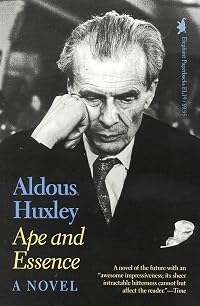
Ape and Essence
by Aldous Huxley 
On This Page
Description
In the year 2108, a rediscovery expedition from New Zealand arrives in a post-nuclear Los Angeles and tries to make sense of what is left of the survivors. Huxley wrote this in 1948 as a response to the use of atomic weapons in WWII and the emerging Cold War.Tags
Recommendations






















Member Reviews
In present-day Hollywood, two movie makers find a curious rejected script in the pile of submissions being sent to the incinerator. The movie script, called Ape and Essence, presents a vision of nuclear war having devastated the world, with the exception of New Zealand. An expedition sets out from New Zealand 100 years after the war to find out if there are any survivors and how they are faring. Radioactivity, disease, and apparently a satanic cult await the explorers. This story is interspersed with vignettes in which baboons and other apes are portrayed doing human-like things while keeping humans as pets — two pet Einsteins press the buttons that launch the nuclear war.
I read this in university for a utopian fiction course (the show more professor: “This course should really be called DYStopian fiction, but I didn’t name it”) and apparently rated it 4 stars. This may be because I got more out of it while reading it for the course. Reading it now, on my own, after 13 years, I can’t see what I saw in it. The cult of Belial is misogynistic, treating women as vessels, and I am fed up with such cults in my reading. The ape vignettes are creepy and unsettling, and the whole thing (with the framing device) strikes me as a bit pretentious. I’m not finishing this and am giving it away. show less
I read this in university for a utopian fiction course (the show more professor: “This course should really be called DYStopian fiction, but I didn’t name it”) and apparently rated it 4 stars. This may be because I got more out of it while reading it for the course. Reading it now, on my own, after 13 years, I can’t see what I saw in it. The cult of Belial is misogynistic, treating women as vessels, and I am fed up with such cults in my reading. The ape vignettes are creepy and unsettling, and the whole thing (with the framing device) strikes me as a bit pretentious. I’m not finishing this and am giving it away. show less
It's certainly unique - I think whatever it's trying to say gets muddled at times but there's enough fascinating ideas here to keep me interested and horrified. Also its written beautifully and I enjoy the layered narration. Though, it's again hard to tell whos saying what, and what ideas are being critiqued. Is the author of the fake movie script a little too into himself? Or is it entirely huxley's voice? Hard to tell, but a handy way to hide any flaws it might have. "Oh? No, that's TALLIS speaking, I'm not that haughty and pretentious, ha!" Or maybe it's critiquing everyone at the same time, including Huxley himself?
You know, it just might be genius.
Oh, by the way, not for the weak of heart! AT ALL! Holy shit. It gets dark.
7/10
You know, it just might be genius.
Oh, by the way, not for the weak of heart! AT ALL! Holy shit. It gets dark.
7/10
In a post-apocalyptic 2108, a New Zealand expedition finds a savage, anti-intellectual society in California. Following a nuclear war, humanity has regressed to devil-worshiping, neo-pagan rituals to cope with mutations, famine, and loss of civilization.
Dr. Alfred Poole, a botanist from New Zealand, the only area spared from full nuclear devastation, is captured by the degenerate inhabitants of Los Angeles. The society is defined by rigid, barbaric rules, grave robbing for clothes, and forced, ritualized reproduction during a single mating season. He falls in love with a local woman, Loola, and they attempt to escape the tyrannical, primitive order.
Dr. Alfred Poole, a botanist from New Zealand, the only area spared from full nuclear devastation, is captured by the degenerate inhabitants of Los Angeles. The society is defined by rigid, barbaric rules, grave robbing for clothes, and forced, ritualized reproduction during a single mating season. He falls in love with a local woman, Loola, and they attempt to escape the tyrannical, primitive order.
The book starts out at a Hollywood studio where a dumptruck bearing rejected movie scripts is headed to the incenerator. One falls out and the author and his friend scoop it up and start to read it. Intrigued they go in search of the author who has since died. The book is a script and it is strange, fascinating, and comical. It was written around the time when the arms race was heating up and the threat of atomic annhilation was (and still is in some respects) all too real.This is but one example of Huxley's expansive imagination.
Cruelty and compassion come with the chromosomes
I've elected to storm into the ranks of Huxley, like a Korean antihero in a Vengeance film. This is a peculiar fruit. There was much from which I recoiled. I feel at moments that History had made the novel look foolish and impotent.
The reasons to dislike this were Legion
The novel's thrust is a rejected screenplay
The narrative then is couched
in satirical and cinematic terms
speaking of a future
a world devastated by nuclear exchange
Kiwis having no strategic importance
Set out to trawl the ruins
Sub-Saharan Africa as well
Though Huxley leaves us with but
an ill humored parenthesis
Back to the New Zealanders
Broaching the California shores
100 years after the mushroom clouds
He finds a strange show more tribal society
One worshiping the Diabolical
For what else could govern their
Haphazard hungry lives?
Sex is outlawed except for
yearly festival of frenzy
the mutated offspring are
sacrificed for their inherent
Misdeed
There is a classic information dump
The devil obviously arrived
in the Scientific Method
Without a humanizing temper
Radioactive fallout was Destiny
It is this final exchange of ideas which redeems the novel, so similar to Brave New World --though here we substitute Shelley for Shakespeare. There is an annoying glibness to this but it appears more a farce than anything meaningful or resonant, whereas the Orgy-Porgy scenes in Brave New World will haunt me forever. There wasn't a corresponding moment in Ape and Essence of the timeless. Parody, just parody. show less
I've elected to storm into the ranks of Huxley, like a Korean antihero in a Vengeance film. This is a peculiar fruit. There was much from which I recoiled. I feel at moments that History had made the novel look foolish and impotent.
The reasons to dislike this were Legion
The novel's thrust is a rejected screenplay
The narrative then is couched
in satirical and cinematic terms
speaking of a future
a world devastated by nuclear exchange
Kiwis having no strategic importance
Set out to trawl the ruins
Sub-Saharan Africa as well
Though Huxley leaves us with but
an ill humored parenthesis
Back to the New Zealanders
Broaching the California shores
100 years after the mushroom clouds
He finds a strange show more tribal society
One worshiping the Diabolical
For what else could govern their
Haphazard hungry lives?
Sex is outlawed except for
yearly festival of frenzy
the mutated offspring are
sacrificed for their inherent
Misdeed
There is a classic information dump
The devil obviously arrived
in the Scientific Method
Without a humanizing temper
Radioactive fallout was Destiny
It is this final exchange of ideas which redeems the novel, so similar to Brave New World --though here we substitute Shelley for Shakespeare. There is an annoying glibness to this but it appears more a farce than anything meaningful or resonant, whereas the Orgy-Porgy scenes in Brave New World will haunt me forever. There wasn't a corresponding moment in Ape and Essence of the timeless. Parody, just parody. show less
Ape and essence by Aldous Huxley is a bit difficult to get into, but once into the story, this short novel is both interesting and engaging. The narrative structure of the book is unusual, resembling a film script. The beginning of the book consists of a science-fiction account of history, referring to various historical event as they could have happened. The film script, written by a genius, by accident escapes destruction, and is, hence, available to being read.
The scripts describes a story in which most of the civilized world has been destroyed in an atomic war, except New Zealand. An expedition from New Zealand reaches the coast of California, to make contact, and investigate the situation in the United States. Having landed, the show more expedition members are captured, and the leading scientist is brought before the leader of the community. In various exchanges, it becomes clear what has happened, how history in the US developed after the war and various anthropological details of American society of that time are revealed.
Ape and essence is a dystopian novel, describing a lapse from civilized society into a barbarous state. While this type of story is now very common, and many films and novels are based on a similar premise, often elaborated along very similar lines, Huxley's Ape and essence is probably the classic that gave rise this this type of genre. The description is more anthropological than contemporary dystopian novels which focus more on horror. Huxley's novel is probably a bit too vanilla for lovers of the genre, and the convoluted beginning of the novel forms an additional barrier. Nonetheless, to lovers of science-fiction, Ape and essence is probably an essential read. show less
The scripts describes a story in which most of the civilized world has been destroyed in an atomic war, except New Zealand. An expedition from New Zealand reaches the coast of California, to make contact, and investigate the situation in the United States. Having landed, the show more expedition members are captured, and the leading scientist is brought before the leader of the community. In various exchanges, it becomes clear what has happened, how history in the US developed after the war and various anthropological details of American society of that time are revealed.
Ape and essence is a dystopian novel, describing a lapse from civilized society into a barbarous state. While this type of story is now very common, and many films and novels are based on a similar premise, often elaborated along very similar lines, Huxley's Ape and essence is probably the classic that gave rise this this type of genre. The description is more anthropological than contemporary dystopian novels which focus more on horror. Huxley's novel is probably a bit too vanilla for lovers of the genre, and the convoluted beginning of the novel forms an additional barrier. Nonetheless, to lovers of science-fiction, Ape and essence is probably an essential read. show less
This is a wierd book.
Flavours of Vonnegut.
It seems both incredibly modern in its commentary on war, politics, exploitation and ignorance about the environment, and incredibly prurient and old fashioned.
I found the satirical commentary really interesting, topical and insightful. The style and framing though, make it a difficult and often uncomfortable read which has sadly not aged very well.
I'm pleased that I read it, but no more than 'okay' for me.
Flavours of Vonnegut.
It seems both incredibly modern in its commentary on war, politics, exploitation and ignorance about the environment, and incredibly prurient and old fashioned.
I found the satirical commentary really interesting, topical and insightful. The style and framing though, make it a difficult and often uncomfortable read which has sadly not aged very well.
I'm pleased that I read it, but no more than 'okay' for me.
Members
- Recently Added By
Lists

Best Post-Apocalyptic Stories
143 works; 88 members

Best of British Literature
226 works; 41 members

20th Century Literature
1,161 works; 55 members

Survey of Classic Dystopias
29 works; 4 members
Books I've Read
40 works; 2 members

Anthony Burgess 99 Post War Novels
99 works; 7 members

The Works of Aldous Huxley
49 works; 1 member

Animals in the Title
498 works; 11 members
Author Information

290+ Works 105,376 Members
Aldous Huxley was born on July 26, 1894, in Surrey, England, into a distinguished scientific and literary family; his grandfather was the noted scientist and writer, T.H. Huxley. Following an eye illness at age 16 that resulted in near-blindness, Huxley abandoned hope of a career in medicine and turned instead to literature, attending Oxford show more University and graduating with honors. While at Oxford, he published two volumes of poetry. Crome Yellow, his first novel, was published in 1927 followed by Antic Hay, Those Barren Leaves, and Point Counter Point. His most famous novel, Brave New World, published in 1932, is a science fiction classic about a futuristic society controlled by technology. In all, Huxley produced 47 works during his long career, In 1947, Huxley moved with his family to southern California. During the 1950s, he experimented with mescaline and LSD. Doors of Perception and Heaven and Hell, both works of nonfiction, were based on his experiences while taking mescaline under supervision. In 1959, Aldous Huxley received the Award of Merit for the Novel from the American Academy of Arts and Letters. He died on November 22, 1963. (Bowker Author Biography) show less
Aldous Huxley has a Legacy Library. Legacy libraries are the personal libraries of famous readers, entered by LibraryThing members from the Legacy Libraries group.
Some Editions
Awards and Honors
Awards
Distinctions
Notable Lists
Series
Belongs to Publisher Series
Work Relationships
Is contained in
Has as a student's study guide
Common Knowledge
- Canonical title*
- Het rijk van Belial
- Original title
- Ape and essence
- Original publication date
- 1948
- Important places
- Los Angeles, California, USA
- Important events
- Post-apocalypse
- First words
- It was the day of Gandhi's assassination; but on Calvary the sightseers were more interested in the contents of their picnic baskets than in the possible significance of the, after all, rather commonplace event they had turne... (show all)d out to witness.
- Quotations
- The leech's kiss, the squid's embrace,
The prurient ape's defiling touch:
And do you like the human race?
No, not much. - Last words
- (Click to show. Warning: May contain spoilers.)He cracks it on the headstone and, as he peels it, scatters the white fragments of the shell over the grave.
- Original language*
- Engels
*Some information comes from Common Knowledge in other languages. Click "Edit" for more information.
Classifications
Statistics
- Members
- 1,481
- Popularity
- 15,808
- Reviews
- 21
- Rating
- (3.44)
- Languages
- 15 — Danish, Dutch, English, French, German, Hungarian, Italian, Norwegian (Bokmål), Norwegian, Polish, Romanian, Croatian, Spanish, Turkish, Portuguese (Portugal)
- Media
- Paper, Ebook
- ISBNs
- 41
- ASINs
- 47