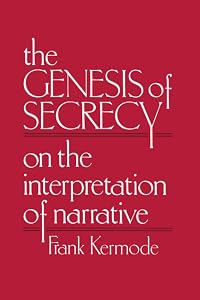
The Genesis of Secrecy: On the Interpretation of Narrative
by Frank Kermode
On This Page
Description
An examination of some enigmatic passages and episodes in the gospels.Tags
Recommendations













Member Reviews
"The Genesis of Secrecy" is a set of the collected and expanded Charles Eliot Norton lectures given at Harvard during 1977-1978. In this book, Kermode announces his task to be one of a secular interpreter (or anti-interpreter, as it were), completely unencumbered, yet still highly knowledgeable, of older Biblical-critical traditions and their concomitant dogma.
Hermeneutics is the main concern here. The Gospel of Mark is the real center of gravity, but Kermode's catholicity draws him also to James Joyce and Henry Green, with some non-canonical Gospels thrown in for good measure. In the first lecture, "Carnal and Spiritual Senses," the act of interpretation is likened to an attempt to transition from being an "outsider" to an "insider," show more that is, someone with special, institutionalized knowledge about the text at hand. Interpretation is necessarily an act that always frustrates itself if it aims to find a concrete, absolute nugget of meaning; instead, the multiplicity and indeterminacy of hermeneutic practice, and our proclivity for allegorical and elliptical readings, mean that any essentialism is textually impossible. In fact, Kermode all but says that what it means to be a narrative is to have "hermeneutic potential." His carnal and spiritual are reconfigurations of Freud's manifest and latent, but without all the Freudian baggage. With biblical texts, he sometimes opts for the similar "pleromatist" instead of latent.
In another lecture titled "What are the Facts?," he discusses the role of textual facticity in historical writing. This is especially controversial, considering that Kermode has chosen the Gospels as a main focus - texts whose historical facts are hard to square, to say the least. To add to the complexity of looking at the Gospels as historical documents, one must consider that the Passion narrative was foretold in the Old Testament, and therefore its authenticity was a prerequisite to the supposed authority of the Gospels. In short, Kermode makes the dubious claim that, as a textual outsider, it is well nigh impossible to discern historical writing from any other type.
It is uncertain whether Kermode knew exactly how close he is to poststructuralism here. It is not the case that all narratives dissolve into an incoherent semiological play of signs and signifiers when under interpretive scrutiny. Kermode's approach results in a kind of textual nihilism. Interpretation always involves the interplay of intentionality and historical perspective, but there is no reason why that interplay must necessarily annihilate our ability to discern between genres, or what those genres are trying to accomplish. Kermode also never discusses his controversial choice of texts he uses to reach his conclusions. What would have happened had he chosen Sallust or Polybius, whose accounts can be checked against other texts and archaeological evidence? The choice of the Gospel of Mark makes Kermode's arguments no less fascinating or thought-provoking, but it does make arguing the point much easier.
This is one of the best-known books of Kermode's latter theory, and is indicative of a marked turn away from some of his earlier work, especially 1957's "The Romantic Image," which was a more traditional piece of criticism. In the earlier book, he accuses historians of applying some "false categories of modern thought," rendering their work little more than "myth" or "allegory." Many of Kermode's attacks in "The Romantic Image" were driven by a call for a correspondence theory of truth between all kinds of texts - critical, historical, and literary. Unfortunately, "The Genesis of Secrecy" took a turn away from his earlier attempts at genre criticism, and toward what Kermode has elsewhere called "French utopianism."
This is a wonderful and interesting book, and one that everyone interested in modern criticism should be exposed to. I happen to disagree with its conclusions, but I found that it made me wrestle with some of the most fundamental assumptions I had about criticism as an act. Even considering the significant change in approach in the twenty years separating "The Romantic Image" and "Genesis of Secrecy," Kermode never lost any of his scholarly cosmopolitanism and humane warmth, which is what draws me to read him again and again. show less
Hermeneutics is the main concern here. The Gospel of Mark is the real center of gravity, but Kermode's catholicity draws him also to James Joyce and Henry Green, with some non-canonical Gospels thrown in for good measure. In the first lecture, "Carnal and Spiritual Senses," the act of interpretation is likened to an attempt to transition from being an "outsider" to an "insider," show more that is, someone with special, institutionalized knowledge about the text at hand. Interpretation is necessarily an act that always frustrates itself if it aims to find a concrete, absolute nugget of meaning; instead, the multiplicity and indeterminacy of hermeneutic practice, and our proclivity for allegorical and elliptical readings, mean that any essentialism is textually impossible. In fact, Kermode all but says that what it means to be a narrative is to have "hermeneutic potential." His carnal and spiritual are reconfigurations of Freud's manifest and latent, but without all the Freudian baggage. With biblical texts, he sometimes opts for the similar "pleromatist" instead of latent.
In another lecture titled "What are the Facts?," he discusses the role of textual facticity in historical writing. This is especially controversial, considering that Kermode has chosen the Gospels as a main focus - texts whose historical facts are hard to square, to say the least. To add to the complexity of looking at the Gospels as historical documents, one must consider that the Passion narrative was foretold in the Old Testament, and therefore its authenticity was a prerequisite to the supposed authority of the Gospels. In short, Kermode makes the dubious claim that, as a textual outsider, it is well nigh impossible to discern historical writing from any other type.
It is uncertain whether Kermode knew exactly how close he is to poststructuralism here. It is not the case that all narratives dissolve into an incoherent semiological play of signs and signifiers when under interpretive scrutiny. Kermode's approach results in a kind of textual nihilism. Interpretation always involves the interplay of intentionality and historical perspective, but there is no reason why that interplay must necessarily annihilate our ability to discern between genres, or what those genres are trying to accomplish. Kermode also never discusses his controversial choice of texts he uses to reach his conclusions. What would have happened had he chosen Sallust or Polybius, whose accounts can be checked against other texts and archaeological evidence? The choice of the Gospel of Mark makes Kermode's arguments no less fascinating or thought-provoking, but it does make arguing the point much easier.
This is one of the best-known books of Kermode's latter theory, and is indicative of a marked turn away from some of his earlier work, especially 1957's "The Romantic Image," which was a more traditional piece of criticism. In the earlier book, he accuses historians of applying some "false categories of modern thought," rendering their work little more than "myth" or "allegory." Many of Kermode's attacks in "The Romantic Image" were driven by a call for a correspondence theory of truth between all kinds of texts - critical, historical, and literary. Unfortunately, "The Genesis of Secrecy" took a turn away from his earlier attempts at genre criticism, and toward what Kermode has elsewhere called "French utopianism."
This is a wonderful and interesting book, and one that everyone interested in modern criticism should be exposed to. I happen to disagree with its conclusions, but I found that it made me wrestle with some of the most fundamental assumptions I had about criticism as an act. Even considering the significant change in approach in the twenty years separating "The Romantic Image" and "Genesis of Secrecy," Kermode never lost any of his scholarly cosmopolitanism and humane warmth, which is what draws me to read him again and again. show less
This is a brilliant work on the narrative complexity of the Gospels--brilliant in both its hermeneutics and semiotics. What is especially valuable is the level of comprehension. Kermode does not resort to lofty diatribes to further enshroud the delicate polemics of biblical narrative, but instead relies on varied and astute scholarship which he communicates clearly to almost any reader. A wonderful resource for narrative theory in general to understand how meaning is related and hidden.
This volume of Kermode's Norton Lectures addresses "some of the forces that make interpretation necessary and virtually impossible, and some of the constraints under which it is carried on." (125) Although he uses various literary instances (notably Henry Green's Party Going, Joyce's Ulysses, and Pynchon's Crying of Lot 49), his central and recurrent case study is the gospel of Mark.
Kermode treats various important hermeneutic dilemmas, such as the determining influence of institutional readings, the difficulty in delineating between history and fiction, the chicken-and-egg relationship between plot and character, and the difference between meaning and truth. First and foremost, though, he explores the necessity of both esoteric and show more exoteric interpretation. He suggests that the notion of esoteric sense in text may be especially pervasive in Western literature due to the influence of the gospels.
This is a short volume, but one worth savoring by anyone whose sense of the real, the sacred, or the beautiful is invested in a text. And it communicates important ideas about the nature of secrecy and its effects. show less
Kermode treats various important hermeneutic dilemmas, such as the determining influence of institutional readings, the difficulty in delineating between history and fiction, the chicken-and-egg relationship between plot and character, and the difference between meaning and truth. First and foremost, though, he explores the necessity of both esoteric and show more exoteric interpretation. He suggests that the notion of esoteric sense in text may be especially pervasive in Western literature due to the influence of the gospels.
This is a short volume, but one worth savoring by anyone whose sense of the real, the sacred, or the beautiful is invested in a text. And it communicates important ideas about the nature of secrecy and its effects. show less
Ratings
Members
- Recently Added By
Author Information

68+ Works 4,887 Members
Sir John Frank Kermode, November 29, 1919 - August 17, 2010 John Kermode was a British literary critic best known for his work The Sense of an Ending: Studies in the Theory of Fiction, published in 1967 (revised 2000), and for his extensive book-reviewing and editing. He was the Lord Northcliffe Professor of Modern English Literature at University show more College London and the King Edward VII Professor of English Literature at Cambridge University. Kermode served during World War II with the Royal Navy. After the war, Kermode held positions at Manchester University, Bristol University, University College of London, and Cambridge University, all in England, and at Columbia University in New York City. He was Charles E. Norton Professor at Harvard University in 1977-78 and Henry Luce Professor at Yale University in 1994. Kermode wrote several books on literary figures, including D.H. Lawrence and Wallace Stevens. His works of criticism include An Appetite for Poetry and The Art of Telling. Kermode was also the editor of the cultural journal, Encounter and his memoir, Not Entitled, was published in 1995. Kermode serves on the editorial board of the London Review of Books and Common Knowledge and has acted as judge for the Booker Prize. He was knighted for his service to English literature and he was named a Foreign Honorary Member of the American Academy of Arts and Letters in 1999. He died in Cambridge on August 17, 2010. (Bowker Author Biography) Frank Kermode has written & edited many works, among them "Forms of Attention" & a memoir, "Not Entitled" (FSG, 1995). He lives in Cambridge, England, & has frequently taught in the United States. (Publisher Provided) show less
Series
Belongs to Publisher Series
Charles Eliot Norton Lectures (1977-1978)
Common Knowledge
- Canonical title
- The Genesis of Secrecy: On the Interpretation of Narrative
Classifications
- Genres
- Nonfiction, Literature Studies and Criticism, Religion & Spirituality, Fiction and Literature
- DDC/MDS
- 801.95 — Literature & rhetoric Literature, rhetoric & criticism Philosophy and theory Nature and character Literary theory and criticism
- LCC
- PN81 .K4 — Language and Literature Literature (General) Literature (General) Criticism
- BISAC
Statistics
- Members
- 205
- Popularity
- 160,124
- Reviews
- 3
- Rating
- (4.33)
- Languages
- English, Italian
- Media
- Paper
- ISBNs
- 3
- ASINs
- 1