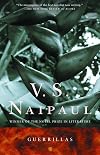
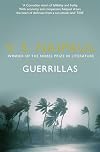
Guerrillas
by V. S. Naipaul
On This Page
Description
On an unnamed Caribbean Island, political tensions provoked by race and poverty are high. Jimmy Ahmed, a young mixed-race man, has been hailed as a revolutionary leader of the people. Roche, imprisoned for activities against South Africa's apartheid regime, and Jane, a feckless English rich girl wanting to feel a part of something bigger, get sucked into the turmoil and world of Ahmed. But does anyone achieve anything by causing unrest? Do any of them really want freedom in a new society or show more just the old society with themselves at the helm of power? show lessTags
Recommendations


































Member Reviews
Naipaul can really write, but his racism taints everything. Despite that, he created quite a compelling character in Jimmy Ahmed - he could be portrayed as just a monster, or ridiculous, but he ends up being more. Jane's character is not as shallowly drawn as it might initially seem, but it's hard to get a handle on her when the perspective keeps switching from her own to how she is perceived by Roche. Meredith could have been fleshed out more; he is clearly interesting but his motivations aren't clear. Roche is intended to be the authorial narrative voice, the standard of 'reason' by which all the 'madness' of the island is measured against, but in fact he is an empty cipher, the most unconvincing character of all. The most interesting show more and sympathetic character (despite his crimes) is the confused, manipulated young boy Bryant. A story told from his point of view and focusing on his experiences would have been much more interesting. But Naipaul lacks the capability to tell that story, sadly. show less
I have read about three-fourths of this book before finally giving up on the prose. The story borrows some elements from 'Jane Eyre' and, in a way, attempts to give a revisionist view of madness in love. Like Jean Rhys's 'Wide Sargasso Sea', Naipaul reinvents the psychology of conjugal love and subverts its conventional treatment of male-female power struggle. Overall this book would have been very interesting if not for the 'corrugated' writing style.
1789 Guerrillas, by V. S. Naipaul (read 13 Nov 1984) This 1975 novel is laid on a West Indian island and tells of an English girl, Jane, who comes there with Peter Roche, who had been tortured in South Africa. Jimmy Alimed is a black 'guerrilla' who Jane, for no conceivable reason, has two sexual encounters with--Naipaul paints the scene and the atmosphere of the hot awful island well, but there is nobody to care about in the story. The sex is brutal and nauseating. It is all rather obscure and supposedly freighted with more meaning than is immediately clear to me. It is not fun reading, though one must admire the writing ability of Naipaul. But he sure could have omitted the explicit nauseating repulsive sex scenes. I had not show more encountered anything like that in the two prior books of his I have read. show less
Auf einer namentlich nicht näher genannten Karibikinsel (vermutlich Trinidad, dem Geburtsort des Autors) herrscht der Verfall. Nach einem politischen Mord kommt es zu rassistisch motivierten Unruhen, ein Regierungsumsturz liegt in der Luft. In diesem gewalttätigen, bedrückenden Ambiente kreuzen sich die Schicksalslinien des Revolutionärs Jimmy Ahmad, einem chinesisch-schwarzen Mischling, der abseits der Städte eine Agrarkommune führt, der weißen Verlegerin Jane, ihres Lebensgefährten, einem aus Südafrika stammenden Anti-Apartheid-Aktivisten und Meredith, einem Politiker und Mitglied der postkolonialen, schwarzen Elite.
Leider bleibt das Werk fast alles schuldig: Der Plot ist derart verschachtelt, dass man ihn kaum begreift, viel show more zu vieles bleibt im Dunkeln, deutlich beschrieben sind lediglich die drastischen Schilderungen des Geschlechtsaktes, nicht jedoch der übrigen Ereignisse, deren Zusammenhänge aufgrund von Auslassungen des Autors im Dunkeln bleiben. Entgegen dem Klappentext offenbart das Buch auch keineswegs eine fühlbare, beklemmende Endzeitstimmung, Spannung kommt beim Lesen des Buches nie auf, vor allem auch, weil eine klare Erzählstruktur und Zeitlinie fehlt.
Es war das erste Buch von Naipaul, das ich gelesen habe und es wird vermutlich auch mein letztes bleiben... show less
Leider bleibt das Werk fast alles schuldig: Der Plot ist derart verschachtelt, dass man ihn kaum begreift, viel show more zu vieles bleibt im Dunkeln, deutlich beschrieben sind lediglich die drastischen Schilderungen des Geschlechtsaktes, nicht jedoch der übrigen Ereignisse, deren Zusammenhänge aufgrund von Auslassungen des Autors im Dunkeln bleiben. Entgegen dem Klappentext offenbart das Buch auch keineswegs eine fühlbare, beklemmende Endzeitstimmung, Spannung kommt beim Lesen des Buches nie auf, vor allem auch, weil eine klare Erzählstruktur und Zeitlinie fehlt.
Es war das erste Buch von Naipaul, das ich gelesen habe und es wird vermutlich auch mein letztes bleiben... show less
Feb 10, 2021German
Ambientada en una isla del Caribe al borde de la revolución, donde asiáticos, africanos, americanos y antiguos colonos británicos conviven en un estado de histeria contenida, Guerrillas es una novela sobre el colonialismo y la revolución.
Por el Premio Nobel de Literatura V.S. Naipaul.
En busca de nuevas causas por las que luchar, un hombre blanco, héroe de la resistencia sudafricana, llega a una isla del Caribe que se encuentra al borde de la revolución y donde asiáticos, africanos, americanos y ex colonos británicos conviven en un estado de histeria contenida. Lo acompaña su amante, Jane, una mujer inglesa llena de fantasías sobre la sexualidad y el poder nativos, e incapaz de prever las consecuencias de sus acciones. Ahí show more conocen a James «Jimmy» Ahmed, un revolucionario con delirios de grandeza y de poder, líder de una guerrilla que aspira a derrocar al gobierno. En medio de un clima sofocante, marcado por pequeños actos de violencia implícita y privada, la muerte de Stephens, el líder de una de las bandas juveniles, desata una espiral de muertes, violencia sexual e impotencia moral. show less
Por el Premio Nobel de Literatura V.S. Naipaul.
En busca de nuevas causas por las que luchar, un hombre blanco, héroe de la resistencia sudafricana, llega a una isla del Caribe que se encuentra al borde de la revolución y donde asiáticos, africanos, americanos y ex colonos británicos conviven en un estado de histeria contenida. Lo acompaña su amante, Jane, una mujer inglesa llena de fantasías sobre la sexualidad y el poder nativos, e incapaz de prever las consecuencias de sus acciones. Ahí show more conocen a James «Jimmy» Ahmed, un revolucionario con delirios de grandeza y de poder, líder de una guerrilla que aspira a derrocar al gobierno. En medio de un clima sofocante, marcado por pequeños actos de violencia implícita y privada, la muerte de Stephens, el líder de una de las bandas juveniles, desata una espiral de muertes, violencia sexual e impotencia moral. show less
Apr 27, 2026Spanish
> Babelio : https://www.babelio.com/livres/Naipaul-Guerilleros/203490
> BAnQ (Major A., Le devoir, 10 août 2002) : https://collections.banq.qc.ca/ark:/52327/2809065
> Bibliographie : https://www.librarything.fr/work/6103198/book/203997403
> BAnQ (Major A., Le devoir, 10 août 2002) : https://collections.banq.qc.ca/ark:/52327/2809065
> Bibliographie : https://www.librarything.fr/work/6103198/book/203997403
Aug 5, 2021French
Ratings
Members
- Recently Added By
Published Reviews
added by doomjesse
Lists

New York Public Library's Books of the Century - All
170 works; 14 members
Author Information

99+ Works 25,841 Members
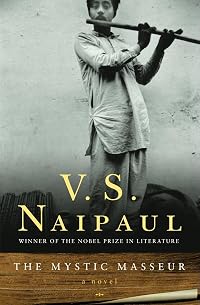
Vidiadhar Surajprasad Naipaul was born of Indian ancestry in Chaguanas, Trinidad on August 17, 1932. He was educated at University College, Oxford and lived in Great Britain since 1950. From 1954 to 1956, he edited a radio program on literature for the British Broadcasting Corporation's Caribbean Service. His first novel, The Mystic Masseur, was show more published in 1957. His other novels included A House for Mr. Biswas, A Bend in the River, Guerrillas, and Half a Life. In a Free State won the Booker Prize in 1971. He started writing nonfiction in the 1960s. His first nonfiction book, The Middle Passage, was published in 1962. His other nonfiction works included An Area of Darkness, Among the Believers, Beyond Belief, and A Turn in the South. He was knighted in 1990 and received the Nobel Prize in Literature in 2001. He died on August 11, 2018 at the age of 85. (Bowker Author Biography) show less
Some Editions
Awards and Honors
Distinctions
Series
Belongs to Publisher Series
Common Knowledge
- Original title
- Guerrillas
- Original publication date
- 1975
Classifications
Statistics
- Members
- 712
- Popularity
- 40,045
- Reviews
- 6
- Rating
- (3.19)
- Languages
- 11 — Danish, Dutch, English, Estonian, Finnish, French, German, Italian, Norwegian (Bokmål), Spanish, Swedish
- Media
- Paper, Audiobook, Ebook
- ISBNs
- 40
- ASINs
- 10