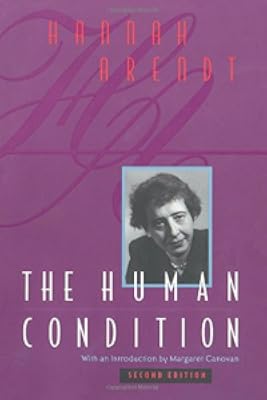
The Human Condition
by Hannah Arendt 
On This Page
Description
The past year has seen a resurgence of interest in the political thinker Hannah Arendt, "the theorist of beginnings," whose work probes the logics underlying unexpected transformations-from totalitarianism to revolution. A work of striking originality, The Human Condition is in many respects more relevant now than when it first appeared in 1958. In her study of the state of modern humanity, Hannah Arendt considers humankind from the perspective of the actions of which it is capable. The show more problems Arendt identified then-diminishing human agency and political freedom, the paradox that as human powers increase through technological and humanistic inquiry, we are less equipped to control the consequences of our actions-continue to confront us today. This new edition, published to coincide with the sixtieth anniversary of its original publication, contains Margaret Canovan's 1998 introduction and a new foreword by Danielle Allen. A classic in political and social theory, The Human Condition is a work that has proved both timeless and perpetually timely. show lessTags
Recommendations





















Member Reviews
I don't have my book with me as I write this, so I'll mostly limit myself to a few notes about things I’d like to keep thinking about after finishing this, the first book I’ve read by Hannah Arendt. I really enjoyed this book and will continue to refer to her labor/work/action distinction as a model for understanding human activity. Labor, in short, is what Marx would classify as reproductive activity: the stuff we do to keep ourselves alive in the day-to-day. I think bread-making is an example she uses a lot. You make the bread, consume it, make it again, consume it, and so on. Work, on the other hand, has to do with constructing a world. Building tables is an example she uses at least once or twice. You build an object, that show more finished object endures in your world, and you have an idea of its permanence as you’re making it. Work implies a fixed beginning and end (you finish making the table, or house, or whatever), whereas labor is more of a metabolic activity characterized by a never-ending cycle of activity. Action, finally, is when people come together and make open-ended plans for the future. It’s characterized by its plural nature (one person can make a table, but humans in the plural come together in action), and it has to do with a certain commitment to an uncertain future (and to the possibility that things could go wrong) that make it necessary for Arendt to talk about the centrality of things like promises and forgiveness in the context of action.
Arendt’s basic understanding of her own historical context is that a notion of labor has come to dominate contemporary (mid-20th-century) understandings of human activity: all of us form a giant organism, and its productive processes are taken as one giant metabolic process aimed at reproducing humankind. Marxist thought, and classical economics as well, are largely responsible for recognizing the centrality of labor. This is important and commendable, but it also served to obscure the sort of complexities in human activity that Arendt wants to bring back to the surface with the labor/work/action distinction. It is relatively easy to historicize her concern: she sees humanity as stuck between a sort of Cold-War-era rock and a hard place: between the bureaucratic structures of mid-century capitalism and the totalitarian structures of the Soviet bloc. In both cases, human beings become laboring cogs in a massive machine that obscures the work-and action-related aspects of their existence. Everything becomes labor aimed at maintaining the corporate (or Soviet) metabolism. The first nagging question I had while reading The Human Condition had to do with this vision of the modern world. On a few occasions, Arendt talks about how workers have moved from making a daily wage to earning a salary and becoming just like every other employee in the corporation. She predicts that the weekly salary will soon be replaced by a guaranteed basic income, which in her view would represent the culmination of the historical processes she’s studying. That, obviously, did not happen. Her assumption is that there will be increasing income equality between the laborers and the workers, so to speak; an increasing lack of differentiation between different activities.
So how does one read her in the present 2016 context? I happened to be reading another excellent book, Luc Boltanski and Ève Chiapello’s The New Spirit of Capitalism, at the same time as I read the final chapters of Arendt’s book. They talk about how capitalism was able to absorb some of the major critiques formulated against it in the 1950s and 60s, regarding the dehumanizing, alienating nature of work under mid-century conditions. Since then, the nature of work has changed radically: workers are given more autonomy, work is organized as a series of projects carried out by teams who are able to come together and formulate solutions to pressing problems, and one’s working life increasingly follows the logic of the network, where a worker participates in a series of projects whose effects are open-ended in the sense that they will contribute in unforeseen ways to one’s future employability. In the old days, you would go to work for an organization and assume you would spend the rest of your life there, with the organization providing for your future (and the future of your children). Now you have much more autonomy in the work you do, but there is also a greater risk that you could find yourself excluded from the project-based network economy if things go wrong. Anyway, my basic point is that what Boltanski and Chiapello call the “artistic critique” of 1950s and 60s capitalism sounds a lot to me like Arendt’s critique of the mid-century situation. They ask us to consider that capitalism absorbed and neutralized this critique, and I think their point is a good one. Maybe now we’re doing much more work and action, but it’s not because our condition is more human. It’s because capitalism has changed.
This brings me to the second point I’d like to keep in mind as I continue to read Arendt into the future. It’s easy to see her book as a critique of Marxism tout court. Marx is her major interlocutor, and her reading of his body of work is amazing. Among other things, she historicizes his discovery of labor power and his use of a process-based model for understanding the world in ways that I find entirely convincing. However, I think it’s important to keep in mind that hers is a necessarily partial reading of Marx, based mainly on his understanding of labor, alienated or unalienated, throughout human history. She tries to show that his position on labor is a constant throughout his corpus (citing all three volumes of Capital alongside his earlier writings), and I think she does a good job of making this case. However, I think it’s important to think about the Marxian concepts she doesn’t interact with. She doesn’t have a theory of capital here, she rejects Marxist understandings of reification, she doesn’t discuss the impact of the commodity form on human consciousness, and so on. My tentative conclusion is that it is necessary to historicize her relation to Marxism: she seems to be reacting to postwar currents in Marxist thought that largely draw on the early Marx (the 1844 manuscripts, which were only starting to be widely read and studied at that time) to try and formulate a humanist Marxism in reaction to the vicissitudes of Stalinism. That seems to be the Marxism she’s in dialogue with. At many points in time I thought it would be helpful to read her critique of that strain of Marxist thought alongside the writings of Louis Althusser from the early 1960s. They seem to be critiquing some of the same mid-century Marxist standpoints, but they do so in very, very different ways. Arendt reconnects humanist Marxism to a much broader philosophical tradition of thinking about the human condition, while Althusser investigates the implications of what he calls the “epistemological break” separating the earlier “humanist” Marx and the later Marx of Capital.
Finally, I wanted to point out that her last chapter about the “Vita activa and the Modern Age” does a great deal to clarify both her argument in the preceding chapters, and her position in 20th century intellectual history. She cites people like Alexander Koyré and Alfred North Whitehead whose work deals with the philosophy of science, and her understanding of the modern age is based on three events—the discovery of the new world, the protestant reformation, and Galileo’s invention of the telescope. Of these three, she devotes the most time to the third, attempting to understand the implications of advances in technology on the standpoints from which human beings attempt to interpret life in the universe. I wouldn’t be able to do justice to the intellectual history she unfolds in that chapter, but I do have two final comments. First, I would like to read her book alongside those of later authors such as Hans Blumenberg and Michel Foucault, because, like they do, she understands how intellectual historians must come to terms with the impact of science and technology on human thought. Second, I think she makes an interesting critique of Marx in this context—that he failed to recognize that many important scientific discoveries were not made in the service of capital and its productive capacities, but rather in terms of a sort of disinterested drive for knowledge that does not have to do with increasing production/wealth/etc. Of course, one could argue (and I would) that Marx would respond by saying that she’s just not willing to recognize the connections between this drive for knowledge and the expansion of the capitalist mode of production—those scientists were in the service of capital, unbeknownst to themselves, and their capacity to carry out “disinterested” scientific explorations was made possible by the development of the productive forces and the division of labor characteristic of their historical moment. Arendt does understand this possibility (there’s an interesting footnote about the foundation of the Royal Academy of Science and its ultimately political inspiration around page 270), but I think she disagrees with Marx.
In any case, this was an amazing book and, as someone who’s read a great deal of Marx in the past few years, I really appreciated Arendt’s clear and powerful argument regarding the human condition. show less
Arendt’s basic understanding of her own historical context is that a notion of labor has come to dominate contemporary (mid-20th-century) understandings of human activity: all of us form a giant organism, and its productive processes are taken as one giant metabolic process aimed at reproducing humankind. Marxist thought, and classical economics as well, are largely responsible for recognizing the centrality of labor. This is important and commendable, but it also served to obscure the sort of complexities in human activity that Arendt wants to bring back to the surface with the labor/work/action distinction. It is relatively easy to historicize her concern: she sees humanity as stuck between a sort of Cold-War-era rock and a hard place: between the bureaucratic structures of mid-century capitalism and the totalitarian structures of the Soviet bloc. In both cases, human beings become laboring cogs in a massive machine that obscures the work-and action-related aspects of their existence. Everything becomes labor aimed at maintaining the corporate (or Soviet) metabolism. The first nagging question I had while reading The Human Condition had to do with this vision of the modern world. On a few occasions, Arendt talks about how workers have moved from making a daily wage to earning a salary and becoming just like every other employee in the corporation. She predicts that the weekly salary will soon be replaced by a guaranteed basic income, which in her view would represent the culmination of the historical processes she’s studying. That, obviously, did not happen. Her assumption is that there will be increasing income equality between the laborers and the workers, so to speak; an increasing lack of differentiation between different activities.
So how does one read her in the present 2016 context? I happened to be reading another excellent book, Luc Boltanski and Ève Chiapello’s The New Spirit of Capitalism, at the same time as I read the final chapters of Arendt’s book. They talk about how capitalism was able to absorb some of the major critiques formulated against it in the 1950s and 60s, regarding the dehumanizing, alienating nature of work under mid-century conditions. Since then, the nature of work has changed radically: workers are given more autonomy, work is organized as a series of projects carried out by teams who are able to come together and formulate solutions to pressing problems, and one’s working life increasingly follows the logic of the network, where a worker participates in a series of projects whose effects are open-ended in the sense that they will contribute in unforeseen ways to one’s future employability. In the old days, you would go to work for an organization and assume you would spend the rest of your life there, with the organization providing for your future (and the future of your children). Now you have much more autonomy in the work you do, but there is also a greater risk that you could find yourself excluded from the project-based network economy if things go wrong. Anyway, my basic point is that what Boltanski and Chiapello call the “artistic critique” of 1950s and 60s capitalism sounds a lot to me like Arendt’s critique of the mid-century situation. They ask us to consider that capitalism absorbed and neutralized this critique, and I think their point is a good one. Maybe now we’re doing much more work and action, but it’s not because our condition is more human. It’s because capitalism has changed.
This brings me to the second point I’d like to keep in mind as I continue to read Arendt into the future. It’s easy to see her book as a critique of Marxism tout court. Marx is her major interlocutor, and her reading of his body of work is amazing. Among other things, she historicizes his discovery of labor power and his use of a process-based model for understanding the world in ways that I find entirely convincing. However, I think it’s important to keep in mind that hers is a necessarily partial reading of Marx, based mainly on his understanding of labor, alienated or unalienated, throughout human history. She tries to show that his position on labor is a constant throughout his corpus (citing all three volumes of Capital alongside his earlier writings), and I think she does a good job of making this case. However, I think it’s important to think about the Marxian concepts she doesn’t interact with. She doesn’t have a theory of capital here, she rejects Marxist understandings of reification, she doesn’t discuss the impact of the commodity form on human consciousness, and so on. My tentative conclusion is that it is necessary to historicize her relation to Marxism: she seems to be reacting to postwar currents in Marxist thought that largely draw on the early Marx (the 1844 manuscripts, which were only starting to be widely read and studied at that time) to try and formulate a humanist Marxism in reaction to the vicissitudes of Stalinism. That seems to be the Marxism she’s in dialogue with. At many points in time I thought it would be helpful to read her critique of that strain of Marxist thought alongside the writings of Louis Althusser from the early 1960s. They seem to be critiquing some of the same mid-century Marxist standpoints, but they do so in very, very different ways. Arendt reconnects humanist Marxism to a much broader philosophical tradition of thinking about the human condition, while Althusser investigates the implications of what he calls the “epistemological break” separating the earlier “humanist” Marx and the later Marx of Capital.
Finally, I wanted to point out that her last chapter about the “Vita activa and the Modern Age” does a great deal to clarify both her argument in the preceding chapters, and her position in 20th century intellectual history. She cites people like Alexander Koyré and Alfred North Whitehead whose work deals with the philosophy of science, and her understanding of the modern age is based on three events—the discovery of the new world, the protestant reformation, and Galileo’s invention of the telescope. Of these three, she devotes the most time to the third, attempting to understand the implications of advances in technology on the standpoints from which human beings attempt to interpret life in the universe. I wouldn’t be able to do justice to the intellectual history she unfolds in that chapter, but I do have two final comments. First, I would like to read her book alongside those of later authors such as Hans Blumenberg and Michel Foucault, because, like they do, she understands how intellectual historians must come to terms with the impact of science and technology on human thought. Second, I think she makes an interesting critique of Marx in this context—that he failed to recognize that many important scientific discoveries were not made in the service of capital and its productive capacities, but rather in terms of a sort of disinterested drive for knowledge that does not have to do with increasing production/wealth/etc. Of course, one could argue (and I would) that Marx would respond by saying that she’s just not willing to recognize the connections between this drive for knowledge and the expansion of the capitalist mode of production—those scientists were in the service of capital, unbeknownst to themselves, and their capacity to carry out “disinterested” scientific explorations was made possible by the development of the productive forces and the division of labor characteristic of their historical moment. Arendt does understand this possibility (there’s an interesting footnote about the foundation of the Royal Academy of Science and its ultimately political inspiration around page 270), but I think she disagrees with Marx.
In any case, this was an amazing book and, as someone who’s read a great deal of Marx in the past few years, I really appreciated Arendt’s clear and powerful argument regarding the human condition. show less
Arendt's book is a masterpiece of modern philosophy. Like any masterpiece, especially of philosophy, and even more especially of modern philosophy, this mistakes it very difficult to summarize. In this book, she draws on the history of Western thought from the ancient Jews, Greeks, and Romans through to Marx and Nietzsche to diagnose, as the title puts it, “the human condition.” Nearly every page is filled with insight into what it means to be human. She moves swiftly through the ages, introducing us to the ideas that have shaped our modern way of life and our way of viewing ourselves. And she finally ends with where we are at and why a reevaluation of our own humanity is now more pressing than ever (and now even more pressing than show more when Arendt wrote the book): our worst fears have been realized. Man has been simultaneously reduced to the state of an animal – a biological machine of no lasting worth – and elevated to the position of a god – capable of destroying worlds. What are we to do now? I recommend that everyone read this book – and ponder every word deeply. show less
This is a difficult read, although initially more frightening than it ends up actually being. Arendt's intellect is intimidating to say the least, and the manner in which she launches into a discussion of the human condition in the modern age is altogether unlike anything I've ever seen before -- "unique" is certainly an understatement. She completely renovates the discussion of political and social theory, but does it in a way that makes it seem logical and even natural. The scope of her knowledge is breathtaking, as she deftly handles everything from Ancient Greek property rights to modern day astrophysics, displaying an impressive working knowledge of Greek, Latin, German, French, and Italian in the process.
The book's greatest value show more is in its content. In addition to Arendt's revolutionary proposal of the vita activa (contrasted with the vita contemplativa) as broken up into the three separate areas of labor, work, and action, she also develops background arguments in each of these three categories that could have become books unto themselves. Her discussion of slavery in ancient Greece and Rome was one of the highlights. It was utterly fascinating to learn that unlike modern slaves that exist for production's sake, ancient slaves existed chiefly to free their masters from the necessities of everyday labor (day-to-day maintenance such as cleaning and cooking). This distinction does not seem like much on first glance, but it completely shifted the manner in which these two separate cultures thought about labor and human liberty:
I also enjoyed Arendt's writing style. Though she tended to lose me with some of her longer sentences, the meaning is always very clear when you take the time to parse down each phrase and aside. She is precise, if not concise. She is seemingly without pretension; neither arrogant in the way that she boldly takes down to size intellectual giants like Marx, Adam Smith, Bentham, Kant, or any of the Stoics or Epicureans, nor overly humble when she kneads the entire mass of political philosophy into a new (and more appropriate) form. Also, she seems to intuit that her ideas are complex and not immediately penetrable; some of the concepts in the first chapters that leave you scratching your head she knowingly addresses in more detail later on, without calling too much attention to the repetition and further elaboration. It's as if she knew you wouldn't have any idea what she was talking about the first time and wanted to inconspicuously help you, avoiding any embarrassment on your part.
My biggest problem with the book is its lack of stated purpose or overall thematic vision. I know she mentioned early on that the idea was to get people to think more, and I can respect that. But I was left confused with what she was actually proposing. I understood that she seemed to value action higher than either work or labor, but she was fairly clear in her condemnation of some of the worse outcomes of unplanned action as well (unpredictability, irreversibility). So what, then, is a reasonable model to follow, according to Arendt? Or is it just about developing more appropriate categories for these ideas? The introduction (which I recommend reading AFTER the text itself) addresses this issue but doesn't fully resolve it either. All in all, the genius of the discussion itself more than makes up for this lack, and that indeed was probably her intention all along. show less
The book's greatest value show more is in its content. In addition to Arendt's revolutionary proposal of the vita activa (contrasted with the vita contemplativa) as broken up into the three separate areas of labor, work, and action, she also develops background arguments in each of these three categories that could have become books unto themselves. Her discussion of slavery in ancient Greece and Rome was one of the highlights. It was utterly fascinating to learn that unlike modern slaves that exist for production's sake, ancient slaves existed chiefly to free their masters from the necessities of everyday labor (day-to-day maintenance such as cleaning and cooking). This distinction does not seem like much on first glance, but it completely shifted the manner in which these two separate cultures thought about labor and human liberty:
The opinion that labor and work were despised in antiquity because only slaves were engaged in them is a prejudice of modern historians. The ancients reasoned the other way around and felt it necessary to possess slaves because of the slavish nature of all occupations that served the needs for the maintenance of life. It was precisely on these grounds that the institution of slavery was defended and justified. p.83In order to have freedom to pursue the truly worthy human deeds (politics, oration, philosophy), they had to enslave these servants. Arendt's documentation of this shift is perhaps the most memorable part of the book.
I also enjoyed Arendt's writing style. Though she tended to lose me with some of her longer sentences, the meaning is always very clear when you take the time to parse down each phrase and aside. She is precise, if not concise. She is seemingly without pretension; neither arrogant in the way that she boldly takes down to size intellectual giants like Marx, Adam Smith, Bentham, Kant, or any of the Stoics or Epicureans, nor overly humble when she kneads the entire mass of political philosophy into a new (and more appropriate) form. Also, she seems to intuit that her ideas are complex and not immediately penetrable; some of the concepts in the first chapters that leave you scratching your head she knowingly addresses in more detail later on, without calling too much attention to the repetition and further elaboration. It's as if she knew you wouldn't have any idea what she was talking about the first time and wanted to inconspicuously help you, avoiding any embarrassment on your part.
My biggest problem with the book is its lack of stated purpose or overall thematic vision. I know she mentioned early on that the idea was to get people to think more, and I can respect that. But I was left confused with what she was actually proposing. I understood that she seemed to value action higher than either work or labor, but she was fairly clear in her condemnation of some of the worse outcomes of unplanned action as well (unpredictability, irreversibility). So what, then, is a reasonable model to follow, according to Arendt? Or is it just about developing more appropriate categories for these ideas? The introduction (which I recommend reading AFTER the text itself) addresses this issue but doesn't fully resolve it either. All in all, the genius of the discussion itself more than makes up for this lack, and that indeed was probably her intention all along. show less
Excellently written philosophy and observations on human life, that explores work art and technology in seamlessly written chapters. Flawless methodology, and although some of the reference points are dated from a book written in 1959, Arendt has presented an observation on the (western) human condition that was not only groundbreaking in its time, but was prophetic of the generations to come.
A work of striking originality bursting with unexpected insights, The Human Condition is in many respects more relevant now than when it first appeared in 1958. In her study of the state of modern humanity, Hannah Arendt considers humankind from the perspective of the actions of which it is capable. The problems Arendt identified then--diminishing human agency and political freedom, the paradox that as human powers increase through technological and humanistic inquiry, we are less equipped to control the consequences of our actions--continue to confront us today. This new edition, published to coincide with the fortieth anniversary of its original publication, contains an improved and expanded index and a new introduction by noted show more Arendt scholar Margaret Canovan which incisively analyses the book's argument and examines its present relevance. A classic in political and social theory, The Human Condition is a work that has proved both timeless and perpetually timely.
Hannah Arendt (1906-1975) was one of the leading social theorists in the United States. Her Lectures on Kant's Political Philosophy and Love and Saint Augustine are also published by the University of Chicago Press. show less
Hannah Arendt (1906-1975) was one of the leading social theorists in the United States. Her Lectures on Kant's Political Philosophy and Love and Saint Augustine are also published by the University of Chicago Press. show less
I read this when I was sophomore at Berkeley and it changed my life. As a political philosopher, her fundamental belief about the human condition is that we must think about what we are doing as citizen of the world, as public beings who make the world and defend it from thoughtlessness and blind ignorance. Sigh. If I could be three of the most brilliant women of the 20th century, I would be Simone Weil, Gillian Rose, and this woman--Hannah Arendt.
A timeless and fascinatingly philosophical look at humanity seen through its defining activities. The author divides these into labor, work, and action: after Aristotle's division of knowledge into episteme, techne, and phronesis. Labor is the activity of necessity: what we must do to sustain ourselves in the world. Work is the activity of craft and artifact: what we can do to build an enduring and beneficial environment. Action is the activity of ethical praxis: what we should do to improve ourselves and our progeny.
Members
- Recently Added By
Published Reviews
I denne boken, som er Arendts hovedverk, gis en historisk analyse av forholdet mellom det aktive livets tre komponenter: arbeid, produksjon og handling. Arbeid bidrar til å opprettholdet livet, produksjon er menneskets aktivitet innenfor en tingverden, men først med handling oppstår den politiske sfære. Arendts analyse av det virksomme livet er preget av antikkens begreper, men disse er show more satt inn i en ramme der også moderne filosofiske posisjoner er innreflektert. Boken ble første gang utgitt i 1958. Har sak- og personregister. show less
added by kirstenlund
Lists

Non-Fiction Worth Reading
1,016 works; 262 members

On Work
7 works; 1 member

Filosofía - Clásicos
217 works; 1 member

Alan Kay's Reading List
103 works; 3 members

Art of Reading
188 works; 5 members

Books Read in College
80 works; 5 members

Other
2 works; 1 member

Writers In Public Domain 2026
90 works; 1 member

In Our Time books
4,934 works; 2 members
Author Information

260+ Works 26,290 Members
Born in Hanover, Germany, Hannah Arendt received her doctorate from Heidelberg University in 1928. A victim of naziism, she fled Germany in 1933 for France, where she helped with the resettlement of Jewish children in Palestine. In 1941, she emigrated to the United States. Ten years later she became an American citizen. Arendt held numerous show more positions in her new country---research director of the Conference on Jewish Relations, chief editor of Schocken Books, and executive director of Jewish Cultural Reconstruction in New York City. A visiting professor at several universities, including the University of California, Columbia, and the University of Chicago, and university professor on the graduate faculty of the New School for Social Research, in 1959 she became the first woman appointed to a full professorship at Princeton. She also won a number of grants and fellowships. In 1967 she received the Sigmund Freud Prize of the German Akademie fur Sprache und Dichtung for her fine scholarly writing. Arendt was well equipped to write her superb The Origins of Totalitarianism (1951) which David Riesman called "an achievement in historiography." In his view, "such an experience in understanding our times as this book provides is itself a social force not to be underestimated." Arendt's study of Adolf Eichmann at his trial---Eichmann in Jerusalem (1963)---part of which appeared originally in The New Yorker, was a painfully searching investigation into what made the Nazi persecutor tick. In it, she states that the trial of this Nazi illustrates the "banality of evil." In 1968, she published Men in Dark Times, which includes essays on Hermann Broch, Walter Benjamin, and Bertolt Brecht (see Vol. 2), as well as an interesting characterization of Pope John XXIII. (Bowker Author Biography) show less
Hannah Arendt has a Legacy Library. Legacy libraries are the personal libraries of famous readers, entered by LibraryThing members from the Legacy Libraries group.
Some Editions
Awards and Honors
Series
Belongs to Publisher Series
Work Relationships
Has as a commentary on the text
Common Knowledge
- Canonical title
- The Human Condition
- Original title
- The Human Condition
- Original publication date
- 1958
- Quotations
- Being seen and being heard by others derive their significance from the fact that everybody sees and hears from a different position. This is the meaning of public life, compared to which even the riches and most satisfying f... (show all)amily life can offer only the prolongation or multiplication of one's own position with its attending aspects and perspectives.
- Original language
- English
- Canonical DDC/MDS
- 301
- Canonical LCC
- HM211
Classifications
- Genres
- Philosophy, Sociology, Politics and Government, Nonfiction, General Nonfiction, History
- DDC/MDS
- 301 — Society, government, & culture Social sciences, sociology & anthropology Sociology and anthropology
- LCC
- HM211 — Social sciences Sociology (General) Sociology These are obsolete numbers no longer used
- BISAC
Statistics
- Members
- 3,413
- Popularity
- 4,917
- Reviews
- 28
- Rating
- (4.19)
- Languages
- 24 — Catalan, Chinese, Czech, Danish, Dutch, English, Finnish, French, German, Greek, Hebrew, Italian, Lithuanian, Norwegian (Bokmål), Norwegian, Polish, Romanian, Russian, Serbian, Croatian, Spanish, Swedish, Turkish, Portuguese (Portugal)
- Media
- Paper, Audiobook, Ebook
- ISBNs
- 84
- ASINs
- 26