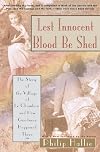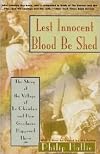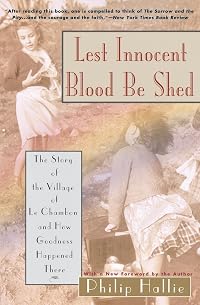
Lest Innocent Blood Be Shed: The Story of the Village of Le Chambon and How Goodness Happened There
by Philip Hallie
On This Page
Description
"Le Chambon's villagers and their clergy organized to save thousands of Jewish children and adults from certain death."Tags
Recommendations





















Member Recommendations
2wonderY This older written account is more succinct and better written. The Moorhead book has much more detail about ancillary matters.
Member Reviews
For more reviews and bookish posts please visit: https://www.ManOfLaBook.com
Lest Innocent Blood Be Shed by Philip Paul Hallie tells of Le Chambon, a small hamlet of Protestants in Vichy France who were helping Jewish refugees escape. Mr. Hallie is a professor of Philosophy, he left a manuscript of this book which was posthumously published.
The book tells of a small, but significant slice of history. The village of Le Chambon-sur-Lignon became part of a wide network to rescue Jews from the Nazi killing machine. The movement, led by Huguenot pastor André Trocmé and his wife Magda is credited with saving at least 2,000 persons. This is the second book I’ve read about the Le Chambon, Village of Secrets: Defying the Nazis in Vichy France show more by Caroline Moorehead was the first.
In a moving narrative, Lest Innocent Blood Be Shed by Philip Paul Hallie shows the goodness that people are capable of, as well as the bravery it takes to act upon that calling. I wasn’t too thrilled to find out the author was a philosopher, as I’m more interested in the actions of real people as opposed to high-brow abstractions. Luckily, so was Mr. Hallie who mentioned abstract virtues in passing, while concentrating on the astounding story of a whole village (almost), cooperating to rescue Jews during World War II at much risk to themselves and everyone they know.
Why did poor villagers who barely had enough to eat risk everything to help others? This was at a time when many refused.
Why, and how does an entire community gather together to work for a common goal in great peril?
Pastor Trocmé and his wife led the rescue effort, sticking to their ethical ideology unwaveringly and with fortitude. The Huguenots, with their history of persecution, were more than willing to help.
Focusing on personality, history, and culture, the book brings context to the conviction of Le Chambon which many find difficult to understand. Ethics, for Mr. Hallie, is not about abstraction, but about how people act when they are called up in the present, and whether the call to action is answered.
The people of Le Chambon answered quietly and their stories deserved to be told. Both André and Magda Trocmé were honored by Yad Vashem as Righteous among the Nations. show less
Lest Innocent Blood Be Shed by Philip Paul Hallie tells of Le Chambon, a small hamlet of Protestants in Vichy France who were helping Jewish refugees escape. Mr. Hallie is a professor of Philosophy, he left a manuscript of this book which was posthumously published.
The book tells of a small, but significant slice of history. The village of Le Chambon-sur-Lignon became part of a wide network to rescue Jews from the Nazi killing machine. The movement, led by Huguenot pastor André Trocmé and his wife Magda is credited with saving at least 2,000 persons. This is the second book I’ve read about the Le Chambon, Village of Secrets: Defying the Nazis in Vichy France show more by Caroline Moorehead was the first.
In a moving narrative, Lest Innocent Blood Be Shed by Philip Paul Hallie shows the goodness that people are capable of, as well as the bravery it takes to act upon that calling. I wasn’t too thrilled to find out the author was a philosopher, as I’m more interested in the actions of real people as opposed to high-brow abstractions. Luckily, so was Mr. Hallie who mentioned abstract virtues in passing, while concentrating on the astounding story of a whole village (almost), cooperating to rescue Jews during World War II at much risk to themselves and everyone they know.
Why did poor villagers who barely had enough to eat risk everything to help others? This was at a time when many refused.
Why, and how does an entire community gather together to work for a common goal in great peril?
Pastor Trocmé and his wife led the rescue effort, sticking to their ethical ideology unwaveringly and with fortitude. The Huguenots, with their history of persecution, were more than willing to help.
Focusing on personality, history, and culture, the book brings context to the conviction of Le Chambon which many find difficult to understand. Ethics, for Mr. Hallie, is not about abstraction, but about how people act when they are called up in the present, and whether the call to action is answered.
The people of Le Chambon answered quietly and their stories deserved to be told. Both André and Magda Trocmé were honored by Yad Vashem as Righteous among the Nations. show less
The inspiring account of the village of Le Chambon and their success in saving hundreds of Jews from the Nazis through nonviolent resistance. Their example shows that nonviolence can indeed be successful against even such rapacious evil as Nazism. The account is somewhat difficult to follow because of the achronological exposition. Hallie did a great job of exploring the human qualities of his subjects, which makes Le Chambon's undertaking seem even more glorious than had Hallie deified them.
This book differs from so many other books about WW2 because instead of focusing on HOW the events unfolded- who was involved, when it happened etc- it focused on WHY the people reacted in the ways that they did.
It's a interesting read but prepare to ponder the ethics of those involved rather than gathering a clear picture of the timeline of events in Le Chambon.
It's a interesting read but prepare to ponder the ethics of those involved rather than gathering a clear picture of the timeline of events in Le Chambon.
The story line will pull at your heartstrings. It is a slow read but one with impact. The devotion to religion of the residents of Le Chambon fostered the humanistic elements of ethics, goodness and compassion within them. The vivid imagery within Hallie’s prose held this reader’s attention, and I wanted to learn more about the village and its residents, wanted to learn more about the historical background.
Lest Innocent Blood be Shed is a book that definitely has historical value. The story is inspiring and a tribute to the entire village.
I recommend Lest Innocent Blood be Shed: The Story of the Village of Le Chambon and how Goodness Happened, by Philip P. Hallie, to everyone interested in the history of individuals who helped show more rescue Jews, and to those who want to learn more about the Holocaust and its rescuers. show less
Lest Innocent Blood be Shed is a book that definitely has historical value. The story is inspiring and a tribute to the entire village.
I recommend Lest Innocent Blood be Shed: The Story of the Village of Le Chambon and how Goodness Happened, by Philip P. Hallie, to everyone interested in the history of individuals who helped show more rescue Jews, and to those who want to learn more about the Holocaust and its rescuers. show less
This book as the message that there can be hope, even in darkest of times. During WWII, the entire community of Le Chambon refused to cooperate with the Nazis and helped more than 5,000 Jews escape Nazi camps. There was no one hero... rather the whole community engaged in a conspiracy of goodness. Whenever I start to think that it's impossible for a community to tackle a difficult issue, I find myself reflect what this amazing community was able to achieve. There is a good documentary about this community called Weapons of the Spirit.
The harrowing story of Le Chambon, a mountain village in southern France, and their heroic work of saving Jewish refugees during World War 2. It is a story guaranteed to inspire goodness and hope.
Inspiring account of a village that rescued endangered people during WWII. Practical example of genuine love for people.
Members
- Recently Added By
Author Information
12+ Works 774 Members
Awards and Honors
Notable Lists
Common Knowledge
- Original publication date
- 1979
- People/Characters
- André Trocmé
- Important places
- Le Chambon-sur-Lignon, Auvergne-Rhône-Alpes, France
- Epigraph
- In the deserts of the heart
Let the healing fountains start,
In the prison of his days
Teach the free man how to praise.
- W. H. Auden,
"In Memory of W. B. Yeats"
"May Heaven reward you!" we said to her. "You are a good woman."
"Me, young ladies?" she returned with surprise. "Hush!"
- Charles Dickens,
"Bleak House" - Dedication
- To Elane Norych Geller, who, after it all, prevails
- First words
- At seven o'clock in the eveing of February 13, 1943, an official black automovile stopped not far from the Protestant presbytery of Le Chambon.
- Last words
- (Click to show. Warning: May contain spoilers.)I know that I want to be able to say, from those depths, "Naturally, come in, and come in."
- Blurbers
- Des Pres, Terrence; Bliven, Naomi; Morgan, Ted
Classifications
Statistics
- Members
- 689
- Popularity
- 41,426
- Reviews
- 11
- Rating
- (4.14)
- Languages
- English
- Media
- Paper
- ISBNs
- 5
- ASINs
- 7