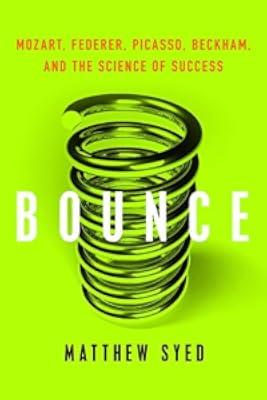
Bounce: Mozart, Federer, Picasso, Beckham, and the Science of Success
by Matthew Syed
On This Page
Description
In this thoughtful, provocative book, a former Olympian persuasively demonstrates how sports offer powerful and often overlooked tools with which to explore fundamental subjects, including biology, morality, globalization, culture, gender, race, and economics.Tags
Recommendations
Member Recommendations

Member Reviews
What set great achievers and successful people apart from the rest? Simple: hard work and practice.
Simple as and, yet, it still is baffling to see how many still believe in 'talent' or 'genius' that is, inner and innate capabilities that one either has or doesn't! Debunking many prejudices, from child prodigies to so called sparks of creative genius, Matthew Syed here shows that success and achievement have nothing to do with genetic predispositions (talent, then) but, are down to hard work, meaningful practice, perseverance and, above all, a specific kind of mindset which is, ironically enough, the exact opposite of the one permeating our society. Sounds naive or, too good to be true? Think again. Here's not a pop self-help fix nor, show more some kind of new age bullshit about the power of positive thinking in a vacuum but, a powerful argument seriously grounded in , both the personal experience of the author (a table tennis champion) and, neuroscience and psychology- the inspirational works of Anders Ericsson and Carol Dweck taking a big chunk of the book.
No cutting: I loved it all through and through and couldn't put it down. At long last! Here's the ethos I firmly believe in and try to instil in my own kids being brillantly vindicated! More, the author being an athlete and, most of his examples being taken from the world of sport, 'Bounce' ends with a very relevant questioning of how, now, we might be able to improve on performances using genetic engineering and/or doping. Would it be moral? Would it be that bad? The author's answers are surely light (that's not his main topic, having said that) but, I found such ending a nice way to close it all.
So, read this, drop the shitty excuses about 'talent', 'genetics' and 'I am not made for this or that' and, go achieve! Encouraging and inspirational. show less
Simple as and, yet, it still is baffling to see how many still believe in 'talent' or 'genius' that is, inner and innate capabilities that one either has or doesn't! Debunking many prejudices, from child prodigies to so called sparks of creative genius, Matthew Syed here shows that success and achievement have nothing to do with genetic predispositions (talent, then) but, are down to hard work, meaningful practice, perseverance and, above all, a specific kind of mindset which is, ironically enough, the exact opposite of the one permeating our society. Sounds naive or, too good to be true? Think again. Here's not a pop self-help fix nor, show more some kind of new age bullshit about the power of positive thinking in a vacuum but, a powerful argument seriously grounded in , both the personal experience of the author (a table tennis champion) and, neuroscience and psychology- the inspirational works of Anders Ericsson and Carol Dweck taking a big chunk of the book.
No cutting: I loved it all through and through and couldn't put it down. At long last! Here's the ethos I firmly believe in and try to instil in my own kids being brillantly vindicated! More, the author being an athlete and, most of his examples being taken from the world of sport, 'Bounce' ends with a very relevant questioning of how, now, we might be able to improve on performances using genetic engineering and/or doping. Would it be moral? Would it be that bad? The author's answers are surely light (that's not his main topic, having said that) but, I found such ending a nice way to close it all.
So, read this, drop the shitty excuses about 'talent', 'genetics' and 'I am not made for this or that' and, go achieve! Encouraging and inspirational. show less
Matthew Syed is an ex-British table tennis Olympian turned motivational speaker / journalist / writer. In this book he looks at the culture of success, particular amongst sporting elite, examining what separates those at the peak of their game (in whatever context) from the rest of us mere mortals.
Whilst I was initially concerned that a lot of the book could probably be summed up in a couple of pages (i.e. that talent matters much less than putting in the effort - a minimum of 10 years of dedicated focus), Syer does delve into several interesting sub-topic areas across his chapters, such as debunking the myth of child prodigies (again, it's all about thousands of hours of practice), the role the brain has in hardwiring complex sporting show more or musical pieces so that the sum of the parts become subconscious actions (and how 'choking' can occur when these elements become separated under stress), the psychology of how the best coaches most effectively praise the talent they're working with (and how this translates to education as well, with transformational results when comparing praise for effort versus intelligence) and the placebo effect, in particular how religious faith can have a placebo effect on settling athletes' nerves before big games.
The final chapter was also very interesting - debunking the theory of why black athletes are considered superior runners. Syers examines how racial stereotyping comes into generalisations about long-distance runners being 'east Africans' and sprinters 'west Africans', and how scientific research has shown that when top athletes from small hot spots of sporting success were gene tested, there was much more gene variation than expected, even within small towns. The evidence Syer finds from studies puts forward a counter argument to genetic physical advantage, i.e. that unequal opportunity is much more likely to play into black dominance of running events. In some African and Caribbean countries, running is the sport with the lowest economic barrier to entry, and in one particular hot spot town for long-distancing running in Kenya it was found that most of the top athletes from that area had to run in excess of 20km per day just to attend school (and also at high altitude).
All in all an enjoyable read with lots of interesting stories to back up Syer's arguments. Ultimately, however, it seems to mostly be intense dedication to practice that separates the wheat from the chaff.
4 hours - an interesting insight into how top talent is made, not born. show less
Whilst I was initially concerned that a lot of the book could probably be summed up in a couple of pages (i.e. that talent matters much less than putting in the effort - a minimum of 10 years of dedicated focus), Syer does delve into several interesting sub-topic areas across his chapters, such as debunking the myth of child prodigies (again, it's all about thousands of hours of practice), the role the brain has in hardwiring complex sporting show more or musical pieces so that the sum of the parts become subconscious actions (and how 'choking' can occur when these elements become separated under stress), the psychology of how the best coaches most effectively praise the talent they're working with (and how this translates to education as well, with transformational results when comparing praise for effort versus intelligence) and the placebo effect, in particular how religious faith can have a placebo effect on settling athletes' nerves before big games.
The final chapter was also very interesting - debunking the theory of why black athletes are considered superior runners. Syers examines how racial stereotyping comes into generalisations about long-distance runners being 'east Africans' and sprinters 'west Africans', and how scientific research has shown that when top athletes from small hot spots of sporting success were gene tested, there was much more gene variation than expected, even within small towns. The evidence Syer finds from studies puts forward a counter argument to genetic physical advantage, i.e. that unequal opportunity is much more likely to play into black dominance of running events. In some African and Caribbean countries, running is the sport with the lowest economic barrier to entry, and in one particular hot spot town for long-distancing running in Kenya it was found that most of the top athletes from that area had to run in excess of 20km per day just to attend school (and also at high altitude).
All in all an enjoyable read with lots of interesting stories to back up Syer's arguments. Ultimately, however, it seems to mostly be intense dedication to practice that separates the wheat from the chaff.
4 hours - an interesting insight into how top talent is made, not born. show less
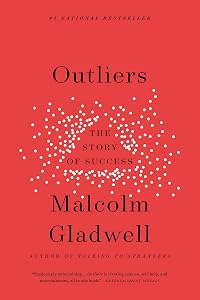
I was initially disappointed as this book starts out very much like the book "Outliers", and I thought it would be more of the same. (Page 17) Fortunately, it quickly got beyond that into a much more general discussion of the development of ability in various sports. The thesis of the book is that it's not genes, it's not innate talent, it's serious practice that develops great ability. Ten thousand hours spread across ten years is what it takes. The book also observes that when the environment is right there will be a location where many highly skilled individuals originate. In the examples, those environmental conditions include: a passionate coach (the skill is valued), the opportunity to practice, and, if applicable, people to show more practice with.
Chapter 5: The Placebo Effect goes into not only the power of a placebo in the medical arena, but much more generally in sports and life.
"This ability to instill belief in others is a vital facet of leadership - whether in politics or the military - but it can also create a huge advantage in sport through its impact on competitors." (Page 171)
"One of the most remarkable findings of modern psychology is the extraordinary capacity of human beings to mold the evidence to fit thier beliefs rather than the other way around; it is our capacity to believe in spite of the evidence and sometimes in spite of our otehr deeply held beliefs. And it is this capacity, ore than any other, which- psychologically speaking - distinguishes top athletes from the rest." (Page 174)
Chapter 6: The Curse of Choking and how to avoid it
Choking - when the conscious brain takes over what has already been expertly learned by the unconscious brain.
Chapter 7: ... Why Great Sportsmen Feel Miserable After Winning
Chapter 9: Drugs in Sports has some interesting reflections on the use of drugs in sports (a zero sum game) versus in society at large. show less
Chapter 5: The Placebo Effect goes into not only the power of a placebo in the medical arena, but much more generally in sports and life.
"This ability to instill belief in others is a vital facet of leadership - whether in politics or the military - but it can also create a huge advantage in sport through its impact on competitors." (Page 171)
"One of the most remarkable findings of modern psychology is the extraordinary capacity of human beings to mold the evidence to fit thier beliefs rather than the other way around; it is our capacity to believe in spite of the evidence and sometimes in spite of our otehr deeply held beliefs. And it is this capacity, ore than any other, which- psychologically speaking - distinguishes top athletes from the rest." (Page 174)
Chapter 6: The Curse of Choking and how to avoid it
Choking - when the conscious brain takes over what has already been expertly learned by the unconscious brain.
Chapter 7: ... Why Great Sportsmen Feel Miserable After Winning
Chapter 9: Drugs in Sports has some interesting reflections on the use of drugs in sports (a zero sum game) versus in society at large. show less
An enjoyable and interesting book on the subject of nature vs. nurture. The author examines the now well known "ten thousand hours of practice" rule of expertise, using both anecdotes and research, and shows that it seems to apply even to so-called prodigies. He also examines the psychological aspects of performance and how it applies to both success and "choking".
There may not be, as critics have pointed out, anything totally new or revelatory here. But it is well presented and easy to read, and a somewhat compelling introduction to the topic. The final two chapters, dealing with doping and racial issues, seem a little out of place. But they do not overly detract from the overall message.
There may not be, as critics have pointed out, anything totally new or revelatory here. But it is well presented and easy to read, and a somewhat compelling introduction to the topic. The final two chapters, dealing with doping and racial issues, seem a little out of place. But they do not overly detract from the overall message.
So it turns out there's no such thing as talent, there's only hard work. This concept is immediately counter-intuitive, but the further through Bounce you get, the more it makes sense. They've identified ten years as the magic time it takes to produce a world champion - and only if that ten years is filled with lots of purposeful practice. Even Mozart turns out to have put in the prerequisite ten years before he wrote his first true masterpiece.
The overall message is profound. Where it really hit home for me, as a father, was reading about the studies in which two groups of children were told either "aren't you clever!" or "didn't you work hard!" and the dramatic effects of each statement.
This is the first time I've stumbled upon show more these ideas. The ideas are not the author's own but he neatly summarises studies across multiple disciplines, adding his own interesting research, resulting in a very accessible introduction to the topic of excellence. show less
The overall message is profound. Where it really hit home for me, as a father, was reading about the studies in which two groups of children were told either "aren't you clever!" or "didn't you work hard!" and the dramatic effects of each statement.
This is the first time I've stumbled upon show more these ideas. The ideas are not the author's own but he neatly summarises studies across multiple disciplines, adding his own interesting research, resulting in a very accessible introduction to the topic of excellence. show less
There's popularising and there's popularising, and with the huge proviso that I know absolutely nothing about sports psychology or racial genetics, this seems to me an example of decent popularising of insights from these disciplines. As one who's vaguely assumed that Federer and Tiger Woods were miraculous beings born with unearthly powers, the first half of the book, with its repeated demonstrations of the power of practice - focused, motivated, regular and frequent practice - to amplify perceptions, change the physiology of brain and body, and create so-called 'talent', is fascinating and to me unanswerable. The stories of the Polgár sisters, the apparently freakish concentration of British table-tennis talent on one street in show more Reading, these were quite new to me. The later sections wander from the initial premise and form a loose collection of essays on racial 'characteristics' and other interesting topics. Syed freely acknowledges that he is popularising the work of Ericsson, among others, but his book is a bit more than just a patchwork of illustrative anecdotes, thanks in part to the inclusion of his own experiences as a top-level table tennis player and subsequent contact with some of the greats through his journalism. show less
Bounce made me rethink (still in progress) how I approach my day to day activities. Which ones I would like to get good at? And which ones I would just like to enjoy while passing time? Which ones I would continue to enjoy while improving my skills?
The chapter about purposeful practice is very useful for anyone playing a musical instrument.
The last chapter was a cherry on the cake: ethics of human augmentation.
The chapter about purposeful practice is very useful for anyone playing a musical instrument.
The last chapter was a cherry on the cake: ethics of human augmentation.
Members
- Recently Added By
Published Reviews
added by lemontwist
Lists

Books Read in 2020
4,379 works; 123 members
Author Information

16 Works 1,710 Members
Matthew Syed is a columnist for the London Times and a commentator for the BBC, and was recently named British Sports Feature Writer of the Year by the Sports Journalists' Association and Sports Journalist of the Year at the British Press Awards. He is also the former Commonwealth table tennis champion, two-time Olympian, and a graduate of Oxford show more University. show less
Awards and Honors
Work Relationships
Common Knowledge
- Original publication date
- 2010
- Dedication
- For Dilys
- First words
- In January 1995, I became the British number-one table tennis player for the very first time which, I am sure you will agree, is a heck of an achievement.
- Last words
- (Click to show. Warning: May contain spoilers.)If we could only ditch our race-tinted spectacles, the world would not only look very different, it would soon become very different, too.
Classifications
- Genres
- Nonfiction, General Nonfiction, Business, Sports and Leisure, Science & Nature
- DDC/MDS
- 650.1 — Applied science & technology Management & public relations Business Skills & Management Personal success in business
- LCC
- BF637 .S8 .S867 — Philosophy, Psychology and Religion Psychology Psychology Applied psychology
- BISAC
Statistics
- Members
- 641
- Popularity
- 45,291
- Reviews
- 22
- Rating
- (3.94)
- Languages
- English, German, Japanese, Portuguese
- Media
- Paper, Audiobook, Ebook
- ISBNs
- 15
- UPCs
- 1
- ASINs
- 13