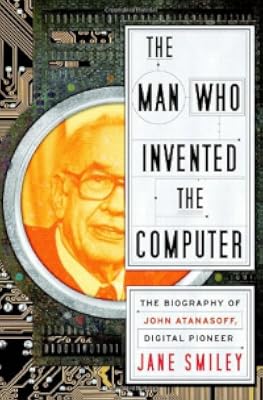
The Man Who Invented the Computer: The Biography of John Atanasoff, Digital Pioneer
by Jane Smiley
On This Page
Description
One night in the late 1930s, in a bar on the Illinois-Iowa border, John Vincent Atanasoff, a professor of physics at Iowa State University, after a frustrating day performing tedious mathematical calculations in his lab, hit on the idea that the binary number system and electronic switches, combined with an array of capacitors on a moving drum to serve as memory, could yield a computing machine that would make his life easier. Then he went back and built the machine. It worked, but he never show more patented the device, and the developers of the far-better-known ENIAC almost certainly stole critical ideas from him. But in 1973 a court declared that the patent on that Sperry Rand device was invalid, opening the gates to the computer revolution. Biographer Jane Smiley makes the race to develop digital computing as gripping as a real-life techno-thriller.--From publisher description. show lessTags
Recommendations









Member Reviews
An interesting book about a computing pioneer I had never heard of. The Author weaves John Atanasoff's computer creation story in parallel with the other computer creators of the time: Alan Turing, Tommy Flowers, Max Newman, John Mauchly, Presper Eckert, Konrad Zeus and John von Neumann. She shows most of these individuals had a strong need to solve some heavy calculation problems. These individuals stood out also as very creative people with traits like: self-confidence, independence, high energy, willingness to take risks, above-average intelligence, openness to experience, and preference for complexity. Including a key component of a creative mind, what R. Keith Sawyer's (creativity expert) calls "problem finding"—that is, the show more ability to productively formulate a problem so that the terms of the problem lead to a solution.
John Atanasoff certainly appears to have been the first to get a computer going in the USA, neck and neck with Konrad Zeus in Germany. But he is visited by John Mauchly who understands more than John realises. With WWII intervening and patients not being file, it is only resolved years later in 1973 that John Atanasoff ideas had been used in the UNIVAC. The book runs out of steam at the end getting too involved with the patent dispute and court case. show less
John Atanasoff certainly appears to have been the first to get a computer going in the USA, neck and neck with Konrad Zeus in Germany. But he is visited by John Mauchly who understands more than John realises. With WWII intervening and patients not being file, it is only resolved years later in 1973 that John Atanasoff ideas had been used in the UNIVAC. The book runs out of steam at the end getting too involved with the patent dispute and court case. show less
So far (p. 28) Smiley has asserted a couple of head-scratchers: "The measurement required by an analog calculator would be replaced by counting. Since this is similar to the way a child counts on his fingers, this came to be known as digital calculation."
This is more the early cross-pollination that led to computers rather than the biography of a single man; the title is misleading but the book is interesting so that's okay.
This is more the early cross-pollination that led to computers rather than the biography of a single man; the title is misleading but the book is interesting so that's okay.
The Man Who Invented The Computer is not so much about John Vincent Atanasoff as it is about the development of the computer in general. In that grain of thinking, the book takes us to a number of computer pioneers and their lives. So the book starts with Atanasoff and Clifford Berry, but as it goes on it also talks about Alan Turing, Tommy Flowers, the guys that developed ENIAC, Howard Aiken, and Konrad Zuse. Zuse seems to have a claim to the earliest working prototype, but Atanasoff's model did things that the others couldn't. Since this is about the development of early computers, it also talks about World War II a lot.
The main reason early pioneers of the computer even built computing machines was to reduce the number of tedious show more calculations required in higher mathematics. For the case of John Vincent Atanasoff, it was for his Doctoral Thesis. He had to calculate using mechanical calculators that couldn't multiply or divide. I couldn't imagine putting up with something like that, but Atanasoff did one better and figured he would build his own. So after he got his doctorate he looked into building his own computing device. Zuse had a different background in that he was more into art, but he built computers for the same reason.
It seems a lot of companies like IBM were trapped in the idea that Binary wouldn't work or would be too complicated. This was why early calculators were so primitive and unusable.
This book was pretty interesting, and it did tell me some stuff I didn't know. show less
The main reason early pioneers of the computer even built computing machines was to reduce the number of tedious show more calculations required in higher mathematics. For the case of John Vincent Atanasoff, it was for his Doctoral Thesis. He had to calculate using mechanical calculators that couldn't multiply or divide. I couldn't imagine putting up with something like that, but Atanasoff did one better and figured he would build his own. So after he got his doctorate he looked into building his own computing device. Zuse had a different background in that he was more into art, but he built computers for the same reason.
It seems a lot of companies like IBM were trapped in the idea that Binary wouldn't work or would be too complicated. This was why early calculators were so primitive and unusable.
This book was pretty interesting, and it did tell me some stuff I didn't know. show less
Interesting story, but the focus was upon the legal and patent issues involved with proving Atanastoff to be the first inventor of a working computer. One gets lost between all the maneuvering of the principals and companies. The best part of the book is a clear exposition of the basic principles of a digital computer.
Jane Smiley has written a facinating account of the early history of computer developments. While she has focused on the story of John Atansoff, the whole history of these early inventors, particularly in US, is interwoven. She does an excellent job of portraying the various personalities for each of them are real "characters".
This book does well in answering the question, who invented the computer? While most students are aware the ancient Babbage computing engine and the most war ENIAC, the real answer to this question is not a simple one. Nearly simultaneous developments, both theoretical and practical, were underway in Iowa (John Atanasoff), England (Alan Turing), and Germany (Konrad Zuse). Then, as Jane explains so well, all of show more these efforts were over come by the events of World War II.
In the US, John Atanasoff's efforts were side tracked by is assignment to other research efforts. World War II also brings John von Neumann and the John Mauchly/ J. Presper Eckhart (ENIAC) team to the forefront. In England, Alan Turing becomes a principal in the use of computers at Bletchley Park to break the Enigma code. Also, in England, we see the more advanced Colossus computer developed by Thomas Flowers (though less well known) to break the more complex Tunny used by German high command. Finally, in Germany, Konrad Zuse is overcoming war time shortages, bureaucratic indifference, and finally Allied bombing raids to continue his developments.
In summary, Jane Smiley has succeeded in clarifying some the most important events of the computer's early history and its colorful characters. show less
This book does well in answering the question, who invented the computer? While most students are aware the ancient Babbage computing engine and the most war ENIAC, the real answer to this question is not a simple one. Nearly simultaneous developments, both theoretical and practical, were underway in Iowa (John Atanasoff), England (Alan Turing), and Germany (Konrad Zuse). Then, as Jane explains so well, all of show more these efforts were over come by the events of World War II.
In the US, John Atanasoff's efforts were side tracked by is assignment to other research efforts. World War II also brings John von Neumann and the John Mauchly/ J. Presper Eckhart (ENIAC) team to the forefront. In England, Alan Turing becomes a principal in the use of computers at Bletchley Park to break the Enigma code. Also, in England, we see the more advanced Colossus computer developed by Thomas Flowers (though less well known) to break the more complex Tunny used by German high command. Finally, in Germany, Konrad Zuse is overcoming war time shortages, bureaucratic indifference, and finally Allied bombing raids to continue his developments.
In summary, Jane Smiley has succeeded in clarifying some the most important events of the computer's early history and its colorful characters. show less
Wonderful clarification of the actual origins of the first computer and the decades long fight to credit the actual inventor.
not due out until October
Members
- Recently Added By
Published Reviews
ThingScore 50
"The narrative shuffles painstakingly along; reading it is like watching a very old man pack for vacation. The characters feel morally and intellectually uninhabited, lighted from without rather than within. The scientific developments at the heart of modern life are never satisfactorily explained (except in the wonderfully lucid appendices). Despite its tantalizing material, “The Man Who show more Invented the Computer” ultimately offers both too little computer and too little man. " show less
added by lorax
Neither Steve Jobs nor Bill Gates invented the computer, despite the impressions they tend to leave. The guy with the best claim to making the first "automatic electronic digital computer" was John Atanasoff, a young associate professor of physics at Iowa State College.
So why isn't Atanasoff as famous as Gates or Jobs or even his contemporary, Alan Turing? As novelist Jane Smiley (A Thousand show more Acres, Moo) explains in her biography of Atanasoff, The Man Who Invented the Computer, Iowa State didn't really grasp what he had wrought: "His ideas were so advanced that he had to prove they were worth something to people who did not really understand them."
The inventor didn't always play nice with others, and World War II, though an enormous stimulus to computer development, got in the way of both patent processes and scientific information sharing.
Atanasoff, who earned a doctorate in theoretical physics from the University of Wisconsin in 1930, began working on a calculating machine because, Smiley writes, "He saw over and over again that all scientific and engineering progress would be retarded until some sort of breakthrough in methods of calculation." Smiley describes him as a classic American innovator, inquisitive, practical and hands-on. By 1938, he had worked out the basic principles of his machine, and it was operational by mid 1940. Atanasoff's invention was a milestone, but also only a stepping-stone to the personal computers we depend on today.
Some passages of Smiley's bio are challenging simply because the topics, mathematical and mechanical, require effort to grasp, but her writing is clear and crisp. She finds plenty of drama and personality along the way: "There was no inventor of the computer who was not a vivid personality, and no two are alike."
Whether this was a labor of love or a bread-and-butter job for the eclectic Smiley, readers can be grateful she used her intelligence and narrative skills for this story. show less
So why isn't Atanasoff as famous as Gates or Jobs or even his contemporary, Alan Turing? As novelist Jane Smiley (A Thousand show more Acres, Moo) explains in her biography of Atanasoff, The Man Who Invented the Computer, Iowa State didn't really grasp what he had wrought: "His ideas were so advanced that he had to prove they were worth something to people who did not really understand them."
The inventor didn't always play nice with others, and World War II, though an enormous stimulus to computer development, got in the way of both patent processes and scientific information sharing.
Atanasoff, who earned a doctorate in theoretical physics from the University of Wisconsin in 1930, began working on a calculating machine because, Smiley writes, "He saw over and over again that all scientific and engineering progress would be retarded until some sort of breakthrough in methods of calculation." Smiley describes him as a classic American innovator, inquisitive, practical and hands-on. By 1938, he had worked out the basic principles of his machine, and it was operational by mid 1940. Atanasoff's invention was a milestone, but also only a stepping-stone to the personal computers we depend on today.
Some passages of Smiley's bio are challenging simply because the topics, mathematical and mechanical, require effort to grasp, but her writing is clear and crisp. She finds plenty of drama and personality along the way: "There was no inventor of the computer who was not a vivid personality, and no two are alike."
Whether this was a labor of love or a bread-and-butter job for the eclectic Smiley, readers can be grateful she used her intelligence and narrative skills for this story. show less
added by PLReader
Author Information

50+ Works 25,546 Members
Jane Smiley was born in Los Angeles, California on September 26, 1949. She received a B. A. from Vassar College in 1971 and an M.F.A. and a Ph.D from the University of Iowa. From 1981 to 1996, she taught undergraduate and graduate creative writing workshops at Iowa State University. Her books include The Age of Grief, The Greenlanders, Moo, Horse show more Heaven, Ordinary Love and Good Will, Some Luck, and Early Warning. In 1985, she won an O. Henry Award for her short story Lily, which was published in The Atlantic Monthly. A Thousand Acres received both the National Book Critics Circle Award and the Pulitzer Prize. (Bowker Author Biography) show less
Classifications
- Genres
- Technology, Nonfiction, Biography & Memoir, General Nonfiction, History, Science & Nature
- DDC/MDS
- 004.092 — Computer science, information & general works Computer science, knowledge & systems Computer science standard subdivisions History, geographic treatment, biography Biography
- LCC
- QA76.2 .A75 .S64 — Science Mathematics Mathematics Instruments and machines Calculating machines
- BISAC
Statistics
- Members
- 198
- Popularity
- 165,291
- Reviews
- 7
- Rating
- (3.52)
- Languages
- English
- Media
- Paper, Audiobook, Ebook
- ISBNs
- 4
- ASINs
- 3