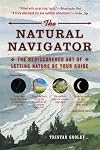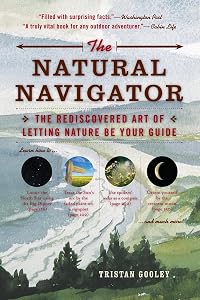
The Natural Navigator: The Rediscovered Art of Letting Nature Be Your Guide
by Tristan Gooley
On This Page
Description
Offers a guide to the age-old tradition of navigation on both land and sea through the observation of the Sun, Moon, and stars, weather patterns, landscape, growth of plants, and habitats of wildlife.Tags
Recommendations





















Member Reviews
Fantastic guide to learning how to use natural cues to orient yourself and hold a course, but goes beyond this to help anyone enjoy the outdoors even if you don't need to use the skills for navigation.
The author doesn't just give a list of rule-of-thumb pointers in nature, but starts the discussion by talking about the major factors that shape the natural world. Light from the sun, wind, water, and how the Earth rotates and orbits around the sun are the reasons behind the rules-of-thumb found in so many other navigation books. Each section of the book provides a basic foundation of knowledge about how these things affect the world around us, and then gives practical examples of how to use them for natural navigation. Because of this show more approach, the book goes beyond a navigation guide and becomes a tool to help you understand what you see around you.
If you understand how the plants and land react to sun and wind, then you can begin to make your own inferences about direction and the natural history of a location even if you can't remember exactly what side of a tree some book said moss is supposed to grow on -- which, by the way, is no side of any tree where I live. Tips about north or south easily become useless when you don't understand the reason why they work. I don't need to spend my time looking for moss that isn't there when I could just be looking for growth patterns in everything that is there. That is what this book tries to teach you to do.
The most interesting and unique part of this book, I think, is the section on the moon. I learned things about using the moon to infer direction that I had not read anywhere else. After learning why and how it can be used, I wondered why the reason wasn't just obvious to everyone and in all the books.
This is a great book even if you don't care about navigation and just want to appreciate what you see in the world around you. show less
The author doesn't just give a list of rule-of-thumb pointers in nature, but starts the discussion by talking about the major factors that shape the natural world. Light from the sun, wind, water, and how the Earth rotates and orbits around the sun are the reasons behind the rules-of-thumb found in so many other navigation books. Each section of the book provides a basic foundation of knowledge about how these things affect the world around us, and then gives practical examples of how to use them for natural navigation. Because of this show more approach, the book goes beyond a navigation guide and becomes a tool to help you understand what you see around you.
If you understand how the plants and land react to sun and wind, then you can begin to make your own inferences about direction and the natural history of a location even if you can't remember exactly what side of a tree some book said moss is supposed to grow on -- which, by the way, is no side of any tree where I live. Tips about north or south easily become useless when you don't understand the reason why they work. I don't need to spend my time looking for moss that isn't there when I could just be looking for growth patterns in everything that is there. That is what this book tries to teach you to do.
The most interesting and unique part of this book, I think, is the section on the moon. I learned things about using the moon to infer direction that I had not read anywhere else. After learning why and how it can be used, I wondered why the reason wasn't just obvious to everyone and in all the books.
This is a great book even if you don't care about navigation and just want to appreciate what you see in the world around you. show less
To start, what I enjoyed about this book were the unexpected historical and cultural insights that filled each chapter. The quotes and anthropological gems made it a worthwhile read.
However, the book fails to deliver what I expected: applicable tactics for finding one's way using information in the environment instead of navigational instruments. I was hoping to make hikes more enjoyable through increased awareness and tactics to practice. In the end, there are some very loose recommendations that I would not trust myself to use correctly.
The science lessons in this text appear too often, are very simplistic, and gloss over many details. I wonder who they are for. The subject matter in these lessons are straight from grade school and show more shouldn't have to be spelled out. They distract from what should be the main focus: navigation.
I would not recommend reading this book if you want hard skills. If you want to be entertained, then I won't stop you. show less
However, the book fails to deliver what I expected: applicable tactics for finding one's way using information in the environment instead of navigational instruments. I was hoping to make hikes more enjoyable through increased awareness and tactics to practice. In the end, there are some very loose recommendations that I would not trust myself to use correctly.
The science lessons in this text appear too often, are very simplistic, and gloss over many details. I wonder who they are for. The subject matter in these lessons are straight from grade school and show more shouldn't have to be spelled out. They distract from what should be the main focus: navigation.
I would not recommend reading this book if you want hard skills. If you want to be entertained, then I won't stop you. show less
A little fluffy and self-congratulatory in the vein of [b:Shop Class as Soulcraft|6261332|Shop Class as Soulcraft An Inquiry Into the Value of Work|Matthew B. Crawford|https://d.gr-assets.com/books/1442839731s/6261332.jpg|6444549] and [b:Zen and the Art of Motorcycle Maintenance:|629|Zen and the Art of Motorcycle Maintenance An Inquiry Into Values|Robert M. Pirsig|https://d.gr-assets.com/books/1410136019s/629.jpg|175720]--I believe the author quotes both of these other authors at some point. When Gooley gets down to focusing on the subject of how to locate yourself in nature, though, the book is fascinating. I personally would have preferred more of this type of straightforward information, for example, what you can learn from the shape show more of sand dunes, and less of the too-long side trips Gooley makes to tell stories about how people used to get around. Gooley seems more than a bit influenced by Rousseau's 18th century thinking about the Natural Man, and not in a good way. Still he has perked my interest and given me new thoughts. show less
This is possibly the most useful book I've ever come across on the topic of navigation. I have no sense of direction. None. I've read several books which discuss how people make mental maps in their head to orient themselves and I never have any idea what they are talking about. This book has me knowing how to look at a tree and know what direction I'm heading. Awesome.
I'd hoped this book would teach me a little about navigating without maps or GPS and provide another way to get in touch with nature better. I generally have a good sense of direction and tend not to get lost easily, but was looking for a way to understand the natural signs around me better so I could use those tools when I am lost and need to find my way. I also expected a somewhat interesting read, based on the TV spot on the Today Show. Now, I'm not sure why I spent the time reading the whole thing. Inspite of the endorsements, this book is NOT in-depth, it does NOT provide much in the way of useful tools, and even the the personal anecdotes did little to engage me. I felt like I was in a calculus class, with key formula missing! show more Okay, I get that the art of navigation relies heavily on mathematics. Give me the full instructions to use it at least! I found infinitely more useful information on just a few pages of National Geographics Survival Guide that was much better organized and much clearer! I found this book to be stuffed with hot air, little true substance, and mostly dull! This had the potential to be very fascinating, informative, & useful but instead continued to fall short time after time. show less
Ratings
Members
- Recently Added By
Lists

Books Read in 2024
4,727 works; 125 members
Author Information

25 Works 4,143 Members
Tristan Gooley, New York Times-bestselling author of How to Read Water and The Lost Art of Reading Nature's Signs, has led expeditions on five continents, climbed mountains in three, and is the only living person to have both Mown and sailed solo across the Atlantic. His more than two decades of pioneering outdoor experience include research among show more tribal peoples in some of the remotest regions on Earth. show less
Common Knowledge
- Canonical title
- The Natural Navigator: The Rediscovered Art of Letting Nature Be Your Guide
- Alternate titles
- The Natural Navigator: A Watchful Explorer's Guide to a Nearly Forgotten Skill
- Dedication
- For Sophie, Benedict, and Vincent
- First words
- The most common method for finding direction on land relies on the traveler's familiarity with the landscape itself.
- Last words
- (Click to show. Warning: May contain spoilers.)"Head south until the butter melts," she said, "and then turn right."
- Blurbers
- Palin, Michael; Grylls, Bear; Fiennes, Sir Ranulph
Classifications
- Genres
- Science & Nature, Nonfiction, Sports and Leisure, General Nonfiction
- DDC/MDS
- 796.58 — Arts & recreation Recreation, sports, and performing arts Athletic and outdoor sports and games Outdoor leisure Orienteering and geocaching
- LCC
- VK555 — Naval Science Navigation. Merchant marine Navigation. Merchant marine Science of navigation
- BISAC
Statistics
- Members
- 464
- Popularity
- 65,969
- Reviews
- 5
- Rating
- (3.79)
- Languages
- 5 — Czech, English, German, Italian, Spanish
- Media
- Paper, Audiobook, Ebook
- ISBNs
- 22
- UPCs
- 1
- ASINs
- 8