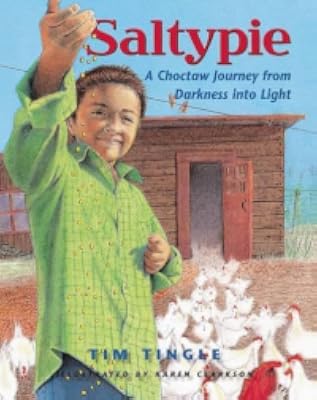
Saltypie: A Choctaw Journey from Darkness into Light
by Tim Tingle
On This Page
Description
Bee stings on the backside! That was just the beginning. Tim was about to enter a world of the past, with bullying boys, stones and Indian spirits of long ago. But they were real spirits, real stones, very real memories...In this powerful family saga, author Tim Tingle tells the story of his family's move from Oklahoma Choctaw country to Pasadena, TX. Spanning 50 years, Saltypie describes the problems encountered by his Choctaw grandmother—from her orphan days at an Indian boarding school show more to hardships encountered in her new home on the Gulf Coast.
Tingle says, “Stories of modern Indian families rarely grace the printed page. Long before I began writing, I knew this story must be told." Seen through the innocent eyes of a young boy, Saltypie — a 2011 Skipping Stones honor book, WordCraft Circle 2012 Children's Literature Award-winner, and winner of the 2011 Paterson Prize for Books for Young People in the category of Grades 4-6 — is the story of one family's efforts to honor the past while struggling to gain a foothold in modern America.
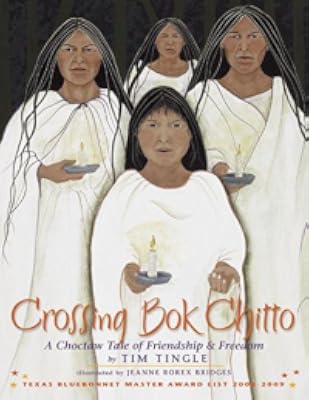
Tim Tingle, a member of the Choctaw Nation of Oklahoma, is a sought-after storyteller for folklore festivals, library conferences, and schools across America. At the request of Choctaw Chief Pyle, Tim tells a story to the tribe every year before Pyle's State of the Nation Address at the Choctaw Labor Day Gathering. Tim's previous and often reprinted books from Cinco Puntos Press—Walking the Choctaw Road and Crossing Bok Chitto—received numerous awards, but what makes Tim the proudest is the recognition he receives from the American Indian communities.
Karen Clarkson, a Choctaw tribal member, is a self-taught artist who specializes in portraits of Native Americans. She did not start painting until after her children had left home; she has since been widely acclaimed as a Native American painter. She lives in San Leandro, California.
. show less
Tags
Recommendations




Member Reviews
Tim Tingle - a Choctaw storyteller and children's author, whose Crossing Bok Chitto won an American Indian Youth Literature Award - tells the story of Mawmaw, his grandmother, in this moving autobiographical picture-book. With her sweet smile, and her "quiet funny laugh, like there was so much more to laugh at than you would ever know," gentle Mawmaw was the heart of young Tim's family: the one to whom he would run, when stung by a bee, the one who really knew how to listen. He grew up hearing the stories of his family's move from Choctaw country to Texas: of the rock thrown at Mawmaw, when she was a young woman, because she was an Indian; and of the invention of the word "Saltypie" by his own father, in response to the rock-throwing show more incident, and the injury it caused - a word that would come, in the Tingle family, to stand for the hardships of life. It wasn't until he was six, that young Tim even realized that Mawmaw was blind...
Like his grandmother, Tim Tingle has a gentle and deeply affecting style, making Saltypie: A Choctaw Journey from Darkness into Light one of those books that really creeps up on you, emotionally speaking. One minute you're reading a fairly simple picture-book about a modern Choctaw family's experiences, and then suddenly you're starting to tear up, as all the Tingles rush to the hospital, when Mawmaw must have an operation, or to really think about how we communicate with one another, and how we confront the wrongs done in the past, when reading Tingle's afterword. The accompanying illustrations by Karen Clarkson, also a member of the Choctaw nation, really capture the various people in the story - particularly Mawmaw, both young and old.
As the narrator says at one point: "At Mawmaw's, it always seemed that if you waited quietly, you could know things that ought to be known, hidden in the sounds." And that's what this book is like: it tells you things you ought to know - about racism, about family, about healing - in a quiet, compassionate way that is all the more effective, for its lack of sensationalism. Well done, Tim Tingle and Karen Clarkson! show less
Like his grandmother, Tim Tingle has a gentle and deeply affecting style, making Saltypie: A Choctaw Journey from Darkness into Light one of those books that really creeps up on you, emotionally speaking. One minute you're reading a fairly simple picture-book about a modern Choctaw family's experiences, and then suddenly you're starting to tear up, as all the Tingles rush to the hospital, when Mawmaw must have an operation, or to really think about how we communicate with one another, and how we confront the wrongs done in the past, when reading Tingle's afterword. The accompanying illustrations by Karen Clarkson, also a member of the Choctaw nation, really capture the various people in the story - particularly Mawmaw, both young and old.
As the narrator says at one point: "At Mawmaw's, it always seemed that if you waited quietly, you could know things that ought to be known, hidden in the sounds." And that's what this book is like: it tells you things you ought to know - about racism, about family, about healing - in a quiet, compassionate way that is all the more effective, for its lack of sensationalism. Well done, Tim Tingle and Karen Clarkson! show less
Starting with his childhood memories of his grandmother comforting him after being stung by a bee, Tingle then goes on to tell of her move to Pasadena, Texas from Oklahoma in 1915, and how, once there, as a young mother, she was hit in the eye by a rock thrown at her because she was an American Indian. How their Choctaw family dealt with that unprovoked hate crime and life’s other trial and disappointments carries forward to 1970 when an eye transplant enabled her to regain her sight.
Clarkson’s soft lines and dramatic use of background color highlights the shifting mood of Tingle’s family story that spans decades and generations. In addition, an afterword by him, illustrated with family photos, talks about the perceptions and show more misperceptions that many Americans have about the original inhabitants of the land. This book is a powerful addition to his original oral story. show less
Clarkson’s soft lines and dramatic use of background color highlights the shifting mood of Tingle’s family story that spans decades and generations. In addition, an afterword by him, illustrated with family photos, talks about the perceptions and show more misperceptions that many Americans have about the original inhabitants of the land. This book is a powerful addition to his original oral story. show less
"Agrandmother’s life story centers this welcome depiction of a contemporary Choctaw family. A young boy’s bee sting is soothed when the grandmother calls his hurt “saltypie.” A flashback reveals the origin of the expression: A stone malevolently thrown at a young mother injures her, and her son, thinking the blood is like pie filling, tastes it and pronounces it “saltypie.” When the bee-stung boy discovers his grandmother’s blindness, possibly resulting from the blow, an uncle explains, “You just kind of shrug it off, say saltypie. It helps you carry on.” Years later, the extended family gathers in a Houston hospital, sharing its collective past while the grandmother undergoes eye surgery: “No more saltypie …Mawmaw show more can see.” The grown boy realizes that his grandmother, “Blind as she was…taught so many how to see.” The term “eye transplant,” the cause of the blindness and the sequencing of events could be clearer. Nevertheless, Tingle provides a corrective view of contemporary Native American life, as his author’s note reveals was his intent. Clarkson’s evocative illustrations bathe each scene in a soft light that accentuates the warmth of the family’s love. (author’s note) (Picture book/biography. 5-10)" www.kirkusreviews.com show less
Saltypie is a family story, focused on the author's grandmother. The book takes place from the 1910s to the 1970s, so it is a good representation of modern Native Americans. The story was somewhat disjointed, with no discernible plot. The text was unimaginative but straightforward, and would be easy for young students to follow. The major benefit of reading this book to students would be a discussion on Native American life today, and also how they faced overt racism in the early 20th century. Overall, I think there are probably better books out there that would address the same issues.
Beautifully illustrated, autobiographical children’s book has many important messages – respect for elders, understanding your heritage, aging with grace and dignity, overcoming life’s obstacles – but the story bounced from present to past to present and there were no smooth transitions. Ages 5-8.
I knew, when requesting this, that it's an important story. And that it would be powerful, and intense. I did not realize how beautiful it would be. And I did not realize how much I would learn from the author's note in the back. Thank you, Mr. Tingle and Ms Clarkson, for creating this book for all of us and for all of our children.
Saltypie is a nice story about family and some of the things that it means to be Native American, but the real lesson comes from the author’s note at the end, in which he explains all the wonderful things that Native Americans are, as opposed to their stereotypes, and relates his observations well to his story.
Members
- Recently Added By
Lists

Top 100 books by Indigenous Masters
134 works; 7 members

Indigenous America Reader
145 works; 12 members

GraceCollection TBR NDN OV
9 works; 1 member
Author Information

30+ Works 2,586 Members
All Editions
Awards and Honors
Awards
Distinctions
Classifications
Statistics
- Members
- 116
- Popularity
- 280,832
- Reviews
- 13
- Rating
- (3.79)
- Languages
- English
- Media
- Paper, Ebook
- ISBNs
- 5