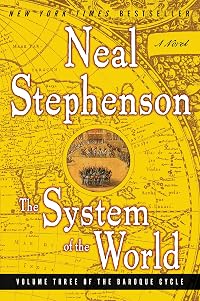
The System of the World
by Neal Stephenson
The Baroque Cycle (Collections and Selections — Vol. III, Books 6-8)
On This Page
Description
Tis done. The world is a most confused and unsteady place -- especially London, center of finance, innovation, and conspiracy -- in the year 1714, when Daniel Waterhouse makes his less-than-triumphant return to England's shores. Aging Puritan and Natural Philosopher, confidant of the high and mighty and contemporary of the most brilliant minds of the age, he has braved the merciless sea and an assault by the infamous pirate Blackbeard to help mend the rift between two adversarial geniuses at show more a princess's behest. But while much has changed outwardly, the duplicity and danger that once drove Daniel to the American Colonies is still coin of the British realm. No sooner has Daniel set foot on his homeland when he is embroiled in a dark conflict that has been raging in the shadows for decades. It is a secret war between the brilliant, enigmatic Master of the Mint and closet alchemist Isaac Newton and his arch nemesis, the insidious counterfeiter Jack the Coiner, a.k.a. Jack Shaftoe, King of the Vagabonds. Hostilities are suddenly moving to a new and more volatile level, as Half-Cocked Jack plots a daring assault on the Tower itself, aiming for nothing less than the total corruption of Britain's newborn monetary system. Unbeknownst to all, it is love that set the Coiner on his traitorous course; the desperate need to protect the woman of his heart -- the remarkable Eliza, Duchess of Arcachon-Qwghlm -- from those who would destroy her should he fail. Meanwhile, Daniel Waterhouse and his Club of unlikely cronies comb city and country for clues to the identity of the blackguard who is attempting to blow up Natural Philosophers with Infernal Devices -- as political factions jockey for position while awaiting the impending death of the ailing queen; as the "holy grail" of alchemy, the key to life eternal, tantalizes and continues to elude Isaac Newton, yet is closer than he ever imagined; as the greatest technological innovation in history slowly takes shape in Waterhouse's manufactory. Everything that was will be changed forever ...The System of the World is the concluding volume in Neal Stephenson's Baroque Cycle, begun with Quicksilver and continued in The Confusion. show lessTags
Recommendations






















Member Reviews
The conclusion of Stephenson's delightful Baroque Cycle brings the world-spanning adventure of its second volume back to a focus on London at the time of the Hanoverian Succession. If the first volume focused on the rise of the scientific method, and the latter on commerce, the third touches on numismatics and the first flowering of the Industrial Revolution. It's also the most political of the three, with action centering around England's parliamentary democracy as opposed to the revolutions and absolutist monarchies of previous volumes.
Stephenson keeps up his wry wit and dense historical allusions, mixing in real and fictional characters, while adding in a valedictory tone as the series draws to a close. Compared to my favorite show more volume, "Quicksilver," it has some pacing issues, with false climaxes littering the book's final third. But those are minor quibbles in a highly enjoyable series for people who enjoy both history and nerdy flourishes. show less
Stephenson keeps up his wry wit and dense historical allusions, mixing in real and fictional characters, while adding in a valedictory tone as the series draws to a close. Compared to my favorite show more volume, "Quicksilver," it has some pacing issues, with false climaxes littering the book's final third. But those are minor quibbles in a highly enjoyable series for people who enjoy both history and nerdy flourishes. show less
This book and the trilogy of which it is the conclusion, these don't really develop rich characters. The number of characters is reasonably small so we hear and see their actions again and again. But it's one of these Rube Goldberg contraptions. The whole plot is wildly, impossibly complex and interwoven. The characters are mostly just the steel balls that run the channels and trip the levers.
But the point of the book is not really the plot. All the channels and levers are a kind of demonstration, of the system of the world. Not so much the physics of Newton, but the structure and dynamics of modern society. Money is the main character here and what is most richly developed. And indeed money is the essence of the modern world.
Beneath show more that there is this intriguing metaphysical puzzle: the two labyrinths, the nature of the continuum and the puzzle of determinism and free will. Are these two actually facets of the same conundrum? Stephenson's notion seems to be that society is patched together with some rough approximation of a solution to the conundrum, which works for a while and then finally the flaws overwhelm the system and some new approach needs to be worked out.
I have to wonder if the point of the book is really to help us confront the situation we are facing now. Newton, Leibniz, Spinoza et al. put together the modern world that has survived some 350 years roughly. At this point the thing seems to be crumbling. We don't need a new solution that is any more perfect than the modern solution. We just need a new system that can see us through the next few centuries, that can provide enough structure for society that people can lead fulfilling lives and and prepare for the next revolution in how our world is put together. show less
But the point of the book is not really the plot. All the channels and levers are a kind of demonstration, of the system of the world. Not so much the physics of Newton, but the structure and dynamics of modern society. Money is the main character here and what is most richly developed. And indeed money is the essence of the modern world.
Beneath show more that there is this intriguing metaphysical puzzle: the two labyrinths, the nature of the continuum and the puzzle of determinism and free will. Are these two actually facets of the same conundrum? Stephenson's notion seems to be that society is patched together with some rough approximation of a solution to the conundrum, which works for a while and then finally the flaws overwhelm the system and some new approach needs to be worked out.
I have to wonder if the point of the book is really to help us confront the situation we are facing now. Newton, Leibniz, Spinoza et al. put together the modern world that has survived some 350 years roughly. At this point the thing seems to be crumbling. We don't need a new solution that is any more perfect than the modern solution. We just need a new system that can see us through the next few centuries, that can provide enough structure for society that people can lead fulfilling lives and and prepare for the next revolution in how our world is put together. show less
I had two thoughts upon finishing this:
1. Phew!
2. I should read them again.
This third volume completes Neal Stephenson's three volume, eight book, million+ word Baroque Cycle (alongside Quicksilver and The Confusion). The length and intricate detail of this epic makes the conclusion that much sweeter. Plot threads left dangling hundreds of thousands of words earlier suddenly return with one-armed vengeance!
This cycle can be appreciated on so many levels. The plot is gripping—especially in this third volume. The prose sucks you into the world of eighteenth century Europe. The philosophical debates are engaging. The characters feel as real as your neighbours.
The part that impressed me the most was a detailed theological debate between show more two characters in the eighth book. When the characters started to argue I began to worry. Theology is my discipline and I expected to find errors and omissions in Stephenson's work. To my surprise, the author handled the minutiae of eighteenth century theology with great insight! This increased my confidence in the rest of his historical research.
The Baroque Cycle is historical fiction like no other. It is gripping literature at its finest. If you haven't yet read it, I envy you. You're in for a wild ride. show less
1. Phew!
2. I should read them again.
This third volume completes Neal Stephenson's three volume, eight book, million+ word Baroque Cycle (alongside Quicksilver and The Confusion). The length and intricate detail of this epic makes the conclusion that much sweeter. Plot threads left dangling hundreds of thousands of words earlier suddenly return with one-armed vengeance!
This cycle can be appreciated on so many levels. The plot is gripping—especially in this third volume. The prose sucks you into the world of eighteenth century Europe. The philosophical debates are engaging. The characters feel as real as your neighbours.
The part that impressed me the most was a detailed theological debate between show more two characters in the eighth book. When the characters started to argue I began to worry. Theology is my discipline and I expected to find errors and omissions in Stephenson's work. To my surprise, the author handled the minutiae of eighteenth century theology with great insight! This increased my confidence in the rest of his historical research.
The Baroque Cycle is historical fiction like no other. It is gripping literature at its finest. If you haven't yet read it, I envy you. You're in for a wild ride. show less
My favourite way of describing Neal Stephenson as an author is that his ambition vastly outstrips his talent; and the Baroque Cycle is a good point in case, I think. It is fairly obvious what he wanted to do here (mainly because Pynchon already did it before him) and it is even more blatantly obvious that this is not the chef-d’oeuvre describing the emergence of an age and short-circuiting that age with our present time that Stephenson wants it to be.
The first novel, Quicksilver had three protagonists, the second, The Confusion, had two of those, Jack and Eliza, with Daniel being mostly relegated to the background; so it is probably no great surprise that in The System of the World we see Daniel take center stage again, with Jack and show more Eliza moved to the wings. Also, this third novel takes almost exclusively part in England (and most of that in London – as world-roaming as The Confusion was, so confined is The System of the World), and generally this is by far the most focused novel of the Baroque Cycle, one could almost call it tightly constructed. But only almost, as this probably would just not be Stephenson if he would not go on long tangents at every occasion that offers itself, culminating towards the end of the novel in a moment-by-moment description of the “Trial of the Pyx” (basically, a test of the validity of British coinage) that rambles on and on and on over hundreds of pages (felt pages – actually it’s more like several dozen, but still absurdly long).
There also is some mumbling about the threatening chaos of quicksilver being contained into a solid system of the world – a weak and totally unconvincing bit of legerdemain to make readers believe there is some kind of Deeper Meaning at work in the Baroque Cycle rather than a random agglomeration of pointless facts by which of course nobody is taken in. The thing is that you just might get away with piling up heaps of facts and pieces of information in a non-fiction work, but if you want your text to work as a novel, you need to somehow connect that facts in a way that infuses them with significance – take a look at Moby Dick if you want to see how it’s done properly, or Gravity’s Rainbow (or really anything by Thomas Pynchon who is the supreme master of turning facts into metaphor). Neal Stephenson, on the other hand, just keeps shovelling facts, facts and even more facts into his novels in the hope that they’ll magically cohere into something meaningful – which of course they don’t. At best, the facts are curious in interesting in themselves, at worst they’re just a heap of boring pedantry that – except for the, in this case really minor, difference of their being historical rather than made up – could have comfortably fitted in any of Robert Jordan’s Wheel of Time novels and that only distracts from what remains at heart a rip-roaring adventure story.
Thankfully, that heart beats strong enough in The System of the World to make itself felt through all the intellectual waste Stephenson piles on it, and its rhythm is compelling enough to keep the reader turning the pages even when they are filled with tedious descriptions of irrelevant detail. This third novel of the Baroque Cycle is to my taste at least the most entertaining, with two major struggles driving the plot forward – the rupture between Isaac Newton and Gottfried von Leibniz about the authorship of the calculus which Daniel tries to mediate on one hand, and the struggle between Master of the Mint Newton and master forger Jack Shaftoe in wich Daniel also is involved. It is mainly the second one (no surprise, as Jack plays a central part) which keeps things going and the reader interested as Daniel first hunts down the forger with a group of unlikely investigators (most of which turn out to have – at least! – a double agenda) and then once again becomes a mediator trying to unite the opposing factions in a common purpose. We get a big heist (targeting the tower), a duel (with cannons), a wild chase (with coaches) and quite a few colourful and exciting things more.
Summing up (or well, repeating my sermon for the umpteenth time), The Baroque Cycle could have been such a wonderful book if it wasn’t for Neal Stephenson’s delusions of grandeur. Someone really should rescue the fun adventure novel hidden in the trilogy by pulling an S. Morgenstern on Stephenson and make an abridgement with just the good parts. show less
The first novel, Quicksilver had three protagonists, the second, The Confusion, had two of those, Jack and Eliza, with Daniel being mostly relegated to the background; so it is probably no great surprise that in The System of the World we see Daniel take center stage again, with Jack and show more Eliza moved to the wings. Also, this third novel takes almost exclusively part in England (and most of that in London – as world-roaming as The Confusion was, so confined is The System of the World), and generally this is by far the most focused novel of the Baroque Cycle, one could almost call it tightly constructed. But only almost, as this probably would just not be Stephenson if he would not go on long tangents at every occasion that offers itself, culminating towards the end of the novel in a moment-by-moment description of the “Trial of the Pyx” (basically, a test of the validity of British coinage) that rambles on and on and on over hundreds of pages (felt pages – actually it’s more like several dozen, but still absurdly long).
There also is some mumbling about the threatening chaos of quicksilver being contained into a solid system of the world – a weak and totally unconvincing bit of legerdemain to make readers believe there is some kind of Deeper Meaning at work in the Baroque Cycle rather than a random agglomeration of pointless facts by which of course nobody is taken in. The thing is that you just might get away with piling up heaps of facts and pieces of information in a non-fiction work, but if you want your text to work as a novel, you need to somehow connect that facts in a way that infuses them with significance – take a look at Moby Dick if you want to see how it’s done properly, or Gravity’s Rainbow (or really anything by Thomas Pynchon who is the supreme master of turning facts into metaphor). Neal Stephenson, on the other hand, just keeps shovelling facts, facts and even more facts into his novels in the hope that they’ll magically cohere into something meaningful – which of course they don’t. At best, the facts are curious in interesting in themselves, at worst they’re just a heap of boring pedantry that – except for the, in this case really minor, difference of their being historical rather than made up – could have comfortably fitted in any of Robert Jordan’s Wheel of Time novels and that only distracts from what remains at heart a rip-roaring adventure story.
Thankfully, that heart beats strong enough in The System of the World to make itself felt through all the intellectual waste Stephenson piles on it, and its rhythm is compelling enough to keep the reader turning the pages even when they are filled with tedious descriptions of irrelevant detail. This third novel of the Baroque Cycle is to my taste at least the most entertaining, with two major struggles driving the plot forward – the rupture between Isaac Newton and Gottfried von Leibniz about the authorship of the calculus which Daniel tries to mediate on one hand, and the struggle between Master of the Mint Newton and master forger Jack Shaftoe in wich Daniel also is involved. It is mainly the second one (no surprise, as Jack plays a central part) which keeps things going and the reader interested as Daniel first hunts down the forger with a group of unlikely investigators (most of which turn out to have – at least! – a double agenda) and then once again becomes a mediator trying to unite the opposing factions in a common purpose. We get a big heist (targeting the tower), a duel (with cannons), a wild chase (with coaches) and quite a few colourful and exciting things more.
Summing up (or well, repeating my sermon for the umpteenth time), The Baroque Cycle could have been such a wonderful book if it wasn’t for Neal Stephenson’s delusions of grandeur. Someone really should rescue the fun adventure novel hidden in the trilogy by pulling an S. Morgenstern on Stephenson and make an abridgement with just the good parts. show less
After a considerable expenditure of ink and paper, Daniel Waterhouse has finally made it back to England and we have been informed of at lest some of the entanglements that await him there. Jack The Coiner's war with Isaac Newton, Isaac Newton's feud with Gottfried Liebniz, the Whigs at war with the Tories, the Jacobites versus the Hanoverians and so on and so forth. No sooner has he arrived in London than an infernal device explodes quite near him, so at least part of his energy is spent investigating that, while also doing some odds and ends for the Tsar Of All The Russias and sorting out the disposition of the pesky and mysterious Solomonic Gold and the work of Massacustes Bay Institiute For The Technological Sciences or whatever it show more was called again. There is also the matter of a heist, a gaol-break, an elaborate con and possibly bringing the dead back to life. There's also an unusual duel (a faourite bit of the whole trilogy) and a truly epic and climactic hanging day procession. Say what you will about the size of theses books, you get many the bang for the buck.
Ursual Le Guin once said that instead of seeing books as straight arrows that travelled from a beginning through a middle to strike at an end, she preferred books as great big baskets that hold many different things all at once an together. Truly it can be said, that this trilogy is a lovely set of baskets full of fascinating, strange, hilariously funny and often bizarre and horrible things. They all jiggle together quite nicely, rolling around and over each other or sitting snug in a corner or poking jaggedly out but all together forming a genuinely interesting and unitary set of people and things. show less
Ursual Le Guin once said that instead of seeing books as straight arrows that travelled from a beginning through a middle to strike at an end, she preferred books as great big baskets that hold many different things all at once an together. Truly it can be said, that this trilogy is a lovely set of baskets full of fascinating, strange, hilariously funny and often bizarre and horrible things. They all jiggle together quite nicely, rolling around and over each other or sitting snug in a corner or poking jaggedly out but all together forming a genuinely interesting and unitary set of people and things. show less
First of all, wow! Feels good to have finally put a cap on these books after years of them glaring at me from book-baskets and shelves.
We're back to the three-books-in-one structure of Quicksilver, although the point of view hops around all over the place. The first and the last are incredibly enjoyable -- Solomon's Gold relates Daniel Waterhouse's return to Europe and conscription into Isaac Newton's efforts to capture Jack Shaftoe, now a criminal mastermind destroying the new currency that has been built up in the past two books. It's half political thriller, half Ocean's 11 (as Jack's storyline focuses on a spectacular break-in at the Tower of London). The final portion of the book (before a hefty set of epilogues), with the same show more title as the novel as a whole, splits its time between Jack's date with destiny at the hands of Jack Ketch, and Isaac and Daniel's date with destiny as the new King of England assesses the coins Newton has been churning out.
The middle bit, Currency, sort of defies description, but not in a good way -- there are some amusing parts as Daniel tries, again, to capture Shaftoe, and a spectacular showdown between Shaftoe and the villainous Father de Gex (who I was certain was a real person -- nice job, Stephenson), but ultimately it feels like Stephenson shunting around the major players like pieces on a board to line them up for the grand finale.
So, the question naturally arises: did Stephenson pull this off -- a three book, probably three-thousand-page trek through the dawn of modern science, economics, etc.? I'd say the answer is "pretty much" -- there are some big dropped threads along the way (namely Eliza, and her efforts to abolish slavery in England -- they feel like they were cut from this book, as Stephenson gets really close to going somewhere but then fails to deliver), but The Baroque Cycle is quite the ride and may (wonder of wonders) end up matching my all-time favorite Cryptonomicon for laughs, thrills, and deep dives into things never really thought about by most. Definitely recommended. Pack a lunch. show less
We're back to the three-books-in-one structure of Quicksilver, although the point of view hops around all over the place. The first and the last are incredibly enjoyable -- Solomon's Gold relates Daniel Waterhouse's return to Europe and conscription into Isaac Newton's efforts to capture Jack Shaftoe, now a criminal mastermind destroying the new currency that has been built up in the past two books. It's half political thriller, half Ocean's 11 (as Jack's storyline focuses on a spectacular break-in at the Tower of London). The final portion of the book (before a hefty set of epilogues), with the same show more title as the novel as a whole, splits its time between Jack's date with destiny at the hands of Jack Ketch, and Isaac and Daniel's date with destiny as the new King of England assesses the coins Newton has been churning out.
The middle bit, Currency, sort of defies description, but not in a good way -- there are some amusing parts as Daniel tries, again, to capture Shaftoe, and a spectacular showdown between Shaftoe and the villainous Father de Gex (who I was certain was a real person -- nice job, Stephenson), but ultimately it feels like Stephenson shunting around the major players like pieces on a board to line them up for the grand finale.
So, the question naturally arises: did Stephenson pull this off -- a three book, probably three-thousand-page trek through the dawn of modern science, economics, etc.? I'd say the answer is "pretty much" -- there are some big dropped threads along the way (namely Eliza, and her efforts to abolish slavery in England -- they feel like they were cut from this book, as Stephenson gets really close to going somewhere but then fails to deliver), but The Baroque Cycle is quite the ride and may (wonder of wonders) end up matching my all-time favorite Cryptonomicon for laughs, thrills, and deep dives into things never really thought about by most. Definitely recommended. Pack a lunch. show less
Early on in The System of the World, Daniel Waterhouse laments that his panoramic life has had “[t]oo many threads, and too much information for his stiff old brain to cope with.âÂ? One suspects this is also Neal StephensonâÂÂs sly jab at the reader, who has an equally confounding task at hand.
One year, two volumes, and some three thousand pages later (reportedly all written in longhand), the American author wraps up The Baroque Cycle, his epic opus to the complete overhaul of modern thinking.
True to form, he completes it in all its dumbfounding, anachronistic, mercurial glory. It is a Lord of the Rings for history buffs, complete with towers, battles, and a mysterious ring.
Following directly after Quicksilver and The show more Confusion, The System of the World plunges headlong into 1714 England. The country is in disarray; âÂÂParliament had its knobby fingers around the MonarchâÂÂs throat . . . Whigs and Tories were joined in an eternal shin-kicking contest to determine which faction should have the honor of throttling her Majesty, and how hard.âÂ?
Similarly, StephensonâÂÂs characters are tangled in a monkeyâÂÂs fist of plotlines. Scientific auteur Isaac Newton obsesses over Solomonic Gold, purported to have properties essential to Alchemy. Eliza, Duchess of Arcachon-Qwghlm, schemes to ensure Princess Caroline attains the Throne of England.
Daniel Waterhouse, aging Natural Philosopher, is constantly at risk of premature death by Infernal Devices, as hidden time bombs go off around him with surprising regularity.
Finally, thereâÂÂs the picaresque Jack Shaftoe, a man âÂÂso surpassingly and transcendently bad that it was necessary for him to be put to death by the most gruesome and, hence, entertaining means that the English mind could conceive of.âÂ? Now a counterfeiter, Jack plans an attack that could cripple EnglandâÂÂs monetary structure while still in its infancy.
StephensonâÂÂs world, while baffling, is never dull, and rarely less than fascinating. As Western society evolves from its established doctrine of Monarchy to the understanding that money makes the world go round, Stephenson marshals his talents, summarizing a period where, like today, logic goes head-to-head with ritual and fear, and the winner is always in doubt.
As usual, there is never a theme Stephenson doesnâÂÂt pursue. The System of the World is chock full of philosophical discourse, scientific reasoning, and mad chases through LondonâÂÂs seamy underbelly.
Stephenson, a genius at plotting, performs some sort of literary miracle by keeping everything organized. It is testament to his mad skills that a discussion as to who first invented calculus, Newton or von Leibniz, is as exciting as JackâÂÂs duel in an opera house, swords clanging and blood spurting as Georg Friedrich Handel frantically attempts to continue his conducting duties.
By its touching finale, it is clear that The Baroque Cycle is in a category all its own, a tribute to anyone who fights ignorance, or pursues insane theories with joyful abandon. It has become that rarest of creatures, a three thousand-word tome that you donâÂÂt want to end. The System of the World, like both its predecessors and Stephenson himself, is complicated, maddening, bizarrely funny, and spectacular. show less
One year, two volumes, and some three thousand pages later (reportedly all written in longhand), the American author wraps up The Baroque Cycle, his epic opus to the complete overhaul of modern thinking.
True to form, he completes it in all its dumbfounding, anachronistic, mercurial glory. It is a Lord of the Rings for history buffs, complete with towers, battles, and a mysterious ring.
Following directly after Quicksilver and The show more Confusion, The System of the World plunges headlong into 1714 England. The country is in disarray; âÂÂParliament had its knobby fingers around the MonarchâÂÂs throat . . . Whigs and Tories were joined in an eternal shin-kicking contest to determine which faction should have the honor of throttling her Majesty, and how hard.âÂ?
Similarly, StephensonâÂÂs characters are tangled in a monkeyâÂÂs fist of plotlines. Scientific auteur Isaac Newton obsesses over Solomonic Gold, purported to have properties essential to Alchemy. Eliza, Duchess of Arcachon-Qwghlm, schemes to ensure Princess Caroline attains the Throne of England.
Daniel Waterhouse, aging Natural Philosopher, is constantly at risk of premature death by Infernal Devices, as hidden time bombs go off around him with surprising regularity.
Finally, thereâÂÂs the picaresque Jack Shaftoe, a man âÂÂso surpassingly and transcendently bad that it was necessary for him to be put to death by the most gruesome and, hence, entertaining means that the English mind could conceive of.âÂ? Now a counterfeiter, Jack plans an attack that could cripple EnglandâÂÂs monetary structure while still in its infancy.
StephensonâÂÂs world, while baffling, is never dull, and rarely less than fascinating. As Western society evolves from its established doctrine of Monarchy to the understanding that money makes the world go round, Stephenson marshals his talents, summarizing a period where, like today, logic goes head-to-head with ritual and fear, and the winner is always in doubt.
As usual, there is never a theme Stephenson doesnâÂÂt pursue. The System of the World is chock full of philosophical discourse, scientific reasoning, and mad chases through LondonâÂÂs seamy underbelly.
Stephenson, a genius at plotting, performs some sort of literary miracle by keeping everything organized. It is testament to his mad skills that a discussion as to who first invented calculus, Newton or von Leibniz, is as exciting as JackâÂÂs duel in an opera house, swords clanging and blood spurting as Georg Friedrich Handel frantically attempts to continue his conducting duties.
By its touching finale, it is clear that The Baroque Cycle is in a category all its own, a tribute to anyone who fights ignorance, or pursues insane theories with joyful abandon. It has become that rarest of creatures, a three thousand-word tome that you donâÂÂt want to end. The System of the World, like both its predecessors and Stephenson himself, is complicated, maddening, bizarrely funny, and spectacular. show less
Members
- Recently Added By
Published Reviews
ThingScore 100
Neal Stephenson spent nearly 2,000 pages setting his convergent plots into motion in The System of the World, and they all collide brilliantly in the third and final installment of his Baroque Cycle.
added by MikeBriggs
"Learned, violent, sarcastic, and profound: a glorious finish to one of the most ambitious epics of recent years."
added by bookfitz
Lists

Best Historical Fiction
620 works; 261 members

Top-Rated Books on LibraryThing
272 works; 117 members

Favorite Long Books
330 works; 42 members

Best 21st Century Books (So Far)
670 works; 86 members
Favourite Books
1,819 works; 316 members

Unread books
1,063 works; 87 members

Favourite Science Fiction Books of the 21st Century
47 works; 8 members

Blue Pyramid 1,276 Best Books of All Time
1,248 works; 32 members

Arthur C. Clarke Award Winners and Shortlisted Books
219 works; 14 members

Stories featuring characters who are mathematicians
42 works; 5 members

What if... a speculative history list
25 works; 2 members

United Kingdom
82 works; 5 members

Books Read in 2022
5,168 works; 114 members
Speculative Fiction to Read
706 works; 32 members

Cryptology - non-fiction and fiction
57 works; 4 members
Author Information

80+ Works 118,733 Members
Neal Stephenson, the science fiction author, was born on October 31, 1959 in Maryland. He graduated from Boston University in 1981 with a B.A. in Geography with a minor in physics. His first novel, The Big U, was published in 1984. It received little attention and stayed out of print until Stephenson allowed it to be reprinted in 2001. His second show more novel was Zodiac: The Eco-Thriller was published in 1988, but it was his novel Snow Crash (1992) that brought him popularity. It fused memetics, computer viruses, and other high-tech themes with Sumerian mythology. Neal Stephenson has won several awards: Hugo for Best Novel for The Diamond Age (1996), the Arthur C. Clarke for Best Novel for Quicksilver (2004), and the Prometheus Award for Best Novel for The System of the World (2005). He recently completed the The Baroque Cycle Trilogy, a series of historical novels. It consists of eight books and was originally published in three volumes and Reamde. His latest novel is entitled The Rise and Fall of D. O. D. O. Stephenson also writes under the pseudonym Stephen Bury. (Bowker Author Biography) show less
All Editions
Some Editions
Awards and Honors
Awards
Distinctions
Notable Lists
Series

Work Relationships
Is contained in
Common Knowledge
- Canonical title
- The System of the World
- Original title
- The System of the World
- Original publication date
- 2004
- People/Characters
- Daniel Waterhouse; Jack Shaftoe; Isaac Newton; Gottfried Wilhelm von Leibniz; Enoch Root; Eliza Countess de la Zeur (show all 24); Louis XIV, 1638-1715; Peter the Great; Roger Comstock, Marquis of Ravenscar; Peter Hoxton; Saturn; Mr. Threader; Mr. Orney; Mr. Kikin; Henry St. John, 1st Viscount Bolingbroke; Anne, Queen of Great Britain; Charles White; Johann von Hacklheber; Caroline of Ansbach, Queen Consort of Great Britain and Ireland (as Princess Caroline); Robert Shaftoe; Dappa; Edouard de Gex; George I, King of Great Britain and Ireland; John Churchill, 1st Duke of Marlborough
- Important places
- London, England, UK; Clerkenwell, London, England, UK; Crane Court; Tower of London, London, England, UK; Leine Schloss, Hanover, Germany; Fleet Prison, London, England, UK
- Important events
- Thirty Years' War
- Epigraph
- But first whom shall we send
In search of this new world, whom shall we find
Sufficient? Who shall tempt with wandring feet
The dark unbottom'd infinite Abyss
And through the palpable obscure find out
His uncou... (show all)th way, or spread his aerie flight
Upborn with indefatigable wings
Over the vast abrupt, ere he arrive
The happy Ile...
— Milton, Paradise Lost
There was the usual amount of corruption, intimidation, and rioting.
— Sir Charles Petrie, describing a Parliamentary election of the era.
It remains that, from the same principles, I now demonstrate the frame of the System of the World.
— Newton, Principia Mathematica - Dedication
- To Mildred
- First words
- "Men half your age and double your weight have been slain on these wastes by Extremity of Cold," said the Earl of Lostwithiel, Lord Warden of the Stannaries, and Rider of the Forest and Chase of Dartmoor, to one of his two fe... (show all)llow-travelers.
- Last words
- (Click to show. Warning: May contain spoilers.)He has done his job. "I'm going home now," he says.
- Original language
- English
- Disambiguation notice
- This is the third volume of the three-volume edition. Please don't combine with the eighth volume of the eight-volume edition with the same title.
Classifications
- Genres
- Fiction and Literature, Science Fiction, Historical Fiction, General Fiction
- DDC/MDS
- 813.54 — Literature & rhetoric American literature in English American fiction in English 1900-1999 1945-1999
- LCC
- PS3569 .T3868 .S97 — Language and Literature American literature American literature Individual authors 1961-
- BISAC
Statistics
- Members
- 6,217
- Popularity
- 2,000
- Reviews
- 75
- Rating
- (4.25)
- Languages
- English, French, German, Polish
- Media
- Paper, Audiobook, Ebook
- ISBNs
- 27
- ASINs
- 10