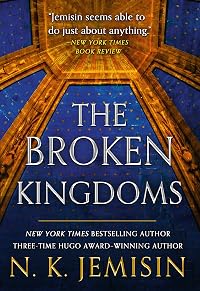
On This Page
Description
A man with no memory of his past and a struggling, blind street artist will face off against the will of the gods as the secrets of this stranger's past are revealed in the sequel to The Hundred Thousand Kingdoms, the debut novel of NYT bestselling author N. K. Jemisin.In the city of Shadow, beneath the World Tree, alleyways shimmer with magic and godlings live hidden among mortalkind. Oree Shoth, a blind artist, takes in a strange homeless man on an impulse. This act of kindness engulfs show more Oree in a nightmarish conspiracy. Someone, somehow, is murdering godlings, leaving their desecrated bodies all over the city. And Oree's guest is at the heart of it. . . show less
Tags
Recommendations







Member Recommendations

Member Reviews
Haroo! This second installment of the Jemisin trilogy had me gripped from start to end. More character development and a more intriguing situation, as the formerly most powerful of the three gods that created this world, is punished by the other two for his cruelties to them by being turned into a mortal (with a difference - he can die a thousand different ways - but he will always come back to life with the dawn). The question now is can he be rehabilitated or will the punishment first promise to save him, but then go on for too long, ruining him again and perpetuating the fight between the three into eternity. In this one, the main character is a blind woman with some unusual abilities who ends up caretaking the now mortal, former show more god. I'll be plunging right into book 3, to the detriment, of course, to my more cerebral fare...... **** show less
Summary: Oree Shoth is blind. Or, rather, she's blind to the mundane, but she can see magic. That wasn't a particularly useful ability in her small hometown, but now that she has moved to Shadow - the city at the base of the Arameri city of Sky, and at the base of the newly-grown World Tree - there is magic everywhere. Shadow is filled with godlings, and Oree can see them, and their workings. Which is a dangerous position to be in, especially when one of the godlings is found murdered in an alley near the market where Oree sells her art. To further complicate matters, Shiny - the silent yet strangely magical man she lives with - becomes involved as well, killing some of the priestly guards who are sent to investigate. Oree never wanted show more to mix in the affairs of the mighty, but now she is caught in a vast struggle, involving powers beyond even her comprehension.
Review: The Broken Kingdoms takes place ten years after The Hundred Thousand Kingdoms, and while it doesn't feature the same (mortal) characters, neither is it exactly a stand-alone. On the one hand, Oree doesn't know much about the events that happened at the end of The Hundred Thousand Kingdoms, and Jemisin summarizes / re-does her worldbuilding well enough so that a new reader wouldn't be missing any crucial information. On the other hand, however, the most interesting part of these books is the relationship between the gods, and the portrayal of the Gods' War in this book is much richer for having already heard about it from an opposing perspective in the first book.
On the third hand, though, having read the first book means that the reader spends the entire book two and a half steps ahead of Oree. Surprisingly, I didn't find this as annoying as I might have predicted; for example, I figured out who Shiny was very, very early on (at least from the first time Sieh shows up, if not before), but the point was not who he was so much as what he would do, and how he interacted with Oree. And that part was fascinating. I'm a big sucker for fiction about religion, and mythology, and what happens when gods interact with mortals, so Jemisin's plots are right up my alley. I kind of love the fundamental question of what happens when you meet your god, only to find out that he's a sullen jerk? Do you still reflexively pray to god when he's sitting at your kitchen table? Where does religion stop and your actual interaction with your god begin? Jemisin hints at these questions without belaboring (or even answering) them, which adds a wonderful layer of depth that you don't always find in the average fantasy novel.
However, while intellectually I really enjoyed this story (which was more streamlined and flowed better than that of The Hundred Thousand Kingdoms, and the story kept me engaged and wanting to listen to more throughout, I never got as emotionally involved as I would have liked. I never quite clicked with Oree - not that I didn't like her, or empathize with her, but for some reason her feelings never became my feelings. That's probably totally idiosyncratic; I doubt its the fault of the writing, which was powerfully evocative in places. (Particularly the scenes involving Madding, Oree's godling ex-lover. Jemisin did make my heart break a bit... but for Madding himself, not for Oree.) So ultimately, while this book probably isn't destined to become a favorite, it was certainly a worthwhile listening experience. 4 out of 5 stars.
Recommendation: Recommended for those who like their gods interacting directly with mortals, and unique secondary world fantasy novels more generally. It can be read independently of The Hundred Thousand Kingdoms, although I think they're richer if read in order. show less
Review: The Broken Kingdoms takes place ten years after The Hundred Thousand Kingdoms, and while it doesn't feature the same (mortal) characters, neither is it exactly a stand-alone. On the one hand, Oree doesn't know much about the events that happened at the end of The Hundred Thousand Kingdoms, and Jemisin summarizes / re-does her worldbuilding well enough so that a new reader wouldn't be missing any crucial information. On the other hand, however, the most interesting part of these books is the relationship between the gods, and the portrayal of the Gods' War in this book is much richer for having already heard about it from an opposing perspective in the first book.
On the third hand, though, having read the first book means that the reader spends the entire book two and a half steps ahead of Oree. Surprisingly, I didn't find this as annoying as I might have predicted; for example, I figured out who Shiny was very, very early on (at least from the first time Sieh shows up, if not before), but the point was not who he was so much as what he would do, and how he interacted with Oree. And that part was fascinating. I'm a big sucker for fiction about religion, and mythology, and what happens when gods interact with mortals, so Jemisin's plots are right up my alley. I kind of love the fundamental question of what happens when you meet your god, only to find out that he's a sullen jerk? Do you still reflexively pray to god when he's sitting at your kitchen table? Where does religion stop and your actual interaction with your god begin? Jemisin hints at these questions without belaboring (or even answering) them, which adds a wonderful layer of depth that you don't always find in the average fantasy novel.
However, while intellectually I really enjoyed this story (which was more streamlined and flowed better than that of The Hundred Thousand Kingdoms, and the story kept me engaged and wanting to listen to more throughout, I never got as emotionally involved as I would have liked. I never quite clicked with Oree - not that I didn't like her, or empathize with her, but for some reason her feelings never became my feelings. That's probably totally idiosyncratic; I doubt its the fault of the writing, which was powerfully evocative in places. (Particularly the scenes involving Madding, Oree's godling ex-lover. Jemisin did make my heart break a bit... but for Madding himself, not for Oree.) So ultimately, while this book probably isn't destined to become a favorite, it was certainly a worthwhile listening experience. 4 out of 5 stars.
Recommendation: Recommended for those who like their gods interacting directly with mortals, and unique secondary world fantasy novels more generally. It can be read independently of The Hundred Thousand Kingdoms, although I think they're richer if read in order. show less
After finishing The Broken Earth Trilogy , I devoured the first entry in Jemisin's earlier trilogy. I enjoyed The Hundred Thousand Kingdoms , but the time in spent in the Kingdom of Sky felt a bit stuffy. And yet, the ending was at once both very open and very final, so I was intrigued to see where Jemisin would take the sequels. She didn't disappoint. Inheritance #2 is a boots on the ground story of the unintended consequences of The Hundred Thousand Kingdoms' ending and how they affect a normal person in this world. All be it, a woman who has magic eyes and casually fucks Gods, but still normalish. Jemisin builds her world out with new characters and drills down on the ones we've met before managing to humanize (literally) the show more villain from the first book. Once again, I'm excited to see where we go in #3. show less
The second installment of Jemisin's Inheritance trilogy was every bit as good as the first. We have moved forward in time, a decade or so, and have changed narrators, but the world that was built in the previous novel is still remarkable in its rich detail and wonderfully imaginative variety. This novel is more focused on the parts of the world -- and its people -- that live outside of the Arameri stronghold, so the characters are no longer dominated by politically manipulative motivations. Instead, the reader gets to experience more of the diversity that Jemisin has woven within her words, both in the sense of characters and of ideas. The core plot is part murder-mystery, part high fantasy, which makes this book seem perhaps even more show more accessible, at least at first.
Another level of accessibility comes from the shift of narrator. Rather than Yeine, as in the first installment, the reader learns this story through the perspective of Oree, a young, extraordinary, blind woman. Oree's attitude and narration are a good deal simpler than Yeine's was -- so much so that I wasn't sure I liked it for the first part of the book. Reading them so close together made the change more difficult and, since I had enjoyed some of the non-linear complexities of Yeine's telling, made Oree's seem simplistic at first. Fortunately, this book has a collection of truly great characters who dragged me into the narrative anyway. By the end, I was thoroughly engaged, running the gamut of emotions as the climactic events unfolded.
Jemisin is one of the best young fantasy writers out there, in my opinion. She constructs a complete fantasy world, filled with characters from different statuses, ethnicities, abilities, etc. but free of tokenism or condescension. She composes word-made images that awe the reader with their color. All this, and the mere fact that her sequel is as solid as her debut, makes me want to read every single thing she has written. You might want to too. show less
Another level of accessibility comes from the shift of narrator. Rather than Yeine, as in the first installment, the reader learns this story through the perspective of Oree, a young, extraordinary, blind woman. Oree's attitude and narration are a good deal simpler than Yeine's was -- so much so that I wasn't sure I liked it for the first part of the book. Reading them so close together made the change more difficult and, since I had enjoyed some of the non-linear complexities of Yeine's telling, made Oree's seem simplistic at first. Fortunately, this book has a collection of truly great characters who dragged me into the narrative anyway. By the end, I was thoroughly engaged, running the gamut of emotions as the climactic events unfolded.
Jemisin is one of the best young fantasy writers out there, in my opinion. She constructs a complete fantasy world, filled with characters from different statuses, ethnicities, abilities, etc. but free of tokenism or condescension. She composes word-made images that awe the reader with their color. All this, and the mere fact that her sequel is as solid as her debut, makes me want to read every single thing she has written. You might want to too. show less
This novel was easily and truly better, imho, than the first in the trilogy.
From start to finish I loved the gentle rolling cadences of the story, the hope for a better life in the middle of so much poverty, even when it was the godlings and a certain shiny god that was experiencing the poverty. I originally thought this might actually turn out to be a mainline tale of redemption, and it was, for the most part, but I was even more surprised to enjoy the fact that it was a tale of demons, or the progeny of gods and mortals, if you prefer, and I don't mind either way. I thought it was a very beautiful story. I've got a really huge soft spot in my heart for tales like this.
Even if it's a redemption tale for the biggest asshole in the first show more book. Oh, but let me be clear, here: Shiny hardly gets anything that he desires, and the briefest of tastes of happiness is still going to have to last him for the next two thousand years, if twilight and darkness continue to have any say in it, but it's the glimmer of hope that I choose to focus on.
I'm certain that Oree would agree with me. I really love her. She's the consummate observer, strong in will and understanding, and never lets her blindness hold her back. The little gift she holds makes her very interesting and gives the reason and impetus of the story, as well, but more than that, it throws us into the middle of the lives of the godlings without ever being truly a "part" of it. Such a nice balancing act. The realism and the humorous beginnings, aside, the plot was nothing to sneeze at, either. The direct implications may not have been as grandiose as the first novel, but the long term definitely was.
The complete assassination of all the gods? Wow. And the ignorance was just as staggering, giving me a great time yelling at the bad guys, saying "No, don't! You idiot! Don't you know...?"
Too funny. I really enjoyed this novel. Jemisin is a master storyteller. I'm going to be running through her entire catalog before long. :) show less
From start to finish I loved the gentle rolling cadences of the story, the hope for a better life in the middle of so much poverty, even when it was the godlings and a certain shiny god that was experiencing the poverty. I originally thought this might actually turn out to be a mainline tale of redemption, and it was, for the most part, but I was even more surprised to enjoy the fact that it was a tale of demons, or the progeny of gods and mortals, if you prefer, and I don't mind either way. I thought it was a very beautiful story. I've got a really huge soft spot in my heart for tales like this.
Even if it's a redemption tale for the biggest asshole in the first show more book. Oh, but let me be clear, here: Shiny hardly gets anything that he desires, and the briefest of tastes of happiness is still going to have to last him for the next two thousand years, if twilight and darkness continue to have any say in it, but it's the glimmer of hope that I choose to focus on.
I'm certain that Oree would agree with me. I really love her. She's the consummate observer, strong in will and understanding, and never lets her blindness hold her back. The little gift she holds makes her very interesting and gives the reason and impetus of the story, as well, but more than that, it throws us into the middle of the lives of the godlings without ever being truly a "part" of it. Such a nice balancing act. The realism and the humorous beginnings, aside, the plot was nothing to sneeze at, either. The direct implications may not have been as grandiose as the first novel, but the long term definitely was.
The complete assassination of all the gods? Wow. And the ignorance was just as staggering, giving me a great time yelling at the bad guys, saying "No, don't! You idiot! Don't you know...?"
Too funny. I really enjoyed this novel. Jemisin is a master storyteller. I'm going to be running through her entire catalog before long. :) show less
When I picked up the first book in this series, The Hundred Thousand Kingdoms, I was dubious about fantasy involving gods and demi-gods as major characters. I like my fantasy more... mundane? They're gods gods' sake. How can you relate to an omnipotent being? I keep expecting deus ex machina to rear its ugly head. But with Jemisin we're in good hands. The magic and the nature of the gods is handled believably within the context of the story. I was hooked by the first book and this one has only drawn me further in. The main protagonists of the first book only play "minor" or peripheral roles in this book so this time we're introduced to Oree Shoth, a blind young woman who can see magic. Blindness aside, Oree does miss a couple of things show more that a blindingly obvious to the reader, but Oree probably didn't read the first book. That said there are still surprises to be had and the story is absorbing.
There's something almost science fictional in feel of the cosmology and deities of this story even though the setting and magic are deeply fantastical. The world is complex, complete and rich. This book is the second in the series but I think it could probably be read as standalone. Highly recommended. show less
There's something almost science fictional in feel of the cosmology and deities of this story even though the setting and magic are deeply fantastical. The world is complex, complete and rich. This book is the second in the series but I think it could probably be read as standalone. Highly recommended. show less
Up front, I will acknowledge that there are issues of pacing/plotting, and that The Broken Kingdoms reads as less focused than the first book in the trilogy. There's also a lot of stuff that needs to be unpacked here with regards to Oree as a blind protagonist (she's never magically healed, no, but there is the whole compensating-superpower trope, which made me a little uneasy. Also every now and then, I think, Oree made references to colours which... how does that work?).
That said, I still blew through this book very quickly, because it's a rollicking good read, and there's so much going on in the narrative (meta and otherwise) that made me kick up my heels in glee. I did like Oree (another nonwhite female protagonist who picks herself show more up and keeps going!), and while Itempas/Shiny was a jerk, he was an interesting jerk (and someone whose physical appearance maps onto Black/African in our world is presented as the embodiment of order and stability!). The world building is complex and intriguing, and it was nice to get another perspective on the world to which we'd been introduced in the first book. Reservations aside, I'm still looking forward immensely to the third book. show less
That said, I still blew through this book very quickly, because it's a rollicking good read, and there's so much going on in the narrative (meta and otherwise) that made me kick up my heels in glee. I did like Oree (another nonwhite female protagonist who picks herself show more up and keeps going!), and while Itempas/Shiny was a jerk, he was an interesting jerk (and someone whose physical appearance maps onto Black/African in our world is presented as the embodiment of order and stability!). The world building is complex and intriguing, and it was nice to get another perspective on the world to which we'd been introduced in the first book. Reservations aside, I'm still looking forward immensely to the third book. show less
Members
- Recently Added By
Lists

Female Protagonist
1,056 works; 57 members
Female Author
1,234 works; 67 members

Books Read in 2023
5,638 works; 147 members

Shelf 101
60 works; 1 member

Books Read in 2013
1,630 works; 51 members

Books Read in 2014
2,343 works; 89 members

Best African and African diaspora books
111 works; 4 members

Books Read in 2015
3,299 works; 129 members

Expand Your Reading Demographics!
47 works; 15 members

Black Authors
384 works; 28 members

Books Read in 2025
4,128 works; 98 members
Author Information

68+ Works 45,640 Members
N. K. Jemisin is an American author and blogger, born in 1972, and based in Brooklyn, New York. She earned a B.S. in Psychology from Tulane University and her Masters of Education from the University of Maryland College Park. Her work includes numerous short stories, a novella, a triptych, The Inheritance trilogy, Dreamblood series, and The Broken show more Earth trilogy. The Fifth Season is a book in The Inheritance trilogy for which she won the 2016 Hugo Award for Best Novel. Her other awards include Romantic Times Reviewers' Choice, Fantasy (for The Shadowed Sun); Sense of Gender Award, 2011 (for The Hundred Thousand Kingdoms, Japanese version); Romantic Times Reviewers' Choice, Fantasy (for The Broken Kingdoms); and the Locus Award, 2010 (First Novel, for The Hundred Thousand Kingdoms). She won the 2017 Nebula Award and the 2018 Hugo Award, Best Novel category for The Stone Sky. (Bowker Author Biography) show less

N. K. Jemisin is a LibraryThing Author, an author who lists their personal library on LibraryThing.
Some Editions
Awards and Honors
Series

Work Relationships
Is contained in
Common Knowledge
- Canonical title
- The Broken Kingdoms
- Original title
- The Broken Kingdoms
- Original publication date
- 2010-11-03
- People/Characters
- Oree Shoth; Shiny; Madding; Sieh; Lil; Serymn Arameri (show all 15); Hado; Paitya; Kitr; Dump; Dateh Lorillalia; T'vril Arameri; Rimarn; Nemmer; Nahadoth
- Important places
- Shadow
- First words
- I remember that it was midmorning.
- Last words
- (Click to show. Warning: May contain spoilers.)And then you and I, together, will welcome him home.
- Blurbers
- Novik, Naomi
- Original language*
- Englisch
*Some information comes from Common Knowledge in other languages. Click "Edit" for more information.
Classifications
Statistics
- Members
- 2,064
- Popularity
- 10,073
- Reviews
- 100
- Rating
- (4.00)
- Languages
- English, French, German, Spanish
- Media
- Paper, Audiobook, Ebook
- ISBNs
- 24
- ASINs
- 11