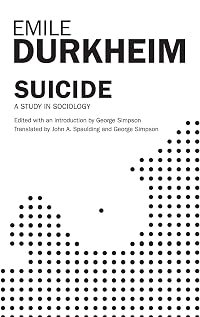
Suicide
by Émile Durkheim
On This Page
Description
There would be no need for sociology if everyone understood the social frameworks within which we operate. That we do have a connection to the larger picture is largely thanks to the pioneering thinker E mile Durkheim. He recognized that, if anything can explain how we as individuals relate to society, then it is suicide: Why does it happen? What goes wrong? Why is it more common in some places than others? In seeking answers to these questions, Durkheim wrote a work that has fascinated, show more challenged and informed its readers for over a hundred years. Far-sighted and trail-blazing in its show lessTags
Recommendations














































Member Reviews
SUMMARY: This is a groundbreaking study in Sociology by notable functionalist, Émile Durkheim. The book addresses suicide and its social causes and argues that suicide is the result of a lack of social integration into society. Suicide also provides psychological explanations and practical applications of the impact of suicide on victims, family members and society.
NOTES: I read this book for my advanced sociological theory class. I enjoyed it, but I've always found Durkheim's writing style to be very dense, which can be draining. Pushing aside the obvious methodological flaws in his study, this study is interesting and very influential for the field of sociology.
NOTES: I read this book for my advanced sociological theory class. I enjoyed it, but I've always found Durkheim's writing style to be very dense, which can be draining. Pushing aside the obvious methodological flaws in his study, this study is interesting and very influential for the field of sociology.
Professor David Downes has chosen to discuss Emile Durkheim’s Suicide: A Study in Sociology, on FiveBooks as one of the top five on his subject -Crime and Punishment, saying that:
“…Durkheim focuses on the ‘non-contractual elements in contract’ – trust, integrity and moral obligations – as the prime source of social cohesion in economic relations. Elementary sociology but ignored by, or unknown to economists, for whom Durkheim should be compulsory reading. Feral bankers are a far greater threat to civil peace than feral children.…
This is a great taproot for modern theories of crime in the anomie tradition, anomie being a state lacking social and moral cohesion. It was Durkheim who, in this book, did most to establish show more sociology as a subject in its own right, by showing how suicide, that supremely individual act, varied in relation to social pressures. He stressed the pursuit of ‘infinite aspirations’ as generating higher rates of anomic suicide, due to the weakening of moral regulation in the wake of economic boom as well as slump. Suicide also rose as social bonds weakened due to ‘egoism’ – there is a higher suicide rate in Protestant countries than there is in Catholic ones. And, counter-intuitively, the rate falls when social integration strengthens, as in time of war. His theories of crime, deviance and control are intensely relevant today in the midst of financial crisis following the crash of 2008....”
The full interview is available here: http://fivebooks.com/interviews/david-downes show less
“…Durkheim focuses on the ‘non-contractual elements in contract’ – trust, integrity and moral obligations – as the prime source of social cohesion in economic relations. Elementary sociology but ignored by, or unknown to economists, for whom Durkheim should be compulsory reading. Feral bankers are a far greater threat to civil peace than feral children.…
This is a great taproot for modern theories of crime in the anomie tradition, anomie being a state lacking social and moral cohesion. It was Durkheim who, in this book, did most to establish show more sociology as a subject in its own right, by showing how suicide, that supremely individual act, varied in relation to social pressures. He stressed the pursuit of ‘infinite aspirations’ as generating higher rates of anomic suicide, due to the weakening of moral regulation in the wake of economic boom as well as slump. Suicide also rose as social bonds weakened due to ‘egoism’ – there is a higher suicide rate in Protestant countries than there is in Catholic ones. And, counter-intuitively, the rate falls when social integration strengthens, as in time of war. His theories of crime, deviance and control are intensely relevant today in the midst of financial crisis following the crash of 2008....”
The full interview is available here: http://fivebooks.com/interviews/david-downes show less
gut erhalten, mehrfache Neuausgaben
Feb 21, 2026German
Ratings
Members
- Recently Added By
Lists

New York Public Library's Books of the Century - All
170 works; 14 members

Sociology
18 works; 1 member
Author Information

159+ Works 6,475 Members
Emile Durkheim was born in Epinal, France on April 15, 1858. He received a baccalauréats in Letters in 1874 and Sciences in 1875 from the Collège d'Epinal. He became a professor of sociology at the Sorbonne, where he founded and edited the journal L'Annee Sociologique. He is renowned for the breadth of his scholarship; for his studies of show more primitive religion; for creating the concept of anomie (normlessness); for his study of the division of labor; and for his insistence that sociologists must use sociological (e.g., rates of behavior) rather than psychological data. He published several works including His Suicide in 1897. His notion of community, his view that religion forms the basis of all societies, had a profound impact on the course of community studies. He died on November 15, 1917 at the age of 59. (Bowker Author Biography) show less
Some Editions
Awards and Honors
Series
Belongs to Publisher Series
Common Knowledge
- Original title
- Le suicide : étude de sociologie
- Original publication date
- 1897
Classifications
- Genres
- Sociology, Nonfiction, General Nonfiction
- DDC/MDS
- 394.8 — Society, government, & culture Customs, etiquette & folklore General customs Dueling and suicide
- LCC
- HV6545 .D812 — Social sciences Social pathology. Social and public welfare. Criminology Social pathology. Social and public welfare. Criminology Crimes and offenses
- BISAC
Statistics
- Members
- 1,375
- Popularity
- 17,351
- Reviews
- 4
- Rating
- (3.70)
- Languages
- 15 — Chinese, English, Finnish, French, German, Hungarian, Italian, Japanese, Norwegian (Bokmål), Norwegian, Portuguese, Romanian, Spanish, Swedish, Turkish
- Media
- Paper, Ebook
- ISBNs
- 84
- ASINs
- 23