The Odes
by Pindar
On This Page
Description
One of the most celebrated poets of the classical world, Pindar wrote odes for athletes that provide a unique perspective on the social and political life of ancient Greece. Commissioned in honor of successful contestants at the Olympic games and other Panhellenic contests, these odes were performed in the victors' hometowns and conferred enduring recognition on their achievements. Andrew M. Miller's superb new translation captures the beauty of Pindar's forty-five surviving victory odes, show more preserving the rhythm, elegance, and imagery for which they have been admired since antiquity while adhering closely to the meaning of the original Greek. This edition provides a comprehensive introduction and interpretive notes to guide readers through the intricacies of the poems and the worldview that they embody. show lessTags
Recommendations








Member Reviews
Number 3 in my ancient Greek literature Odyssey. This collection of poems in praise of sporting success serendipitously coincided with the 2024 Paris Olympics. Makes you wonder what the original Olympians would have thought of our modern version of their event. Too many clothes and not enough chariot-racing, probably.
These are songs that would have likely been accompanied by music and dance, so it's almost impossible to get a true idea of their original intent just by reading from a book, especially in translation.
Additionally, the works are so thick with references to people, places and myths that they can be difficult to parse from 2000+ years in the future. Praise for Pindar tends to focus on the momentum in his poetry, but my show more reading was slow and jerky as I checked the notes and tried to interpret his lines.
As I continued, I made a conscious effort to read faster, and didn't have to stop so often to double-check the names and references. The work turned out to be much easier to appreciate that way. show less
These are songs that would have likely been accompanied by music and dance, so it's almost impossible to get a true idea of their original intent just by reading from a book, especially in translation.
Additionally, the works are so thick with references to people, places and myths that they can be difficult to parse from 2000+ years in the future. Praise for Pindar tends to focus on the momentum in his poetry, but my show more reading was slow and jerky as I checked the notes and tried to interpret his lines.
As I continued, I made a conscious effort to read faster, and didn't have to stop so often to double-check the names and references. The work turned out to be much easier to appreciate that way. show less
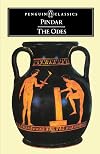
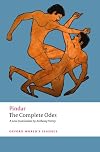
If you judged this book by its cover and picked it up hoping for some rough man-love, think again, Buster.
What we have here are the texts of commissioned chorus pieces. Divorced from the original Greek poetry, music and performance, I'm not sure that you could call them literature. There is the occasional great turn of phrase. It's worth underlining them, hidden as they are amongst the chaff. Personally I don't think there's enough of them to rescue Pindar as a poet. The fact that rich athletes would buy poems comparing them to the gods I find unspeakably vulgar.
On the other hand the paper used for this edition is nice. There is a good introduction and notes. The translation is clear. It's essentially prose which has had it's lines show more broken so that it looks like poetry. Happily Verity makes no further pretence towards poetry.
The 5 star rating is for the amount of time the poems have survived. Well done, boys! show less
What we have here are the texts of commissioned chorus pieces. Divorced from the original Greek poetry, music and performance, I'm not sure that you could call them literature. There is the occasional great turn of phrase. It's worth underlining them, hidden as they are amongst the chaff. Personally I don't think there's enough of them to rescue Pindar as a poet. The fact that rich athletes would buy poems comparing them to the gods I find unspeakably vulgar.
On the other hand the paper used for this edition is nice. There is a good introduction and notes. The translation is clear. It's essentially prose which has had it's lines show more broken so that it looks like poetry. Happily Verity makes no further pretence towards poetry.
The 5 star rating is for the amount of time the poems have survived. Well done, boys! show less
This was an extremely intriguing and interesting ancient Greek text (odes based on mythology and so forth.) Pindar's style stands out as a epitome of what ancient Greece was capable of nurturing and bringing forth amongst its ranks. Pindar is quite a poet, and his inventive and powerful focus brings a deeper sense of meaning to what he is writing about. Overall, a great book for those interested in the classics- and those into poetry in general.
4 stars.
4 stars.
For some reason Charlton Griffin has read most of my favorite books for audio, and most of them are available only with him reading them. Unfortunately, Charlton Griffin is about my least favorite reader. Much as I love the various works he reads, it's always a struggle for me to pay attention to his reading. He sounds like an Edwardian gentleman full of ennui, as though he can barely be bothered to pay attention to the book he's reading. Also, audiobook publishers have a bad habit of not disclosing the translators of the books being read. This is beginning to change, but it drives me stark raving mad. I've read some Pindar in Greek and have a couple of different translations of his Odes, so this, fortunately, isn't my only approach to show more his poems.
That said, I'm thrilled to be able to listen to Pindar ktl. while on long drives, which are usually to work. show less
That said, I'm thrilled to be able to listen to Pindar ktl. while on long drives, which are usually to work. show less
I got this because the other translation of Pindar I was reading had no notes and often made little sense without them.
2016 (review can be found at the link - which is a LibraryThing page)
read both the Richmond Lattimore & Roy Arthur Swanson translations
https://www.librarything.com/topic/226898#5842048
read both the Richmond Lattimore & Roy Arthur Swanson translations
https://www.librarything.com/topic/226898#5842048
Edition: // Descr: xii, 170 p. 20.5 cm. // Series: Call No. { 888 P65 2 } Translated by Richmond Lattimore Contains Glossary of Names. // //
Members
- Recently Added By
Lists

Harold Bloom - The Western Canon: A. The Theocratic Age
97 works; 13 members

Philip Ward's Lifetime Reading Plan
592 works; 22 members

Book Titles Mentioned In Newberry Medal And Honor Books
884 works; 3 members

The Well-Educated Mind, Susan Wise Bauer, 2016
179 works; 3 members

Works Cited in The Life and Death of Democracy by John Keane
278 works; 1 member

el
1,139 works; 1 member

In Our Time books
4,934 works; 2 members
Author Information

176+ Works 1,949 Members
The Greek poet Pindar, a Boeotian aristocrat who wrote for aristocrats, lived at Thebes, studied at Athens, and stayed in Sicily at the court of Hieron at Syracuse. His epinicians, choral odes in honor of victors at athletic games, survive almost complete and are divided into four groups, depending upon whether they celebrate victory at the show more Olympian, Pythian, Nemean, or Isthmian games. Scholars surmise that these are representative of his other poetry, such as hymns, processional songs, and dirges, extant in fragments. The 44 surviving odes joyfully praise beautiful, brilliant athletes who are like the gods in their moment of triumph. Bold mythological metaphor, dazzling intricacy of language, and metrical complexity together create sublimity of thought and of style. Pindar was famous in his lifetime and later throughout the Hellenistic world, as is attested by the story that Alexander the Great in 335 B.C. ordered the poet's house spared when his army sacked Thebes. The "Pindaric ode" form used in England in the seventeenth and early eighteenth centuries was based on an incorrect understanding of Pindar's metrical schemes and was characterized by grandiose diction. Pindar is considered to be the greatest of the Greek lyric poets. (Bowker Author Biography) show less
Some Editions
Awards and Honors
Notable Lists
Series
Belongs to Publisher Series
Work Relationships
Has as a reference guide/companion
Common Knowledge
- Canonical title
- The Odes
- Important places
- Greece; Hyperborea
- First words
- Best of all things is water: but gold, like a gleaming fire/ by night, outshines all pride of wealth beside.
- Blurbers
- Hadas, Moses; Dillon, George
Classifications
Statistics
- Members
- 860
- Popularity
- 31,805
- Reviews
- 8
- Rating
- (3.55)
- Languages
- 8 — Catalan, Dutch, English, German, Greek (Ancient), Multiple languages, Portuguese, Spanish
- Media
- Paper, Audiobook, Ebook
- ISBNs
- 44
- UPCs
- 1
- ASINs
- 20