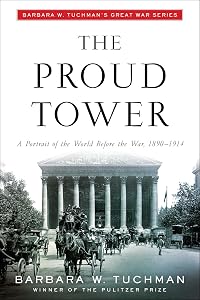
The Proud Tower: A Portrait of the World Before the War, 1890-1914
by Barbara Tuchman
The Coming of the Great War (1)
On This Page
Description
In The Proud Tower, Barbara Tuchman concentrates on society rather than the state. With an artist's selectivity, Tuchman brings to vivid life the people, places, and events that shaped the years leading up to the Great War: the Edwardian aristocracy and the end of their reign; the anarchists of Europe and America, who voiced the protest of the oppressed; Germany, as portrayed through the figure of the self-depicted hero, Richard Strauss; the sudden gorgeous blaze of Diaghilev's Russian show more Ballet and Stravinsky's music; the Dreyfus Affair; the two peace conferences in The Hague; and, finally, the youth, ideals, enthusiasm, and tragedy of socialism, epitomized in the moment when the heroic Jean Jaurès was shot to death on the night the War began and an epoch ended. show lessTags
Recommendations

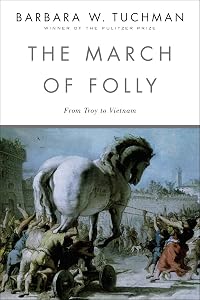
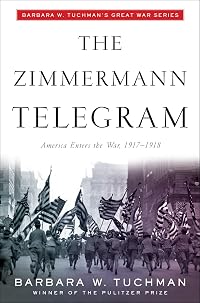














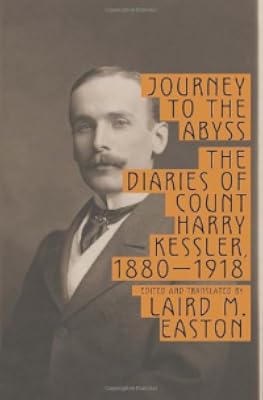
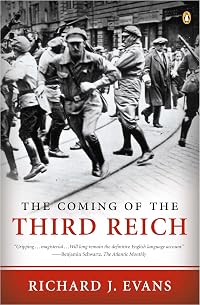





Member Recommendations

SusannainSC Like The Proud Tower, a thematic exploration of the pre-war period, 1900-1914.
20

The World That Never Was: A True Story of Dreamers, Schemers, Anarchists, and Secret Agents by Alex Butterworth
CGlanovsky Addressing roughly the same time period, both books shed light on the 19th and early 20th Century Anarchist and Socialist movements.
Member Reviews
Barbara Tuchman’s book, ‘The Proud Tower,’ is, as the blurb describes it, a portrait of the Western world at the turn of the nineteenth century. Her descriptions are vivid, and if you are familiar with European and American history, especially of this period, you will visualize the massive changes in society, culture, and the political landscape.
Those unfamiliar with the history and the cast of characters will find the narrative confusing because you don’t know who the people are and their role in society and politics.
However, I advise against allowing the details to bog you down. The uninitiated reader must focus on the big picture; if you do that, you will appreciate the massive change during those years.
British politics show more changed, American politicians became demanding (people like Mahan played a dominant role in defining the shifting military and naval landscape), the Dreyfuss affair rocked France, Nietzsche’s philosophy took center stage in Germany, and changes happened in Russia.
Social and political changes often leave scars, and leaders must adapt to and manage the change. Leaders who fail to adjust and modify their strategy create a recipe for disaster. When reading Barbara Tuchman’s book, I understood that the leaders of the world’s major powers were living in a dream world, unaware of the forces slowly being unleashed. Her book holds lessons for society, nations, and leaders today: technological, political, and societal changes are dramatic, and we sleepwalk into another disaster. Additionally, we live in a massive climate shift disruption. These factors, combined, are creating an explosive mixture. The leaders of the early twentieth century were blind to the dangers ahead, as are today’s leaders.
Her book does not analyze the events of those distant days but paints a vivid portrait of the era. I hoped for an analysis, but when I completed the book, I realized her approach was perfect: she painted a picture, leaving it to us to draw inferences and lessons for our age. show less
Those unfamiliar with the history and the cast of characters will find the narrative confusing because you don’t know who the people are and their role in society and politics.
However, I advise against allowing the details to bog you down. The uninitiated reader must focus on the big picture; if you do that, you will appreciate the massive change during those years.
British politics show more changed, American politicians became demanding (people like Mahan played a dominant role in defining the shifting military and naval landscape), the Dreyfuss affair rocked France, Nietzsche’s philosophy took center stage in Germany, and changes happened in Russia.
Social and political changes often leave scars, and leaders must adapt to and manage the change. Leaders who fail to adjust and modify their strategy create a recipe for disaster. When reading Barbara Tuchman’s book, I understood that the leaders of the world’s major powers were living in a dream world, unaware of the forces slowly being unleashed. Her book holds lessons for society, nations, and leaders today: technological, political, and societal changes are dramatic, and we sleepwalk into another disaster. Additionally, we live in a massive climate shift disruption. These factors, combined, are creating an explosive mixture. The leaders of the early twentieth century were blind to the dangers ahead, as are today’s leaders.
Her book does not analyze the events of those distant days but paints a vivid portrait of the era. I hoped for an analysis, but when I completed the book, I realized her approach was perfect: she painted a picture, leaving it to us to draw inferences and lessons for our age. show less
Sometimes, the best way to understand why something happens is to study the time before it happened. Barbara Tuchman does an excellent job of placing World War I in perspective by ignoring it and writing about what was going on in the world for the 25 years preceding it. The book was not necessarily chronological, but was divided into sections by subject (and sometimes by country). It sounds terrible, but reading a book like this helps you to realize why wars continue to happen. I don't think I ever realized just how different the world was before 1914. And yet, we keep doing the same things and expecting different results.
I'm amazed at how much I don't know sometimes and this book floored me. I'm going to try to find a book about Thomas Reed now. The book is so well written I keep flashing back to parts of it weeks after I read it. I loved the line "The working class went to war willingly, even eagerly, like the middle class, like the upper class, like the species." And if anyone has a list of places they want to visit when time travel is invented (yes, I have a list and you probably do too) Tuchman's description of Nijinski dancing the Faun in Paris will have you adding to it.
Reading The Proud Tower: A Portrait of the World Before the War 1890-1914, by Barbara Tuchman, reminds us of a style of narrative history that no longer exists, a kind that is starkly and unashamedly interpretative and neither makes a pretense to impartiality nor an attempt to disguise the author’s bias. In this vein, the way the story is told is nearly as important as the story itself; perhaps more so at times. Indeed, Tuchman – a true master of her craft – literally exhales pointed sentences that wickedly characterize and sometimes caricature the people, nations, and movements that come to life at the stroke of her pen. It is not the dull footnoted history of academic journals nor the sensationalized popular brand that is thin show more on facts and thick with swagger. Rather, it is highly observational, often judgmental and artfully written – without sacrificing the fundamentals of writing good history that at its root documents the facts on the ground. As such, Tuchman establishes the particulars and then unapologetically spells out the implications. The Proud Tower provides perhaps the best vehicle for her flourish of all of her books. Sadly, it is the kind of history that could not be written and published today, not only because the author has passed on but because this genre has passed on with her. What a pity.
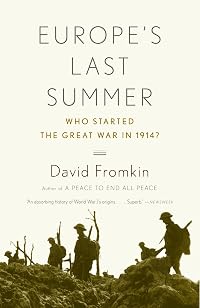
I came to Proud Tower because of my recent focus on the causes of World War I during the centennial of Europe’s singular great cataclysm – upon the heels of reading To End All Wars by Adam Hochschild, Europe’s Last Summer by David Fromkin, and Sleepwalkers by Christopher Clark – which led to the realization that my knowledge of global affairs in the decades preceding the Great War was spotty at best. Events almost never spring forth from a historical vacuum: the American Civil War, for instance, cannot be properly understand except in the context of the years that led up to it.
I have actually owned this volume for more than thirty years, a nice reminder that one of the benefit of amassing a fine personal library is that you may often pluck just what you are looking for right off of your own neatly ordered shelves. Apparently I even once made a go of reading it some years back; there was a bookmark abandoned around page fifty although I cannot recall when I made this abortive attempt. No matter: back to page one.
It should be noted at the outset that the use of the phrase “Portrait of the World Before the War” in the subtitle is no literary flourish. Proud Tower is nothing like Tuchman’s other books in its structure. In fact, it is hardly like any other book at all. Rather than a historical study it is instead a series of snapshots of nations and movements on the eve of the tragedy of the Great War that ended what historians of Europe term “the long nineteenth century.” Far from a textbook approach, Tuchman elegantly thumbnails certain aspects of prevailing national character in key countries – England, France, Germany and the United States – and significant international movements of the era: anarchism, socialism and the budding crusade for peace centered upon treaties at the Hague to avoid or moderate conflict. A chapter is devoted to each – except the Brits, who without explanation earn two. The result is an uneven narrative that combines flashes of brilliance with occasional long pauses of tedium. Still, there is much to value in Tuchman’s broad-brush approach: I learned a great deal about facets of the era that I expect will send me down various future corridors of inquiry.
Among the most fascinating portions of the book is the chapter entitled “The Idea and the Deed,” that focuses upon the anarchists – who were the unabashed terrorists of their era. All but forgotten today, the anarchists – driven by a vague anti-authoritarian impulse that promoted a stateless society -- wreaked havoc across national borders for decades with surprising successes that in the end accomplished … well … nothing. Still, on a macro level their grandiose flamboyance shook the globe with a triumph of violence that targeted heads of state with an astonishing rate of headlining achievement. In the three decades from 1881-1911, anarchists were responsible for the assassinations of Tsar Alexander II of Russia, King Umberto of Italy, King Carlos I of Portugal and his son the Crown Prince, King George I of Greece, President of the United States William McKinley, Empress Elisabeth of Austria-Hungary, a Russian Prime Minister, two Spanish Prime Ministers and the President of France -- and these were only their most prominent victims! Tuchman’s treatment of anarchism and its adherents is engrossing, although to my mind neither she nor other historians I have read on this subject properly delve into the long term consequences for European stability fraught by the murder of so many key leaders in essentially a single generation. In probing the causes for World War I, I believe that this topic begs deeper exploration.
Tuchman’s two chapters on Britain reveals a nation blessed with great freedom and protections for the rights of its citizens yet burdened with a surprisingly very narrow franchise and a shocking gap – even by the standards of the period – between the conspicuous wealth of the aristocratic elite who controlled everything and the masses of the desperately poor who turned the cogs of that storybook society of drawing rooms and balls. However, political power was – albeit very slowly – gradually coming to the labor forces who would transform British politics in the twentieth century. Tuchman’s wide-lens perspective is perhaps most effective in the long chapter on France devoted to the signature “Dreyfus Affair” and how that impacted every aspect of French politics and society. The chapter devoted to the United States highlights a clear break with its past as America – in the Spanish-American War and beyond – embarked not only upon imperialism and internationalism but a striking celebration of militarism often overlooked by historians. The chapter on the efforts at the Hague to seek through international law a triumph of diplomacy over jingoism exposes that the U.S. was among the most vigorously opposed to any limitations on the number and types of weapons permissible in combat, including “dumdum” expanding bullets, larger navies, developing prospects for air warfare – and it was America that provided the lone vote against the use of asphyxiating gas! The most bizarre chapter, and in my view the least successful, is the one on Germany entitled “Neroism is in the Air,” that seems to use opera in the era of Strauss as a metaphor for the looming madness in the German zeitgeist. Curiously, there is no chapter devoted to Russia, although the Russians step on and off stage in various dramas throughout the book.
In my opinion, the weakness in Proud Tower is that it should more probably have been fashioned as a collection of essays rather than as a continuous narrative for there is almost no flow from one chapter to the next. Tuchman’s attempt to clothe all of it in a common fabric comes in the final chapter devoted to the Socialists, entitled “The Death of Jaurès,” after its eponymous and most celebrated leader, but this effort tends to fall flat as the threads do not neatly bind the rest of the work into a definitive seamless garment. Tuchman leaves us to draw our own conclusions; here is my own: although Jean Jaurès, like Austrian Archduke Franz Ferdinand, is assassinated on the eve of the Great War by a nationalist rather than an anarchist, I was struck once more by the phenomenon of so many leading individuals suddenly and randomly plucked from the political sphere, voices at once silenced that might have offered some moderation to the great catastrophe of world war that was soon to engulf Europe and echo far beyond its geography. Despite its faults, I would recommend Proud Tower to any reader who seeks a greater understanding of the nature of that notable age that loomed large at the dramatic eve of one era and the terrible dawn of another. show less
I came to Proud Tower because of my recent focus on the causes of World War I during the centennial of Europe’s singular great cataclysm – upon the heels of reading To End All Wars by Adam Hochschild, Europe’s Last Summer by David Fromkin, and Sleepwalkers by Christopher Clark – which led to the realization that my knowledge of global affairs in the decades preceding the Great War was spotty at best. Events almost never spring forth from a historical vacuum: the American Civil War, for instance, cannot be properly understand except in the context of the years that led up to it.
I have actually owned this volume for more than thirty years, a nice reminder that one of the benefit of amassing a fine personal library is that you may often pluck just what you are looking for right off of your own neatly ordered shelves. Apparently I even once made a go of reading it some years back; there was a bookmark abandoned around page fifty although I cannot recall when I made this abortive attempt. No matter: back to page one.
It should be noted at the outset that the use of the phrase “Portrait of the World Before the War” in the subtitle is no literary flourish. Proud Tower is nothing like Tuchman’s other books in its structure. In fact, it is hardly like any other book at all. Rather than a historical study it is instead a series of snapshots of nations and movements on the eve of the tragedy of the Great War that ended what historians of Europe term “the long nineteenth century.” Far from a textbook approach, Tuchman elegantly thumbnails certain aspects of prevailing national character in key countries – England, France, Germany and the United States – and significant international movements of the era: anarchism, socialism and the budding crusade for peace centered upon treaties at the Hague to avoid or moderate conflict. A chapter is devoted to each – except the Brits, who without explanation earn two. The result is an uneven narrative that combines flashes of brilliance with occasional long pauses of tedium. Still, there is much to value in Tuchman’s broad-brush approach: I learned a great deal about facets of the era that I expect will send me down various future corridors of inquiry.
Among the most fascinating portions of the book is the chapter entitled “The Idea and the Deed,” that focuses upon the anarchists – who were the unabashed terrorists of their era. All but forgotten today, the anarchists – driven by a vague anti-authoritarian impulse that promoted a stateless society -- wreaked havoc across national borders for decades with surprising successes that in the end accomplished … well … nothing. Still, on a macro level their grandiose flamboyance shook the globe with a triumph of violence that targeted heads of state with an astonishing rate of headlining achievement. In the three decades from 1881-1911, anarchists were responsible for the assassinations of Tsar Alexander II of Russia, King Umberto of Italy, King Carlos I of Portugal and his son the Crown Prince, King George I of Greece, President of the United States William McKinley, Empress Elisabeth of Austria-Hungary, a Russian Prime Minister, two Spanish Prime Ministers and the President of France -- and these were only their most prominent victims! Tuchman’s treatment of anarchism and its adherents is engrossing, although to my mind neither she nor other historians I have read on this subject properly delve into the long term consequences for European stability fraught by the murder of so many key leaders in essentially a single generation. In probing the causes for World War I, I believe that this topic begs deeper exploration.
Tuchman’s two chapters on Britain reveals a nation blessed with great freedom and protections for the rights of its citizens yet burdened with a surprisingly very narrow franchise and a shocking gap – even by the standards of the period – between the conspicuous wealth of the aristocratic elite who controlled everything and the masses of the desperately poor who turned the cogs of that storybook society of drawing rooms and balls. However, political power was – albeit very slowly – gradually coming to the labor forces who would transform British politics in the twentieth century. Tuchman’s wide-lens perspective is perhaps most effective in the long chapter on France devoted to the signature “Dreyfus Affair” and how that impacted every aspect of French politics and society. The chapter devoted to the United States highlights a clear break with its past as America – in the Spanish-American War and beyond – embarked not only upon imperialism and internationalism but a striking celebration of militarism often overlooked by historians. The chapter on the efforts at the Hague to seek through international law a triumph of diplomacy over jingoism exposes that the U.S. was among the most vigorously opposed to any limitations on the number and types of weapons permissible in combat, including “dumdum” expanding bullets, larger navies, developing prospects for air warfare – and it was America that provided the lone vote against the use of asphyxiating gas! The most bizarre chapter, and in my view the least successful, is the one on Germany entitled “Neroism is in the Air,” that seems to use opera in the era of Strauss as a metaphor for the looming madness in the German zeitgeist. Curiously, there is no chapter devoted to Russia, although the Russians step on and off stage in various dramas throughout the book.
In my opinion, the weakness in Proud Tower is that it should more probably have been fashioned as a collection of essays rather than as a continuous narrative for there is almost no flow from one chapter to the next. Tuchman’s attempt to clothe all of it in a common fabric comes in the final chapter devoted to the Socialists, entitled “The Death of Jaurès,” after its eponymous and most celebrated leader, but this effort tends to fall flat as the threads do not neatly bind the rest of the work into a definitive seamless garment. Tuchman leaves us to draw our own conclusions; here is my own: although Jean Jaurès, like Austrian Archduke Franz Ferdinand, is assassinated on the eve of the Great War by a nationalist rather than an anarchist, I was struck once more by the phenomenon of so many leading individuals suddenly and randomly plucked from the political sphere, voices at once silenced that might have offered some moderation to the great catastrophe of world war that was soon to engulf Europe and echo far beyond its geography. Despite its faults, I would recommend Proud Tower to any reader who seeks a greater understanding of the nature of that notable age that loomed large at the dramatic eve of one era and the terrible dawn of another. show less
A social history of the world (Europe, U. S. A. and Russia) that runs the gamut between some brilliant insightful highs to some perverse and offensive lows. What else can you expect from Barbara W. Tuchman, whose book had me eagerly page turning one minute and wanting to throw it across the room the next. Her subject is a huge one; to give a lasting impression of the more developed countries in the period before they would all joyfully launch themselves into the first world war, and however skewed her impressions are I think she largely succeeds.
Tuchman’s excellent foreword describes her thought processes in writing the book: she says she has been highly selective in the subjects she has chosen to portray the social and cultural show more milieu of the period. There are chapters on late Victorian and early Edwardian governments in England, chapters on the anarchist movement in Europe, American expansionism, the Dreyfus affair in France, peace conferences at the Hague, the rise of socialism and most bizarrely the music of Richard Strauss, which she describes as the barometer of the weather in Germany. She says that there are other subjects she could have chosen to make her points about the societies in the various countries, so much so that her book could have been totally re-written. This selectivity could present the reader with some problems, because while you might well be interested in the rise of socialism, you might not be quite so interested in a long chapter on the music of Richard Strauss. To Tuchman’s credit her enthusiasm for the subjects she has chosen are undiminished and can carry the reader through the more esoteric of these.
Her book was published in 1966 and smacks of the now outdated patrician approach to history telling. At times it is like reading a selection of newspaper tabloid headlines and while these are undoubtedly entertaining and attention grabbing the reader might miss a more reasoned analysis of the issues. Tuchman is altogether short on analysis, she hits you with some facts and some colourful anecdotes of the characters involved and lets the reader form their own impressions. She cannot resist giving piquant pen portraits that sometimes verge on satire for example:
Lloyd George:
He had strong political principles but no scruples. Small and handsome, fearless, ruthless, and honey-tongued, with bright blue eyes, brown moustache and intense vitality, he constantly pursued and attracted women and adroitly avoided the occasional legal consequences. As a public speaker he was the Bernhardt of the political platform who ravished audiences with Celtic-lilt and strong emotion.
Captain Alfred Dreyfus:
As a person he was not liked by his brother officers. Stiff, silent, cold and almost unnaturally correct, he was without friends, opinions or visible feelings and attention. These characteristics appeared sinister as soon as he came under suspicion. His appearance the reverse of flamboyant, seemed the perfect cover for a spy. Of medium height and weight, medium brown hair, and medium age, thirty-six, he had a toneless voice and unremarkable features, distinguished only by rimless pince-nez, the fashionable form of eye glasses in his milieu.
Tuchman certainly has her heroes and her villains and she can’t help herself from going slightly over the top when it comes to describing handsome men. Women do not, by and large get the same treatment.
The overriding theme at the start of the period is how out of touch the leading politicians and the aristocracy were with the common people and the burgeoning industrialist. Rather like today there was a tremendous gap between the very rich and the rest of the population, but this was not such an issue for the leaders at that time because of the class system. People knew their place and although the period saw the sporadic violence of anarchism and the more thoughtful political gains of the socialist movement, when their country was seen to be threatened; nationalism took over. The herd instinct always in evidence was probably more prevalent at the turn of the nineteenth century. War it would seem was inevitable.
The Proud Tower will not be to everybody’s taste, but as an example of popular history, backed up by a wealth of research (50 pages of notes) and some humour then it proved to be an entertaining if somewhat frustrating read. Ridiculous even hysterical at times, but also packed with information and a portrait of the period that provides the basis for what happened next. A four star read. show less
Tuchman’s excellent foreword describes her thought processes in writing the book: she says she has been highly selective in the subjects she has chosen to portray the social and cultural show more milieu of the period. There are chapters on late Victorian and early Edwardian governments in England, chapters on the anarchist movement in Europe, American expansionism, the Dreyfus affair in France, peace conferences at the Hague, the rise of socialism and most bizarrely the music of Richard Strauss, which she describes as the barometer of the weather in Germany. She says that there are other subjects she could have chosen to make her points about the societies in the various countries, so much so that her book could have been totally re-written. This selectivity could present the reader with some problems, because while you might well be interested in the rise of socialism, you might not be quite so interested in a long chapter on the music of Richard Strauss. To Tuchman’s credit her enthusiasm for the subjects she has chosen are undiminished and can carry the reader through the more esoteric of these.
Her book was published in 1966 and smacks of the now outdated patrician approach to history telling. At times it is like reading a selection of newspaper tabloid headlines and while these are undoubtedly entertaining and attention grabbing the reader might miss a more reasoned analysis of the issues. Tuchman is altogether short on analysis, she hits you with some facts and some colourful anecdotes of the characters involved and lets the reader form their own impressions. She cannot resist giving piquant pen portraits that sometimes verge on satire for example:
Lloyd George:
He had strong political principles but no scruples. Small and handsome, fearless, ruthless, and honey-tongued, with bright blue eyes, brown moustache and intense vitality, he constantly pursued and attracted women and adroitly avoided the occasional legal consequences. As a public speaker he was the Bernhardt of the political platform who ravished audiences with Celtic-lilt and strong emotion.
Captain Alfred Dreyfus:
As a person he was not liked by his brother officers. Stiff, silent, cold and almost unnaturally correct, he was without friends, opinions or visible feelings and attention. These characteristics appeared sinister as soon as he came under suspicion. His appearance the reverse of flamboyant, seemed the perfect cover for a spy. Of medium height and weight, medium brown hair, and medium age, thirty-six, he had a toneless voice and unremarkable features, distinguished only by rimless pince-nez, the fashionable form of eye glasses in his milieu.
Tuchman certainly has her heroes and her villains and she can’t help herself from going slightly over the top when it comes to describing handsome men. Women do not, by and large get the same treatment.
The overriding theme at the start of the period is how out of touch the leading politicians and the aristocracy were with the common people and the burgeoning industrialist. Rather like today there was a tremendous gap between the very rich and the rest of the population, but this was not such an issue for the leaders at that time because of the class system. People knew their place and although the period saw the sporadic violence of anarchism and the more thoughtful political gains of the socialist movement, when their country was seen to be threatened; nationalism took over. The herd instinct always in evidence was probably more prevalent at the turn of the nineteenth century. War it would seem was inevitable.
The Proud Tower will not be to everybody’s taste, but as an example of popular history, backed up by a wealth of research (50 pages of notes) and some humour then it proved to be an entertaining if somewhat frustrating read. Ridiculous even hysterical at times, but also packed with information and a portrait of the period that provides the basis for what happened next. A four star read. show less
The "Proud Tower" is one of Barbara Tuchman's many popular historical works. The Ballantine (mass paperback) edition is a reprint of the 1966 original, probably made because Tuchman's pleasant and accessible writing style has guaranteed excellent sales on all her books. In this particular work, she sets out to describe how the late Victorian period (indicated here as roughly 1890-1914) was not a time of peace and progress, as is often the way it is portrayed in the most simple and shallow of historical descriptions such as those in high schools, but in reality a period of upheaval and tension, making World War I rather a climax than a sudden break.
But it is here also that the content does not merit the style. Tuchman clearly has a good show more knowledge of her subject and a popular historian's love for storytelling, but what mars her project is her obvious bias and unfairness towards some of the subjects she writes about. For example, her first chapter, on the British upper class, pays absolutely no attention to any of the striking class differences of the time, to the role of Labour leaders, to the economic basis on which the British rentier system was based, etc.
On the contrary, all we are given is some sixty pages meant to convey the utterly clich?d conservative message: that the British aristocracy was perhaps a little far detached from current events, but nevertheless their leisure allowed them to rule the country well thanks to the virtues of upper class education and their lack of "greed".
The same approach is taken towards the other end of the spectrum, in this case incidentally in the next chapter, where Tuchman discusses the anarchist movements. At no point is she willing to even entertain the idea that the anarchists might have had legitimate ideas and that perhaps the lack of enfranchisement and opportunities was a cause for their, admittedly, radical and violent approach. Oh no. Instead the reader is bombarded with phrases such as "the Idea", "the bomb was to be the Messiah", "throbbing with the consciousness of Martyrdom", etc. etc. At each and every turn Tuchman takes her time to discredit every lower class attempt at lashing back, to speak her contempt for the ideals of young, suffering people ("a rebellious soul", "a highly excitable nature"), and to underline how much she hates the idea of revolution even if it is from the horrors of industrial age capitalism and hardly or not at all democratic states ("his goal, like his hate, was generalized toward destruction", "[he] wrote wrathfully for the revolutionary press", "behind the poor foolish megalomania (...) glowed the Idea") and so on. Her own 'insight' into anarchism seems to be best represented by this callous quote: "One of them [the poor] with a sense of injury or a sense of mission, would rise up, go out and kill-and sacrifice his own life on the altar of the Idea". I am myself no anarchist, but her treatment of desperate people, so crushed by their society that they see no other way out than the violent overthrow of even the whole idea of governance, is nothing but cruel and stupefying.
Looking at the following chapters in the book proves this to be no accident. Her description of the transformation of the United States from an isolationist country to a more imperialist approach is positively gushing (expansionists being invariably described as "an adroit master of political strategy and tactics" and "shrewd, worldly, forceful" etc.), she blames the assassination of McKinley for ending attempts to block the negative sides of this imperialism (never anywhere mentioning McKinley's corruption and support for union busting etc.), and when by Chapter Five Tuchman was trying to explain how futile the attempts of the various Peace Conferences were and she describes one of the main expansionist thinkers, Admiral Mahan, as "trying to instruct the public to take an honest look at war", I had enough. Only the chapter about Dreyfus seemed untainted by her dubious look at history, although this is of course easy since the good and the bad side are quite clear to distinguish from hindsight in that particular affair.
This book may be fun for light reading and informative if you know little about the period, but I would not ever rely on it for an honest view of the people or events described in it. For that, it is simply too tainted by her constant awe for all aristocrats and her equally strong contempt for all attempts at political change. Progressive minded people, beware. show less
But it is here also that the content does not merit the style. Tuchman clearly has a good show more knowledge of her subject and a popular historian's love for storytelling, but what mars her project is her obvious bias and unfairness towards some of the subjects she writes about. For example, her first chapter, on the British upper class, pays absolutely no attention to any of the striking class differences of the time, to the role of Labour leaders, to the economic basis on which the British rentier system was based, etc.
On the contrary, all we are given is some sixty pages meant to convey the utterly clich?d conservative message: that the British aristocracy was perhaps a little far detached from current events, but nevertheless their leisure allowed them to rule the country well thanks to the virtues of upper class education and their lack of "greed".
The same approach is taken towards the other end of the spectrum, in this case incidentally in the next chapter, where Tuchman discusses the anarchist movements. At no point is she willing to even entertain the idea that the anarchists might have had legitimate ideas and that perhaps the lack of enfranchisement and opportunities was a cause for their, admittedly, radical and violent approach. Oh no. Instead the reader is bombarded with phrases such as "the Idea", "the bomb was to be the Messiah", "throbbing with the consciousness of Martyrdom", etc. etc. At each and every turn Tuchman takes her time to discredit every lower class attempt at lashing back, to speak her contempt for the ideals of young, suffering people ("a rebellious soul", "a highly excitable nature"), and to underline how much she hates the idea of revolution even if it is from the horrors of industrial age capitalism and hardly or not at all democratic states ("his goal, like his hate, was generalized toward destruction", "[he] wrote wrathfully for the revolutionary press", "behind the poor foolish megalomania (...) glowed the Idea") and so on. Her own 'insight' into anarchism seems to be best represented by this callous quote: "One of them [the poor] with a sense of injury or a sense of mission, would rise up, go out and kill-and sacrifice his own life on the altar of the Idea". I am myself no anarchist, but her treatment of desperate people, so crushed by their society that they see no other way out than the violent overthrow of even the whole idea of governance, is nothing but cruel and stupefying.
Looking at the following chapters in the book proves this to be no accident. Her description of the transformation of the United States from an isolationist country to a more imperialist approach is positively gushing (expansionists being invariably described as "an adroit master of political strategy and tactics" and "shrewd, worldly, forceful" etc.), she blames the assassination of McKinley for ending attempts to block the negative sides of this imperialism (never anywhere mentioning McKinley's corruption and support for union busting etc.), and when by Chapter Five Tuchman was trying to explain how futile the attempts of the various Peace Conferences were and she describes one of the main expansionist thinkers, Admiral Mahan, as "trying to instruct the public to take an honest look at war", I had enough. Only the chapter about Dreyfus seemed untainted by her dubious look at history, although this is of course easy since the good and the bad side are quite clear to distinguish from hindsight in that particular affair.
This book may be fun for light reading and informative if you know little about the period, but I would not ever rely on it for an honest view of the people or events described in it. For that, it is simply too tainted by her constant awe for all aristocrats and her equally strong contempt for all attempts at political change. Progressive minded people, beware. show less
I only rate this book as "about average." Tuchman has very strong biases — in her discussion of anarchism, her treatment of Emma Goldman is condescendingly dismissive — and she also tends to emphasize these biases through flamboyant language, for example (emphasis mine, and quoting from the Library of America edition pages 1077 and 1080)...
Hervé continued his campaign against army and country, undaunted by further trials and a term in jail. "We shall reply to the mobilization order by revolt!" he screamed.
and
In an opening tirade, Hervé again proposed mass disobedience to mobilization, in effect insurrection.
Overall, The Proud Tower is a fairly enjoyable read, though including some tediously long-winded descriptions of upper-class show more English society in its opening chapter, but the subjects which Tuchman covers (each chapter being somewhat self-contained topically) are limited and – notwithstanding brief references to Fashoda, Morocco, and the like – she largely ignores the overwhelmingly important topic of colonialism, with the exception of discussion of the American occupation of the Philippines (and even this is from a predominately American rather than Filipino perspective). Some of her choices of subject can also be quirky, notably, covering Germany by devoting an entire chapter to composer Richard Strauss.
Don't expect to derive any real understanding from this book of the underlying causes of the First World War, which will themselves be much-debated by historians of various stripes. The Proud Tower is more a collection of essays covering select subjects in the roughly quarter-century leading up to the War. Not bad, but it didn't really meet my expectations, considering Tuchman's high reputation as an historian and my own memory of other books like The Guns of August and Stilwell and the American Experience in China.
I read this in the Library of America edition, and I'm actually a bit surprised that the LoA would have bothered to include Tuchman in their canon. She's not, in my view, anywhere near as central to American historical literature as, say, Henry Adams or Francis Parkman, and The Proud Tower itself seems to me one of the lesser of her works. show less
Hervé continued his campaign against army and country, undaunted by further trials and a term in jail. "We shall reply to the mobilization order by revolt!" he screamed.
and
In an opening tirade, Hervé again proposed mass disobedience to mobilization, in effect insurrection.
Overall, The Proud Tower is a fairly enjoyable read, though including some tediously long-winded descriptions of upper-class show more English society in its opening chapter, but the subjects which Tuchman covers (each chapter being somewhat self-contained topically) are limited and – notwithstanding brief references to Fashoda, Morocco, and the like – she largely ignores the overwhelmingly important topic of colonialism, with the exception of discussion of the American occupation of the Philippines (and even this is from a predominately American rather than Filipino perspective). Some of her choices of subject can also be quirky, notably, covering Germany by devoting an entire chapter to composer Richard Strauss.
Don't expect to derive any real understanding from this book of the underlying causes of the First World War, which will themselves be much-debated by historians of various stripes. The Proud Tower is more a collection of essays covering select subjects in the roughly quarter-century leading up to the War. Not bad, but it didn't really meet my expectations, considering Tuchman's high reputation as an historian and my own memory of other books like The Guns of August and Stilwell and the American Experience in China.
I read this in the Library of America edition, and I'm actually a bit surprised that the LoA would have bothered to include Tuchman in their canon. She's not, in my view, anywhere near as central to American historical literature as, say, Henry Adams or Francis Parkman, and The Proud Tower itself seems to me one of the lesser of her works. show less
Members
- Recently Added By
Lists

"I'd Group-Read That"
20 works; 6 members

Non-Fiction Worth Reading
1,025 works; 264 members

Books about World War I
80 works; 14 members

World War I - fiction & non-fiction
19 works; 4 members

Favourite Books
1,820 works; 316 members

Books Read in 2013
1,630 works; 51 members

My List
302 works; 1 member

Club Read's Recommended Nonfiction Written by Women
618 works; 30 members
Author Information

28+ Works 29,914 Members
Barbara W. Tuchman achieved prominence as a historian with The Zimmermann Telegram, and international fame with The Guns of August--a huge bestseller and winner of the Pulitzer Prize. There followed other successes, including The Proud Tower, Stilwell and the American Experience in China (also awarded the Pulitzer Prize), A Distant Mirror, The show more March of Folly, and The First Salute. show less
Some Editions
Awards and Honors
Series

Belongs to Publisher Series
Work Relationships
Common Knowledge
- Canonical title
- The Proud Tower: A Portrait of the World Before the War, 1890-1914
- Original title
- The Proud Tower: A Portrait of the World Before the War, 1890-1914
- Alternate titles
- The Proud Tower
- Original publication date
- 1966
- People/Characters
- Alfred Dreyfus; Robert Gascoyne-Cecil, 3rd Marquess of Salisbury; Thomas Brackett Reed; Theodore Roosevelt; Richard Strauss; David Lloyd George
- Important places
- Austro-Hungarian Empire; France; Germany; United Kingdom
- Important events
- Origins of World War I; Dreyfus Affair; Spanish-American War
- Epigraph
- While from a proud tower in the town
Death looks gigantically down.
-- From"The City in the Sea"
Edgar Allan Poe - First words
- The last government in the Western world to possess all the attributes of the aristocracy in working condition took office in England in June of 1895.
- Last words
- (Click to show. Warning: May contain spoilers.)Overhead the bells he had invoked at Basle tolled for him and all the world, "I summon the living, I mourn the dead."
- Blurbers
- Plumb, J H; Foot, Michael; Beloff, Max
- Original language
- English
- Canonical DDC/MDS
- 901.941; 909.82
- Canonical LCC
- D398
Classifications
Statistics
- Members
- 3,086
- Popularity
- 5,736
- Reviews
- 40
- Rating
- (4.02)
- Languages
- 9 — Dutch, English, German, Hebrew, Italian, Polish, Spanish, Swedish, Chinese, traditional
- Media
- Paper, Audiobook, Ebook
- ISBNs
- 49
- ASINs
- 33