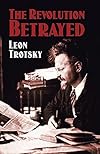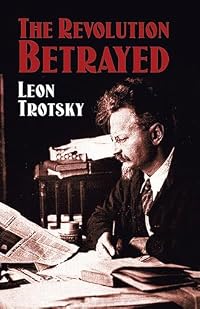
The Revolution Betrayed
by Leon Trotsky
Museo Casa de León Trotsky & CEIP León Trotsky: Obras Escogidas de León Trotsky (Volumen 6)
On This Page
Description
Written in 1936 and published the following year, this brilliant and profound evaluation of Stalinism from the Marxist standpoint prophesied the collapse of the Soviet Union. Trotsky employs facts, figures, and statistics to show how Stalinist policies rejected the enormous productive potential of the nationalized planned economy engendered by the October Revolution.Tags
Recommendations
















Member Reviews
When I lecture I will often, in the heat of the moment, say things based on my understanding of the topic, and oftentimes it is hard to pin-point where this knowledge came from - a case of: how do I know what I know? The experience usually sends me back to the books to reconfirm my knowledge. Whenever I read the classic political science texts from J.S. Mill, Rousseau, Hobbes, Locke, Burke, et al., I feel as though I am reading what I know. This is clearly a result of my education, but after having read these works, a series of gaps in my knowledge is simultaneously filled, and then, like a muscle at the gym, ripped asunder. To be sure, this is how we learn and improve, but the experience to this day leaves me feeling desperate for more show more time on this earth to learn the things I do not know - a list that grows daily. And Trotsky's work read like a familiar text. I may have read parts of it before, but in my class readers during my political science degree. But to rediscover these words and thoughts and ideas and ideals is mind-blowing. Trotsky was clearly a genius. This cannot be denied. But he was a politician in the same vein as Dr John Hewson: Fightback! was brilliant, and it has been for the most part implemented, but Dr Hewson was not a popular politician, Fightback! was a (in a "presentist" sense) a policy failure, yet Dr Hewson was right all along. I am probably drawing a long bow by putting Dr Hewson in the same category as Trotsky, but the same high intellectual-low political capability divide is evident. Parts of this work remind me of an old Soviet joke:
Comrade 1: What is the difference between capitalism and communism?
Comrade 2: In capitalism, man exploits man. In communism, it is the other way around.Trotsky points out all the theoretical problems with Stalinism, and brings in a useful comparison with the French Revolution, a common thread throughout the work, with the Thermidorian reaction to Robespierre explaining what was happening in Russia in the mid-1930s. Trotsky has no issue with deviations from the communist plot. He is well-aware that Russia was not meant to be where the great international revolution would begin. But now that it had, then some things had to be taken into account. Trotsky's issue was that these deviations from the plot, albeit necessary, were being hidden in bureaucratic nonsense, enabling the exploitation of man by man pretending to be a system that was meant to be overthrowing this very system. Trotsky's arguments are so solid that Stalin had to "liquidate" his ideas. The habit of purging, of course, was the antithesis of the Marxian ideal, and showed Stalin's "socialism within one country" as little more than a nouveau-bourgeois power-grab. Ultimately, Trotsky's predictions proved correct, and the rest is history. Trotsky's attack on the international "friends of socialism", in particular the Webbs ([a:Sidney Webb|15312770|Sidney Webb|https://images.gr-assets.com/authors/1467563522p2/15312770.jpg] and [a:Beatrice Webb|16198007|Beatrice Webb|https://s.gr-assets.com/assets/nophoto/user/u_50x66-632230dc9882b4352d753eedf9396530.png]), demonstrates his commitment to theoretical communism. I suspect that Lenin had the political nous that Trotsky lacked. Little wonder the back cover blurb states, accurately, that this work is "one of Marxism's most important texts". That communist theory has been so routinely dismissed because of Stalinism and the Russian experience is premature. In the long course of history, especially as technological developments mean there is less for more of us to do, if life continues as it does now, forevermore, then the extinction of the species will demonstrate natural justice in a way that our theorising never could. show less
Why did I read this book at all? I always wanted to know what happened, What went wrong, And why people are the one that had to pay for it in the end? Sadly, it seemed to me as if everyone trying to purify themselves and make as much justification as they can. Although the book has some helpful points, but to me, the sad thing is that no reform is ever about people, it can be about many things such as capital, power and influence but not about them.
Largely polemic, lots of mixed metaphors, and even casual racism. Basically, it reads like period Leninist texts.
Trotsky's analysis of the Soviet Union and Stalinism in the 1930s.
Ratings
Members
- Recently Added By
Lists

All Things Russia
459 works; 11 members

Liste Otto
107 works; 1 member
Author Information

792+ Works 7,744 Members
Leon Trotsky was born Lev Davidovich Bronshteyn on November 7, 1879 in Yanovka, Ukraine. As a teenager, he became involved in underground activities and was soon arrested, jailed and exiled to Siberia where he joined the Social Democratic Party. He escaped from exile in Siberia by using the name of a jailer called Trotsky on a false passport. show more During World War I, he lived in Switzerland, France, England, and New York City, where he edited the newspaper Novy Mir (New World). In 1917, after the overthrow of Tsar Nicholas II, he went back to Russia and joined Vladimir Lenin in the first, abortive, July Revolution of the Bolsheviks. A key organizer of the successful October Revolution, he was People's Commissar for Foreign Affairs in the Lenin regime. He was then made war commissar and in this capacity, built up the Red Army which prevailed against the White Russian forces in the civil war. Antagonism developed between him and Joseph Stalin during the Civil War of 1918-1920. When Lenin fell ill and died, Stalin became the new leader and Trotsky was thrown out of the party in 1927. Trotsky fled across Siberia to Norway, France, and finally settled in Mexico in 1936. He began working on the biography of Stalin. He was able to complete 7 of the 12 chapters before an assassin, acting on Stalin's orders, stabbed Trotsky with an ice pick. He died on August 21, 1940. The construction of the remaining five chapters was accomplished by the translator Charles Malamuth, from notes, worksheets, and fragments. (Bowker Author Biography) show less
Some Editions
Series

Belongs to Publisher Series
Work Relationships
Is abridged in
Common Knowledge
- Canonical title*
- Les crime de Staline
- Original publication date
- 1936
- Original language*
- Russisch
*Some information comes from Common Knowledge in other languages. Click "Edit" for more information.
Classifications
- Genres
- Nonfiction, History, General Nonfiction, Politics and Government
- DDC/MDS
- 947.084 — History & geography History of Europe Eastern European Counties and Russia Russian & Slavic History by Period 1855- 1917-1953 ; Communist period
- LCC
- DK267 .T698713 — History of Europe, Asia, Africa and Oceania Russia. Soviet Union. Former Soviet Republics – Poland History of Russia. Soviet Union. Former Soviet Republics History Soviet regime, 1918-1991
- BISAC
Statistics
- Members
- 564
- Popularity
- 52,207
- Reviews
- 4
- Rating
- (4.11)
- Languages
- 13 — Catalan, Czech, Dutch, English, French, German, Hungarian, Italian, Japanese, Polish, Portuguese, Spanish, Swedish
- Media
- Paper, Audiobook, Ebook
- ISBNs
- 42
- UPCs
- 1
- ASINs
- 10