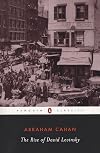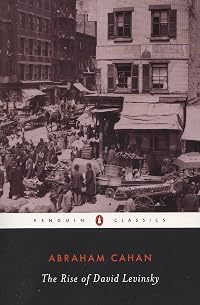
The Rise of David Levinsky
by Abraham Cahan
On This Page
Description
Born in Lithuania, Abraham Cahan rose to literary acclaim in America as both a journalist and a writer of fiction. In The Rise of David Levinsky, which stands as Cahan's best-known novel, he charts the trials, tribulations, and triumphs of David Levinsky, a Russian boy who loses his parents and seeks his fortune in the United States..
Tags
Recommendations
































Member Reviews
41. The Rise of David Levinsky by Abraham Cahan
published: 1917
format: ~535 page ebook
acquired: 2014 from Project Gutenberg
read: Sep 8 - Oct 9
rating: 4½
I step into the WWI era of literature with a great deal of ignorance and find myself in the world of my ancestry. Cahan, a Russian Jewish immigrant who arrived in New York in 1882, captures a whole world of Jewish New York over a 30 year period of immigration and rebirth. He takes Dickens and Thackeray (or so he more or less claims) and creates history from first hand experience, and it’s moving to someone like me because this world is what four different parts of my family experienced (although not all in NY).
David Levinsky is an orphan and teenage Talmudic scholar who stumbles show more across a benefactor, a young female divorcee, who provides him with a ticket to America. He will arrive, and stumble and fall in so many different ways, each remarkably real. Discarding the Talmud and faith and even theism, he becomes through will and guts and luck someone who finds himself in the newpapers associated with “the Vanderbilts, the Goulds, the Rothschilds...by calling me ‘a fleecer of labor’ it placed me in their class. I felt in good company.”
Cahan was something of a leader in the Jewish socialist movement of the late 1800’s/early 1900’s. That he can write sympathetically of his capitalist hero, one who both fights and has a tolerance for socialists, is interesting and an expression perhaps of a wide experience and open mind.
There is a mixture of history and tragedy of sorts mixed. As Levinsky finds success, and reader gets a lesson on the evolution of Jewish clothing manufacture in American, he becomes a representation of the success of Jews in American with pride and also ambivalence. Listening to the Star-spangled Banner:
There was the jingle of newly-acquired dollars in our applause. But there was something else in it as well. Many of those who were now paying tribute to the Stars and Stripes were listening to the tune with grave, solemn mien. It was as if they were saying: "We are not persecuted under this flag. At last we have found a home.”
But what was the price. David will lose his culture, religion and in a way his soul. He has no family, few close friends despite extensive acquaintances, and is unable to find affection for women remotely appropriate for him. He will end up alone and unable, really, to understand why. A split of intellect from soul, or maybe of real and spiritual, a gain and a loss.
The Dickens sense in the title is no accident. This is the only Cahan novel I know of, but it’s very well developed, entertaining, capturing many different worlds in both Russian and America. It’s long coming of age, and a full fictional autobiography, if you like, and one that clearly reflects Cahan’s own experience. Recommended to those interested in American Jewish heritage.
2017
https://www.librarything.com/topic/260412#6211171 show less
published: 1917
format: ~535 page ebook
acquired: 2014 from Project Gutenberg
read: Sep 8 - Oct 9
rating: 4½
I step into the WWI era of literature with a great deal of ignorance and find myself in the world of my ancestry. Cahan, a Russian Jewish immigrant who arrived in New York in 1882, captures a whole world of Jewish New York over a 30 year period of immigration and rebirth. He takes Dickens and Thackeray (or so he more or less claims) and creates history from first hand experience, and it’s moving to someone like me because this world is what four different parts of my family experienced (although not all in NY).
David Levinsky is an orphan and teenage Talmudic scholar who stumbles show more across a benefactor, a young female divorcee, who provides him with a ticket to America. He will arrive, and stumble and fall in so many different ways, each remarkably real. Discarding the Talmud and faith and even theism, he becomes through will and guts and luck someone who finds himself in the newpapers associated with “the Vanderbilts, the Goulds, the Rothschilds...by calling me ‘a fleecer of labor’ it placed me in their class. I felt in good company.”
Cahan was something of a leader in the Jewish socialist movement of the late 1800’s/early 1900’s. That he can write sympathetically of his capitalist hero, one who both fights and has a tolerance for socialists, is interesting and an expression perhaps of a wide experience and open mind.
There is a mixture of history and tragedy of sorts mixed. As Levinsky finds success, and reader gets a lesson on the evolution of Jewish clothing manufacture in American, he becomes a representation of the success of Jews in American with pride and also ambivalence. Listening to the Star-spangled Banner:
There was the jingle of newly-acquired dollars in our applause. But there was something else in it as well. Many of those who were now paying tribute to the Stars and Stripes were listening to the tune with grave, solemn mien. It was as if they were saying: "We are not persecuted under this flag. At last we have found a home.”
But what was the price. David will lose his culture, religion and in a way his soul. He has no family, few close friends despite extensive acquaintances, and is unable to find affection for women remotely appropriate for him. He will end up alone and unable, really, to understand why. A split of intellect from soul, or maybe of real and spiritual, a gain and a loss.
The Dickens sense in the title is no accident. This is the only Cahan novel I know of, but it’s very well developed, entertaining, capturing many different worlds in both Russian and America. It’s long coming of age, and a full fictional autobiography, if you like, and one that clearly reflects Cahan’s own experience. Recommended to those interested in American Jewish heritage.
2017
https://www.librarything.com/topic/260412#6211171 show less
Published in 1917 by the founder and editor for 50 years of the Jewish Daily Forward, this looks at the American immigrant experience of the time for Eastern European Jews. A couple of ironies: Cahan, a life long socialist, made his hero a rags-to-riches businessman who despised socialism; Cahan’s mission was to explain Jewish life to American readers and make it seem less strange and threatening, while the novel began as pieces solicited by a national magazine that aimed to stir up anti-Semitism for sales partly by using Cahan’s Realist writings.
The story follows David Levinsky’s childhood and young adulthood as a Jew in the Russian Empire, living with his mother in poverty and studying the Talmud full time. Here Cahan takes time show more to explain such concepts as Talmud and the yeshiva, in line with his mission to explain Jewish life to an American readership. This didacticism fades away into a more naturalistic mode after this early start, however.
After his mother is killed in anti-Semitic violence, money is raised for David to emigrate from Russia to America, where he lives among the mass of Jewish immigrants in New York City. Speaking only Yiddish, knowing only Talmud study, and having no money, he embarks on a gradual transformation to become “American”. He learns English, abandons his practice of Judaism, learns a skill in the trades (it was the time when cloak-making was a huge business!), and in a few decades has become a wealthy factory owner.
Another irony, perhaps: Cahan, a socialist who believed in a universal working class, presents a sympathetic portrait of the cost of casting off one’s particularist ethnic identity (which maybe anticipates his sympathy for Zionism by the time of his death in 1951). When David tells an older man in his community in Russia of his plans to emigrate, his friend replies, “To America! Lord of the World! But one becomes a Gentile there.” “Not at all, there are lots of good Jews there, and they don’t neglect their Talmud, either,” David replies. But of course he does, becoming as much of a Gentile as America of the turn of the twentieth century will allow.
In one fantastic section of the novel Cahan portrays the beginnings of the Jewish summer colonies in the Catskills, where middle class Jews could vacation together from the city. David is with a crowd in the ballroom of one such hotel, where the noise is mostly drowning the band out. But this abruptly changes when the conductor picks a certain tune:
That’s the promise of America, it seems to me. Of course the flip side of this general acceptance is often assimilation, which is not an unalloyed positive (as many a second-generation immigrant with identity confusion can attest). In the end despite all his wealth David is unhappy and alone, cut off from community and a feeling of home. It may not be surprising that a socialist would portray his titan of capitalism thusly, as something of the Ebenezer Scrooge type despite David’s frequent philanthropic activities, but resting alongside his overemphasis on money is his loss of cultural identity.
Identity can be a challenging thing! show less
The story follows David Levinsky’s childhood and young adulthood as a Jew in the Russian Empire, living with his mother in poverty and studying the Talmud full time. Here Cahan takes time show more to explain such concepts as Talmud and the yeshiva, in line with his mission to explain Jewish life to an American readership. This didacticism fades away into a more naturalistic mode after this early start, however.
After his mother is killed in anti-Semitic violence, money is raised for David to emigrate from Russia to America, where he lives among the mass of Jewish immigrants in New York City. Speaking only Yiddish, knowing only Talmud study, and having no money, he embarks on a gradual transformation to become “American”. He learns English, abandons his practice of Judaism, learns a skill in the trades (it was the time when cloak-making was a huge business!), and in a few decades has become a wealthy factory owner.
Another irony, perhaps: Cahan, a socialist who believed in a universal working class, presents a sympathetic portrait of the cost of casting off one’s particularist ethnic identity (which maybe anticipates his sympathy for Zionism by the time of his death in 1951). When David tells an older man in his community in Russia of his plans to emigrate, his friend replies, “To America! Lord of the World! But one becomes a Gentile there.” “Not at all, there are lots of good Jews there, and they don’t neglect their Talmud, either,” David replies. But of course he does, becoming as much of a Gentile as America of the turn of the twentieth century will allow.
In one fantastic section of the novel Cahan portrays the beginnings of the Jewish summer colonies in the Catskills, where middle class Jews could vacation together from the city. David is with a crowd in the ballroom of one such hotel, where the noise is mostly drowning the band out. But this abruptly changes when the conductor picks a certain tune:
He was working every muscle and nerve in his body. He played selections from “Aida,” the favorite opera of the Ghetto; he played the popular American songs of the day; he played celebrated hits of the Yiddish stage. All to no purpose. Finally he had recourse to what was apparently his last resort. He struck up the “Star-spangled Banner”. The effect was overwhelming. The few hundred diners rose like one man, applauding. The children and many of the adults caught up the tune joyously, passionately. It was an interesting scene. Men and women were offering thanksgiving to the flag under which they were eating this good dinner, wearing these expensive clothes. There was the jingle of newly-acquired dollars in our applause. But there was something else in it as well. Many of those who were now paying tribute to the Stars and Stripes were listening to the tune with grave, solemn mien. It was as if they were saying: “We are not persecuted under this flag. At last we have found a home.” Love for America blazed up in my soul.
That’s the promise of America, it seems to me. Of course the flip side of this general acceptance is often assimilation, which is not an unalloyed positive (as many a second-generation immigrant with identity confusion can attest). In the end despite all his wealth David is unhappy and alone, cut off from community and a feeling of home. It may not be surprising that a socialist would portray his titan of capitalism thusly, as something of the Ebenezer Scrooge type despite David’s frequent philanthropic activities, but resting alongside his overemphasis on money is his loss of cultural identity.
I am lonely. Amid the pandemonium of my six hundred sewing-machines and the jingle of gold which they pour into my lap I feel the deadly silence of solitude. I can never forget the days of my misery. I cannot escape from my old self. My past and my present do not comport well. David, the poor lad swinging over a Talmud volume at the Preacher’s Synagogue seems to have more in common with my inner identity than David Levinsky, the well-known cloak-manufacturer.
Identity can be a challenging thing! show less
A fascinating look at the Russian-Jewish emigre experience. We see in David Levinsky the entirety of life in pogrom-riddled, antisemitic 19th century Russia; leaving home for New York; followed by life as an impoverished immigrant struggling to succeed. Cahan's genius lies in his ability to paint the picture of life in Manhattan's lower east side and the immigrant experience. Where he falters is in the often-plodding narrative which left me wanting to skip whole pages and move on with the story. Levinsky's story, his rise to wealth at the expense of any values he may have possessed, is the driving force behind the story.
Written in 1917 The Rise of David Levinsky is the story of Russian born immigrant David Levinsky and his rise to riches in the garment industry in New York City. Cahan's depiction of Levinsky remains one of the best accounts of not only immigrants seeking opportunity and fortune in America at the turn of the century, but also the Jewish experience on New York's East Side as well. Cahan illustrates social attitudes towards poverty, religion, ethnicity and economic status through David's character. Using his situation as an orphan, David accepts pity from those with means. He has an uncanny ability to sense the heart of others and use it to his advantage. It is interesting to watch his rise to wealth over the course of David's lifetime.
I found this very interesting, even though we were not provided with a lot of details. I learned about the garment industry and immigration in the early 20th century. I also feel that David Levinsky's psychology was not that different from the feelings of many people of today.
Here's what I wrote in 2014 about this read: "Wow, third book in a row re Eastern European Jewish immigrants to NYC. This one pre-dates Bread Givers, time of immigration is the 1880's and was written in 1917. Novel seems autobiographical, but not so. Receives strong kudo's for well described the immigrant's experience. This character (David Levinsky) is literally rags-to-riches, but he remains a lonely, essentially unloved man." Quotations in the comments section are my exact kindle highlights.
A novel about an immigrant Jew and the trade offs of American business success and the "sacrifice of the intellectual life to the practical." (from the back cover.)
Members
- Recently Added By
Lists

Jewish Books
367 works; 24 members
Tablet Magazine's List of 101 Great Jewish Books
103 works; 9 members

Harold Bloom - The Western Canon: D. The Chaotic Age
833 works; 24 members
Author Information

Born in Russia in 1860 and trained as a teacher, Abraham Cahan emigrated to New York City in 1882. He documented the immigrant experience in Yekl: A Tale of the New York Ghetto (1896) and examined the immigrant's struggle for the American dream of success in The Rise of David Levinsky (1917). His work was recognized and praised for its realism by show more William Dean Howells. In addition to producing a number of short story collections, he worked as a journalist and founded and edited the Yiddish newspaper Forverts (Jewish Daily Forward). His influence in the Jewish American cultural community has been extensive. Cahan was a committed socialist who fought strongly against communism. (Bowker Author Biography) show less
Awards and Honors
Series
Belongs to Publisher Series
Work Relationships
Is contained in
Has the adaptation
Common Knowledge
- Canonical title
- The Rise of David Levinsky
- Original publication date
- 1917
- People/Characters
- David Levinsky
Classifications
Statistics
- Members
- 490
- Popularity
- 61,763
- Reviews
- 7
- Rating
- (3.71)
- Languages
- Danish, English
- Media
- Paper, Ebook
- ISBNs
- 36
- UPCs
- 1
- ASINs
- 15