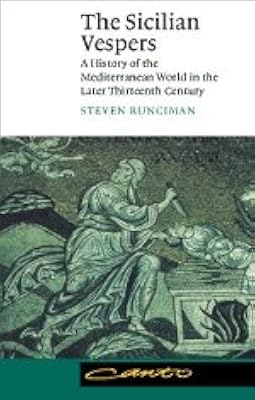
The Sicilian Vespers, a history of the Mediterranean world in the later 13th century
by Steven Runciman
On This Page
Description
On 30 March 1282, as the bells of Palermo were ringing for Vespers, the Sicilian townsfolk, crying 'Death to the French', slaughtered the garrison and administration of their Angevin King. Seen in historical perspective it was not an especially big massacre: the revolt of the long-subjugated Sicilians might seem just another resistance movement. But the events of 1282 came at a crucial moment. Steven Runciman takes the Vespers as the climax of a great narrative sweep covering the whole of show more the Mediterranean in the thirteenth century. His sustained narrative power is displayed here with concentrated brilliance in the rise and fall of this fascinating episode. This is also an excellent guide to the historical background to Dante's Divine Comedy, forming almost a Who's Who of the political figures in it, and providing insight into their placement in Hell, Paradise or Purgatory. show lessTags
Recommendations














Member Reviews
This is a fascinating book about politics and war in the thirteenth century in the Mediterranean and their significance for the history of Europe and in particular the Papacy. It tells the story of Charles, Count of Anjou, brother of the French King Louis IX, Saint Louis. Through his marriage with Beatrice of Provence and the support of his brother and several of the Popes, as well as his political, administrative and military skills, he puts together a large kingdom with lands in France, Sicily, Italy, Albania and even the Holy Land. His core kingdom in the Mediterranean is Sicily, consisting of Sicily and southern Italy. But with his attention focused on other priorities he largely ignores the island of Sicily, which is not as wealthy show more as other holdings and the inhabitants of which he distrusts; he sends French officials to run it. He has a number of successes including defeating King Manfred, a bastard son of Frederick II, manipulating the Papacy and taking control of Italy. He was about to send a fleet in a crusade against Constantinople when revolt in Sicily destroys the main body of his fleet and signals the decline of his power.
The revolt begins when the Sicilians massacre the French garrison at Palermo on March 30, 1282, remembered as the Sicilian Vespers. By instigating events that led to the collapse of Charles’s power in Sicily and Italy, the massacre “altered the fate of nations and of world-wide institutions.” To bring out its importance, Steven Runciman places the massacre in the context of the Mediterranean world in the second half of the thirteenth century. Various threads come together at the massacre: the undoing of Charles by his own arrogance, a conspiracy plotted in Barcelona and Constantinople intended to bring him down and “the gradual suicide of the grandest conception of the Middle Ages, the universal papal monarchy.” The Emperor of Byzantium wanted to disrupt Charles’s plans for an expedition against Constantinople, and King Peter of Aragon, married to Manfred’s daughter Constance, supported a campaign of vengeance against Charles. John of Procida, the King of Aragon’s Chancellor and former Chancellor of Manfred, is generally credited as coordinating the conspiracy with Charles’ opponents in Sicily and Italy. And the Popes, most of whom fully supported Charles (including in the case of Pope Martin IV declaring Holy War against Sicily), severely damaged the Papacy’s credibility as the leader of Christendom.
It is the international setting that brings great complexity to the story. Numerous Popes appear on the scene because many of them die soon after their selection. The struggle between Guelfs (traditional supporters of the Papacy) and Ghibellines (traditional supporters of the Western Emperor) complicates the story in the north of Italy. Dynastic arrangements involving marriages of daughters, sons and grandchildren create new power alliances and territorial holdings. Seesaw struggles between the Latins and the Greeks in Albania and the Peloponnese involve numerous personalities and territories. King Louis’s crusade against the King of Tunis creates a sideshow in North Africa. Charles’s acquisition of the Kingdom of Jerusalem brings the Holy Land into the picture. The ongoing efforts of several Popes and the Byzantine Emperor Michael Palaeologus to implement a union of the churches delayed Charles’s plans for the expedition against Constantinople. (Charles was a loyal son of the Church and would not act without the Pope’s blessing. But this did not stop him from using his power to manipulate the selection of new Popes who would be favorable to him.) Castile, Bulgaria, Serbia, England, Hungary, Bohemia, the Mameluks of Egypt, and the Mongol Ilkhan of Persia all make appearances at different points in the story. In the end, it is by keeping the focus on Charles himself that Runciman enables us to digest this plethora of complications in an intelligible order. A more detailed discussion of the twists and turns of this complicated story is set forth below.
My one criticism is that the book needs a map of Sicily and Southern Italy.
* * *
The prologue provides an introduction to Sicilian history from ancient times through Byzantine and Arab rule to the conquest of the island by the Normans and rule by their descendants. Robert Guiscard and his brother Roger I initiated the conquest in 1060 and completed it by 1091. Roger II became King of Sicily and inherited the Norman holdings in southern Italy as well. His kingdom became a substantial power in the Mediterranean, which was not to the liking of the Papacy and the Western (Hohenstaufen) Emperor. His son, William I, reigned from 1154-1166 and continued his father’s aggressive policies against the Byzantines and the Arabs but also sided with the Papacy against the Emperor, Frederick Barbarossa. William I ran an efficient government but received the surname “the Bad” because of his severity and the unpopularity of his ministers. His son, William II, followed similar policies but his reign (lasting until his death in 1189) was more tranquil so he was called “the Good.” The Sicilians looked back on King William II’s rule as a golden age of rights and liberties, and often recalled “Good King William” in the years that followed.
William the Good died without a male heir. His father’s half-sister Constance and her husband Henry of Hohenstaufen, the son of Frederick Barbarossa, claimed the throne. But the Sicilians and the mainland Italians were not keen to have a German king, so after some intrigue the Crown passed to Tancred, the bastard son of Roger II’s eldest son. Tancred soon died, and Henry arrived with an army to claim his inheritance and was crowned King of Sicily at Palermo on Christmas Day, 1194. On December 26, Constance gave birth to the future Emperor Frederick II. Henry was a harsh ruler and the Sicilians, accustomed to a local ruler, did not appreciate becoming a mere province of the Empire. There was little regret when Henry died in 1197.
Constance died a year later but arranged for Pope Innocent III to act as regent for Frederick, who was formally crowned King of Sicily at Palermo at the age of three and a half. The regency did not go well and when Frederick assumed his royal responsibilities in December 1208 at age 14 the kingdom was greatly impoverished. Having grown up at Palermo, he loved the island and brought it back to prosperity but was not loved by the Sicilians who resented his focus on his ambitions in northern Italy and beyond the Alps. Sicily was no longer the heart and favored part of the kingdom. A diverse land made up of Greeks, Latins and converts from Islam (Frederick had transplanted unconverted Muslims to an area north of Apulia), Sicily was developing a national consciousness. “Sicily, after a brilliant period of independence, saw itself dragged unwillingly into the quagmire of European politics. So long as the magnificent Emperor lived all might be well, for his government was good and his heart was known to be in Sicily, even if his actions seemed sometimes to disprove it. But no one could tell what might not happen under a lesser ruler, if the proud spirit of the Sicilians was not given the respect and consideration that it felt to be its due.” (page 15).
Traditionally, the Empire was the major obstacle to the papal vision of establishing a universal Christian theocracy under the Pope. Accordingly, Innocent IV welcomed Frederick’s death in 1250 as an opportunity to defeat the Empire once and for all and implement the papal vision. However, the Popes misjudged the situation: the Empire was already weakening and new national power centers were arising. By undermining the power of the Hohenstaufen Empire, the Popes overplayed their hand. “The true danger to the Popes was not what they had feared. It was not that the Empire might triumph, but that in destroying the Empire the Papacy itself might commit suicide.” (page 22).
On Frederick’s death, his legitimate son Conrad became the King of Sicily. Another, illegitimate son, Manfred, was given an appanage in southern Italy and was appointed governor of all Italy until Conrad should come and set up his own administration. When Conrad came from Germany in 1251 to assert his control of Italy, Innocent IV was concerned that control of Germany and Italy would make the new Hohenstaufen Emperor too strong. But abruptly in 1254 Conrad died from a fever.
Conrad’s heir was his 2 ½-year-old son, Conrad II, known as Conradin, living in southern Germany. Innocent IV decided that he would take over the kingdom of Sicily subject to considering Conradin’s claims when he came of age. To appease Manfred for the reduction of his territory, the Pope agreed he was to hold the full appanage of Taranto. However, neither party intended to abide by the agreement and Manfred sought support from Conrad’s supporters to prevent the Pope seizing his lands. Manfred succeeded in taking control of southern Italy, and the Pope died knowing his schemes had failed. The new Pope, Alexander IV, continued Innocent’s policies. But Manfred was supreme in southern Italy and also took control of Sicily. He threw off all pretense of loyalty to Conradin and was crowned King of Sicily on August 10, 1258. The Popes henceforth viewed him as a usurper. His ambition was to control all of Italy. “By 1261 all Italy was subject to Manfred’s power; and the Pope was isolated, nervous and powerless, in uncertain possession of Rome and nothing more.” (38).
Manfred’s ambition now turned to Germany and Greece. By supporting the Latin Christians and other opponents (including his father-in-law the Duke of Epirus, a descendant of the Byzantine Angelus family) against the resurgent Byzantine Empire, he hoped both to improve his relations with the Pope (who had been preaching a crusade against the Greeks) and to establish his own power in Greece. However, the Byzantines (now ruled by Michael Palaeologus) won the decisive battle of Pelagonia in 1259 which ensured the Byzantine reconquest of Constantinople and the end of the Latin Empire. Manfred remained the friend of the deposed Latin Emperor, Baldwin II, and still hoped a future expedition to recover Constantinople would put him in the good graces of the Pope.
The new Pope, Urban IV, a Frenchman, sought to strengthen the papal position in Italy and sought ways to weaken Manfred’s dominance. The people in Sicily were disappointed with Manfred, who rarely visited the island, and the Popes had been looking for a candidate to take Manfred’s place on the Sicilian throne. According to papal theory the King of Sicily was the Pope’s vassal, but the Pope would have to find a powerful contender to displace Manfred. While previous Popes had been unsuccessful in finding a French or English candidate (King Louis of France was not interested because, though he disliked Manfred, he also regarded him as a legitimate monarch; King Henry III of England was interested on behalf of his son Edmund but could not afford to pay the financial sum the Popes required to pay off their debts), Pope Urban decided to ask King Louis to reconsider his decision. King Louis compromised by refusing to take the throne himself or for any of his sons but had no objection to the throne being offered to his brother Charles, Count of Anjou. Charles readily agreed to the Pope’s terms in June 1263 even though they were heavily weighted in the Pope’s favor. An ambitious man, Charles knew he could readjust any unwelcome terms later to suit his convenience. His wife Beatrice also was keen to be a queen like her three sisters. Pope Urban IV, seeing Manfred as an immediate threat to Christendom (i.e., papal strength), did not contemplate “that there might be danger ahead if the domination of the Germans in Italy, against which his predecessors had fought so relentlessly, was to be replaced by the domination of the French.” (p. 76).
Almost immediately, Charles had the opportunity to revise the agreement. Contrary to its terms, he was elected a Senator by the city of Rome. Meanwhile, Manfred (usually indolent) had a burst of energy and was threatening Lucca and Ancona, as well as Rome itself. While the Pope was unhappy with changes to the terms of the agreement, he felt he had no choice in light of the threat from Manfred. While the revised agreement was under review, Pope Urban IV died. After several months, in February 1265, the Cardinals in conclave appointed as Pope Clement IV, another French Cardinal, which indicated that, divided as they had been between Charles and Manfred, they had come down in support of the Angevin.
Charles sailed in May 1265 to Rome with a small force, and Manfred withdrew to the south rather than face Charles in a pitched battle. Charles’s main army marched from Lyons and arrived safely in January 1266 in Rome, after bypassing/fighting Manfred’s allies in the north of Italy, the Pallavicini family in Lombardy. Manfred roused himself from his characteristic “lethargy” and gathered the strength of his kingdom. The battle took place as Charles was approaching Benevento. Manfred’s tactical errors led to his defeat and he died in the battle. His kingdom and supporters submitted to Charles (including the Pallavicini). Charles was not vindictive. Manfred’s successes had been undermined by his periods of indolence -- when he would devote himself to his favorite pastime of hunting rather than pay attention to strategic developments or take advantage of opportunities.
Despite his clemency, Charles’s austere nature did not endear him to his new subjects, and Pope Clement IV had been shocked by the sack of Benevento (which in fact Charles had been unable to stop) and unhappy that Charles had been ungenerous in his rewards to the Church. Moreover, the Ghibellines in the north had not forgotten that the 15-year-old Hohenstaufen Conradin was in Germany. Conradin became the locus of Italian opposition to Charles. In his youthful enthusiasm, Conradin decided to make an expedition to Italy to claim his rightful kingdom of Sicily. As he moved through the Alps in September 1267, rebels rose up and seized power in Sicily. By way of Verona and Pisa, he arrived in Rome on July 24, 1268. (Rome had come under the control of Conradin’s ally Henry, the brother of the King of Castile). In the meantime, Charles had been besieging the Saracens in Lucera. When he heard Conradin was in Rome, he marched to Avezzano on the road to Apulia, which Charles had correctly anticipated was the route Conradin would take to enter Apulia. After initial disasters, Charles prevailed at the battle of Tagliacozzo. He captured many of his enemies and was resolved to show no clemency, a sign of weakness, as he had done at Benevento. In particular, Conradin had to die because alive he would be a continuing threat to Charles’s throne. Charges were brought against him, judges pronounced him guilty and he was beheaded on October 29, 1268. His execution shocked the conscience of Europe. “To this day Charles is generally condemned, even by Frenchmen eager to excuse one of the ablest of the Sons of France. To the Germans it has always been the greatest crime in history. Centuries later the poet Heine wrote of it with bitterness. But Charles was a realist who believed that the end justified the means. With Conradin dead he thought that he could reign secure.” (p. 116). This may have been true in the short run, but in the long run Charles was weakened by this merciless act.
A month after Conradin’s execution, Clement IV died, fearing that Charles would not be the Church’s servant as hoped. For three years the conclave of Cardinals could not agree on a replacement—the French cardinals blocked an Italian Pope and the Italians blocked a French one. This meant there was no Pope to restrict Charles’s exercise of power in Rome and the papal states. There was also no Western Emperor to support the Ghibellines in Tuscany so that by the end of 1270 it was under Charles’s control. Lombardy was divided but the opponents of Charles did not pose a threat because they were unsuccessful in getting support from Germany. In August 1269, Charles finally captured the Saracen stronghold of Lucera. Charles recovered Sicily from the rebels. He did not show clemency and his repressive measures against the rebels left a “legacy of bitter hatred.” (p. 125). He put French officials in charge and imposed high taxes to pursue his greater ambitions. His wife Beatrice died after being Queen of Sicily for only one year. Charles involved himself in the details of his administration, and his rule provided order, justice and some prosperity, but he was never popular. With the added resources of his lands in France, Charles intended to build himself a Mediterranean Empire.
His first step was to acquire Corfu and Manfred’s coastal stronghold in Albania that had been in the dowry of his Queen Helena (now the captive of Charles). But Charles had Constantinople in his sights. He entered into an alliance with William of Achaea with a plan for an expedition to sail in the summer of 1270. Alarmed by these preparations, the Byzantine Emperor Michael Palaeologus, in the absence of a pope to deal with, sent an embassy to King Louis proposing a union of the Catholic and Greek Orthodox Churches. Although he would not involve himself in the Pope’s business, this embassy reminded Louis of his desire to conduct another crusade against the infidel to make up for the fiasco of his first one in Egypt. He wanted his brother’s help. Although this would delay the Constantinople expedition and Charles was not in favor of the crusade, Charles could not refuse his brother. But he skillfully directed the crusade against the Muslims in Tunis which would be of direct advantage to him. King Louis landed in Tunis; the king of Tunis, Mustansir, did not come forward to convert to Christianity as Charles had predicted but rather holed up in his fortifications. While waiting for Charles to arrive with his forces, Louis and his army sickened with dysentery and typhoid. Louis, who was already in bad health, died of fever. Charles arrived, defeated Mustansir and negotiated a favorable peace treaty. The French army returned home bur Charles lost eighteen ships in sailing back to Italy, which forced a delay to the Constantinople expedition. In the meantime, he strengthened his position in the Balkans.
New developments delayed Charles’s plans further as well as challenging his power in northern Italy. Consecrated in March 1272, the new Pope, Gregory X, was keen on pursuing the union of the churches and a crusade to the Holy Land. Charles could not pursue his expedition under such circumstances but hoped to do so if the plans for union failed. The Pope did not actively oppose Charles but at the same time did not want the papacy to be dependent on Charles. Indeed, Pope Gregory was happy to have Charles maintain the threat against Constantinople as a negotiating tool with Michael Palaeologus, who was seeking the union precisely because he thought it would preclude an invasion. Michael pursued other diplomatic initiatives to strengthen his position, including providing financial support to the Ghibellines in northern Italy and taking the offensive against Charles’ possessions and allies in Greece. Charles could do little to counter Michael because his hands were tied by the Pope. Meanwhile, in another setback for Charles, the Germans elected Rudolph the Habsburg as the new Western Emperor in October 1273. The Pope supported this result because he thought a German should be Emperor in order to restore order in Germany as well as settling the conflicts between Guelf and Ghibelline in northern Italy. Charles had encouraged his nephew, the new King of France Philip III, to seek the office, but the Pope had not been supportive. Separately, Charles had a falling out with Genoa and was at war with that city at the end of 1272, which expanded to include other Ghibelline cities of northern Italy. As a result, by the summer of 1276 Charles had lost most of his lands in Piedmont.
In May 1274, Pope Gregory opened the Fourteenth Oecumenical Council at Lyons. The Council imposed new restrictions on the cardinals to prevent future long delays in the selection of a new pope, including requiring that cardinals meet without communicating with the outside world until they had made their choice. Little progress was made on a crusade. But the Pope was successful in getting an agreement with the Byzantines for union of the churches, which was formally recognized by a ceremony on July 6, 1274. In an effort to direct Charles’s attention away from Constantinople and towards the Holy Land, the Pope arranged for Charles to purchase the claim to the throne of Jerusalem from Conradin’s heir, Princess Maria of Antioch.
Pope Gregory X died in January 1276. Charles was determined to prevent the election of another pope who shared Gregory’s “inconvenient ideals” of peace in Europe and a crusade against the infidel. The cardinals, conscious of Charles’ nearby presence, chose a cleric known to enjoy Charles’s favor. Innocent V was consecrated in Rome on February 22, 1276. The new Pope immediately confirmed Charles as senator of Rome and Imperial Vicar of Tuscany. The Pope rejected the new Emperor’s protestations on the confirmation of Charles as Imperial Vicar and also arranged peace between Charles and the Genoese. However, four days later, on June 22, 1276, Innocent V died.
Surrounded in the Lateran Palace by Charles’s police, the cardinals chose as the next pope one of Charles’s faithful friends, who became Adrian V. But Adrian died in Viterbo before he could be of assistance to Charles. The conclave met in Viterbo, away from Charles’s police, and selected John XXI as a compromise candidate. John was neither Italian nor French, but rather Portuguese. He was well disposed to Charles and confirmed his traditional rights (Senator of Rome and Imperial Vicar of Tuscany). However, despite the problems Michael was having in persuading his subjects to accept the union of churches, John would not permit an expedition against Constantinople. He followed Gregory’s policy, including favoring Charles’s acquisition of the Kingdom of Jerusalem, which occurred in June 1277. Charles nevertheless remained optimistic that the union of churches would fail and his expedition against Constantinople would then be permitted to proceed.
In May 1277, John XXI died after the ceiling of the new wing at the palace in Viterbo collapsed upon him as he slept. Because John had canceled the papal election reforms adopted at Lyons, the selection of a new pope took six months. A member of the Roman family Orsini was elected on November 25 1277 as Nicholas III. Nicholas asked Charles to resign his positions as Senator of Rome and Imperial Vicar of Tuscany and tried to reconcile Charles and Rudolph. He sided with Charles against Rudolph’s plans to return Provence to Charles’s former sister-in-law, the queen of King Louis. Keeping his ultimate goals in mind, Charles was deferential to the Pope. The union of churches was not going well and Nicholas sent a delegation to check on its acceptance in Byzantium and to impose rigid conditions which went beyond those agreed at Lyons. Michael tried to enforce these conditions throughout the Empire and as a result alienated many of his subjects. While the Pope was not satisfied that his conditions had been met, he also proceeded in a moderate fashion and would not permit Charles to attack Michael.
Then in August 1280 Nicholas died of a heart attack. There was another six months delay. However, the Italian cardinals were divided because some had been unhappy with Nicholas’s rule. In the conclave the cardinals elected a friend of the French royal house who became Pope Martin IV. Martin IV gave back to Charles his senatorial and vicar positions and assisted him in any way he could. He gave the green light to the expedition against Constantinople on the grounds that the Byzantines had not satisfied Nicholas’s conditions.
Michael and Charles had been fighting in Albania and the Peloponnesus, and Michael had the better of these conflicts. But new problems arose for him -- Bulgaria joined his enemies and the Turks began to attack again on the eastern border. By the end of 1280, the outlook for Michael was not good. His enemies were planning an expedition against Constantinople, his efforts to make a deal with the Pope to ward off such an expedition had failed and he had new troubles on other borders. But Runciman points out that Byzantine diplomacy was the best in the world.
At the beginning of 1282, Charles was “the greatest potentate in Europe.” (p. 201). Once he conquered Constantinople, he would rule a Mediterranean empire equal to that of Justinian. But his arrogance blinded him to his danger. Michael Palaeologus had friends. In particular, King Peter of Aragon, who was married to the daughter of Manfred, and his Chancellor John of Procida, who had been Frederick II’s doctor and Manfred’s Chancellor, wanted to avenge Manfred. John coordinated on Peter’s behalf a conspiracy among Michael Palaeologus, the Genoese and the barons of Sicily to destroy Charles. Michael provided Byzantine gold to the Sicilians and the Ghibellines. While Charles was amassing his fleet in Naples, Peter amassed his own fleet at Barcelona, with the avowed goal of a crusade against Muslims in North Africa. According to Sicilian legend, John of Procida personally made two trips secretly to Constantinople to meet with Michael, to Viterbo to meet with Pope Nicholas (to get his blessing for Peter to take the Kingdom of Sicily) and to Sicily to meet with the barons. Runciman doubts that John, who at that time was 70 years old, made these voyages personally, but accepts that his agents (such as his son Francis) may have made these voyages on his behalf. He is also skeptical that Nicholas was willing to support a general war to remove Charles from the Sicilian throne. “The legend errs over John’s physical activities and the Pope’s complicity. But many of its details carry conviction.” (p. 208). John of Procida’s political genius was to target the Sicilians for revolt; he knew that the Italian mainlanders were generally not dissatisfied with Charles, while the Sicilians resented French rule and the neglect by Charles of their island. Charles never visited the island except when he was on his way to the Tunisian crusade with his brother. Also, the Greek element in Sicily was still strong and had some sympathy with the Greeks of Byzantium.
“Charles was wrong to disregard the Sicilians and John of Procida right to seek their support. Of all the peoples of Europe they are the most adept at conspiracy. Their loyalty to the Secret Society is only equaled by their loyalty to the honor of the family. They provided a perfect field for John and his fellow-plotters to cultivate. Their grievances against Angevin rule were real and intense.” Runciman notes that the good conspirator works in silence; accordingly, it is not surprising that there are no records of how the island conspiracy was organized. It is certain that Aragonese agents were working there and that arms were smuggled in. It is also certain that the conspirators were in touch with Constantinople from which they received money. Peter might well wait until Charles was at Constantinople before attacking; Michael could not afford to wait that long and counted on the Sicilians.
King Peter was not making any great effort to hide his intentions. Charles was warned that John of Procida had rallied all the Ghibellines to the support of Aragon. His nephew the King of France told Charles of the huge Aragonese fleet. But Charles ignored these warnings; he thought no one would dare to attack him.
On Easter Monday, March 30, 1282, the Sicilians were attending a Vespers church service outside of Palermo. A group of Frenchmen joined the festivities outside the church and began to pester the young women. The husband of one of the women stabbed a French offender, and the other Sicilians immediately massacred the other Frenchmen while vespers was being sung in the church. Palermo rose up against the hated oppressors and massacred all who did not manage to escape. Other towns followed suit, including nearby Corleone. At first Messina, which had been treated better by Charles, and had his fleet sitting in its harbor, was cautious but soon it also rose up and destroyed the fleet. It also sent a messenger to inform Michael Palaeologus. The Sicilians also sent messengers to the Pope asking him for his protection, but Martin IV fully supported Charles. Once he realized the seriousness of the revolt, Charles postponed his expedition and raised forces to retake the island. Crossing the Straits of Messina, he attacked and blockaded Messina on August 6. Bad weather impeded his attacks but he persisted.
Meanwhile, King Peter had been taken by surprise by the timing of the revolt in Sicily. However, he did not act right away. He continued his pretense of a crusade against Tunis, and indeed sailed to Africa. The Sicilians, repulsed by the Pope, overcame their initial reluctance to welcome a new foreign ruler given that Peter’s wife Constance was the daughter of Manfred and thus in their view the rightful queen of Sicily. They came to Peter in Tunis and persuaded him to become their king. King Peter agreed to bring back the rights and liberties of Sicily from the time of Good King William and set sail for Sicily on August 30, 1282.
King Peter brought his army to Palermo and was proclaimed King of Sicily. He then marched slowly towards Messina, sending messengers ahead ordering Charles to leave the island. Charles would not recognize Peter’s claim but decided to move back across the Straits of Messina to await further reinforcements. His army settled in at Reggio. After securing Sicily and prevailing in some small naval battles with Charles’ forces, Peter also crossed into Calabria and set up a semi blockade of Charles’s position.
While Peter had the support of the Ghibellines in northern Italy, Genoa and the Byzantines, he could not count on them to provide him military forces. Charles on the other hand was fully supported by King Philip of France and by the Pope. However, the cost of war was a major consideration for both rulers. Runciman points to this as an explanation of the odd challenge that King Charles made to King Peter: they should meet in single combat to resolve who would be king of Sicily. The idea being that God would grant the victory to the more deserving king. As Peter was 15 years younger than Charles, the proposal was modified to consist of each King and 100 knights. The Pope opposed the duel (after all, he could speak for God), and both leaders probably had second thoughts. However, neither one could back down without harm to his reputation. Charles left Reggio and moved his army north. The duel was scheduled for June 1, 1283 in English territory at Bordeaux. No specific time was set. King Peter and his knights arrived in the morning to find that his opponent was not there. Peter declared victory and returned to his camp. Later in the afternoon, King Charles arrived with his retinue and also declared victory because Peter was not there. Thus, both kings left Bordeaux claiming victory in the duel. In the meantime, Charles of Salerno, Charles’s son, was issuing decrees to return to the kingdom the rights and liberties of the time of Good King William. But these measures were too late to make a difference.
After the duel, Charles was gathering a force in Provence which he intended to use to recover southern Italy and Sicily. Meanwhile his nephew, King Philip of France, was preparing for an invasion of Aragon. King Peter stayed in Aragon to defend his realm while Queen Constance ruled in Sicily. But the key figure at the time was Roger of Laurial, the admiral of Aragon’s fleet, who secured the defeat of Charles. He successfully obtained control of the seas by defeating Charles’s naval forces whenever they appeared, including capturing Charles of Salerno when he attempted to sail out of Naples to break a blockade. Charles had strictly instructed his son not to attack until he arrived, but disaffection in Naples with the blockade pushed the son to do so. Naples then rose in revolt against the French.
Charles soon arrived with his army, restored order in Naples, and advanced to Reggio to besiege Peter’s forces there. Charles’ fleet bottled up Roger of Lauria in the port of Messina, but Roger escaped during a storm and began to attack the Italian coast, including landing guerrillas behind Charles’s lines. Charles had to give up the siege and retreated to Brindisi, to plan for a new campaign in the spring. However, in Brindisi he fell sick and died, age 58, on January 7, 1283. Runciman sums up the strengths and weaknesses of a man who at one time was the most powerful man in the Mediterranean but died a failure. His administrative and diplomatic skills were of a high order, but he lacked empathy for his subjects and they did not love him. He executed Conradin for strong political reasons, but did not anticipate the revulsion this would cause to the world.
After Charles’s death, the struggles between the Angevin and Aragonese dynasties for control of Sicily continued, with the Pope supporting the Angevin side. Throughout these struggles, the Sicilians were clear that they would never accept French rule again. In the end under King Frederick, the son of Queen Constance and King Peter of Aragon, they eventually achieved their independence which lasted 100 years until 1409, when Sicily became a part of the kingdom of Aragon.
Finally, Runciman looks at the significance of the Sicilian Vespers in the broader context of the history of Europe. The papacy had become inextricably intertwined with Charles and the French. “Their choice of Charles of Anjou is easy to understand; but it was fatal.“ (p. 287). Pope Martin IV was so loyal to Charles that he excommunicated the King of Aragon and the rebels in Sicily, and declared that the war to recover Sicily was a Holy War, a crusade. By using all of his God-given powers to support the particularistic interests of one monarch, he severely damaged the papacy’s credibility. When Charles collapsed, the dream of the universal papacy collapsed with him. The Popes would have been wiser to have continued to cultivate the Empire as a centralizing force that could support their own universal ambitions rather than becoming involved in an affiliation with one nation among others. “The story led to the insult offered to the Holy Father at Anagni [when French troops in 1303 held Pope Boniface VIII captive and physically beat him], to the Babylonian captivity of Avignon, and through schism and dissolution to the troubles of the Reformation.” (p. 287). Nationalism was emerging in Europe and this was directly contrary to the universal ambitions of the papacy. (Charles had recognized the reality of nationalism by using French officials to administer Sicily and other lands but did not realize that nationalism could actually pose a threat to his own strength. By failing to supervise adequately his officials in Sicily and to curb their corruption and arbitrary rule, he brought the revolt upon himself.) (edited January 2022 and April 6, 2025) show less
The revolt begins when the Sicilians massacre the French garrison at Palermo on March 30, 1282, remembered as the Sicilian Vespers. By instigating events that led to the collapse of Charles’s power in Sicily and Italy, the massacre “altered the fate of nations and of world-wide institutions.” To bring out its importance, Steven Runciman places the massacre in the context of the Mediterranean world in the second half of the thirteenth century. Various threads come together at the massacre: the undoing of Charles by his own arrogance, a conspiracy plotted in Barcelona and Constantinople intended to bring him down and “the gradual suicide of the grandest conception of the Middle Ages, the universal papal monarchy.” The Emperor of Byzantium wanted to disrupt Charles’s plans for an expedition against Constantinople, and King Peter of Aragon, married to Manfred’s daughter Constance, supported a campaign of vengeance against Charles. John of Procida, the King of Aragon’s Chancellor and former Chancellor of Manfred, is generally credited as coordinating the conspiracy with Charles’ opponents in Sicily and Italy. And the Popes, most of whom fully supported Charles (including in the case of Pope Martin IV declaring Holy War against Sicily), severely damaged the Papacy’s credibility as the leader of Christendom.
It is the international setting that brings great complexity to the story. Numerous Popes appear on the scene because many of them die soon after their selection. The struggle between Guelfs (traditional supporters of the Papacy) and Ghibellines (traditional supporters of the Western Emperor) complicates the story in the north of Italy. Dynastic arrangements involving marriages of daughters, sons and grandchildren create new power alliances and territorial holdings. Seesaw struggles between the Latins and the Greeks in Albania and the Peloponnese involve numerous personalities and territories. King Louis’s crusade against the King of Tunis creates a sideshow in North Africa. Charles’s acquisition of the Kingdom of Jerusalem brings the Holy Land into the picture. The ongoing efforts of several Popes and the Byzantine Emperor Michael Palaeologus to implement a union of the churches delayed Charles’s plans for the expedition against Constantinople. (Charles was a loyal son of the Church and would not act without the Pope’s blessing. But this did not stop him from using his power to manipulate the selection of new Popes who would be favorable to him.) Castile, Bulgaria, Serbia, England, Hungary, Bohemia, the Mameluks of Egypt, and the Mongol Ilkhan of Persia all make appearances at different points in the story. In the end, it is by keeping the focus on Charles himself that Runciman enables us to digest this plethora of complications in an intelligible order. A more detailed discussion of the twists and turns of this complicated story is set forth below.
My one criticism is that the book needs a map of Sicily and Southern Italy.
* * *
The prologue provides an introduction to Sicilian history from ancient times through Byzantine and Arab rule to the conquest of the island by the Normans and rule by their descendants. Robert Guiscard and his brother Roger I initiated the conquest in 1060 and completed it by 1091. Roger II became King of Sicily and inherited the Norman holdings in southern Italy as well. His kingdom became a substantial power in the Mediterranean, which was not to the liking of the Papacy and the Western (Hohenstaufen) Emperor. His son, William I, reigned from 1154-1166 and continued his father’s aggressive policies against the Byzantines and the Arabs but also sided with the Papacy against the Emperor, Frederick Barbarossa. William I ran an efficient government but received the surname “the Bad” because of his severity and the unpopularity of his ministers. His son, William II, followed similar policies but his reign (lasting until his death in 1189) was more tranquil so he was called “the Good.” The Sicilians looked back on King William II’s rule as a golden age of rights and liberties, and often recalled “Good King William” in the years that followed.
William the Good died without a male heir. His father’s half-sister Constance and her husband Henry of Hohenstaufen, the son of Frederick Barbarossa, claimed the throne. But the Sicilians and the mainland Italians were not keen to have a German king, so after some intrigue the Crown passed to Tancred, the bastard son of Roger II’s eldest son. Tancred soon died, and Henry arrived with an army to claim his inheritance and was crowned King of Sicily at Palermo on Christmas Day, 1194. On December 26, Constance gave birth to the future Emperor Frederick II. Henry was a harsh ruler and the Sicilians, accustomed to a local ruler, did not appreciate becoming a mere province of the Empire. There was little regret when Henry died in 1197.
Constance died a year later but arranged for Pope Innocent III to act as regent for Frederick, who was formally crowned King of Sicily at Palermo at the age of three and a half. The regency did not go well and when Frederick assumed his royal responsibilities in December 1208 at age 14 the kingdom was greatly impoverished. Having grown up at Palermo, he loved the island and brought it back to prosperity but was not loved by the Sicilians who resented his focus on his ambitions in northern Italy and beyond the Alps. Sicily was no longer the heart and favored part of the kingdom. A diverse land made up of Greeks, Latins and converts from Islam (Frederick had transplanted unconverted Muslims to an area north of Apulia), Sicily was developing a national consciousness. “Sicily, after a brilliant period of independence, saw itself dragged unwillingly into the quagmire of European politics. So long as the magnificent Emperor lived all might be well, for his government was good and his heart was known to be in Sicily, even if his actions seemed sometimes to disprove it. But no one could tell what might not happen under a lesser ruler, if the proud spirit of the Sicilians was not given the respect and consideration that it felt to be its due.” (page 15).
Traditionally, the Empire was the major obstacle to the papal vision of establishing a universal Christian theocracy under the Pope. Accordingly, Innocent IV welcomed Frederick’s death in 1250 as an opportunity to defeat the Empire once and for all and implement the papal vision. However, the Popes misjudged the situation: the Empire was already weakening and new national power centers were arising. By undermining the power of the Hohenstaufen Empire, the Popes overplayed their hand. “The true danger to the Popes was not what they had feared. It was not that the Empire might triumph, but that in destroying the Empire the Papacy itself might commit suicide.” (page 22).
On Frederick’s death, his legitimate son Conrad became the King of Sicily. Another, illegitimate son, Manfred, was given an appanage in southern Italy and was appointed governor of all Italy until Conrad should come and set up his own administration. When Conrad came from Germany in 1251 to assert his control of Italy, Innocent IV was concerned that control of Germany and Italy would make the new Hohenstaufen Emperor too strong. But abruptly in 1254 Conrad died from a fever.
Conrad’s heir was his 2 ½-year-old son, Conrad II, known as Conradin, living in southern Germany. Innocent IV decided that he would take over the kingdom of Sicily subject to considering Conradin’s claims when he came of age. To appease Manfred for the reduction of his territory, the Pope agreed he was to hold the full appanage of Taranto. However, neither party intended to abide by the agreement and Manfred sought support from Conrad’s supporters to prevent the Pope seizing his lands. Manfred succeeded in taking control of southern Italy, and the Pope died knowing his schemes had failed. The new Pope, Alexander IV, continued Innocent’s policies. But Manfred was supreme in southern Italy and also took control of Sicily. He threw off all pretense of loyalty to Conradin and was crowned King of Sicily on August 10, 1258. The Popes henceforth viewed him as a usurper. His ambition was to control all of Italy. “By 1261 all Italy was subject to Manfred’s power; and the Pope was isolated, nervous and powerless, in uncertain possession of Rome and nothing more.” (38).
Manfred’s ambition now turned to Germany and Greece. By supporting the Latin Christians and other opponents (including his father-in-law the Duke of Epirus, a descendant of the Byzantine Angelus family) against the resurgent Byzantine Empire, he hoped both to improve his relations with the Pope (who had been preaching a crusade against the Greeks) and to establish his own power in Greece. However, the Byzantines (now ruled by Michael Palaeologus) won the decisive battle of Pelagonia in 1259 which ensured the Byzantine reconquest of Constantinople and the end of the Latin Empire. Manfred remained the friend of the deposed Latin Emperor, Baldwin II, and still hoped a future expedition to recover Constantinople would put him in the good graces of the Pope.
The new Pope, Urban IV, a Frenchman, sought to strengthen the papal position in Italy and sought ways to weaken Manfred’s dominance. The people in Sicily were disappointed with Manfred, who rarely visited the island, and the Popes had been looking for a candidate to take Manfred’s place on the Sicilian throne. According to papal theory the King of Sicily was the Pope’s vassal, but the Pope would have to find a powerful contender to displace Manfred. While previous Popes had been unsuccessful in finding a French or English candidate (King Louis of France was not interested because, though he disliked Manfred, he also regarded him as a legitimate monarch; King Henry III of England was interested on behalf of his son Edmund but could not afford to pay the financial sum the Popes required to pay off their debts), Pope Urban decided to ask King Louis to reconsider his decision. King Louis compromised by refusing to take the throne himself or for any of his sons but had no objection to the throne being offered to his brother Charles, Count of Anjou. Charles readily agreed to the Pope’s terms in June 1263 even though they were heavily weighted in the Pope’s favor. An ambitious man, Charles knew he could readjust any unwelcome terms later to suit his convenience. His wife Beatrice also was keen to be a queen like her three sisters. Pope Urban IV, seeing Manfred as an immediate threat to Christendom (i.e., papal strength), did not contemplate “that there might be danger ahead if the domination of the Germans in Italy, against which his predecessors had fought so relentlessly, was to be replaced by the domination of the French.” (p. 76).
Almost immediately, Charles had the opportunity to revise the agreement. Contrary to its terms, he was elected a Senator by the city of Rome. Meanwhile, Manfred (usually indolent) had a burst of energy and was threatening Lucca and Ancona, as well as Rome itself. While the Pope was unhappy with changes to the terms of the agreement, he felt he had no choice in light of the threat from Manfred. While the revised agreement was under review, Pope Urban IV died. After several months, in February 1265, the Cardinals in conclave appointed as Pope Clement IV, another French Cardinal, which indicated that, divided as they had been between Charles and Manfred, they had come down in support of the Angevin.
Charles sailed in May 1265 to Rome with a small force, and Manfred withdrew to the south rather than face Charles in a pitched battle. Charles’s main army marched from Lyons and arrived safely in January 1266 in Rome, after bypassing/fighting Manfred’s allies in the north of Italy, the Pallavicini family in Lombardy. Manfred roused himself from his characteristic “lethargy” and gathered the strength of his kingdom. The battle took place as Charles was approaching Benevento. Manfred’s tactical errors led to his defeat and he died in the battle. His kingdom and supporters submitted to Charles (including the Pallavicini). Charles was not vindictive. Manfred’s successes had been undermined by his periods of indolence -- when he would devote himself to his favorite pastime of hunting rather than pay attention to strategic developments or take advantage of opportunities.
Despite his clemency, Charles’s austere nature did not endear him to his new subjects, and Pope Clement IV had been shocked by the sack of Benevento (which in fact Charles had been unable to stop) and unhappy that Charles had been ungenerous in his rewards to the Church. Moreover, the Ghibellines in the north had not forgotten that the 15-year-old Hohenstaufen Conradin was in Germany. Conradin became the locus of Italian opposition to Charles. In his youthful enthusiasm, Conradin decided to make an expedition to Italy to claim his rightful kingdom of Sicily. As he moved through the Alps in September 1267, rebels rose up and seized power in Sicily. By way of Verona and Pisa, he arrived in Rome on July 24, 1268. (Rome had come under the control of Conradin’s ally Henry, the brother of the King of Castile). In the meantime, Charles had been besieging the Saracens in Lucera. When he heard Conradin was in Rome, he marched to Avezzano on the road to Apulia, which Charles had correctly anticipated was the route Conradin would take to enter Apulia. After initial disasters, Charles prevailed at the battle of Tagliacozzo. He captured many of his enemies and was resolved to show no clemency, a sign of weakness, as he had done at Benevento. In particular, Conradin had to die because alive he would be a continuing threat to Charles’s throne. Charges were brought against him, judges pronounced him guilty and he was beheaded on October 29, 1268. His execution shocked the conscience of Europe. “To this day Charles is generally condemned, even by Frenchmen eager to excuse one of the ablest of the Sons of France. To the Germans it has always been the greatest crime in history. Centuries later the poet Heine wrote of it with bitterness. But Charles was a realist who believed that the end justified the means. With Conradin dead he thought that he could reign secure.” (p. 116). This may have been true in the short run, but in the long run Charles was weakened by this merciless act.
A month after Conradin’s execution, Clement IV died, fearing that Charles would not be the Church’s servant as hoped. For three years the conclave of Cardinals could not agree on a replacement—the French cardinals blocked an Italian Pope and the Italians blocked a French one. This meant there was no Pope to restrict Charles’s exercise of power in Rome and the papal states. There was also no Western Emperor to support the Ghibellines in Tuscany so that by the end of 1270 it was under Charles’s control. Lombardy was divided but the opponents of Charles did not pose a threat because they were unsuccessful in getting support from Germany. In August 1269, Charles finally captured the Saracen stronghold of Lucera. Charles recovered Sicily from the rebels. He did not show clemency and his repressive measures against the rebels left a “legacy of bitter hatred.” (p. 125). He put French officials in charge and imposed high taxes to pursue his greater ambitions. His wife Beatrice died after being Queen of Sicily for only one year. Charles involved himself in the details of his administration, and his rule provided order, justice and some prosperity, but he was never popular. With the added resources of his lands in France, Charles intended to build himself a Mediterranean Empire.
His first step was to acquire Corfu and Manfred’s coastal stronghold in Albania that had been in the dowry of his Queen Helena (now the captive of Charles). But Charles had Constantinople in his sights. He entered into an alliance with William of Achaea with a plan for an expedition to sail in the summer of 1270. Alarmed by these preparations, the Byzantine Emperor Michael Palaeologus, in the absence of a pope to deal with, sent an embassy to King Louis proposing a union of the Catholic and Greek Orthodox Churches. Although he would not involve himself in the Pope’s business, this embassy reminded Louis of his desire to conduct another crusade against the infidel to make up for the fiasco of his first one in Egypt. He wanted his brother’s help. Although this would delay the Constantinople expedition and Charles was not in favor of the crusade, Charles could not refuse his brother. But he skillfully directed the crusade against the Muslims in Tunis which would be of direct advantage to him. King Louis landed in Tunis; the king of Tunis, Mustansir, did not come forward to convert to Christianity as Charles had predicted but rather holed up in his fortifications. While waiting for Charles to arrive with his forces, Louis and his army sickened with dysentery and typhoid. Louis, who was already in bad health, died of fever. Charles arrived, defeated Mustansir and negotiated a favorable peace treaty. The French army returned home bur Charles lost eighteen ships in sailing back to Italy, which forced a delay to the Constantinople expedition. In the meantime, he strengthened his position in the Balkans.
New developments delayed Charles’s plans further as well as challenging his power in northern Italy. Consecrated in March 1272, the new Pope, Gregory X, was keen on pursuing the union of the churches and a crusade to the Holy Land. Charles could not pursue his expedition under such circumstances but hoped to do so if the plans for union failed. The Pope did not actively oppose Charles but at the same time did not want the papacy to be dependent on Charles. Indeed, Pope Gregory was happy to have Charles maintain the threat against Constantinople as a negotiating tool with Michael Palaeologus, who was seeking the union precisely because he thought it would preclude an invasion. Michael pursued other diplomatic initiatives to strengthen his position, including providing financial support to the Ghibellines in northern Italy and taking the offensive against Charles’ possessions and allies in Greece. Charles could do little to counter Michael because his hands were tied by the Pope. Meanwhile, in another setback for Charles, the Germans elected Rudolph the Habsburg as the new Western Emperor in October 1273. The Pope supported this result because he thought a German should be Emperor in order to restore order in Germany as well as settling the conflicts between Guelf and Ghibelline in northern Italy. Charles had encouraged his nephew, the new King of France Philip III, to seek the office, but the Pope had not been supportive. Separately, Charles had a falling out with Genoa and was at war with that city at the end of 1272, which expanded to include other Ghibelline cities of northern Italy. As a result, by the summer of 1276 Charles had lost most of his lands in Piedmont.
In May 1274, Pope Gregory opened the Fourteenth Oecumenical Council at Lyons. The Council imposed new restrictions on the cardinals to prevent future long delays in the selection of a new pope, including requiring that cardinals meet without communicating with the outside world until they had made their choice. Little progress was made on a crusade. But the Pope was successful in getting an agreement with the Byzantines for union of the churches, which was formally recognized by a ceremony on July 6, 1274. In an effort to direct Charles’s attention away from Constantinople and towards the Holy Land, the Pope arranged for Charles to purchase the claim to the throne of Jerusalem from Conradin’s heir, Princess Maria of Antioch.
Pope Gregory X died in January 1276. Charles was determined to prevent the election of another pope who shared Gregory’s “inconvenient ideals” of peace in Europe and a crusade against the infidel. The cardinals, conscious of Charles’ nearby presence, chose a cleric known to enjoy Charles’s favor. Innocent V was consecrated in Rome on February 22, 1276. The new Pope immediately confirmed Charles as senator of Rome and Imperial Vicar of Tuscany. The Pope rejected the new Emperor’s protestations on the confirmation of Charles as Imperial Vicar and also arranged peace between Charles and the Genoese. However, four days later, on June 22, 1276, Innocent V died.
Surrounded in the Lateran Palace by Charles’s police, the cardinals chose as the next pope one of Charles’s faithful friends, who became Adrian V. But Adrian died in Viterbo before he could be of assistance to Charles. The conclave met in Viterbo, away from Charles’s police, and selected John XXI as a compromise candidate. John was neither Italian nor French, but rather Portuguese. He was well disposed to Charles and confirmed his traditional rights (Senator of Rome and Imperial Vicar of Tuscany). However, despite the problems Michael was having in persuading his subjects to accept the union of churches, John would not permit an expedition against Constantinople. He followed Gregory’s policy, including favoring Charles’s acquisition of the Kingdom of Jerusalem, which occurred in June 1277. Charles nevertheless remained optimistic that the union of churches would fail and his expedition against Constantinople would then be permitted to proceed.
In May 1277, John XXI died after the ceiling of the new wing at the palace in Viterbo collapsed upon him as he slept. Because John had canceled the papal election reforms adopted at Lyons, the selection of a new pope took six months. A member of the Roman family Orsini was elected on November 25 1277 as Nicholas III. Nicholas asked Charles to resign his positions as Senator of Rome and Imperial Vicar of Tuscany and tried to reconcile Charles and Rudolph. He sided with Charles against Rudolph’s plans to return Provence to Charles’s former sister-in-law, the queen of King Louis. Keeping his ultimate goals in mind, Charles was deferential to the Pope. The union of churches was not going well and Nicholas sent a delegation to check on its acceptance in Byzantium and to impose rigid conditions which went beyond those agreed at Lyons. Michael tried to enforce these conditions throughout the Empire and as a result alienated many of his subjects. While the Pope was not satisfied that his conditions had been met, he also proceeded in a moderate fashion and would not permit Charles to attack Michael.
Then in August 1280 Nicholas died of a heart attack. There was another six months delay. However, the Italian cardinals were divided because some had been unhappy with Nicholas’s rule. In the conclave the cardinals elected a friend of the French royal house who became Pope Martin IV. Martin IV gave back to Charles his senatorial and vicar positions and assisted him in any way he could. He gave the green light to the expedition against Constantinople on the grounds that the Byzantines had not satisfied Nicholas’s conditions.
Michael and Charles had been fighting in Albania and the Peloponnesus, and Michael had the better of these conflicts. But new problems arose for him -- Bulgaria joined his enemies and the Turks began to attack again on the eastern border. By the end of 1280, the outlook for Michael was not good. His enemies were planning an expedition against Constantinople, his efforts to make a deal with the Pope to ward off such an expedition had failed and he had new troubles on other borders. But Runciman points out that Byzantine diplomacy was the best in the world.
At the beginning of 1282, Charles was “the greatest potentate in Europe.” (p. 201). Once he conquered Constantinople, he would rule a Mediterranean empire equal to that of Justinian. But his arrogance blinded him to his danger. Michael Palaeologus had friends. In particular, King Peter of Aragon, who was married to the daughter of Manfred, and his Chancellor John of Procida, who had been Frederick II’s doctor and Manfred’s Chancellor, wanted to avenge Manfred. John coordinated on Peter’s behalf a conspiracy among Michael Palaeologus, the Genoese and the barons of Sicily to destroy Charles. Michael provided Byzantine gold to the Sicilians and the Ghibellines. While Charles was amassing his fleet in Naples, Peter amassed his own fleet at Barcelona, with the avowed goal of a crusade against Muslims in North Africa. According to Sicilian legend, John of Procida personally made two trips secretly to Constantinople to meet with Michael, to Viterbo to meet with Pope Nicholas (to get his blessing for Peter to take the Kingdom of Sicily) and to Sicily to meet with the barons. Runciman doubts that John, who at that time was 70 years old, made these voyages personally, but accepts that his agents (such as his son Francis) may have made these voyages on his behalf. He is also skeptical that Nicholas was willing to support a general war to remove Charles from the Sicilian throne. “The legend errs over John’s physical activities and the Pope’s complicity. But many of its details carry conviction.” (p. 208). John of Procida’s political genius was to target the Sicilians for revolt; he knew that the Italian mainlanders were generally not dissatisfied with Charles, while the Sicilians resented French rule and the neglect by Charles of their island. Charles never visited the island except when he was on his way to the Tunisian crusade with his brother. Also, the Greek element in Sicily was still strong and had some sympathy with the Greeks of Byzantium.
“Charles was wrong to disregard the Sicilians and John of Procida right to seek their support. Of all the peoples of Europe they are the most adept at conspiracy. Their loyalty to the Secret Society is only equaled by their loyalty to the honor of the family. They provided a perfect field for John and his fellow-plotters to cultivate. Their grievances against Angevin rule were real and intense.” Runciman notes that the good conspirator works in silence; accordingly, it is not surprising that there are no records of how the island conspiracy was organized. It is certain that Aragonese agents were working there and that arms were smuggled in. It is also certain that the conspirators were in touch with Constantinople from which they received money. Peter might well wait until Charles was at Constantinople before attacking; Michael could not afford to wait that long and counted on the Sicilians.
King Peter was not making any great effort to hide his intentions. Charles was warned that John of Procida had rallied all the Ghibellines to the support of Aragon. His nephew the King of France told Charles of the huge Aragonese fleet. But Charles ignored these warnings; he thought no one would dare to attack him.
On Easter Monday, March 30, 1282, the Sicilians were attending a Vespers church service outside of Palermo. A group of Frenchmen joined the festivities outside the church and began to pester the young women. The husband of one of the women stabbed a French offender, and the other Sicilians immediately massacred the other Frenchmen while vespers was being sung in the church. Palermo rose up against the hated oppressors and massacred all who did not manage to escape. Other towns followed suit, including nearby Corleone. At first Messina, which had been treated better by Charles, and had his fleet sitting in its harbor, was cautious but soon it also rose up and destroyed the fleet. It also sent a messenger to inform Michael Palaeologus. The Sicilians also sent messengers to the Pope asking him for his protection, but Martin IV fully supported Charles. Once he realized the seriousness of the revolt, Charles postponed his expedition and raised forces to retake the island. Crossing the Straits of Messina, he attacked and blockaded Messina on August 6. Bad weather impeded his attacks but he persisted.
Meanwhile, King Peter had been taken by surprise by the timing of the revolt in Sicily. However, he did not act right away. He continued his pretense of a crusade against Tunis, and indeed sailed to Africa. The Sicilians, repulsed by the Pope, overcame their initial reluctance to welcome a new foreign ruler given that Peter’s wife Constance was the daughter of Manfred and thus in their view the rightful queen of Sicily. They came to Peter in Tunis and persuaded him to become their king. King Peter agreed to bring back the rights and liberties of Sicily from the time of Good King William and set sail for Sicily on August 30, 1282.
King Peter brought his army to Palermo and was proclaimed King of Sicily. He then marched slowly towards Messina, sending messengers ahead ordering Charles to leave the island. Charles would not recognize Peter’s claim but decided to move back across the Straits of Messina to await further reinforcements. His army settled in at Reggio. After securing Sicily and prevailing in some small naval battles with Charles’ forces, Peter also crossed into Calabria and set up a semi blockade of Charles’s position.
While Peter had the support of the Ghibellines in northern Italy, Genoa and the Byzantines, he could not count on them to provide him military forces. Charles on the other hand was fully supported by King Philip of France and by the Pope. However, the cost of war was a major consideration for both rulers. Runciman points to this as an explanation of the odd challenge that King Charles made to King Peter: they should meet in single combat to resolve who would be king of Sicily. The idea being that God would grant the victory to the more deserving king. As Peter was 15 years younger than Charles, the proposal was modified to consist of each King and 100 knights. The Pope opposed the duel (after all, he could speak for God), and both leaders probably had second thoughts. However, neither one could back down without harm to his reputation. Charles left Reggio and moved his army north. The duel was scheduled for June 1, 1283 in English territory at Bordeaux. No specific time was set. King Peter and his knights arrived in the morning to find that his opponent was not there. Peter declared victory and returned to his camp. Later in the afternoon, King Charles arrived with his retinue and also declared victory because Peter was not there. Thus, both kings left Bordeaux claiming victory in the duel. In the meantime, Charles of Salerno, Charles’s son, was issuing decrees to return to the kingdom the rights and liberties of the time of Good King William. But these measures were too late to make a difference.
After the duel, Charles was gathering a force in Provence which he intended to use to recover southern Italy and Sicily. Meanwhile his nephew, King Philip of France, was preparing for an invasion of Aragon. King Peter stayed in Aragon to defend his realm while Queen Constance ruled in Sicily. But the key figure at the time was Roger of Laurial, the admiral of Aragon’s fleet, who secured the defeat of Charles. He successfully obtained control of the seas by defeating Charles’s naval forces whenever they appeared, including capturing Charles of Salerno when he attempted to sail out of Naples to break a blockade. Charles had strictly instructed his son not to attack until he arrived, but disaffection in Naples with the blockade pushed the son to do so. Naples then rose in revolt against the French.
Charles soon arrived with his army, restored order in Naples, and advanced to Reggio to besiege Peter’s forces there. Charles’ fleet bottled up Roger of Lauria in the port of Messina, but Roger escaped during a storm and began to attack the Italian coast, including landing guerrillas behind Charles’s lines. Charles had to give up the siege and retreated to Brindisi, to plan for a new campaign in the spring. However, in Brindisi he fell sick and died, age 58, on January 7, 1283. Runciman sums up the strengths and weaknesses of a man who at one time was the most powerful man in the Mediterranean but died a failure. His administrative and diplomatic skills were of a high order, but he lacked empathy for his subjects and they did not love him. He executed Conradin for strong political reasons, but did not anticipate the revulsion this would cause to the world.
After Charles’s death, the struggles between the Angevin and Aragonese dynasties for control of Sicily continued, with the Pope supporting the Angevin side. Throughout these struggles, the Sicilians were clear that they would never accept French rule again. In the end under King Frederick, the son of Queen Constance and King Peter of Aragon, they eventually achieved their independence which lasted 100 years until 1409, when Sicily became a part of the kingdom of Aragon.
Finally, Runciman looks at the significance of the Sicilian Vespers in the broader context of the history of Europe. The papacy had become inextricably intertwined with Charles and the French. “Their choice of Charles of Anjou is easy to understand; but it was fatal.“ (p. 287). Pope Martin IV was so loyal to Charles that he excommunicated the King of Aragon and the rebels in Sicily, and declared that the war to recover Sicily was a Holy War, a crusade. By using all of his God-given powers to support the particularistic interests of one monarch, he severely damaged the papacy’s credibility. When Charles collapsed, the dream of the universal papacy collapsed with him. The Popes would have been wiser to have continued to cultivate the Empire as a centralizing force that could support their own universal ambitions rather than becoming involved in an affiliation with one nation among others. “The story led to the insult offered to the Holy Father at Anagni [when French troops in 1303 held Pope Boniface VIII captive and physically beat him], to the Babylonian captivity of Avignon, and through schism and dissolution to the troubles of the Reformation.” (p. 287). Nationalism was emerging in Europe and this was directly contrary to the universal ambitions of the papacy. (Charles had recognized the reality of nationalism by using French officials to administer Sicily and other lands but did not realize that nationalism could actually pose a threat to his own strength. By failing to supervise adequately his officials in Sicily and to curb their corruption and arbitrary rule, he brought the revolt upon himself.) (edited January 2022 and April 6, 2025) show less
This book takes it name from the "Sicilian Vespers", a popular uprising in that flared up at vespers in Palermo, Easter 1282 and quickly ended Angevin rule on Sicily, but it's rather about the rise and sort-of fall of Charles of Anjou, the first, and as far as the island itself was concerned, last Angevin king of Sicily.
The younger brother of Saint Louis of France, Charles had been called in in 1266 to deliver the Papacy from the heirs of Frederick II, who in the person of Manfred of Sicily seemed on the verge of extinguishing the pope's temporal power outright. Victorious in the great battles of Benevento (1266, against Manfred) and Tagliacozzo (1268, against Conradin, the last generally recognized Hohenstaufen heir), he was rewarded show more with the Kingdom of Sicily, which apart from the island itself covered about the southern third of mainland Italy.
For the next fourteen years Charles was, in alliance with the Papacy, the effective overlord also of much of the rest Italy, and found time to acquire the crowns of Jerusalem and Albania. In the early 1280s he was planning an invasion of Byzantium to restore the defunct Latin Empire of Constantinople.
The Sicilian Vespers then marks the beginning of the fall, or at least the downward course of Charles' fortunes. The Sicilians called in the king of Aragon, whose wife was a Hohenstaufen princess, to rule them, and Charles, despite the backing of the Papacy and the French monarchy was unable to retake the island, let alone pursue his eastern ambitions. Instead, a twenty year war lasted long beyond his death in 1285, to end with the kingdom partitioned, with Sicily proper remaining with the Aragonese while Charles' heirs kept the mainland part of the kingdom (officially still called the "Kingdom of Sicily", but usually known as as the "Kingdom of Naples" to reduce the confusion of latter-day students).
Runciman's is a style of narrative history that could hardly be written today, on the one hand scholarly, on the other always eager to pass aesthetic or moral judgement. The latter can annoy me - I'm not all that interested in whether Manfred of Sicily or Charles of Anjou was a great man, particularly as the criteria are never stated. On the plus side, he's an excellent stylist, at his best when describing battles and other dramatic events. He can get confusing when summarizing longer developments; a chronology and a list of the major personalities with dates and allegiances stated would have been helpful.
To be recommended if you like old-fashioned narrative history. show less
The younger brother of Saint Louis of France, Charles had been called in in 1266 to deliver the Papacy from the heirs of Frederick II, who in the person of Manfred of Sicily seemed on the verge of extinguishing the pope's temporal power outright. Victorious in the great battles of Benevento (1266, against Manfred) and Tagliacozzo (1268, against Conradin, the last generally recognized Hohenstaufen heir), he was rewarded show more with the Kingdom of Sicily, which apart from the island itself covered about the southern third of mainland Italy.
For the next fourteen years Charles was, in alliance with the Papacy, the effective overlord also of much of the rest Italy, and found time to acquire the crowns of Jerusalem and Albania. In the early 1280s he was planning an invasion of Byzantium to restore the defunct Latin Empire of Constantinople.
The Sicilian Vespers then marks the beginning of the fall, or at least the downward course of Charles' fortunes. The Sicilians called in the king of Aragon, whose wife was a Hohenstaufen princess, to rule them, and Charles, despite the backing of the Papacy and the French monarchy was unable to retake the island, let alone pursue his eastern ambitions. Instead, a twenty year war lasted long beyond his death in 1285, to end with the kingdom partitioned, with Sicily proper remaining with the Aragonese while Charles' heirs kept the mainland part of the kingdom (officially still called the "Kingdom of Sicily", but usually known as as the "Kingdom of Naples" to reduce the confusion of latter-day students).
Runciman's is a style of narrative history that could hardly be written today, on the one hand scholarly, on the other always eager to pass aesthetic or moral judgement. The latter can annoy me - I'm not all that interested in whether Manfred of Sicily or Charles of Anjou was a great man, particularly as the criteria are never stated. On the plus side, he's an excellent stylist, at his best when describing battles and other dramatic events. He can get confusing when summarizing longer developments; a chronology and a list of the major personalities with dates and allegiances stated would have been helpful.
To be recommended if you like old-fashioned narrative history. show less
There were few medieval historians writing in English about the affairs of the thirteenth century Mediterranean in the mid twentieth century. Sir Stephen Runciman was one of the few. Into the bargain, his major works dealt with the more complex events that convulsed the basin. Runciman had a mind and research skills equal to the task. This is one of his major works and is still read with profit by students of the period and the place. Sicily, as it had been in the early eleventh century became for a brief period, the cockpit of Europe. The Norman kingdom in the island was tossed between the declining Holy Roman empire and the emerging French monarchy. Into the bargain, the Crusading attempt to destroy the Byzantine state had just show more recently failed, leaving the resurgent Byzantines with enough desperation to fish in these troubled waters with devastating results for their most likely enemies. The story requires careful reading to sort out the players and keep track of their conflicting strategies. I recommend this book as an example of the high levels of plotting our ancestors could rise to. show less
No conception in medieval history was finer than that of the Universal Church, uniting Christendom into one great theocracy governed by the impartial wisdom of the Vicar of God. But in this sinful world even the Vicar of God needs material strength to enforce his holy will.
Feel free to read the above with cynicism. Runciman offers a series of top-down facts. The doctor doesn't appear troubled by living conditions or world views. The principal characters trot onto stage and various episodes unfold. Causality is short-changed. The only detail supplied pertains to battles. One is quickly struck by the precarious health of the Bishops of Rome: it appears that a pope dies every few pages. Ultimately the Sicilians, once a proud multicultural show more society rebel in 1282 against their Angevin occupiers. Their French hegemon, Charles of Anjou had hoped to create a Latin Empire and retake Constantinople from those Greek-speaking Orthodox buggers. As a result of this unexpected intifada, all such Norman expansionist matters ground to a halt. The papacy shifted gears and nationalism edged ahead of the Universal Church. This is not a satisfying text, but it did whet appetites for further researches. show less
Feel free to read the above with cynicism. Runciman offers a series of top-down facts. The doctor doesn't appear troubled by living conditions or world views. The principal characters trot onto stage and various episodes unfold. Causality is short-changed. The only detail supplied pertains to battles. One is quickly struck by the precarious health of the Bishops of Rome: it appears that a pope dies every few pages. Ultimately the Sicilians, once a proud multicultural show more society rebel in 1282 against their Angevin occupiers. Their French hegemon, Charles of Anjou had hoped to create a Latin Empire and retake Constantinople from those Greek-speaking Orthodox buggers. As a result of this unexpected intifada, all such Norman expansionist matters ground to a halt. The papacy shifted gears and nationalism edged ahead of the Universal Church. This is not a satisfying text, but it did whet appetites for further researches. show less
1749 The Sicilian Vespers: A History of the Mediterranean World in the Later Thirteenth Century, by Steven Runciman (read 7 Nov 1982) (Book of the Year) This is an almost perfect book. Runciman's views on the Church are not bad--he says Martin IV was a disaster and he is so right--and he tells this story perfectly. First I thought the book drug, because it tells so much 13th century history, which I am not strong in (it is the one century that I have not read much papal history in), but the work is brilliant and shows the Sicilian Vespers--on Easter Monday, March 20, 1282--as the key event it was. Of course, my great enjoyment of Runciman's three volumes on the Crusades in 1974 told me this book would be great. This book makes Charles show more of Anjou really come alive for me--it is he who was ruling Sicily. Runciman concludes: "By crushing the Universal Empire, which alone might possibly have provided such a support [which all Christendom could trust] the Popes set themselves a hard problem. Their choice of Charles of Anjou is easy to understand; but it was fatal. When Charles' power was broken by the Vespers at Palermo they were too inextricably involved. The story led on to the insult offered to the Holy Father at Anagni, to the Babylonian Captivity at Avignon, and through schism and disillusion to the troubles of the Reformation. It altered fundamentally the history of Christendom." show less
Runciman is a historian of the old school. Straight chronological narrative, no post-modern analysis. Very refreshing and entertaining. After reading I had a better sense of the scale of time and distance and travel and communications in the lives of Medieval people. Also how quickly fortunes changed and how life in the Middle Ages could seem both eternal and fleeting at the same time.
The book's title suggests it is about the revolt in Sicily in 1282 which began with a massacre during Vespers in Palermo, but it really has a much broader focus -- the revolt itself, at least the early and dramatic part, occupies six pages, 75 pages from the end of a 312 page book. The book as a whole is about the rise and fall of Charles of Anjou (1226-85), brother of King Louis IX of France (Saint Louis), and also provides the necessary context to understand his rise, by recounting the fortunes and decline the the Hohenstaufen emperors in Italy: Frederick II, who was the Antichrist to Pope Gregory IX; Conrad IV, and King Manfred of Sicily, who Charles took the Kingdom from. It also provides context from the East, which mainly consists show more of Michael Palaeologus of Nicea's conquest of the Latin Empire set up by the crusaders who took Constantinople some decades earlier.
It's good, but generally bewildering, jumping from person to place at a speedy clip. There is an enormous fold-out genealogical chart of the back of my copy, which would be handy if it weren't sixty years old and printed on the poor quality paper you find in old Pelican paperbacks. I suggest following along with a pencil for drawing these family trees and a few maps handy. Runciman makes the probably-fair assumption early on that you know most of the Kingdom of Sicily consists of southern peninsular Italy -- everything from approximately Naples, south. Sicily proper plays a role mainly for Frederick II and during and after the Vespers. I didn't realise, and that confused the hell out of me initially.
Runciman does have a particular gift for detailed descriptions of events rather than chronologies, and this comes out during the battles of Benevento (Charles v Manfred) and Tagliacozzo (Conradin v Charles), and to a lesser extent smaller battles and events throughout. But most of the book would be better described as a chronology, and although he does attempt to draw some larger points about the Empire, the papacy, and nationalism near the beginning and the end, I don't feel it is as strong a motivation for him as the story itself. Which is fine, in a way. show less
It's good, but generally bewildering, jumping from person to place at a speedy clip. There is an enormous fold-out genealogical chart of the back of my copy, which would be handy if it weren't sixty years old and printed on the poor quality paper you find in old Pelican paperbacks. I suggest following along with a pencil for drawing these family trees and a few maps handy. Runciman makes the probably-fair assumption early on that you know most of the Kingdom of Sicily consists of southern peninsular Italy -- everything from approximately Naples, south. Sicily proper plays a role mainly for Frederick II and during and after the Vespers. I didn't realise, and that confused the hell out of me initially.
Runciman does have a particular gift for detailed descriptions of events rather than chronologies, and this comes out during the battles of Benevento (Charles v Manfred) and Tagliacozzo (Conradin v Charles), and to a lesser extent smaller battles and events throughout. But most of the book would be better described as a chronology, and although he does attempt to draw some larger points about the Empire, the papacy, and nationalism near the beginning and the end, I don't feel it is as strong a motivation for him as the story itself. Which is fine, in a way. show less
Members
- Recently Added By
Lists

Further Reading Recommended by Herrin's Byzantium
151 works; 1 member
Author Information

35+ Works 6,334 Members
Sir Steven Runciman was one of the most acclaimed historians of the Byzantine ear and the author of many influential works, including the three-volume History of the Crusades.
Series
Belongs to Publisher Series
Common Knowledge
- Canonical title
- The Sicilian Vespers, a history of the Mediterranean world in the later 13th century
- Original title
- The Sicilian Vespers, a history of the Mediterranean world in the later 13th century
- Alternate titles
- The Sicilian Vespers
- Original publication date
- 1958 (1st UK original publishing, Cambridge University press) (1st UK original publishing, Cambridge University press); 1989 (New UK publishing, Cambridge university press) (New UK publishing, Cambridge university press)
- People/Characters
- Charles of Anjou, King of Naples; Beatrice of Provence; Louis IX, King of France; Manfred of Sicily; Pope Martin IV; Michael VIII Palaeologos, Emperor of Byzantium
- Important places
- Sicily, Italy; Benevento, Italy; Messina, Italy; Palermo, Italy; Tagliacozzo, Italy
- Dedication
- To George Macaulay Trevelyan in admiration, gratitude and friendship
- First words
- Preface -- The Sicilian Vespers are seldom remembered nowadays.
- Last words
- (Click to show. Warning: May contain spoilers.)Appendix [...] The organization of the conspiracy and the alliances that enabled it to succeed was chiefly due to John of Procida; but the financing and the dating were the work of the Emperor at Constantinople.
- Original language
- English (UK) (UK)
Classifications
- Genres
- History, Nonfiction, General Nonfiction, Religion & Spirituality
- DDC/MDS
- 909.0982202 — History & geography History World history Other Geographic Classifications Other Classifications Ocean And Sea Basins Mediterranean
- LCC
- DG867.28 .R8 — History of Europe, Asia, Africa and Oceania City History of Italy Southern Italy Sicily
- BISAC
Statistics
- Members
- 512
- Popularity
- 58,640
- Reviews
- 10
- Rating
- (4.11)
- Languages
- 9 — Dutch, English, French, German, Hungarian, Italian, Polish, Romanian, Spanish
- Media
- Paper
- ISBNs
- 15
- ASINs
- 25