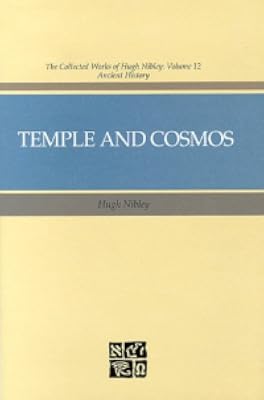
Temple and Cosmos: Beyond This Ignorant Present (The Collected Works of Hugh Nibley, Vol 12 : Ancient History)
by Hugh Nibley, Don E. Norton (Editor)
Foundation for Ancient Research and Mormon Studies (Temple and the Cosmos (Vol 12)), The Collected Works of Hugh Nibley (12)
On This Page
Description
Renowned scholar Hugh Nibley presents a fascinating work written in two distinct yet related sections. In Temple Nibley discusses the meaning of the temple, the history and origin of ordinances and sacred vestments, and the temple's necessity in the Lord's work today.In Cosmos Nibley explores man's place in the cosmos, or the expanse of Heavenly Father's kingdom, and how the temple fits into this divine realm of existence. he also writes about the importance and significance of language and show more writing in a chapter entitled "Genesis of the Written Word."
. show less
Tags
Recommendations



























Member Reviews
This morning [March 2, 2014] we went to the Gilbert Temple Dedication. I came home with lots of thoughts running through my head. After pondering for a few minutes, I decided to begin reading the book Temple and Cosmos, one of the volumes of the collected works of Hugh Nibley.
The first chapter was fascinating. The first four chapters are on temples. The balance, and majority of the book is on Cosmos.
"In 1816, the apocrypha were outlawed by the American Bible Society (which had great influence). So they came to have no prestige, were not read, were not know at all. They were not published in this country; little was known about them. The apocrypha sank to their lowest level in 1945, when H. H. Rowley, the last surviving person to study show more the apocrypha said, 'We'll just close the door now and forget about these. Nobody's reading them anymore. It is so.' And then, bingo, next year the whole thing broke loose again, and everyone was embarrassed, because no one knew anything about apocrypha. The new discoveries caught them completely off guard. (Page 258-259)
"The way these writings talk about these matters is extremely interesting it certainly beats science fiction. ... Since the ideas are nothing but conscious or unconscious plagiarism of biblical and apocryphal ideas ... why do these works have so much greater appeal than the originals? Because the originals, as they are given in the Bible and the apocrypha, have been systematically denatured. ... science fiction - 'folk scripture' - has taken the place of real scripture. (Page 275-276) The science fiction chapter is quite a bit later in the book.
"A wonderful passage from Socrates says, 'When I was a kid and went to school, science knew all the answers' ... "Plutarch talks about the same thing. He says the new physics taught people 'to despise all the superstitious fears which the awe-inspiring signs in the heavens arouse in the minds of those who are ignorant of the real cause of things.' (Page 516) And on and on it goes, with the 20th and 21st century getting the same anti-god rhetoric as millennium ago. The conflict between good and evil has not changed, and will continue. show less
The first chapter was fascinating. The first four chapters are on temples. The balance, and majority of the book is on Cosmos.
"In 1816, the apocrypha were outlawed by the American Bible Society (which had great influence). So they came to have no prestige, were not read, were not know at all. They were not published in this country; little was known about them. The apocrypha sank to their lowest level in 1945, when H. H. Rowley, the last surviving person to study show more the apocrypha said, 'We'll just close the door now and forget about these. Nobody's reading them anymore. It is so.' And then, bingo, next year the whole thing broke loose again, and everyone was embarrassed, because no one knew anything about apocrypha. The new discoveries caught them completely off guard. (Page 258-259)
"The way these writings talk about these matters is extremely interesting it certainly beats science fiction. ... Since the ideas are nothing but conscious or unconscious plagiarism of biblical and apocryphal ideas ... why do these works have so much greater appeal than the originals? Because the originals, as they are given in the Bible and the apocrypha, have been systematically denatured. ... science fiction - 'folk scripture' - has taken the place of real scripture. (Page 275-276) The science fiction chapter is quite a bit later in the book.
"A wonderful passage from Socrates says, 'When I was a kid and went to school, science knew all the answers' ... "Plutarch talks about the same thing. He says the new physics taught people 'to despise all the superstitious fears which the awe-inspiring signs in the heavens arouse in the minds of those who are ignorant of the real cause of things.' (Page 516) And on and on it goes, with the 20th and 21st century getting the same anti-god rhetoric as millennium ago. The conflict between good and evil has not changed, and will continue. show less
Ratings
Members
- Recently Added By
Author Information

77+ Works 2,760 Members
Some Editions
Series


Classifications
- Genres
- Nonfiction, Religion & Spirituality, History, General Nonfiction
- DDC/MDS
- 246.95893 — Religion Christian practice & observance Use of art in Christianity
- LCC
- BX8643 .T4 .N53 — Philosophy, Psychology and Religion Christian Denominations Christian Denominations Protestantism Other Protestant denominations Mormons. Church of Jesus Christ of Latter-Day Saints
Statistics
- Members
- 187
- Popularity
- 174,954
- Reviews
- 1
- Rating
- (4.34)
- Languages
- English
- Media
- Paper, Ebook
- ISBNs
- 2