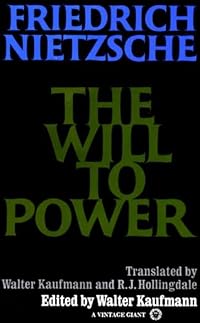
The Will to Power
by Friedrich Nietzsche 
On This Page
Description
"One of the great minds of modernity, Friedrich Nietzsche smashed through the beliefs of his age. These writings, which did much to establish his reputation as a philosopher, offer some of his most powerful and troubling thoughts: on how the values of a new, aggressive elite will save a nihilistic, mediocre Europe, and, most famously, on the 'will to power'--ideas that were seized upon and twisted by later readers. Taken from Nietzsche's unpublished notebooks and assembled by his sister show more after his death, The Will to Power now appears in a clear, fluent new translation, with previous errors corrected in light of the original manuscripts."--Page 4 of cover. show lessTags
Recommendations
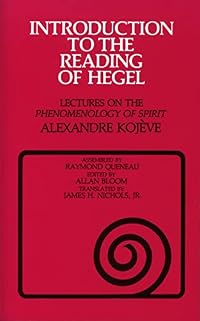
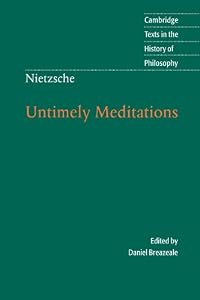
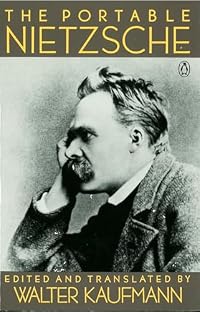
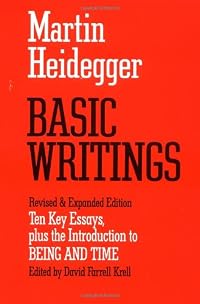



Member Recommendations
Member Reviews
This is, perhaps, Nietzsche's most outrageous work. It's a singular vision that has something to offend the convictions of both the left and the right. Such contemporary obsessions as identity politics and conservative nostalgia are objects of his withering, dismissive scorn. The fragmentary nature of the work precludes sustained argument, but the rationale of his critiques is easily discerned.
The new translation published in Penguin Classics strips away the anachronisms of earlier versions giving clear access to Nietzsche's thought.
The new translation published in Penguin Classics strips away the anachronisms of earlier versions giving clear access to Nietzsche's thought.
I think the most important thing to keep in mind when reading “The Will to Power” is that it is NOT a “book” in the proper sense of the term. It is merely a collection of thoughts and scraps that are extensions of previous thoughts, meditations on works that were being fleshed out at that time, and projections towards future investigations. As Kauffman points out (who, by the way, I became a bit annoyed with throughout this edition with his constant self aggrandizement – despite the fact that he is probably the best Nietzsche scholar to date) this is to be regarded as a journal and nothing more.
The confusions inherent to the nature of this collection though seems to be that it is often hard to distinguish between when show more Nietzsche is making an evaluative description or a normative judgment. His basic principle of “the will to power” which is often juxtaposed and exemplified by hyperbolic examples, do not necessarily mean that he is advocating such means – simply that these are examples which justify his critique of epistemology and modernist idealisms/moralisms of all sorts. In other words, the contradictions that arise from any philosophy or theology that denies the world.
Of most importance to me in this “book” though is the third section entitled “Principles of a New Evaluation.” This is the basis or ground (in my opinion) by which to evaluate all of which is explored throughout the whole volume; primarily in Nietzsche’s assertion of the innocence of becoming. Once this is taken into consideration then some of the most aggressive passages are in all sincerity passionate defenses of his position against those who suppose a “being” of things and consequently the negation of this principle. As notes to himself with zero intention of being published, they express Nietzsche’s authentic (i.e. HUMAN in his Dionysian sense) and empathy towards the ultimate fate of mankind.
There is, and has been, much more to say of “The Will to Power.” Rather than pick and choose which points one finds contentious and others genius, I must agree with Kauffman that this volume is only of secondary importance in regards to the entire cannon of Nietzsche’s published work. Nietzsche continued to write and publish beyond the scope of time which comprises “The Will to Power,” and so to assume these jottings and scraps as the pinnacle of his thought is to do an injustice to his philosophy.
Nevertheless, for those interested in his thoughts and in general the inner workings of the mind which came up with such influential works of philosophy, this is a must read. As with anything indefinite and unauthorized though (and even those which are) it is essential to take it cum grano salis, and as Nietzsche would have it, from your own point of view. show less
The confusions inherent to the nature of this collection though seems to be that it is often hard to distinguish between when show more Nietzsche is making an evaluative description or a normative judgment. His basic principle of “the will to power” which is often juxtaposed and exemplified by hyperbolic examples, do not necessarily mean that he is advocating such means – simply that these are examples which justify his critique of epistemology and modernist idealisms/moralisms of all sorts. In other words, the contradictions that arise from any philosophy or theology that denies the world.
Of most importance to me in this “book” though is the third section entitled “Principles of a New Evaluation.” This is the basis or ground (in my opinion) by which to evaluate all of which is explored throughout the whole volume; primarily in Nietzsche’s assertion of the innocence of becoming. Once this is taken into consideration then some of the most aggressive passages are in all sincerity passionate defenses of his position against those who suppose a “being” of things and consequently the negation of this principle. As notes to himself with zero intention of being published, they express Nietzsche’s authentic (i.e. HUMAN in his Dionysian sense) and empathy towards the ultimate fate of mankind.
There is, and has been, much more to say of “The Will to Power.” Rather than pick and choose which points one finds contentious and others genius, I must agree with Kauffman that this volume is only of secondary importance in regards to the entire cannon of Nietzsche’s published work. Nietzsche continued to write and publish beyond the scope of time which comprises “The Will to Power,” and so to assume these jottings and scraps as the pinnacle of his thought is to do an injustice to his philosophy.
Nevertheless, for those interested in his thoughts and in general the inner workings of the mind which came up with such influential works of philosophy, this is a must read. As with anything indefinite and unauthorized though (and even those which are) it is essential to take it cum grano salis, and as Nietzsche would have it, from your own point of view. show less
It's very interesting to compare this translation with the one my mother owns. This is newer than hers and it's based on more recent scholarship and a more complete original version. This translation negates much of the interference of Nietzsche's sister and her husband (who edited and reorganized his work to push their own antisemitic beliefs). The sense of Nietzsche's meaning and values in this newer version is profoundly different - and sometimes contradictory - to the translation that was standard when my mother was in college.
This is the posthumous collection of Nierzsche's miscellaneous writings. While presenting some of his thoughts on the title subject among others, the book does not have the imprimatur of the original author and has been used in ways antithetical to the Nietzsche's original life project.
Not one of his best, but still deserves merit
Uf, izmedju 4 i 5 zvezdica, ne mogu se odlucit...
Excellent introduction in this edition by R. Kevin Hill - erudite and clear. Not yet read the text itself.
Members
- Recently Added By
Lists

Jordan B. Peterson's Recommended Books
104 works; 5 members

Filosofía - Clásicos
217 works; 1 member

German Literature
518 works; 55 members

Harold Bloom - The Western Canon: C. The Democratic Age
336 works; 15 members

How to Read a Book's Recommended Reading List
309 works; 10 members

philosophy
28 works; 2 members

Maybe This Year? Books to Look Forward To
409 works; 9 members
Author Information

1,365+ Works 77,901 Members
The son of a Lutheran pastor, Friedrich Wilhelm Nietzsche was born in 1844 in Roecken, Prussia, and studied classical philology at the Universities of Bonn and Leipzig. While at Leipzig he read the works of Schopenhauer, which greatly impressed him. He also became a disciple of the composer Richard Wagner. At the very early age of 25, Nietzsche show more was appointed professor at the University of Basel in Switzerland. In 1870, during the Franco-Prussian War, Nietzsche served in the medical corps of the Prussian army. While treating soldiers he contracted diphtheria and dysentery; he was never physically healthy afterward. Nietzsche's first book, The Birth of Tragedy Out of the Spirit of Music (1872), was a radical reinterpretation of Greek art and culture from a Schopenhaurian and Wagnerian standpoint. By 1874 Nietzsche had to retire from his university post for reasons of health. He was diagnosed at this time with a serious nervous disorder. He lived the next 15 years on his small university pension, dividing his time between Italy and Switzerland and writing constantly. He is best known for the works he produced after 1880, especially The Gay Science (1882), Thus Spake Zarathustra (1883-85), Beyond Good and Evil (1886), On the Genealogy of Morals (1887), The Antichrist (1888), and Twilight of the Idols (1888). In January 1889, Nietzsche suffered a sudden mental collapse; he lived the last 10 years of his life in a condition of insanity. After his death, his sister published many of his papers under the title The Will to Power. Nietzsche was a radical questioner who often wrote polemically with deliberate obscurity, intending to perplex, shock, and offend his readers. He attacked the entire metaphysical tradition in Western philosophy, especially Christianity and Christian morality, which he thought had reached its final and most decadent form in modern scientific humanism, with its ideals of liberalism and democracy. It has become increasingly clear that his writings are among the deepest and most prescient sources we have for acquiring a philosophical understanding of the roots of 20th-century culture. (Bowker Author Biography) show less
Friedrich Nietzsche has a Legacy Library. Legacy libraries are the personal libraries of famous readers, entered by LibraryThing members from the Legacy Libraries group.
Some Editions
Awards and Honors
Distinctions
Notable Lists
Series
Belongs to Publisher Series
Work Relationships
Common Knowledge
- Canonical title
- The Will to Power
- Original title
- Der Wille zur Macht
- Original publication date
- 1901
- People/Characters
- Friedrich Nietzsche
Classifications
Statistics
- Members
- 2,229
- Popularity
- 9,009
- Reviews
- 12
- Rating
- (3.80)
- Languages
- 15 — Dutch, English, French, German, Greek (Ancient), Greek, Hungarian, Italian, Japanese, Latvian, Polish, Portuguese, Romanian, Russian, Spanish
- Media
- Paper, Audiobook, Ebook
- ISBNs
- 69
- ASINs
- 26