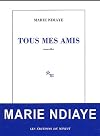
All My Friends
by Marie NDiaye
On This Page
Description
A moody and beautiful reflection on relationships, and how our idea of the world too often fails to match reality, All My Friends delivers five stories that probe the boundaries between individuals to mediate on how well we really know anybody, including ourselves. Written in hypnotic prose with characters both fully fleshed and unfathomable, All My Friends opens with the fraught love story of a man who has fallen for his housekeeper, his student of many years ago. Losing his grip as he show more feels his own family turning against him, he plots romance between the housekeeper and an old friend, whom he thinks is perfect for her. Later NDiaye gives us the harsh tale of a young boy longing to escape his life of poverty by becoming a sex slave, just like the beautiful young man that lived next door. And when a woman takes her mentally challenged son on a bus ride to the city, they both know that she'll return, but he won't. Chilling, provocative, and touching, this is an unflinching look at the personal horrors we fight every day to suppress. show lessTags
Recommendations





























Member Reviews
Marie NDiaye has a background in linguistics, and does it ever show: while her prose is on the surface rather simple, her narrative technique is truly magnificent. Although remaining in the third-person throughout all of the stories collected in All My Friends, NDiaye is able to tap into the psychological mindsets of the stories' main characters, still remaining detached yet observant, similarly skillful—although by no means in terms of style—in this type of omniscient narration as Woolf was in Mrs. Dalloway.
Most of the stories take place on the outskirts of Paris, and this is fitting as NDiaye is concerned with marginalized characters whose stories we rarely get to hear, whose contempt for Paris and the more bourgeois world of show more culture and privilege is always seething under the surface of their own personal conflicts. And each character is indeed poised at the point of conflict, some so deluded in their own thoughts and only slowly allowing the truth to reach the level of consciousness that it's truly awe-inspiring to see how NDiaye can situate the reader within a similar kind of unease or unrest. We come to the realizations with the characters, and, for this reason, I think it's imperative that one not read the blurb on the back cover: NDiaye takes her time to parse the information with which she first bombards the reader (and her characters), starting in medias res both in terms of narration and also in terms of psychological tension. The build-up, and what she withholds, are crucial to her pacing and plotting. One example of what I mean here is how a conversation occurs between one main character and a man whose first name is given for several pages; it is only toward the end of the conversation that the omniscient narrator places the qualifying "her husband" before his name, causing the conversation that just ensued to have an intimacy that was removed and in effect displaced.
Each of these stories is devastating in its own way, dealing with subject matter that might be hard for some people to fathom with the open mind that NDiaye begs of her readers. Searing insight is on each page here, too, into how we distance ourselves in our past and present relationships with others; how we distance ourselves from the truth in order to remain as inviolable as we possibly can; and how the ties that bind—familial and those that we choose—can involve making decisions that, to outsiders, might seem to be unethical or immoral but which, in our state of confusion and panic, seem the only logical way out.
NDiaye was the first black woman to win the coveted Prix Goncourt: her talent is that evident and iconoclastic, even when it is quiet, meditative, and concerned with minutiae and ambiguity. I look forward to reading [b:Three Strong Women|13155297|Three Strong Women|Marie NDiaye|https://d.gr-assets.com/books/1344369394s/13155297.jpg|7011163] very, very soon.
Edit: Having now read Three Strong Women, my review of this other NDiaye title is here.
4.5 stars show less
Most of the stories take place on the outskirts of Paris, and this is fitting as NDiaye is concerned with marginalized characters whose stories we rarely get to hear, whose contempt for Paris and the more bourgeois world of show more culture and privilege is always seething under the surface of their own personal conflicts. And each character is indeed poised at the point of conflict, some so deluded in their own thoughts and only slowly allowing the truth to reach the level of consciousness that it's truly awe-inspiring to see how NDiaye can situate the reader within a similar kind of unease or unrest. We come to the realizations with the characters, and, for this reason, I think it's imperative that one not read the blurb on the back cover: NDiaye takes her time to parse the information with which she first bombards the reader (and her characters), starting in medias res both in terms of narration and also in terms of psychological tension. The build-up, and what she withholds, are crucial to her pacing and plotting. One example of what I mean here is how a conversation occurs between one main character and a man whose first name is given for several pages; it is only toward the end of the conversation that the omniscient narrator places the qualifying "her husband" before his name, causing the conversation that just ensued to have an intimacy that was removed and in effect displaced.
Each of these stories is devastating in its own way, dealing with subject matter that might be hard for some people to fathom with the open mind that NDiaye begs of her readers. Searing insight is on each page here, too, into how we distance ourselves in our past and present relationships with others; how we distance ourselves from the truth in order to remain as inviolable as we possibly can; and how the ties that bind—familial and those that we choose—can involve making decisions that, to outsiders, might seem to be unethical or immoral but which, in our state of confusion and panic, seem the only logical way out.
NDiaye was the first black woman to win the coveted Prix Goncourt: her talent is that evident and iconoclastic, even when it is quiet, meditative, and concerned with minutiae and ambiguity. I look forward to reading [b:Three Strong Women|13155297|Three Strong Women|Marie NDiaye|https://d.gr-assets.com/books/1344369394s/13155297.jpg|7011163] very, very soon.
Edit: Having now read Three Strong Women, my review of this other NDiaye title is here.
4.5 stars show less
Marie Ndiaye is not afraid to write about the “lunatic fringe” of our society. That phrase jumped into my head as I thought about this review and made me search out the Red Rider song of the same name from the ‘80s. I’m listening to it now as I write and it’s an apt soundtrack to the book.
All of these stories made me uncomfortable on some level. In the opening story, from which this collection takes its name, the narrator is a creepy ex-professor obsessing over his former student Séverine who now is his housekeeper. Is he lusting after her? Is he trying to undermine her marriage and fix her up with another ex-student? What exactly is happening at the end? Even the choice of the name Séverine brought up creepy associations: show more there’s the sadomasochistic Severin of Sacher-Masoch’s Venus in Furs, then there is Severin Klosowski, the British poisoner and suspect in the Jack the Ripper case, and even the more distant but also creepy association with Severus Snape of Harry Potter fame. But those associations might be more due to my imagination than an intentional one by Ndiaye.
The obsession theme carries on throughout the collection. The next story finds two long separated childhood friends who had joined in the obsession of the women of their childhoods’ obsession with a famous singer who died when they were young. The old women of the projects swore to mourn him eternally and the two young girls bound themselves with a juvenile promise that they would act on and interpret differently along their way to their final meeting at the time of this story.
“The Boys” is just downright scary on so many levels. It took me a few pages to get my bearings and realize that René was even a boy. I almost thought Ndiaye was going to tell a story from the perspective of a dog or cat or some other domesticated animal looking with curiosity and puzzlement at the behavior of humans. And if these people and the conditions under which they live are any indication, maybe it would be better to be a cat. With unflinching prose, Ndiaye gives us a glimpse into human trafficking that left me wondering how we could have poverty so crushing that a boy can wish to be sold into sexual slavery by his own family. Although not specifically mentioned, I suppose the setting is rural France but I it could be anywhere where poverty exists. Does this happen in America? I know I’ve heard of it in 3rd world countries but in France?
With her stark portrayal of desperation and obsession as lives start to unravel, I can imagine why Ndiaye caused such a sensation with her Prix Goncourt winning novel “Three Strong Women”. I will have to seek it out.
~~~~~~~~~~~~~~~~~~~~~~~~~~~~~~~~~~~~~~~~~~~~~~~~~~~~~~~~~~~~~~~~~~~~~~~~~~~~~~~~~~~~~~~~~~~~~~
This book was reviewed for the LibraryThing Early Reviewers Program
For more book reviews, including the physical book and overall reading experience, visit my blog The Whole Book Experience at http://www.thewholebookexperience.com/ show less
All of these stories made me uncomfortable on some level. In the opening story, from which this collection takes its name, the narrator is a creepy ex-professor obsessing over his former student Séverine who now is his housekeeper. Is he lusting after her? Is he trying to undermine her marriage and fix her up with another ex-student? What exactly is happening at the end? Even the choice of the name Séverine brought up creepy associations: show more there’s the sadomasochistic Severin of Sacher-Masoch’s Venus in Furs, then there is Severin Klosowski, the British poisoner and suspect in the Jack the Ripper case, and even the more distant but also creepy association with Severus Snape of Harry Potter fame. But those associations might be more due to my imagination than an intentional one by Ndiaye.
The obsession theme carries on throughout the collection. The next story finds two long separated childhood friends who had joined in the obsession of the women of their childhoods’ obsession with a famous singer who died when they were young. The old women of the projects swore to mourn him eternally and the two young girls bound themselves with a juvenile promise that they would act on and interpret differently along their way to their final meeting at the time of this story.
“The Boys” is just downright scary on so many levels. It took me a few pages to get my bearings and realize that René was even a boy. I almost thought Ndiaye was going to tell a story from the perspective of a dog or cat or some other domesticated animal looking with curiosity and puzzlement at the behavior of humans. And if these people and the conditions under which they live are any indication, maybe it would be better to be a cat. With unflinching prose, Ndiaye gives us a glimpse into human trafficking that left me wondering how we could have poverty so crushing that a boy can wish to be sold into sexual slavery by his own family. Although not specifically mentioned, I suppose the setting is rural France but I it could be anywhere where poverty exists. Does this happen in America? I know I’ve heard of it in 3rd world countries but in France?
With her stark portrayal of desperation and obsession as lives start to unravel, I can imagine why Ndiaye caused such a sensation with her Prix Goncourt winning novel “Three Strong Women”. I will have to seek it out.
~~~~~~~~~~~~~~~~~~~~~~~~~~~~~~~~~~~~~~~~~~~~~~~~~~~~~~~~~~~~~~~~~~~~~~~~~~~~~~~~~~~~~~~~~~~~~~
This book was reviewed for the LibraryThing Early Reviewers Program
For more book reviews, including the physical book and overall reading experience, visit my blog The Whole Book Experience at http://www.thewholebookexperience.com/ show less
 This review was written for LibraryThing Early Reviewers.
well... what a peculiar and haunting collection of stories. NDiyae is an elegant, lovely writer. there's a lyrical or poetic quality to her writing. her ideas are really... dark and twisty, which makes for quite a juxtaposition to how beautiful her storytelling feels. the stories were troubling. 'the boys', in particular, was quite unnerving. while i read the english translation, i feel jordan stump, serving as translator, has done an excellent job as the moodiness and emotion of each story was definitely and strongly evoked. this isn't a book i would recommend for everyone, but if you love short stories, and dark oddities, definitely check this collection out. i really want to read Three Strong Women now. i think the novel form will show more work better for me, but i was very taken with NDiaye's writing.
from Publishers Weekly, as it sums up well how i also felt:
"Inhabiting the tense, anxiety-riddled interstices where things fall apart, the five stories in this collection don't follow each other so much as collide like objects in a literary maelstrom, achieving a dizzying terminal velocity. NDiaye, who received France's most prestigious literary prize for Three Powerful Women and may be that nation's most startling new literary voice, brings to life an electrifying rogue's gallery of social outcasts, disgruntled wives, and loony strivers. Among them, an Internet-savvy farmer's wife who gives up her attractive son for some steady income, in "The Boys," as seen through the eyes of another child who craves nothing more than to be sold off himself; a penniless actress attempting to leave her abject, devoted husband, in "Brulard's Day," in a swanky alpine resort town; a collision of two old friend who once shared a passion for a popular singer in a decrepit suburb, in "The Death of Claude François." Stump's perfectly calibrated translation captures the rich timbre and fearsome bite of NDiaye's chiseled prose. Empathy may not be NDiaye's strong suit—she prefers a kind of lacerating sincerity—but that may be the price to pay for such lucid and affecting stories. " show less
from Publishers Weekly, as it sums up well how i also felt:
"Inhabiting the tense, anxiety-riddled interstices where things fall apart, the five stories in this collection don't follow each other so much as collide like objects in a literary maelstrom, achieving a dizzying terminal velocity. NDiaye, who received France's most prestigious literary prize for Three Powerful Women and may be that nation's most startling new literary voice, brings to life an electrifying rogue's gallery of social outcasts, disgruntled wives, and loony strivers. Among them, an Internet-savvy farmer's wife who gives up her attractive son for some steady income, in "The Boys," as seen through the eyes of another child who craves nothing more than to be sold off himself; a penniless actress attempting to leave her abject, devoted husband, in "Brulard's Day," in a swanky alpine resort town; a collision of two old friend who once shared a passion for a popular singer in a decrepit suburb, in "The Death of Claude François." Stump's perfectly calibrated translation captures the rich timbre and fearsome bite of NDiaye's chiseled prose. Empathy may not be NDiaye's strong suit—she prefers a kind of lacerating sincerity—but that may be the price to pay for such lucid and affecting stories. " show less
This review was written for LibraryThing Early Reviewers.In All My Friends, Marie Ndiaye presents five stories about people losing their grip on reality. I expect I will remember each one, though except for the final story, “Revelation,” they were disquieting reads. They left me with a sense that I’d missed something, something that would have made each story more understandable, but not with a sense that rereading would have cleared up my confusion. They are all revealing but still ultimately and purposely mysterious. Ndiaye wants me to be uncomfortable when I look inside the mind of the unhappy schoolteacher in the title story or the aging minor actress in “Brulard’s Day.” I’m glad to have read these stories, but am ambivalent about wanting to read another one much like these show more five. Maybe Ndiaye and her translator Jordan Stump have done their jobs too well. They have put me off balance in ways that make me look instead for fiction that is more grounded. show less
This review was written for LibraryThing Early Reviewers.I found this book of short stories ablely translated by Jordan Stump to be an excellent read. Ndiaye creates a host of remarkable characters, each with their own obvious faults and disturbing relationships. The stories are brief , written and translated in a pared down prose. I noticed that all the family relationships- mother to daughter, mother to son, and wife to husband are fractured. The stories reminded me of the subjects in the last Nathan Englander book that I read- the subjects were not what I wanted to know but the writing and characters propelled me through the work. In this book, a young boy wants to be sold into sex slavery, a mother abandons her disabled son, and a doctor tries to relive part of her past while treating her show more ex-husband and daughter very badly. The stories are not easy to read but the distinctive style make this author one to watch. show less
This review was written for LibraryThing Early Reviewers.The five short stories in this excellent collection all deal with ordinary people facing the shortcomings of their lives.
The narrator of the title story is lost and lonely. He tries to connect with his maid (a former student), his estranged wife, an old acquaintance, and the maid’s husband (a former student of his). His attempts fail. He tries to enter a conversation, “But no one hears my wispy voice, and no one pays any mind. I'm nowhere at all anymore.”
In “The Death of Claude François,” an office visit from childhood friend Marlène Vador prompts Doctor Zaka to visit the neighborhood of her childhood. She finds that things are not always the way we remember them.
“The Boys” is the most sinister of the five stories. An show more impoverished family sells a son into some sort of servitude. A neighbor boy witnesses the transaction and the apparently beneficial results for the family. He decides that he, too, should be sold.
Minor actress Eve Brulard faces fading career hopes, a failed marriage, and a difficult relationship with her daughter in “Brulard’s Day.”
“Revelation” a story of a mother saying goodbye to her son who is about to be institutionalized is the shortest, but most poignant of the five stories.
For the most part, Marie Ndiaye treats her subjects with gentle understanding. We can feel empathy with these troubled individuals trying to deal with life’s disappointments. There are things left unsaid and it is not always easy to fill in the blanks. But that’s life and these stories are intriguing slices of life.
Book is from my personal collection. show less
The narrator of the title story is lost and lonely. He tries to connect with his maid (a former student), his estranged wife, an old acquaintance, and the maid’s husband (a former student of his). His attempts fail. He tries to enter a conversation, “But no one hears my wispy voice, and no one pays any mind. I'm nowhere at all anymore.”
In “The Death of Claude François,” an office visit from childhood friend Marlène Vador prompts Doctor Zaka to visit the neighborhood of her childhood. She finds that things are not always the way we remember them.
“The Boys” is the most sinister of the five stories. An show more impoverished family sells a son into some sort of servitude. A neighbor boy witnesses the transaction and the apparently beneficial results for the family. He decides that he, too, should be sold.
Minor actress Eve Brulard faces fading career hopes, a failed marriage, and a difficult relationship with her daughter in “Brulard’s Day.”
“Revelation” a story of a mother saying goodbye to her son who is about to be institutionalized is the shortest, but most poignant of the five stories.
For the most part, Marie Ndiaye treats her subjects with gentle understanding. We can feel empathy with these troubled individuals trying to deal with life’s disappointments. There are things left unsaid and it is not always easy to fill in the blanks. But that’s life and these stories are intriguing slices of life.
Book is from my personal collection. show less
Add Marie NDiaye to your list of talented contemporary French authors. She has a stylistically unique voice that hints of Kafka and Philip Roth (especially in, The Breast and Portnoy's Complaint). NDiaye stretches our psychological perimeters by probing the boundaries of sanity. Loneliness, hatred, revenge and disillusionment haunt her characters, who deal with their problems in eccentric or disturbing ways. I was thoroughly hypnotized by the quality and depth of Ms. NDiaye’s five short stories. I am eager to read, Three Strong Women, and will follow her work in the future.
“If no one ever sees you, where do you find the courage to tell the world you are there.” The Boys
“If no one ever sees you, where do you find the courage to tell the world you are there.” The Boys
This review was written for LibraryThing Early Reviewers.Members
- Recently Added By
Lists

el
1,139 works; 1 member
Author Information

40+ Works 2,094 Members
Marie NDiaye was born on June 4, 1967 in Pithiviers, France. Her first novel, Quant au Riche Avenir, was published in 1985. Her novels and short stories include Autoportrait en vert, Mon couer a l'etroit, Trois femmes puissantes, and Ladivine. One of her plays, Papa Doit Manger, has been taken into the repertoire of the Comédie Française. She show more also writes children's novels, essays and screenplays. Her awards include The 2001 Prix Femina for Rosie Carpe, the 2009 Prix Goncourt for Three Strong Women, and the 2015 Nelly Sachs Prize. (Bowker Author Biography) show less
Awards and Honors
Common Knowledge
- Original publication date
- 2004
- Original language
- French
Classifications
Statistics
- Members
- 79
- Popularity
- 402,905
- Reviews
- 15
- Rating
- (3.64)
- Languages
- English, French, German
- Media
- Paper, Ebook
- ISBNs
- 5
- ASINs
- 1