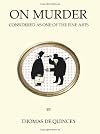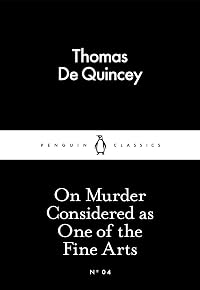
On murder
by Thomas De Quincey
On This Page
Description
Take a look at the entertainment landscape today—the most popular books, movies, and television shows all revolve around murder and its dissection by brilliant investigators. Renowned British essayist Thomas de Quincey stumbled on this truth early in the nineteenth century, prompting him to pen the satirical piece On Murder Considered as One of the Fine Arts. In it, de Quincey gets to the very heart of our ongoing obsession with the finer points of killing..
Tags
Recommendations



















Member Recommendations
Member Reviews
A note in this postcard-sized publication, issued to celebrate eighty years of Penguin paperbacks, tells us that the 26-year-old author was somewhat affected by the Ratcliffe Highway murders in London's East End in late 1811. We know from The Maul and the Pear Tree how deeply traumatising for the public those violent killings were, and De Quincey apparently was to write more than once about them over some three decades.
In 1827 he wrote this witty satire for Blackwood's Magazine---a piece which I fancy the Brontë siblings would have eagerly pored over---in the course of which X. Y. Z. (De Quincey's pseudonym) quotes verbatim a lecture to the fictional Society of Connoisseurs in Murder. As the magazine editor noted, "We cannot suppose show more the lecturer to be in earnest, any more than Erasmus in his Praise of Folly, or Dean Swift in his proposal for eating children." But we can also suspend our disbelief for a while to examine the outrageous claims of the anonymous lecturer, all written in a perfectly learned and civil style. Entitled the Williams' Lecture on Murder (in honour of the supposed perpetrator of the Ratcliffe Highway atrocities) the text is full of Latin and Greek quotations which fortunately are here translated for us in square brackets.
After a consideration of morality, with appeals to Coleridge, Aristotle and Mr. Howship the surgeon, the lecturer then dismisses pretty much all the murders, homicides and assassinations of the classical period. He begins with the first murderer, Cain,"a man of first-rate genius":
All the Cains were men of genius. Tubal Cain invented tubes, I think, or some such thing...
Having established his tongue to be placed firmly in his cheek the author (or his proxy) romps through history, noting obscure murders and even murder attempts and holding up for especial approbation those involving philosophers such as Hobbes. In Munich we hear of "a distinguished amateur of our society" who goes to work on a baker, which proceedings are described in the manner of a boxing match between two unequal pugilists.
The reader will now have unavoidably noted that I have lapsed into a Regency mode of speech, the inevitable outcome of perusing De Quincey's text. Pray bear with me as I complete my summary of this slim volume.
The lecture concludes with a few words about the principles of murder, which touch on the kind of person suited to be a murderer, the place and the time of the deed, and a few other particulars.
"The final purpose of murder, considered as a fine art, is precisely the same as Tragedy, in Aristotle's account of it, " we're told, namely to cleanse the heart of pity and terror. Exactly who, then, is this connoisseur of heart-cleansing? A bloodthirsty surgeon? A butcher of finesse? A dispassionate dispatcher? None of these, it turns out: he declaims all pretensions to the character of a professional man. "I never attempted any murder in my life, except in the year 1801, upon the body of a tom-cat... "
Fifty-six pages of black humour turned out to be just what I needed to restore composure when I was contemplating violence on certain politicians and their asinine supporters: though in truth I had no thoughts of assassination, only to bang heads together. No real sense I suspect would have thus been lodged there, sadly, but I may have---just possibly---felt a bit better. show less
In 1827 he wrote this witty satire for Blackwood's Magazine---a piece which I fancy the Brontë siblings would have eagerly pored over---in the course of which X. Y. Z. (De Quincey's pseudonym) quotes verbatim a lecture to the fictional Society of Connoisseurs in Murder. As the magazine editor noted, "We cannot suppose show more the lecturer to be in earnest, any more than Erasmus in his Praise of Folly, or Dean Swift in his proposal for eating children." But we can also suspend our disbelief for a while to examine the outrageous claims of the anonymous lecturer, all written in a perfectly learned and civil style. Entitled the Williams' Lecture on Murder (in honour of the supposed perpetrator of the Ratcliffe Highway atrocities) the text is full of Latin and Greek quotations which fortunately are here translated for us in square brackets.
People begin to see that something more goes to the composition of a fine murder than two blockheads to kill and be killed---a knife---a purse---and a dark lane [...] Mr. Williams has exalted the ideal of murder to all of us...
After a consideration of morality, with appeals to Coleridge, Aristotle and Mr. Howship the surgeon, the lecturer then dismisses pretty much all the murders, homicides and assassinations of the classical period. He begins with the first murderer, Cain,"a man of first-rate genius":
All the Cains were men of genius. Tubal Cain invented tubes, I think, or some such thing...
Having established his tongue to be placed firmly in his cheek the author (or his proxy) romps through history, noting obscure murders and even murder attempts and holding up for especial approbation those involving philosophers such as Hobbes. In Munich we hear of "a distinguished amateur of our society" who goes to work on a baker, which proceedings are described in the manner of a boxing match between two unequal pugilists.
The reader will now have unavoidably noted that I have lapsed into a Regency mode of speech, the inevitable outcome of perusing De Quincey's text. Pray bear with me as I complete my summary of this slim volume.
The lecture concludes with a few words about the principles of murder, which touch on the kind of person suited to be a murderer, the place and the time of the deed, and a few other particulars.
"The final purpose of murder, considered as a fine art, is precisely the same as Tragedy, in Aristotle's account of it, " we're told, namely to cleanse the heart of pity and terror. Exactly who, then, is this connoisseur of heart-cleansing? A bloodthirsty surgeon? A butcher of finesse? A dispassionate dispatcher? None of these, it turns out: he declaims all pretensions to the character of a professional man. "I never attempted any murder in my life, except in the year 1801, upon the body of a tom-cat... "
Fifty-six pages of black humour turned out to be just what I needed to restore composure when I was contemplating violence on certain politicians and their asinine supporters: though in truth I had no thoughts of assassination, only to bang heads together. No real sense I suspect would have thus been lodged there, sadly, but I may have---just possibly---felt a bit better. show less
“Pleasant it is, no doubt, to drink tea with your sweetheart, but most disagreeable to find her bubbling in the tea-urn.” So wrote the essayist Thomas de Quincey in 1827, and, really, it is hard to argue with him. Even more pleasant, he went on, was to read about someone else’s sweetheart bubbling in the tea-urn. The world adores murder in the abstract. Without it, we’d have no Hamlet. No Tony Soprano. De Quincey created the model for the gentleman-murderer. It was de Quincey, as well, who understood that violent crime plus art equaled a puzzle, a problem, a solution—a how, a who and a why: the core of all crime fiction. To this formula he added charm and humor. As the narrator of “On Murder” warns: “If once a man show more indulges himself in murder, very soon he comes to think little of robbing; and from robbing he comes next to drinking and Sabbath-breaking, and from that to incivility and procrastination.” show less
Strangely hilarious. The club meeting with Toad-in-the-hole killing someone every night and then getting the whole club chant 'can't be found' was absolutely terrifying. And the bit about the gate knocking in Macbeth. Nabokov obviously was taking a lot of notes.
Thomas de Quincey became enthralled and haunted by the murderer John Williams in 1811 and, although his works have always had the macabre about them, this essay looks at murder in particular in a more literary and scholarly way: imbuing it with the same aesthetic pleasures one might gain from other forms of art, such as writing or paintings. It is part-fictional but wholly satirical, commenting on the public horror-cum-delight in murders and the proliferate want of Philosophers to get themselves assassinated.
A wonderful book that really portrays the mind-set of those writing in the 19th Century. One is reminded of rich, languid personalities of the time; those who had money to spare on betting on which trickle of condensation may reach show more the window pane first, and those who viewed murder as nothing but a fanciful notion that may warrant a conversation. It is written in the manner and style as one would expect of a pre-Victorian writer; similar in tone yet without the consumerist pallour of a late-19th Century tale. show less
A wonderful book that really portrays the mind-set of those writing in the 19th Century. One is reminded of rich, languid personalities of the time; those who had money to spare on betting on which trickle of condensation may reach show more the window pane first, and those who viewed murder as nothing but a fanciful notion that may warrant a conversation. It is written in the manner and style as one would expect of a pre-Victorian writer; similar in tone yet without the consumerist pallour of a late-19th Century tale. show less
Aparentemente cínico lo que hace de Quincey es parapetarse tras el humor para criticar a la sociedad en su postura ante el crimen. Con fina ironía incide en analizar el crimen voluptuoso pero también el crimen por motivos materiales. Sin mencionarlo reflexiona también sobre el crimen de estado. Interesante la disertación entre el juicio moral versus juicio estético.
Eccentric, unique and rather funny. It is a mannered send-up of belles-lettres and aesthetic criticism, applied to the history and practice of murder. What could have been grotesque is instead amusingly absurd, and the author's own reference to Jonathan Swift's "Modest Proposal" is quite fitting.
No. 4 in the Little Black Classics series. Once again, this collection delivers a taste of a work long-forgotten but worth remembering.
No. 4 in the Little Black Classics series. Once again, this collection delivers a taste of a work long-forgotten but worth remembering.
Satirical essay on murder as a form of art. Although the idea is great the archaic language makes it relatively hard to enjoy it. My main issue is that I haven't found it funny at all, and it's not a good thing for a supposedly satirical writing.
Members
- Recently Added By
Lists

1001 Books You Must Read Before You Die
1,448 works; 1,134 members
Author Information

296+ Works 6,487 Members
Thomas de Quincey, born in 1785, was an English novelist, essayist, and literary critic. He is best known for his Confessions of an English Opium Eater, an insightful autobiographical account of his addiction to opium. The death of de Quincey's older sister when he was seven years old shaped his life through the grief and sadness that forced him show more to seek comfort in an inner world of imagination. He ran away to Wales when he was 17. He then attended Oxford University. It was at Oxford that he first encountered opium, and he subsequently abandoned his study of poetry without a degree, hoping to find a true philosophy. de Quincey wrote essays for journals in London and Edinburgh in order to support his large family. His prose writings and essays contain psychological insights relevant to the modern reader of today. In addition to his voluminous works of criticism and essays, he wrote a novel, Klosterheim or The Masque. Thomas de Quincey died in 1859. (Bowker Author Biography) show less
Some Editions
Series
Belongs to Publisher Series
Work Relationships
Common Knowledge
- Canonical title
- On murder considered as one of the fine arts; On murder
- Original title
- On murder considered as one of the fine arts
- Alternate titles
- Do assassínio como uma das Belas Artes
- Original publication date
- 1827
- Important places
- Abdera, Thrace
- Original language
- English
Classifications
Statistics
- Members
- 729
- Popularity
- 38,905
- Reviews
- 14
- Rating
- (3.54)
- Languages
- 7 — English, French, German, Italian, Portuguese, Spanish, Turkish
- Media
- Paper, Ebook
- ISBNs
- 47
- ASINs
- 12